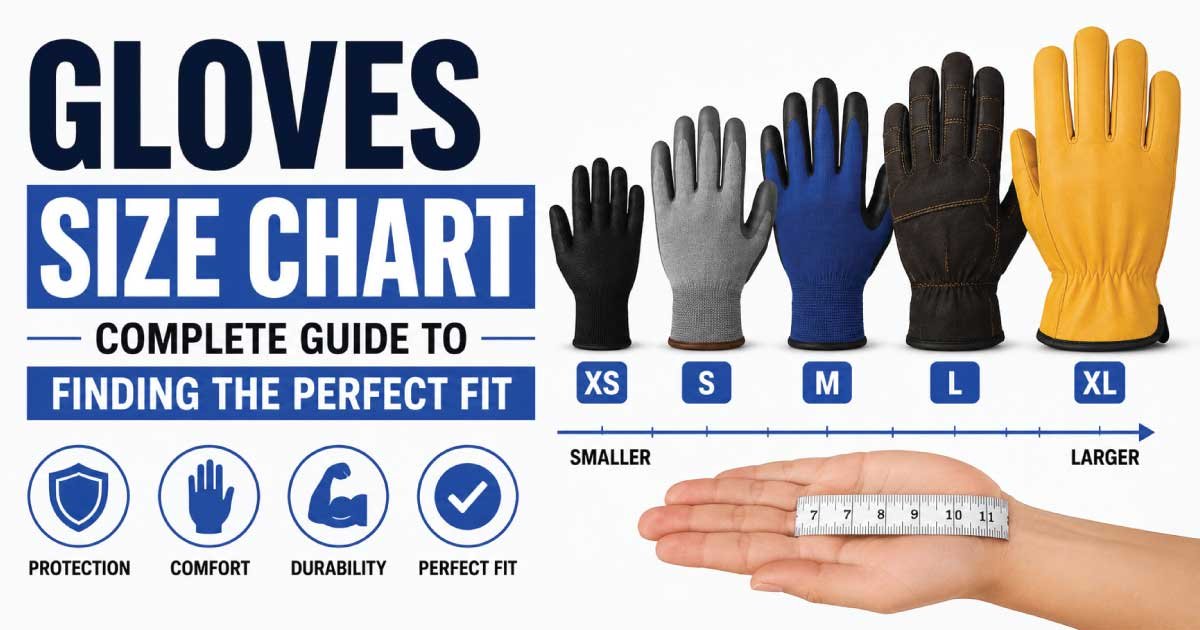
Finding the right glove size is essential for comfort, protection, grip, warmth, and freedom of movement. Whether you are shopping for winter gloves, work gloves, cycling gloves, gardening gloves, sports gloves, leather gloves, or everyday hand wear, the correct size can make a major difference.
A gloves size chart gives you a simple way to compare your hand measurements with standard glove sizes. However, glove sizing is not completely universal. Different brands, materials, and glove styles can fit differently, which is why measuring your hand before buying is always recommended.
In this complete guide, you will learn how glove sizes work, how to measure your hand correctly, how to choose between sizes, and how men’s, women’s, and children’s glove sizes compare. You will also find standard glove size charts, measurement tips, international sizing information, and answers to common glove-sizing questions.
Why Choosing the Correct Glove Size Matters
The right glove should feel comfortable without being excessively loose or painfully tight. Proper sizing allows your fingers to move naturally while keeping the glove securely in place.
A glove that is too small may stretch across the palm and put pressure on your fingers. This can cause discomfort and may reduce circulation during extended use.
On the other hand, gloves that are too large can bunch up around the fingers and palm. Loose material may make it harder to grip tools, handlebars, sports equipment, or other objects.
The correct size provides a balance between comfort, mobility, protection, and grip.
This is particularly important when buying specialized gloves. Work gloves, motorcycle gloves, goalkeeper gloves, winter gloves, and fitness gloves often require a more precise fit than casual gloves.
How Glove Sizes Work
Most adult gloves are sold using letter-based sizes such as XS, S, M, L, XL, and XXL. Some glove manufacturers also use numerical sizing.
The size is generally related to the circumference of your hand, although some brands also consider hand length and finger length.
A typical sizing progression looks like this:
- XS: Extra Small
- S: Small
- M: Medium
- L: Large
- XL: Extra Large
- XXL: Extra Extra Large
The exact measurement associated with each size can vary. For this reason, you should not assume that every medium glove has exactly the same dimensions.
When purchasing online, use your hand measurements and compare them with the seller’s or manufacturer’s size guide whenever possible.
How to Measure Your Hand for Gloves
Measuring your hand is the easiest way to determine your approximate glove size. You only need a flexible measuring tape. If you do not have one, you can use a piece of string and measure the string with a ruler afterward.
Step 1: Measure Hand Circumference
Place your dominant hand in a relaxed position.
Wrap the measuring tape around the widest part of your palm, usually just below the knuckles. Do not include your thumb in the measurement.
Keep the tape comfortably snug. It should touch your hand without squeezing it.
Write down the measurement in inches or centimeters.
Step 2: Measure Hand Length
Place your hand flat on a table with your fingers extended.
Measure from the tip of your middle finger down to the crease at the base of your hand near the wrist.
This gives you your approximate hand length.
Step 3: Measure Both Hands if Necessary
Most people have slightly different-sized hands. If the difference is noticeable, measure both hands.
When buying gloves, use the measurement of the larger hand so the gloves do not feel too tight.
Step 4: Compare Your Measurements
Once you have your measurements, compare them with the appropriate glove size chart.
If your hand falls between two sizes, consider the glove’s intended purpose and material before deciding which size to select.
Standard Gloves Size Chart
The following chart provides general adult glove sizing based primarily on hand circumference.
| Glove Size | Hand Circumference | Approx. Hand Length |
|---|---|---|
| XS | 6–7 inches | 6–6.5 inches |
| S | 7–8 inches | 6.5–7 inches |
| M | 8–9 inches | 7–7.5 inches |
| L | 9–10 inches | 7.5–8 inches |
| XL | 10–11 inches | 8–8.5 inches |
| XXL | 11–12 inches | 8.5–9 inches |
These measurements are general guidelines. Individual brands may use different measurements for their glove sizes.
Men’s Gloves Size Chart
Men’s gloves are often designed around larger average hand dimensions, although there is significant overlap between men’s and women’s sizing.
| Men’s Glove Size | Hand Circumference | General Size |
|---|---|---|
| XS | 6–7 inches | Extra Small |
| S | 7–8 inches | Small |
| M | 8–9 inches | Medium |
| L | 9–10 inches | Large |
| XL | 10–11 inches | Extra Large |
| XXL | 11–12 inches | Extra Extra Large |
Men with particularly long fingers or wide palms may need to consider specialty glove sizes even if their circumference corresponds to a standard size.
Women’s Gloves Size Chart
Women’s gloves generally have smaller measurements than men’s gloves, but there is no strict rule that determines glove size based on gender.
The best approach is always to measure the hand.
| Women’s Glove Size | Hand Circumference | General Size |
|---|---|---|
| XS | 5.5–6.5 inches | Extra Small |
| S | 6.5–7 inches | Small |
| M | 7–8 inches | Medium |
| L | 8–9 inches | Large |
| XL | 9–10 inches | Extra Large |
If your measurements fall outside these ranges, look for a manufacturer that offers additional sizes.
Kids’ Gloves Size Chart
Children’s glove sizes can be estimated by age, but age should not be the only factor. Children’s hands can vary considerably even when they are the same age.
| Kids’ Glove Size | Approx. Age | Approx. Hand Length |
|---|---|---|
| XS | 2–4 years | 4–4.5 inches |
| S | 4–6 years | 4.5–5 inches |
| M | 6–8 years | 5–5.5 inches |
| L | 8–10 years | 5.5–6 inches |
| XL | 10–12 years | 6–6.5 inches |
For children’s winter gloves, ski gloves, and sports gloves, checking the actual hand measurement is especially important because these gloves may have different sizing requirements.
Glove Size Conversion Chart
Glove sizing can be confusing when shopping internationally. Some gloves use letter sizes, while others use numerical measurements.
| Letter Size | Approx. Numerical Size | General Fit |
|---|---|---|
| XS | 6–7 | Extra Small |
| S | 7–8 | Small |
| M | 8–9 | Medium |
| L | 9–10 | Large |
| XL | 10–11 | Extra Large |
| XXL | 11–12 | Extra Extra Large |
Numerical glove sizing commonly relates to hand circumference measured in inches, but sizing conventions vary between manufacturers.
How Should Gloves Fit?
A correctly sized glove should feel secure without restricting your hand.
Your fingers should reach naturally toward the ends of the glove fingers without being pressed tightly against them.
There should also be enough room for normal movement. When you make a fist, the glove should not pull excessively across the knuckles or palm.
Signs Your Gloves Are Too Small
Your gloves may be too small if:
- Your fingertips press firmly against the glove ends.
- The palm feels stretched.
- Your fingers cannot move comfortably.
- Seams dig into your skin.
- The glove becomes uncomfortable when making a fist.
- Your hands feel restricted.
- Circulation seems reduced.
Signs Your Gloves Are Too Large
Your gloves may be too large if:
- Fingertips have excessive empty space.
- The glove slips while you move your hand.
- Material bunches around your palm.
- You have difficulty gripping objects.
- The fingers fold or wrinkle excessively.
- The glove moves independently of your hand.
What to Do If You Are Between Glove Sizes
Sometimes your hand measurement will fall directly between two sizes. In that situation, consider the type of glove you are purchasing.
For thin, flexible gloves such as cycling or fitness gloves, a closer fit may be preferable.
For insulated winter gloves, you may want additional space for warmth and potentially a thin liner underneath.
For work gloves, choose a size that provides enough room for movement while keeping the fingers secure.
The material also matters. Stretchable fabrics can accommodate small differences in hand dimensions, while rigid leather or protective materials may require more precise sizing.
Glove Size by Hand Circumference
Hand circumference is one of the most useful measurements for determining glove size.
| Hand Circumference | Approx. Glove Size |
|---|---|
| 5.5–6.5 inches | XS |
| 6.5–7 inches | S |
| 7–8 inches | M |
| 8–9 inches | L |
| 9–10 inches | XL |
| 10–12 inches | XXL |
These ranges are intended as a general reference rather than a universal standard.
If your measurement is close to the boundary between two sizes, always check the specific manufacturer’s chart.
Also Read: Recliner Size Chart: Complete Guide For Perfect Size
How Different Glove Types Affect Sizing
Not every type of glove should fit exactly the same way.
Winter Gloves
Winter gloves generally need enough space to provide insulation. A very tight glove can compress insulation and reduce comfort.
If you plan to wear a liner underneath, account for that extra layer when choosing your size.
Work Gloves
Work gloves should provide a secure fit because loose gloves can interfere with tools and equipment.
The fingers should move naturally without excessive material at the fingertips.
Cycling Gloves
Cycling gloves usually benefit from a close fit. Excess material can interfere with grip and control.
However, the gloves should not be so tight that they create uncomfortable pressure during long rides.
Sports Gloves
Sports gloves often require precise sizing because hand movement and grip are important.
Baseball, golf, fitness, and other sports gloves may each use their own sizing standards.
Leather Gloves
Leather gloves often fit differently from synthetic gloves. Some leather gloves may relax slightly with use, depending on the type and construction of the leather.
Avoid choosing a dramatically smaller size simply because you expect leather to stretch.
Glove Size and Finger Length
Hand circumference alone does not tell the entire story.
Two people can have the same palm circumference but different finger lengths. One person may have long, narrow fingers while another may have shorter, wider fingers.
If standard gloves frequently feel tight around your fingers while fitting correctly around your palm, look for brands that offer different hand shapes or extended finger designs.
This is particularly important for:
- Motorcycle gloves
- Leather gloves
- Cycling gloves
- Work gloves
- Sports gloves
- Winter gloves
A good glove should fit both the palm and fingers comfortably.
How to Measure Gloves Without a Measuring Tape
If you do not have a flexible measuring tape, you can still measure your hand.
Wrap a piece of string around the widest part of your palm. Mark the point where the string meets.
Lay the string flat against a ruler and measure its length.
You can then compare the result with a glove size chart.
Make sure the string is snug but not tight when measuring your hand.
Also Read: Coffee Table Size Chart: Complete Guide With Pics
Common Glove Sizing Mistakes
Many people choose the wrong glove size because they rely on assumptions instead of measurements.
Choosing Based Only on Age
Age is not a reliable way to determine adult glove size, and it can also be inaccurate for children.
Assuming All Medium Gloves Are the Same
Glove manufacturers may use different sizing standards. A medium from one company may not fit like a medium from another.
Ignoring Hand Circumference
Some shoppers only consider finger length. However, palm circumference is one of the most important measurements for glove sizing.
Buying Extra Large for More Comfort
A larger glove is not automatically more comfortable. Excess material can reduce grip and cause the glove to slide.
Ignoring the Intended Use
The ideal fit for insulated winter gloves may not be the same as the ideal fit for cycling or work gloves.
How to Get the Best Glove Fit When Shopping Online
Buying gloves online can be easy if you know your measurements.
First, measure your hand circumference and length. Next, locate the manufacturer’s glove size chart on the product page.
Compare your measurements rather than relying on the size you normally wear.
Read the product description to determine whether the gloves are designed for a snug, regular, or relaxed fit.
Customer reviews can also provide useful information about whether a particular glove runs small or large.
If your measurements fall between sizes, check whether the manufacturer recommends sizing up or down.
Glove Size Chart in Inches and Centimeters
If you normally use centimeters, the following conversion can make measurements easier.
| Glove Size | Hand Circumference (Inches) | Hand Circumference (cm) |
|---|---|---|
| XS | 6–7 | 15–18 cm |
| S | 7–8 | 18–20 cm |
| M | 8–9 | 20–23 cm |
| L | 9–10 | 23–25.5 cm |
| XL | 10–11 | 25.5–28 cm |
| XXL | 11–12 | 28–30.5 cm |
These are approximate conversions. Small differences may occur because inches and centimeters are rounded.
Frequently Asked Questions About Glove Sizes
How do I know what glove size I need?
Measure the circumference of your hand around the widest part of your palm, excluding the thumb. Compare that measurement with the glove manufacturer’s size chart. If possible, also measure hand length and use both measurements to select the best-fitting size.
Should gloves fit tight or loose?
Gloves should generally fit comfortably snug without restricting movement. There should not be excessive empty space at the fingertips, but your fingers should also not press painfully against the ends. The ideal amount of room depends on the glove type and intended use.
Is glove size based on hand length or circumference?
Glove sizing can use both measurements, but hand circumference is commonly used as the primary measurement. Hand length and finger length are also important because two people can have the same palm circumference but very different finger proportions.
What size is a medium glove?
A medium glove commonly fits a hand circumference of approximately 8–9 inches, although the exact range varies by manufacturer. Always compare your measurements with the specific brand’s sizing information before purchasing gloves online.
How do I measure my hand for gloves?
Wrap a flexible measuring tape around the widest part of your palm, excluding the thumb, and record the circumference. You can also measure from the tip of your middle finger to the base of your hand to determine hand length.
Should I size up for winter gloves?
You may need slightly more room in winter gloves if you plan to wear a liner underneath. However, excessively large gloves can reduce dexterity and warmth. Check the manufacturer’s recommendations and consider how you intend to layer the gloves.
What happens if my gloves are too big?
Oversized gloves may slip, bunch up, and reduce your ability to grip objects. Excess space can also make precise movements more difficult. For work and sports gloves especially, a secure fit is usually preferable to excessive room.
What happens if gloves are too small?
Gloves that are too small can restrict finger movement, stretch across the palm, create pressure points, and become uncomfortable during extended use. If the fingers are pressed against the ends or the palm feels excessively tight, consider going up a size.
Are men’s and women’s glove sizes different?
Men’s and women’s gloves often use different average size ranges, but there is considerable overlap. Gender should not be the only factor when choosing a glove. Measuring your hand and checking the manufacturer’s size chart provides a more accurate result.
Can children use adult glove sizes?
Older children with larger hands may fit some adult glove sizes, but it is better to use hand measurements rather than age alone. Children’s gloves are designed around smaller hand proportions, so a properly sized children’s glove may provide a better fit.
Also Read: Side Table Size Guide with Chart: Complete Guide
Final Thoughts on Choosing the Right Glove Size
Choosing the correct glove size starts with accurate hand measurements. Rather than guessing based on age, gender, or the size you normally purchase, measure your hand circumference and, when possible, your hand length.
A gloves size chart provides a useful starting point, but individual brands can have different sizing standards. Always check the manufacturer’s measurements before ordering.
Remember that the ideal fit depends on the glove’s purpose. Winter gloves may require additional room for insulation or liners, while cycling, sports, and work gloves generally benefit from a more secure fit.
With accurate measurements and the right sizing information, you can choose gloves that provide the combination of comfort, flexibility, protection, warmth, and grip you need.
