Finding the right hat size is important for comfort, appearance, and a secure fit. A hat that is too tight can leave pressure marks and become uncomfortable, while a hat that is too loose may slip, move around, or fall off during everyday activities.
A hat size chart makes it easier to match your head measurement with a standard hat size. Whether you are buying a baseball cap, fitted cap, cowboy hat, sun hat, winter hat, fedora, bucket hat, or formal hat, knowing your head circumference can help you select the right size.
Hat sizes may be shown in inches, centimeters, numerical sizes, or letter sizes such as XS, S, M, L, and XL. Because sizing can vary between manufacturers, measuring your head and checking the brand’s size guide is the most reliable way to choose.
This complete guide explains how hat sizes work, how to measure your head correctly, standard hat size conversions, men’s and women’s hat sizes, children’s hat sizes, and how different hat styles should fit.
Why Choosing the Right Hat Size Matters
A properly fitted hat should feel secure without creating uncomfortable pressure around your head.
The correct size helps the hat stay in position while allowing you to wear it for extended periods. It also improves the overall appearance because a correctly sized hat sits naturally rather than looking overly tight or oversized.
An incorrectly sized hat can cause several problems. A hat that is too small may feel restrictive, while a hat that is too large may move whenever you walk or bend over.
Choosing the correct hat size is particularly important for fitted hats because they do not have an adjustable strap.
How Hat Sizes Work
Hat sizes are commonly determined by head circumference.
Unlike shoes, where sizing systems can be complicated by foot width and length, hats are primarily measured around the head.
Common hat sizing systems include:
- Inches
- Centimeters
- Numerical hat sizes
- XS, S, M, L, and XL
- Adjustable or one-size-fits-most sizing
For example, a hat labeled 7 may correspond to a particular head circumference, while a medium hat may cover a range of measurements.
The exact sizing system varies by manufacturer, so you should always compare your measurement with the brand’s own chart.
How to Measure Your Head for a Hat
Measuring your head is simple and only takes a few moments.
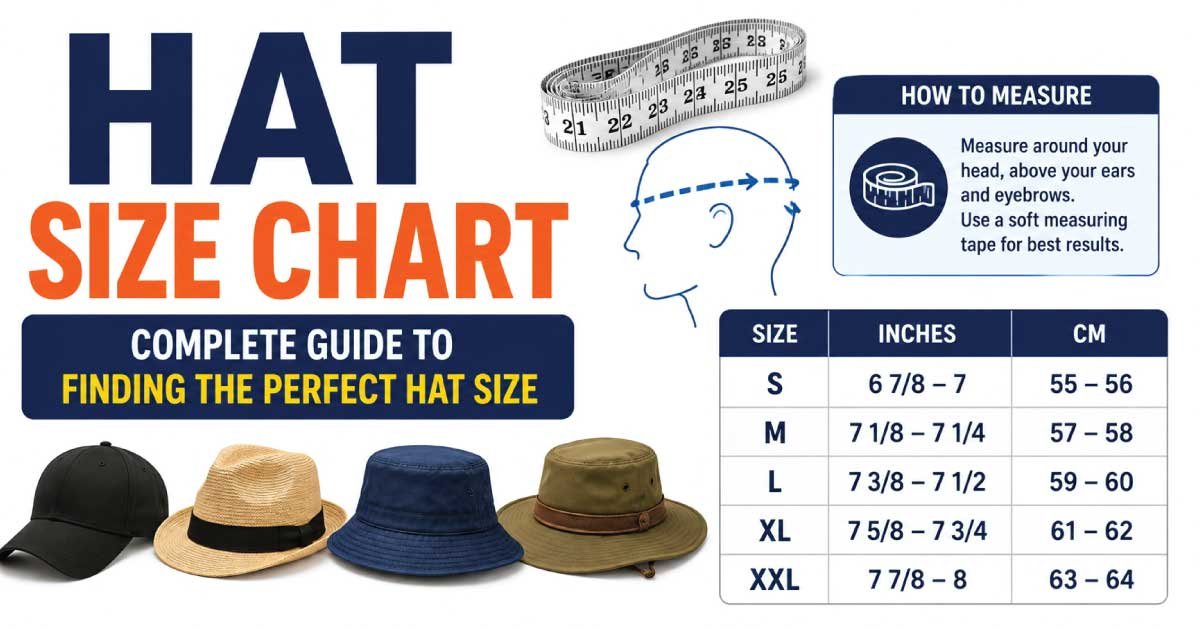
Step 1: Use a Flexible Measuring Tape
Take a soft measuring tape and place it around your head.
Position the tape approximately 1 inch above your eyebrows and just above your ears.
This is generally the area where a hat’s sweatband or inner band will sit.
Step 2: Keep the Tape Level
Make sure the measuring tape remains level all the way around your head.
Do not pull it excessively tight. The tape should feel comfortably snug because you want to measure your actual head circumference rather than compressing your head.
Step 3: Record Your Measurement
Record the circumference in inches or centimeters.
For example, if your head measures approximately 22 inches, use the corresponding hat size for that measurement.
Step 4: Repeat the Measurement
For better accuracy, measure your head two or three times.
If your measurements differ slightly, use the most consistent result.
Standard Hat Size Chart
The following chart provides a general reference for adult hat sizing.
| Hat Size | Head Circumference | Approx. Letter Size |
|---|---|---|
| 6 3/4 | 21 1/8 in | XS |
| 6 7/8 | 21 1/2 in | S |
| 7 | 21 7/8 in | S/M |
| 7 1/8 | 22 1/4 in | M |
| 7 1/4 | 22 5/8 in | M/L |
| 7 3/8 | 23 in | L |
| 7 1/2 | 23 1/2 in | L/XL |
| 7 5/8 | 23 7/8 in | XL |
| 7 3/4 | 24 1/4 in | XL/XXL |
| 7 7/8 | 24 5/8 in | XXL |
| 8 | 25 in | XXL |
These measurements are general guidelines. Individual hat manufacturers may use slightly different size conversions.
Hat Size Chart in Inches and Centimeters
If you prefer metric measurements, use the following general conversion.
| Hat Size | Head Circumference (Inches) | Head Circumference (cm) |
|---|---|---|
| 6 3/4 | 21 1/8 | 53.5 cm |
| 6 7/8 | 21 1/2 | 54.5 cm |
| 7 | 21 7/8 | 55.5 cm |
| 7 1/8 | 22 1/4 | 56.5 cm |
| 7 1/4 | 22 5/8 | 57.5 cm |
| 7 3/8 | 23 | 58.5 cm |
| 7 1/2 | 23 1/2 | 59.5 cm |
| 7 5/8 | 23 7/8 | 60.5 cm |
| 7 3/4 | 24 1/4 | 61.5 cm |
| 7 7/8 | 24 5/8 | 62.5 cm |
| 8 | 25 | 63.5 cm |
When shopping internationally, centimeters can be particularly useful because they provide a direct measurement of your head circumference.
Men’s Hat Size Chart
Men’s hats commonly use numerical sizes, although many modern hats are also sold in letter sizes.
| Men’s Hat Size | Head Circumference | Approx. Letter Size |
|---|---|---|
| 6 7/8 | 21 1/2 in | S |
| 7 | 21 7/8 in | S/M |
| 7 1/8 | 22 1/4 in | M |
| 7 1/4 | 22 5/8 in | M/L |
| 7 3/8 | 23 in | L |
| 7 1/2 | 23 1/2 in | L/XL |
| 7 5/8 | 23 7/8 in | XL |
| 7 3/4 | 24 1/4 in | XL/XXL |
| 7 7/8 | 24 5/8 in | XXL |
| 8 | 25 in | XXL |
Men’s hat sizing is not fundamentally different from women’s hat sizing. Head circumference is the important measurement regardless of gender.
Women’s Hat Size Chart
Women’s hats may use letter sizing more frequently, particularly for casual and fashion hats.
| Women’s Hat Size | Head Circumference | Approx. Numerical Size |
|---|---|---|
| XS | 20–21 in | 6 1/4–6 5/8 |
| S | 21–21 1/2 in | 6 5/8–6 7/8 |
| M | 21 1/2–22 1/4 in | 6 7/8–7 1/8 |
| L | 22 1/4–23 in | 7 1/8–7 3/8 |
| XL | 23–24 in | 7 3/8–7 5/8 |
Women’s hat sizes vary between brands and styles, so measuring your head is more reliable than selecting a size based only on gender.
Kids’ Hat Size Chart
Children’s hats are often sized according to head circumference and age.
Because children grow at different rates, head circumference is a better measurement than age alone.
| Children’s Hat Size | Approx. Age | Head Circumference |
|---|---|---|
| XS | 0–2 years | 17–19 in |
| S | 2–4 years | 19–20 in |
| M | 4–7 years | 20–21 in |
| L | 7–12 years | 21–22 in |
| XL | 12+ years | 22+ in |
These age ranges are approximate. Always measure the child’s head when possible.
Baby Hat Size Chart
Baby hat sizing can vary significantly because babies grow quickly.
| Baby Hat Size | Approx. Age | Head Circumference |
|---|---|---|
| Newborn | 0–3 months | 13–15 in |
| Small | 3–6 months | 14–16 in |
| Medium | 6–12 months | 16–18 in |
| Large | 12–24 months | 17–19 in |
A baby’s hat should be comfortably fitted without being tight around the head.
Hat Size Conversion Chart
Hat sizing can differ between US, UK, European, and metric systems. The following is a general conversion reference.
| US Hat Size | Head Circumference | Approx. UK Size | Approx. EU Size |
|---|---|---|---|
| 6 3/4 | 21 1/8 in | 6 5/8 | 53 |
| 7 | 21 7/8 in | 6 7/8 | 55 |
| 7 1/8 | 22 1/4 in | 7 | 57 |
| 7 1/4 | 22 5/8 in | 7 1/8 | 58 |
| 7 3/8 | 23 in | 7 1/4 | 59 |
| 7 1/2 | 23 1/2 in | 7 3/8 | 60 |
| 7 5/8 | 23 7/8 in | 7 1/2 | 61 |
| 7 3/4 | 24 1/4 in | 7 5/8 | 62 |
| 7 7/8 | 24 5/8 in | 7 3/4 | 63 |
| 8 | 25 in | 7 7/8 | 64 |
International conversions can vary slightly, so use the manufacturer’s chart whenever available.
Also Read: Dining Bench Size Chart: Complete Size Guide
How Should a Hat Fit?
A correctly fitted hat should sit securely on your head without creating excessive pressure.
The hat band should touch your head comfortably. It should not leave deep marks or cause discomfort after only a few minutes.
The hat should also remain stable when you move your head.
Signs Your Hat Is Too Small
Your hat may be too small if:
- It feels tight around your forehead.
- It leaves deep pressure marks.
- You develop discomfort after wearing it.
- It is difficult to put on.
- The hat sits unusually high on your head.
- You feel excessive pressure around your temples.
Signs Your Hat Is Too Large
Your hat may be too large if:
- It moves when you walk.
- It slides over your eyebrows.
- It falls off when you bend over.
- There is visible space between the hat band and your head.
- Wind easily blows it off.
- The hat feels unstable.
What to Do If You Are Between Hat Sizes
If your head measurement falls between two available sizes, the best choice depends on the hat’s construction.
For fitted hats, choosing the larger size is often more comfortable than wearing a hat that is too tight.
Some hats can be adjusted using sizing tape or inserts. This can make a slightly larger hat easier to fit securely.
For structured hats, avoid choosing a size that is significantly smaller because the material may not stretch enough to provide a comfortable fit.
Fitted Hat Size Guide
Fitted hats are sold in specific numerical sizes rather than adjustable ranges.
Common fitted hat sizes include:
- 6 7/8
- 7
- 7 1/8
- 7 1/4
- 7 3/8
- 7 1/2
- 7 5/8
- 7 3/4
- 7 7/8
- 8
Because fitted hats cannot be tightened or loosened with a strap, accurate head measurement is especially important.
If you frequently fall between two sizes, try both sizes if possible to determine which provides the most comfortable fit.
Baseball Cap Size Guide
Baseball caps come in several different constructions.
Some are fitted, while others use an adjustable strap, snapback, buckle, or hook-and-loop closure.
Adjustable caps are more forgiving because they can accommodate a range of head sizes.
For fitted baseball caps, measure your head carefully and compare the circumference with the manufacturer’s numerical sizing.
A baseball cap should sit comfortably without excessive pressure around the forehead.
Also Read: Vanity Stool Size Chart: Easy Measurement Guide
Cowboy Hat Size Guide
Cowboy hats are generally measured by head circumference and commonly use numerical hat sizes.
Because cowboy hats are often structured, selecting the right size is important.
A properly fitting cowboy hat should rest securely on the head without feeling excessively tight.
The hat should not wobble significantly when you move your head, but it should also not leave painful pressure around the forehead or sides.
Fedora and Dress Hat Size Guide
Fedoras and other dress hats often use traditional numerical hat sizes.
When choosing a dress hat, measure your head at the position where you want the hat to sit.
The hat should feel comfortable around the sweatband and should remain stable without excessive tightness.
Because many formal hats have structured materials, selecting the correct size before purchasing is especially important.
Beanie Size Guide
Beanies are usually made from stretchy materials and are commonly sold as one-size-fits-most or in simple letter sizes.
The flexibility of knitted fabric makes beanies more forgiving than fitted hats.
However, a beanie that is too tight may become uncomfortable around the forehead, while an oversized beanie may not stay securely in place.
When possible, check the manufacturer’s head circumference range.
Bucket Hat Size Guide
Bucket hats are commonly available in adjustable or fixed sizes.
Because the brim sits around the head, the hat should fit securely without creating excessive pressure.
Measure your head circumference and compare it with the product’s size chart.
If the bucket hat is adjustable, choose a size that allows you to position the hat comfortably without tightening the strap excessively.
How Hat Material Affects Fit
Hat material can affect how the final fit feels.
Cotton Hats
Cotton hats are comfortable and breathable, but some fabrics may change slightly after washing.
Wool Hats
Wool hats can provide warmth and may have some natural flexibility depending on construction.
Straw Hats
Straw hats can be structured and may not stretch significantly. Accurate sizing is therefore important.
Leather Hats
Leather hats may soften over time, but you should not rely on substantial stretching to correct an incorrectly sized hat.
Stretch Fabrics
Stretchable materials can accommodate a wider range of head sizes and are often used in casual hats and beanies.
How to Choose the Right Hat Size Online
Shopping for hats online is much easier when you know your head circumference.
Start by measuring your head with a flexible measuring tape.
Next, check whether the product uses inches, centimeters, numerical sizes, or letter sizes.
Compare your measurement with the manufacturer’s size chart.
If the product is a fitted hat, pay particular attention to the exact numerical size.
If the hat is adjustable, look for the manufacturer’s recommended head-size range.
Customer reviews can also help identify whether a particular style runs small, large, shallow, or deep.
Also Read: China Cabinet Size Chart: Standard Dimensions Guide
Common Hat Sizing Mistakes
Measuring Too High on the Head
Measuring near the crown rather than around the normal hat-wearing position can produce an inaccurate result.
Pulling the Tape Too Tight
The measuring tape should be snug but not tight. Pulling it too firmly can make your head measurement appear smaller than it actually is.
Choosing Based Only on Age
Age is only an estimate for children’s hats. Head circumference is much more accurate.
Assuming Every Brand Uses the Same Size
A size medium from one manufacturer may not have exactly the same dimensions as a medium from another.
Ignoring the Hat Style
A fitted cap, beanie, cowboy hat, and structured fedora may all fit differently even when they have similar measurements.
Frequently Asked Questions About Hat Sizes
How do I know what hat size I need?
Measure the circumference of your head with a flexible measuring tape, positioning it around the head approximately one inch above your eyebrows and above your ears. Compare the measurement with the manufacturer’s hat size chart to select the closest size.
What is the most common adult hat size?
Many adults fall somewhere around the middle of the standard hat-size range, but there is no single universal hat size. Head circumference varies from person to person, so measuring your head is more accurate than assuming a particular size.
Is hat size based on head circumference?
Yes. Hat size is primarily based on head circumference. The measurement is taken around the part of the head where the hat will sit. Numerical hat sizes and centimeter measurements are generally derived from this circumference.
What size hat is 22 inches?
A head circumference of approximately 22 inches generally falls around a US hat size of 7 to 7 1/8, depending on the sizing system. Always check the manufacturer’s chart because exact conversions can vary.
What size hat is 23 inches?
A 23-inch head circumference generally corresponds to approximately a US hat size 7 3/8. However, brands may use slightly different measurements, so checking the specific product’s sizing guide is recommended.
Should a hat be tight or loose?
A hat should fit securely without feeling tight. It should remain in place when you move your head but should not create painful pressure around your forehead, temples, or ears.
What should I do if I am between hat sizes?
If you are between sizes, the larger size is often more comfortable for fitted hats, especially if the smaller size feels tight. A slightly larger hat may also be adjusted using sizing tape or an appropriate insert.
Are men’s and women’s hat sizes different?
Hat sizing is primarily based on head circumference, so the fundamental measurement is the same. Men’s and women’s hats may use different style ranges, but you can choose a size based on your actual head measurement.
How do I measure a child’s head for a hat?
Wrap a flexible measuring tape around the child’s head above the eyebrows and ears. Keep the tape level and comfortably snug. Record the circumference and compare it with the children’s hat size chart.
Do hats stretch over time?
Some hats can relax or stretch slightly with use, particularly those made from flexible materials. However, you should not depend on stretching to correct a significantly undersized hat. Choosing the correct size initially is the best approach.
Final Thoughts on Choosing the Right Hat Size
Choosing the correct hat size starts with one simple measurement: head circumference. Once you know your measurement, you can compare it with a standard hat size chart and then confirm the result using the manufacturer’s sizing information.
Remember that different hat styles can fit differently. A fitted baseball cap requires more precise sizing than an adjustable cap, while stretchy beanies may accommodate a wider range of head sizes.
For the best fit, measure your head carefully, keep the measuring tape comfortably snug, and check the brand’s size guide before purchasing. A properly fitted hat should feel secure, comfortable, and natural without excessive pressure or unwanted movement.
