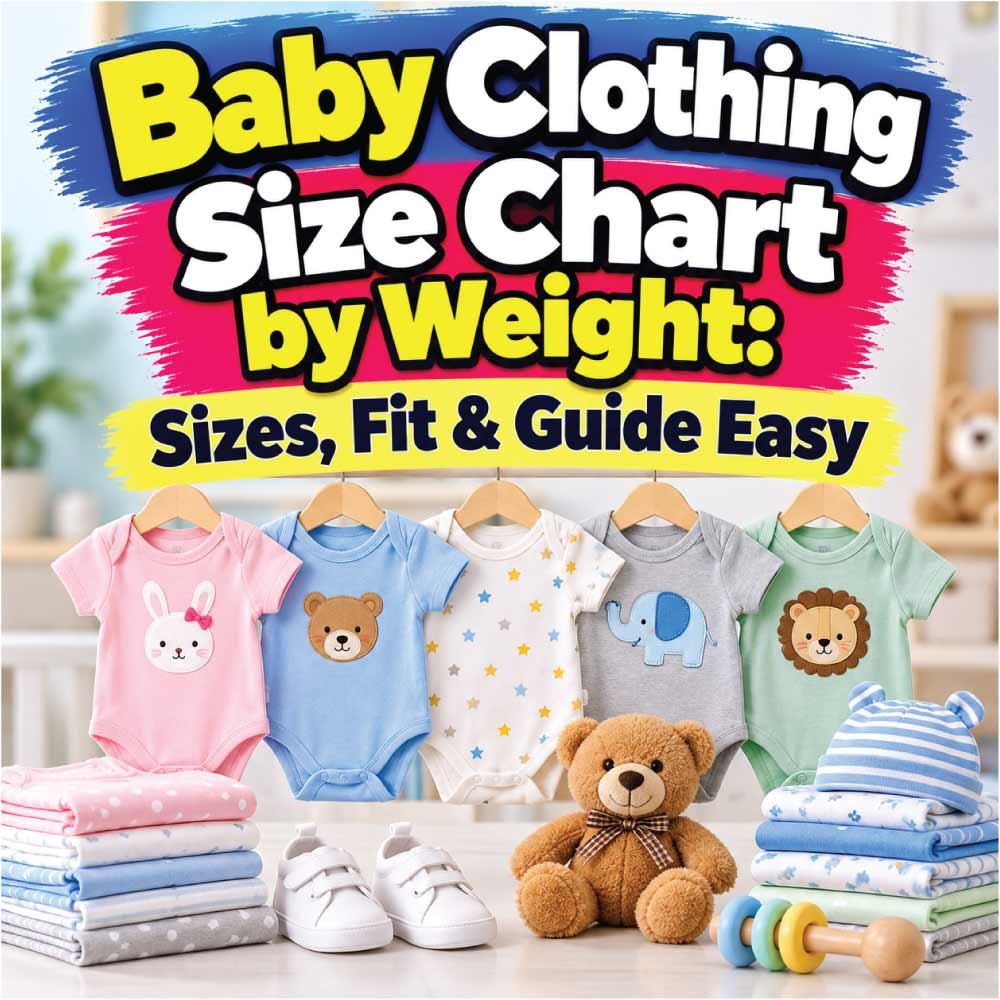
Choosing the right baby clothing size can be surprisingly difficult. Age labels such as newborn, 0–3 months, or 6–9 months provide a useful starting point, but babies grow at different rates and do not always fit their age-based clothing size. A baby clothing size chart by weight can make the process easier by giving parents another way to compare a baby’s current size with common clothing ranges.
Weight is particularly helpful when shopping online, buying gifts, or deciding whether a baby is ready to move into the next clothing size. However, weight should not be the only measurement you consider. Height, body length, diaper size, garment design, and brand-specific measurements can all affect the final fit.
This guide explains baby clothing sizes by weight, how newborn and infant sizes compare, what to do when your baby is between sizes, and how to use a manufacturer’s size chart to make a better choice.
Baby Clothing Size Chart by Weight
The following chart provides a general reference for common baby clothing sizes. These ranges are not universal standards because clothing manufacturers may use different measurements and sizing systems.
| Baby Clothing Size | Approx. Weight | Typical Age | General Fit Stage |
|---|---|---|---|
| Newborn (NB) | Up to about 7–9 lb | Newborn | Very small babies |
| 0–3 Months | About 7–12.5 lb | 0–3 months | Early infancy |
| 3–6 Months | About 12.5–17 lb | 3–6 months | Growing infants |
| 6–9 Months | About 17–20 lb | 6–9 months | Active infants |
| 9–12 Months | About 20–24 lb | 9–12 months | Larger infants |
| 12–18 Months | About 24–28 lb | 12–18 months | Toddler transition |
| 18–24 Months | About 28–32 lb | 18–24 months | Older toddlers |
These numbers should be treated as general shopping guidance, not exact rules. A baby may fit comfortably into a larger or smaller size depending on height, body proportions, and the brand’s cut.
When a manufacturer provides its own weight and height chart, use that chart before relying on a general baby clothing size chart.
How Baby Clothing Sizes Work
Baby clothing is usually labeled according to age, weight, height, or a combination of these measurements. Common labels include NB, 0–3M, 3–6M, 6–9M, 9–12M, 12–18M, and 18–24M.
The number on the label represents a general growth stage rather than a precise measurement.
For example, two babies who are both six months old can have very different body sizes. One may comfortably wear 3–6 month clothing, while another may need 6–9 month clothing.
This is why it is useful to consider several measurements rather than relying on age alone.
Age-Based Baby Clothing Sizes
Age is the easiest sizing method because it is printed directly on most baby garments. However, age ranges are broad.
A 3–6 month label does not mean every baby between three and six months will fit the garment equally well. Growth rate, height, weight, and body proportions all vary.
Weight-Based Baby Clothing Sizes
Weight provides a more individualized way to estimate clothing size. If you know the baby’s current weight, you can compare it with the manufacturer’s recommended range.
Weight is especially useful when:
- The baby is smaller or larger than average for their age.
- You are buying clothes online.
- You are purchasing clothes as a gift.
- The baby is between two age-based sizes.
- You do not know the baby’s exact height.
Height and Length
Height is another important measurement because some babies are long and relatively slim. A garment may fit their weight but be too short through the torso, sleeves, or legs.
For bodysuits, rompers, and sleepers, body length can be particularly important.
Why Use a Baby Clothing Size Chart by Weight?
A weight-based chart gives parents an additional way to estimate clothing size without depending entirely on age.
This can be useful because babies develop at different rates. A baby who weighs more than the typical range for their age may need to move into a larger clothing size earlier.
A weight chart can also help when shopping for:
- Newborn clothes
- Baby shower gifts
- Infant pajamas
- Bodysuits
- Baby pants
- Rompers
- Seasonal clothing
- Future-size clothing
However, a weight chart is best used as a starting point. Before purchasing, compare the baby’s measurements with the individual brand’s sizing information.
Newborn Baby Clothing Size by Weight
Newborn clothing is usually labeled NB and is designed for very small babies. A general reference range is up to approximately 7–9 pounds, although the exact range varies by manufacturer.
Some babies wear newborn clothing for several weeks, while others move into 0–3 month clothing almost immediately.
When Should You Buy Newborn Size?
Newborn clothing can be useful for the first days and weeks after birth. If you are preparing a baby’s wardrobe before birth, it is usually sensible to have some newborn clothing without purchasing an excessive amount.
Useful newborn items may include:
- Bodysuits
- Sleepers
- Gowns
- Soft pants
- Shirts
- Lightweight layers
Because babies can grow quickly, having several pieces in the next size can also be practical.
Can You Skip Newborn Clothing?
Yes. Some babies are too large for newborn clothing at birth or outgrow it very quickly. In those situations, 0–3 month clothing may be more practical.
If you do not know the baby’s expected size, having a small selection of newborn clothes and more 0–3 month pieces can provide flexibility.
0–3 Month Baby Clothing Size by Weight
The 0–3 month size is commonly used during the early months of infancy. A broad reference range is approximately 7–12.5 pounds.
This size is often used for:
- Bodysuits
- Sleepers
- Pajamas
- Rompers
- Soft pants
- T-shirts
- Baby gowns
Weight is helpful, but length should also be considered. A long baby may outgrow a bodysuit because of torso length even when their weight remains within the recommended range.
3–6 Month Baby Clothing Size by Weight
A general reference for 3–6 month clothing is approximately 12.5–17 pounds.
At this stage, babies are becoming increasingly active. Clothing should allow comfortable movement without excessive tightness.
Look for clothing that provides enough room around the:
- Chest
- Waist
- Torso
- Diaper area
- Arms
- Legs
Stretchy fabrics can provide additional flexibility, but they should not be used as a substitute for selecting the correct size.
6–9 Month Baby Clothing Size by Weight
A general weight range for 6–9 month clothing is around 17–20 pounds.
Babies in this stage may move frequently, roll, sit, crawl, or begin other forms of mobility. Comfortable clothing can make these activities easier.
When selecting this size, check whether the garment has:
- Enough torso length
- Comfortable waistbands
- Flexible fabric
- Adequate diaper room
- Appropriate sleeve and leg length
A baby who is close to the upper end of the size range may be ready for the next size, especially if the current clothing already feels snug.
9–12 Month Baby Clothing Size by Weight
The 9–12 month category commonly accommodates babies weighing around 20–24 pounds, although individual brands can differ.
At this stage, clothing may need to accommodate increasing movement and changing body proportions.
For example, a baby may fit the weight range but require a larger size because of height or torso length.
This is especially important with one-piece garments such as:
- Rompers
- Bodysuits
- Sleepers
- Overalls
A shirt or loose top may provide more flexibility than a fitted one-piece garment.
12–18 Month Baby Clothing Size by Weight
The 12–18 month category generally moves toward toddler clothing. A broad reference range is approximately 24–28 pounds.
Children at this stage can have noticeably different body shapes. Some are tall and slim, while others have shorter or broader proportions.
For that reason, weight and height should both be considered when available.
Clothing should allow the child to:
- Walk comfortably
- Sit and stand
- Bend
- Crawl when needed
- Move their arms freely
- Wear a diaper comfortably when applicable
18–24 Month Baby Clothing Size by Weight
A general reference range for 18–24 month clothing is approximately 28–32 pounds.
Children may move into toddler sizes at different times, so the age printed on clothing should not be treated as a strict requirement.
If the child is near the upper limit of the manufacturer’s weight range, compare the next size before purchasing.
This is particularly important for clothing that will be worn for several months.
How to Choose the Correct Baby Clothing Size
Finding the right size does not have to be complicated. A simple process can help you make a better choice.
Step 1: Check the Baby’s Current Weight
Use the most recent reliable weight available. Babies can grow quickly, so an older measurement may no longer represent their current size.
Step 2: Check Height or Length
If the manufacturer provides a height range, compare it with the baby’s height or length.
This is especially important for one-piece garments.
Step 3: Read the Brand’s Size Chart
Never assume that every brand follows exactly the same measurements.
The manufacturer’s chart should normally take priority over a general chart.
Step 4: Consider the Garment Type
A bodysuit, pair of pants, sweater, and sleeper may all fit differently even when they carry the same size label.
Step 5: Allow Practical Growing Room
A small amount of growing room can make clothing more useful. However, extremely oversized clothing may be uncomfortable or impractical.
What If Your Baby Is Between Two Sizes?
It is common for a baby’s measurements to fall between two clothing sizes.
When this happens, compare the manufacturer’s weight and height ranges rather than automatically choosing the larger size.
Choose the Smaller Size When
The smaller size may work when:
- The baby’s measurements are comfortably inside its range.
- The garment has a naturally roomy cut.
- The baby needs a closer fit.
- The next size is significantly too large.
Choose the Larger Size When
The larger size may be preferable when:
- The baby is near the top of the smaller size.
- The baby is growing quickly.
- The garment is intended to last longer.
- The baby’s height is already near the smaller size’s upper limit.
- Additional room is needed for layering.
The correct choice depends on the garment and the manufacturer’s measurements.
Also Read:
Baby Clothing Weight vs. Height
Weight and height provide different information.
Weight gives an indication of overall body size, while height helps determine whether the clothing is long enough.
| Size | Approx. Weight | Why Height Matters |
|---|---|---|
| Newborn | Up to about 7–9 lb | Helps prevent excessive garment length |
| 0–3M | About 7–12.5 lb | Important for torso and sleeve length |
| 3–6M | About 12.5–17 lb | Helps determine overall fit |
| 6–9M | About 17–20 lb | Useful for active infants |
| 9–12M | About 20–24 lb | Helps with longer body proportions |
| 12–18M | About 24–28 lb | Important during toddler transition |
| 18–24M | About 28–32 lb | Helps prevent short sleeves and legs |
If both measurements are available, using weight and height together generally gives you a better starting point than either measurement alone.
How Baby Clothes Should Fit
Baby clothes should be comfortable and provide enough room for normal movement.
Clothing should not be excessively tight around the neck, chest, waist, torso, arms, or legs.
Signs of a Good Fit
A properly fitting garment generally:
- Allows comfortable movement.
- Has enough room around the diaper area.
- Does not pull excessively across the torso.
- Allows snaps and closures to fasten without strain.
- Has sleeves and legs of practical length.
- Does not leave deep pressure marks.
Signs Clothing Is Too Small
Watch for:
- Difficult-to-close snaps.
- Tight neck openings.
- Fabric pulling across the chest.
- Short sleeves.
- Short pant legs.
- Restricted movement.
- A compressed diaper area.
If several of these signs appear, moving up a size is worth considering.
Signs Clothing Is Too Large
Clothing may be excessively large when:
- Sleeves cover the hands.
- Pant legs bunch substantially.
- Waistbands slip.
- The neckline sits too loosely.
- Excess fabric interferes with movement.
A little growing room is useful, but excessive sizing is not always the best solution.
Also Read:
Do Baby Clothing Sizes Vary by Brand?
Yes. Baby clothing sizes can vary between manufacturers.
A 3–6 month garment from one brand may fit differently from another brand’s 3–6 month garment. Differences can occur in garment length, width, cut, fabric stretch, and intended fit.
Before ordering online, check whether the brand provides measurements for:
- Weight
- Height
- Chest
- Waist
- Hip
- Garment length
- Inseam
When a detailed manufacturer chart is available, it should be your primary reference.
Also Read:
Common Baby Clothing Size Mistakes
Parents and gift buyers often make simple sizing mistakes.
Choosing Only by Age
Age is convenient but does not account for individual growth.
Ignoring Height
A baby’s weight may fit the size while their body is too long for the garment.
Assuming All Brands Fit the Same
Different brands use different sizing systems and garment dimensions.
Buying Too Many Newborn Clothes
Some babies outgrow newborn clothing very quickly.
Buying Extremely Large Sizes
Oversized clothing may provide growing room but can also be uncomfortable or difficult to manage.
Forgetting the Diaper
One-piece baby clothing needs enough room for the diaper. A garment can fit the chest but still be too short through the torso.
Tips for Buying Baby Clothes Online
Online shopping requires more attention to measurements because you cannot try the clothing on before purchasing.
Use these practical tips:
- Check the baby’s current weight.
- Measure height or length when possible.
- Read the manufacturer’s size chart.
- Compare more than one measurement.
- Check whether the garment is fitted or roomy.
- Consider fabric stretch.
- Read customer reviews for sizing information when available.
- Check the return or exchange policy.
- Avoid buying large quantities from an unfamiliar brand until you understand its fit.
If you are purchasing clothing for future use, also think about the season in which the baby is likely to wear it.
Seasonal Baby Clothing Size Considerations
Season can influence how you plan a baby’s wardrobe.
A baby may need lightweight clothing during warm weather and additional layers during colder months. If you are buying clothes several months in advance, the baby’s size is likely to change before the clothes are needed.
For this reason, avoid purchasing too many future outfits based on the baby’s current weight.
Instead, consider buying a reasonable selection in the current size and a smaller selection in the next likely size.
Growth cannot be predicted perfectly, so flexibility is more useful than trying to calculate an exact future clothing size.
How Many Baby Clothes Should You Buy?
There is no universal number of garments every baby needs. The ideal amount depends on laundry frequency, weather, lifestyle, and how often the baby changes clothes.
A flexible wardrobe may include:
- Several everyday bodysuits
- A few sleepers
- Comfortable pants
- Tops or shirts
- Seasonal layers
- A few special outfits
- Socks and other practical accessories
Avoid filling the wardrobe with too many pieces in one size. Babies can move through clothing sizes quickly, and some garments may only be worn a few times before becoming too small.
Frequently Asked Questions
What weight is 0–3 month baby clothing?
A general reference range for 0–3 month baby clothing is approximately 7–12.5 pounds. Actual sizing varies by manufacturer, so compare the baby’s weight and height with the brand’s specific chart before purchasing.
What weight is newborn baby clothing?
Newborn clothing is commonly designed for babies up to approximately 7–9 pounds, although manufacturers may use different ranges. Some babies move into 0–3 month clothing shortly after birth.
Should I choose baby clothes by weight or age?
Use both whenever possible. Age gives you a general size category, while weight provides a better indication of the baby’s current body size. Height or length can further improve your sizing decision.
What if my baby is between two sizes?
Compare the baby’s weight and height with both size ranges. If the baby is near the upper limit of the smaller size, the larger size may provide more practical growing room.
Are baby clothing sizes standardized?
No. Baby clothing sizes can vary between brands. A particular age range or size label does not guarantee identical measurements across manufacturers.
Can weight alone determine baby clothing size?
No. Weight is useful, but it does not account for height, torso length, body proportions, diaper size, garment design, or fabric stretch. Use weight together with other available measurements.
Should baby clothes be loose or tight?
Baby clothes should provide a comfortable fit without being excessively tight or excessively loose. There should be enough room for movement and, where appropriate, the diaper.
Do babies always wear their age-based clothing size?
No. Babies grow at different rates, so a child may wear a larger or smaller size than their age suggests. Weight and height can provide a more useful indication of current clothing fit.
Final Thoughts on Baby Clothing Size by Weight
A baby clothing size chart by weight is a useful tool for estimating the right clothing size, especially when shopping online or choosing clothes for a baby whose age does not clearly indicate their size.
The most reliable approach is to use weight, height, and the manufacturer’s sizing chart together. Age labels are helpful, but they should not be treated as exact measurements.
Remember that babies grow quickly and at different rates. If your baby is between sizes, consider the garment’s design, current measurements, available growing room, and intended use before making your choice.
For newborns, it is generally practical to keep a small selection of newborn clothing while having additional pieces in the next size. As the baby grows, continue checking measurements rather than assuming the same size system will work across every brand.
The best baby clothing size is ultimately the one that provides comfortable movement, appropriate coverage, and a practical fit without being unnecessarily tight or oversized.
