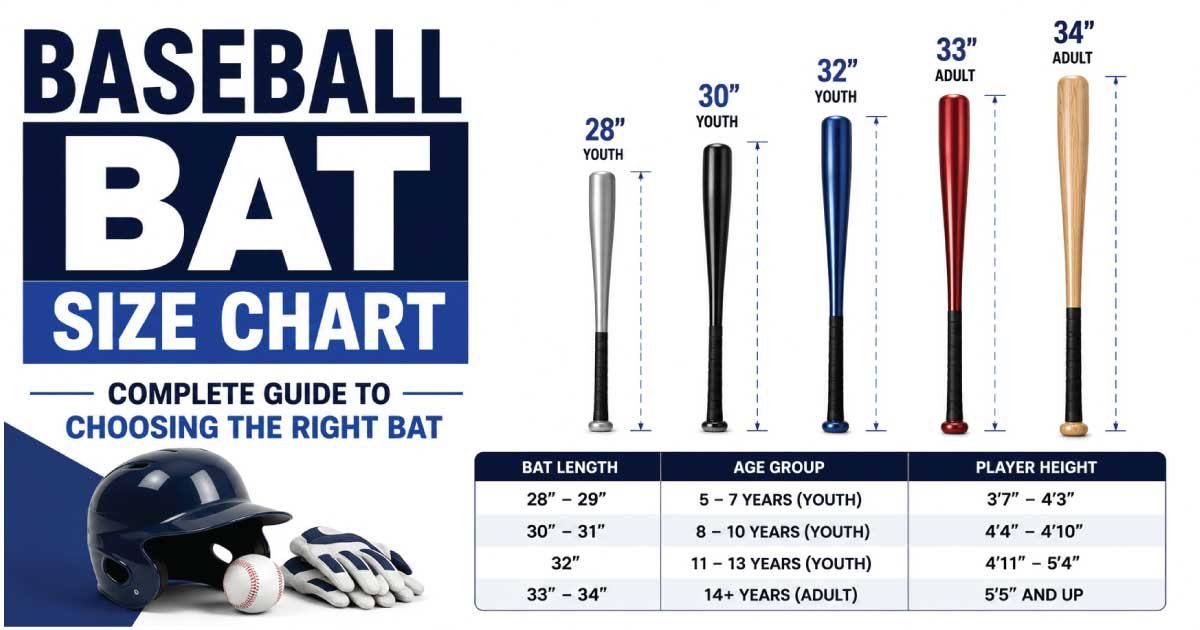
Choosing the correct baseball bat size is important for comfort, swing speed, control, and overall performance. A bat that is too heavy can make it difficult to generate bat speed, while one that is too long may reduce control and make consistent contact harder.
A baseball bat size chart helps players compare bat length and weight based on age, height, weight, and playing level. Youth players generally need shorter and lighter bats, while older and stronger players can usually handle longer and heavier models.
Baseball bats are commonly measured using length in inches and weight in ounces. The difference between these two measurements is called the length-to-weight ratio, often referred to as the drop weight.
This complete guide explains baseball bat sizes for youth players, high school players, adults, Little League, travel baseball, and different age groups. You will also learn how to measure for a bat, understand drop weight, and choose the right bat length and weight.
Why Choosing the Right Baseball Bat Size Matters
The size of a baseball bat affects how easily a player can control the barrel and generate swing speed.
A bat that is too heavy can slow the swing and make it difficult to maintain proper mechanics. A bat that is too light may be easier to swing but might not provide the desired feel or power.
The correct bat should allow the player to:
- Maintain good swing mechanics
- Control the barrel
- Generate sufficient bat speed
- Make consistent contact
- Swing comfortably
- Maintain balance throughout the swing
The ideal bat is not necessarily the longest or heaviest option. It should match the player’s physical development, age, skill level, league requirements, and personal swing.
Baseball Bat Size Chart by Age
Age can provide a useful starting point when selecting a baseball bat, particularly for youth players.
| Age | Typical Bat Length | Typical Bat Weight |
|---|---|---|
| 5–7 years | 24–27 in | 13–17 oz |
| 7–9 years | 26–29 in | 15–19 oz |
| 9–11 years | 28–31 in | 17–21 oz |
| 11–13 years | 29–32 in | 19–23 oz |
| 13–15 years | 31–33 in | 21–26 oz |
| 15–18 years | 32–34 in | 26–31 oz |
| Adult | 32–34 in | 28–32+ oz |
These are general starting ranges rather than strict requirements. Players of the same age can have significantly different heights, weights, strength levels, and swing abilities.
League regulations should always be checked before purchasing a bat for organized play.
Baseball Bat Size Chart by Height and Weight
Height and body weight can provide additional information when choosing a youth baseball bat.
| Player Height | Player Weight | Suggested Bat Length |
|---|---|---|
| 3’5″–3’8″ | 40–60 lb | 24–26 in |
| 3’9″–4’0″ | 45–65 lb | 25–27 in |
| 4’1″–4’4″ | 50–75 lb | 26–28 in |
| 4’5″–4’8″ | 55–85 lb | 27–29 in |
| 4’9″–5’0″ | 65–100 lb | 28–30 in |
| 5’1″–5’4″ | 75–120 lb | 29–31 in |
| 5’5″–5’8″ | 90–140 lb | 30–32 in |
| 5’9″–6’0″ | 110–160 lb | 31–33 in |
| 6’1″+ | 130+ lb | 32–34+ in |
Use these measurements as a starting point rather than an absolute sizing rule.
A player’s swing mechanics and ability to control the bat should ultimately influence the final choice.
How Baseball Bat Sizes Work
Baseball bats are described using two primary measurements:
Bat length: measured from the end of the knob to the end of the barrel.
Bat weight: measured in ounces.
For example, a bat labeled 30/20 is approximately:
- 30 inches long
- 20 ounces in weight
The difference between the length and weight is called the drop weight.
What Is Baseball Bat Drop Weight?
Drop weight is calculated by subtracting the bat’s weight in ounces from its length in inches.
For example:
30-inch bat − 20-ounce weight = -10 drop
A bat labeled -10 has a 10-ounce difference between its length and weight.
A larger negative number generally means a lighter bat.
| Bat Length | Bat Weight | Drop Weight |
|---|---|---|
| 28 in | 18 oz | -10 |
| 29 in | 19 oz | -10 |
| 30 in | 20 oz | -10 |
| 31 in | 21 oz | -10 |
| 32 in | 22 oz | -10 |
| 32 in | 25 oz | -7 |
| 33 in | 27 oz | -6 |
| 34 in | 30 oz | -4 |
Drop weight is particularly important in youth and high school baseball because many leagues have specific bat regulations.
Youth Baseball Bat Size Chart
Youth baseball bats are generally shorter and lighter than adult bats.
| Youth Age | Common Bat Length | Common Drop |
|---|---|---|
| 5–7 | 24–27 in | -10 to -13 |
| 7–9 | 26–29 in | -10 to -13 |
| 9–11 | 28–31 in | -10 to -12 |
| 11–13 | 29–32 in | -8 to -11 |
| 12–14 | 30–32 in | -8 to -10 |
Younger players usually benefit from a bat they can control easily.
Choosing a bat that is too heavy simply because it is longer can make it harder for a young player to develop consistent swing mechanics.
Little League Baseball Bat Size Guide
Little League players generally use youth-sized bats, but the exact bat requirements depend on the league and division.
Before purchasing a bat, check the current regulations for the specific competition.
For many youth players, common bat lengths fall around 28–32 inches, with weight determined by the player’s size and the required bat standard.
The correct bat should be:
- Easy to control
- Comfortable during practice
- Appropriate for the player’s age
- Legal for the player’s league
- Suitable for the player’s strength
League approval is particularly important because not every bat is legal in every competition.
Baseball Bat Size for 8-Year-Olds
An 8-year-old player may commonly use a bat around 26–29 inches long.
The correct weight depends on the child’s height, weight, strength, and ability to swing the bat comfortably.
A smaller 8-year-old may need a shorter, lighter bat, while a taller and stronger player may be comfortable with a longer model.
Instead of selecting based solely on age, compare the child’s height and weight with a bat size chart.
Baseball Bat Size for 10-Year-Olds
A 10-year-old player may commonly use a bat around 28–30 inches.
A lighter drop-weight bat can be useful for developing swing speed and control.
However, if the player can comfortably handle additional weight without losing bat speed or balance, a slightly heavier bat may be appropriate.
Baseball Bat Size for 12-Year-Olds
Many 12-year-old players use bats around 29–32 inches.
At this age, differences in height, body weight, strength, and playing level can become more noticeable.
A recreational player may prefer a lighter bat for easier control, while a stronger and more experienced player may be comfortable with a heavier model.
Baseball Bat Size for 13-Year-Olds
A 13-year-old player may begin transitioning toward larger and heavier bats.
Common lengths are around 30–32 inches, although taller players may require a longer bat.
At this stage, league regulations become especially important because bat standards may change between age divisions.
Baseball Bat Size for 14-Year-Olds
A 14-year-old player may use a bat around 31–33 inches, depending on physical development and league requirements.
Players should focus on maintaining bat speed and control rather than simply selecting the heaviest available bat.
A properly fitted bat should allow the player to complete a controlled swing without excessive effort.
High School Baseball Bat Size Chart
High school baseball bats are typically larger and heavier than youth bats.
| Player Type | Common Bat Length | Common Weight Range |
|---|---|---|
| Smaller high school player | 31–32 in | 26–29 oz |
| Average high school player | 32–33 in | 28–30 oz |
| Larger high school player | 33–34 in | 29–31 oz |
| Strong adult-style hitter | 33–34 in | 30–32+ oz |
High school baseball has specific bat regulations, so players should verify that the bat meets the applicable certification requirements.
College Baseball Bat Size Guide
College players typically use heavier bats than most youth players.
A common range is approximately 32–34 inches, with weights often around 29–31 ounces or more depending on the player’s size and preference.
College bat regulations can differ from youth and recreational leagues, so certification and league rules should always be checked before purchasing.
Adult Baseball Bat Size Chart
Adult players can choose from several bat sizes depending on strength, position, swing mechanics, and playing level.
| Adult Player Type | Typical Length | Typical Weight |
|---|---|---|
| Smaller adult | 31–32 in | 27–29 oz |
| Average adult | 32–33 in | 28–31 oz |
| Larger adult | 33–34 in | 30–32 oz |
| Power hitter | 33–34 in | 31–34 oz |
These are general ranges. Adult players should choose a bat based on performance and comfort rather than assuming a heavier bat is automatically better.
Also Read: Armchair Size Guide with Chart: Complete Guide
How to Measure for a Baseball Bat
There are several simple ways to estimate the correct bat length.
Method 1: Measure From the Floor
Stand the bat vertically next to the player.
The knob should touch the floor while the barrel points upward.
For many youth players, a bat that reaches approximately the hip area can be a useful starting point.
Method 2: Use the Fingertip Test
Place the bat beside the player with the knob on the floor.
The player should be able to reach toward the barrel comfortably.
This is only a basic sizing test and should not replace actual swing evaluation.
Method 3: Use Height and Weight
Compare the player’s height and weight with a baseball bat sizing chart.
This is one of the easiest approaches when shopping online.
How to Choose Baseball Bat Weight
Length is only half of the sizing equation.
Bat weight has a significant effect on swing speed and control.
A lighter bat is generally easier to accelerate.
A heavier bat can provide a more substantial feel but requires greater strength and control.
The correct weight should allow the player to maintain a consistent swing without dropping the barrel or losing balance.
Light vs. Heavy Baseball Bats
Advantages of a Lighter Bat
A lighter bat can provide:
- Faster swing speed
- Easier barrel control
- Better maneuverability
- Easier adjustment during the swing
This can be particularly useful for younger players.
Advantages of a Heavier Bat
A heavier bat may provide:
- More mass behind the ball
- A stronger feel through contact
- Greater resistance during impact
However, these benefits only matter if the player can swing the bat efficiently.
How to Know if a Baseball Bat Is Too Heavy
A bat may be too heavy if the player:
- Cannot maintain bat speed
- Drops the barrel during the swing
- Struggles to control the bat
- Loses balance
- Has difficulty completing the swing
- Becomes fatigued quickly
If a player can only swing a bat effectively with significant effort, moving to a lighter option may improve control.
How to Know if a Baseball Bat Is Too Light
A bat may be too light if the player:
- Has excellent control but wants more mass
- Easily swings the bat without challenge
- Feels the bat lacks stability
- Is physically ready for a heavier model
However, increasing weight should be gradual.
The goal is to find the best combination of swing speed, control, and feel.
Also Read: Sofa Size Guide with Chart: Complete Guide
One-Piece vs. Two-Piece Baseball Bats
Bat construction can also affect how a bat feels.
One-Piece Bats
One-piece bats are made from a continuous construction.
They can provide a firm and direct feel during contact.
Two-Piece Bats
Two-piece bats separate the handle and barrel components.
They can provide different vibration characteristics and may feel more forgiving on mishits.
Bat construction does not replace proper sizing. A correctly sized bat should still be the priority.
Baseball Bat Size by Player Position
Position alone does not determine bat size, but some playing styles may influence preferences.
Power Hitters
Power hitters may prefer heavier bats if they have the strength and swing speed to control them.
Contact Hitters
Players focused on quick bat control may prefer a lighter setup.
Youth Players
Younger players generally benefit from bats that emphasize control and swing speed.
Ultimately, the player’s individual swing should determine the final choice.
How Bat Length Affects Swing
A longer bat provides greater reach across the plate.
However, additional length also increases the amount of bat that must be controlled.
A bat that is too long can make it harder to get the barrel into the hitting zone quickly.
A shorter bat can improve control but may reduce reach.
The goal is to find a length that provides adequate plate coverage without compromising swing mechanics.
How Bat Diameter Affects Size
Youth and adult baseball bats can have different barrel diameter requirements.
Common youth barrel sizes include approximately:
- 2 1/4 inches
- 2 5/8 inches
- 2 3/4 inches
The appropriate diameter depends on the bat category and league regulations.
Do not assume that a larger barrel is automatically better. Barrel size can affect the overall weight and balance of the bat.
Also Read: Ottoman Size Guide with Chart: Complete Guide
Balanced vs. End-Loaded Baseball Bats
Bat balance can influence how heavy a bat feels during the swing.
Balanced Bats
Balanced bats distribute weight more evenly along the bat.
They can feel easier to control and may be suitable for players who prioritize bat speed.
End-Loaded Bats
End-loaded bats place more mass toward the barrel.
They may appeal to stronger players who prefer additional barrel weight and can control the bat effectively.
The best balance depends on the player’s strength, swing style, and experience.
Common Baseball Bat Sizing Mistakes
Choosing Only by Age
Age provides a starting point, but height, weight, strength, and skill also matter.
Choosing the Longest Bat
Longer is not automatically better.
Choosing the Heaviest Bat
A heavier bat is useful only when the player can maintain proper swing speed and control.
Ignoring League Rules
Different leagues can have different bat requirements.
Buying Without Measuring
A quick height and weight check can make the selection much more accurate.
Copying a Teammate’s Bat
A bat that works well for one player may not work for another.
Frequently Asked Questions About Baseball Bat Sizes
What size baseball bat should I use?
The appropriate bat depends on your age, height, weight, strength, playing level, and league requirements. Youth players commonly use bats around 24–32 inches, while older players often use bats around 31–34 inches.
What size baseball bat should a 10-year-old use?
Many 10-year-old players use a bat around 28–30 inches, but the correct size depends on the player’s height, weight, strength, and swing. A lighter bat is often easier to control for developing players.
What size baseball bat should a 12-year-old use?
A 12-year-old may commonly use a bat around 29–32 inches. Physical development varies significantly at this age, so height, weight, swing speed, and league regulations should also be considered.
What size bat should a 13-year-old use?
Many 13-year-old players use bats around 30–32 inches. Taller or stronger players may prefer longer bats, while smaller players may benefit from shorter and lighter options.
What size baseball bat should a 14-year-old use?
A 14-year-old may commonly use a 31–33 inch bat. The correct weight depends on the player’s strength and ability to maintain swing speed and control.
What size baseball bat is best for adults?
Many adult players use bats between 32 and 34 inches. Weight commonly falls around 28–32 ounces, although individual preferences and league requirements vary.
What does -10 mean on a baseball bat?
A -10 bat has a 10-ounce difference between its length and weight. For example, a 30-inch, 20-ounce bat has a -10 drop weight.
Is a heavier baseball bat better?
Not necessarily. A heavier bat can provide more mass, but only if the player can swing it efficiently. A bat that is too heavy may reduce swing speed and control.
How do I know if a baseball bat is too long?
A bat may be too long if the player struggles to control the barrel, loses balance, or has difficulty generating adequate swing speed. The bat should provide enough reach without interfering with proper mechanics.
How do I know if a baseball bat is too heavy?
If the player cannot maintain bat speed, drops the barrel, loses balance, or struggles to complete the swing, the bat may be too heavy.
What is drop weight on a baseball bat?
Drop weight is the difference between bat length in inches and bat weight in ounces. A 32-inch bat weighing 22 ounces has a -10 drop weight.
Does height determine baseball bat size?
Height is an important factor, but it should not be used alone. Weight, strength, age, swing mechanics, and league rules also influence the appropriate bat size.
What is the best bat size for youth baseball?
Youth bat sizes commonly range from approximately 24 to 32 inches. The correct size depends on the player’s physical development and the rules of the league in which they play.
Final Thoughts on Choosing the Right Baseball Bat Size
Choosing the correct baseball bat size is about finding a balance between length, weight, control, and swing speed. Age, height, and weight can provide a useful starting point, but the player’s individual ability should ultimately guide the decision.
For younger players, a lighter bat that is easy to control can help develop consistent swing mechanics. Older and stronger players may be able to use longer and heavier bats without sacrificing control.
Always check the rules of your specific baseball league before purchasing a bat, because approved sizes, certifications, barrel diameters, and drop weights can vary.
The best baseball bat is not necessarily the biggest or heaviest one. It is the bat that allows the player to swing confidently, maintain control, generate good bat speed, and make consistent contact.
