
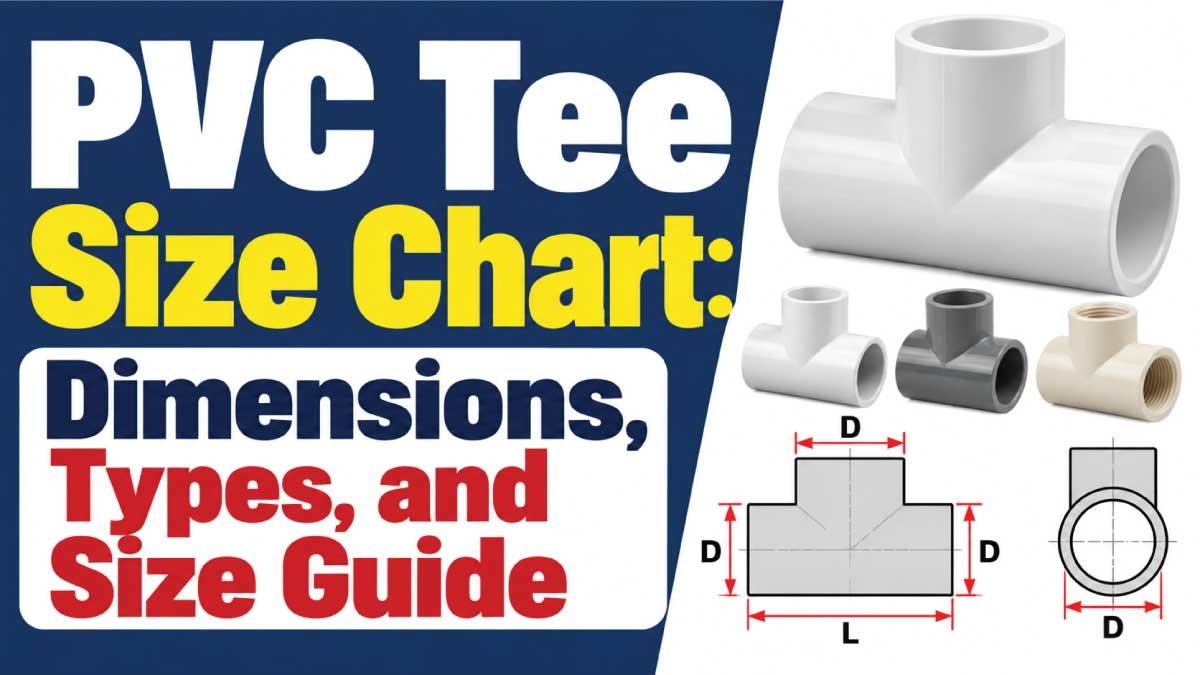
PVC tee fittings are essential plumbing components used to create branch connections in piping systems. They allow water or other compatible fluids to flow from a main pipe into a secondary line, making them useful for irrigation, water distribution, drainage, and many industrial applications.
Choosing the correct PVC tee size helps ensure compatible connections, proper flow, and reliable installation. However, selecting a tee involves more than matching the nominal pipe size. You also need to consider the branch size, connection type, pipe dimensional standard, pressure requirements, and intended application.
This PVC tee size chart explains common nominal sizes, outside diameters, fitting types, and important dimensions. You will also learn how to identify reducing tees, measure existing fittings, compare Schedule 40 and Schedule 80 systems, and avoid common sizing mistakes.
PVC Tee Size Chart: Common Sizes and Dimensions
A PVC tee typically has three openings: two aligned with the main pipeline and one branch extending at an angle, usually 90 degrees. A standard tee connects three pipes of the same nominal size, while a reducing tee connects a smaller or larger branch to the main line.
For standard North American IPS PVC systems, the following chart lists common nominal pipe sizes and their corresponding outside diameters. These pipe dimensions help identify compatible socket-style tee fittings.
| Nominal Pipe Size (inches) | Outside Diameter (inches) | Outside Diameter (mm) | Common Applications |
|---|---|---|---|
| 1/2 | 0.840 | 21.34 | Small water lines and irrigation |
| 3/4 | 1.050 | 26.67 | Residential plumbing and garden systems |
| 1 | 1.315 | 33.40 | Water distribution and equipment connections |
| 1-1/4 | 1.660 | 42.16 | Branch connections and supply lines |
| 1-1/2 | 1.900 | 48.26 | Plumbing and drainage |
| 2 | 2.375 | 60.33 | Irrigation and larger distribution lines |
| 2-1/2 | 2.875 | 73.03 | Larger piping systems |
| 3 | 3.500 | 88.90 | Commercial piping and drainage |
| 4 | 4.500 | 114.30 | Building drainage and sewer systems |
| 6 | 6.625 | 168.28 | Large distribution and drainage systems |
| 8 | 8.625 | 219.08 | Industrial and infrastructure piping |
These measurements describe the outside diameter of standard IPS PVC pipe, not the inside diameter of a tee’s socket. Tee dimensions and availability vary by manufacturer, fitting design, and applicable standard.
Important: A nominal 1-inch PVC tee is designed for compatible nominal 1-inch pipe, even though the pipe’s outside diameter measures approximately 1.315 inches. Always verify the dimensional standard before purchasing fittings.
Understanding PVC Tee Dimensions
PVC tee dimensions determine how the fitting connects to the pipe and how much space it occupies during installation. Although nominal size identifies the intended pipe connection, other measurements can be important when planning a piping layout.
Nominal Size
Nominal size is the designation used to identify the intended pipe size. A standard 2-inch PVC tee, for example, connects compatible nominal 2-inch PVC pipes through its three openings.
A reducing tee has more than one nominal size because its branch differs from the main line.
Outside Diameter
Outside diameter (OD) is the measurement across the exterior of the pipe. It is an important compatibility dimension for standard IPS socket-style PVC fittings.
The outside diameter generally remains the same for corresponding Schedule 40 and Schedule 80 IPS pipe sizes, even though the wall thickness differs.
Inside Diameter
Inside diameter (ID) measures the open space inside a pipe or fitting. It affects the available flow area and depends on pipe wall thickness and fitting geometry.
A thicker pipe wall generally produces a smaller inside diameter when the nominal size and outside diameter remain unchanged.
Center-to-End Dimensions
Center-to-end dimensions describe the distance from the fitting’s centerline to the end of a connection. These measurements help determine how a tee fits into a compact piping arrangement.
The exact dimensions vary according to nominal size, tee configuration, and manufacturer. Do not assume that all 1-inch or 2-inch tees have identical overall dimensions.
Socket Depth
Socket depth is the distance that the pipe enters the fitting. Correct socket engagement is necessary for a suitable solvent-weld connection.
Use the manufacturer’s installation instructions to determine the appropriate preparation, insertion, and assembly procedure. Do not calculate insertion depth solely from the tee’s overall length.
Types of PVC Tee Fittings
PVC tees are available in different configurations to accommodate various piping layouts. Understanding these types makes it easier to choose a fitting that performs the required function.
1. Standard PVC Tee
A standard PVC tee has three openings of the same nominal size. It is commonly used to create a branch from a main pipeline without changing the nominal pipe size.
For example, a 1-inch standard tee connects two nominal 1-inch main-line sections and a nominal 1-inch branch.
Typical applications include:
- Irrigation distribution.
- Water supply branches.
- Pool circulation systems.
- Compatible industrial piping.
- General plumbing connections.
2. PVC Reducing Tee
A reducing tee has a smaller or otherwise different-sized branch connection compared with the main-line openings. It allows a branch line to connect without installing a separate reducer in every configuration.
For example, a 2 × 2 × 1-inch reducing tee typically has two nominal 2-inch main-line connections and one nominal 1-inch branch.
| Reducing Tee Size | Main-Line Size | Branch Size | Typical Purpose |
|---|---|---|---|
| 1 × 1 × 1/2 inch | 1 inch | 1/2 inch | Small branch from a supply line |
| 1-1/2 × 1-1/2 × 1 inch | 1-1/2 inches | 1 inch | Reduced branch connection |
| 2 × 2 × 1 inch | 2 inches | 1 inch | Smaller distribution branch |
| 2 × 2 × 1-1/2 inches | 2 inches | 1-1/2 inches | Medium-sized branch connection |
| 3 × 3 × 2 inches | 3 inches | 2 inches | Larger branch from a main line |
| 4 × 4 × 2 inches | 4 inches | 2 inches | Reduced branch in a larger system |
These are examples of common nominal size combinations, not a guarantee that every configuration is available from every manufacturer.
3. PVC Threaded Tee
A threaded PVC tee uses threaded connections on some or all of its openings. Depending on the design, the connections may be male, female, or a combination.
Threaded tees can be useful when a connection needs to be assembled or disassembled without solvent welding. However, the thread specification must match the connecting component.
Check the nominal thread size and thread type carefully. Do not assume that a fitting’s actual thread diameter equals its listed nominal size.
4. PVC Socket Tee
A socket tee has openings designed to accept compatible pipe ends for solvent-weld assembly. This is a common configuration in many standard PVC plumbing and pressure-piping systems.
The pipe and fitting must use compatible materials, dimensions, and joining products. Follow the manufacturer’s instructions for surface preparation, cement application, and curing time.
5. PVC DWV Tee
Drainage, waste, and vent (DWV) tees are designed for specific drainage applications. Their shape and internal geometry can differ from tees intended for pressurized service.
Use the fitting configuration permitted by the applicable drainage standard and local plumbing code. A tee that physically connects to a pipe is not automatically suitable for every drainage direction or pressure condition.
Also Read:
PVC Tee Size Chart by Connection Configuration
The size designation of a PVC tee describes its three connections. Understanding how these sizes are written helps prevent ordering the wrong fitting.
| Tee Configuration | Connection A | Connection B | Branch Connection |
|---|---|---|---|
| 1/2 × 1/2 × 1/2 inch | 1/2 inch | 1/2 inch | 1/2 inch |
| 3/4 × 3/4 × 3/4 inch | 3/4 inch | 3/4 inch | 3/4 inch |
| 1 × 1 × 1 inch | 1 inch | 1 inch | 1 inch |
| 1-1/2 × 1-1/2 × 1-1/2 inches | 1-1/2 inches | 1-1/2 inches | 1-1/2 inches |
| 2 × 2 × 2 inches | 2 inches | 2 inches | 2 inches |
| 2 × 2 × 1 inch | 2 inches | 2 inches | 1 inch |
| 3 × 3 × 2 inches | 3 inches | 3 inches | 2 inches |
| 4 × 4 × 2 inches | 4 inches | 4 inches | 2 inches |
The order in which sizes are written can vary by seller or product catalog. Confirm which measurement represents the main line and which represents the branch before placing an order.
Schedule 40 vs. Schedule 80 PVC Tees
Schedule 40 and Schedule 80 identify different wall-thickness series for applicable PVC piping. Their corresponding standard IPS pipe sizes share the same nominal size and outside diameter, but their wall thicknesses and inside diameters differ.
| Feature | Schedule 40 PVC | Schedule 80 PVC |
|---|---|---|
| Nominal pipe size | Standard nominal sizes | Standard nominal sizes |
| Outside diameter | Same as corresponding IPS size | Same as corresponding IPS size |
| Pipe wall | Generally thinner | Generally thicker |
| Inside diameter | Generally larger | Generally smaller |
| Common color convention | Often white | Often gray |
| Selection factors | Pressure, temperature, and application | Pressure, temperature, and application |
Color is only a convention and should not be used as the sole way to identify a fitting’s material or pressure rating.
Are Schedule 40 and Schedule 80 Tees Interchangeable?
Many standard IPS Schedule 40 and Schedule 80 socket fittings can connect to compatible pipe of the same nominal size because the outside diameter is the same.
However, interchangeability should never be assumed for every product. Verify the tee’s dimensional standard, material, pressure rating, and intended service before mixing components.
The pressure capacity of a piping assembly depends on the components used and the system’s operating conditions. A fitting’s schedule alone does not establish that an entire installation is suitable for a particular pressure or temperature.
Also Read:
How to Choose the Correct PVC Tee Size
Selecting the correct PVC tee begins with identifying the existing pipe and understanding the purpose of the branch.
Identify the Pipe Size
Check the pipe markings or original product specifications. These may identify the nominal diameter, material, schedule, and applicable standard.
If the markings are missing, measure the outside diameter with a caliper and compare it with the correct dimensional chart. Measuring the outside diameter is useful, but it does not independently identify every possible pipe standard.
Determine Whether You Need a Standard or Reducing Tee
Choose a standard tee when the main line and branch use the same nominal size.
Choose a reducing tee when the branch needs a different nominal size. For example, a 2-inch main line with a 1-inch branch may require a 2 × 2 × 1-inch reducing tee.
Check the Connection Type
Determine whether the existing pipe uses socket, threaded, or another connection system. The tee must be compatible with the pipe material and connection method.
For threaded fittings, verify the thread standard and size. For solvent-weld fittings, confirm that the pipe, fitting, primer where required, and cement are suitable for the system.
Consider Flow and Application
A tee creates a branch, but the fitting size alone does not determine the system’s flow capacity. Pipe inside diameter, branch configuration, flow rate, pressure losses, and the overall system design also matter.
For drainage installations, follow the applicable drainage layout and code requirements. For pressure systems, verify pressure and temperature limits for the complete assembly.
Allow Space for Installation
Check the tee’s overall dimensions, socket depth, and branch projection. This is particularly important in narrow cabinets, equipment enclosures, irrigation manifolds, and replacement work.
Also Read:
How to Measure an Existing PVC Tee
If you are replacing a damaged tee or matching an existing fitting, these steps can help you identify the correct replacement.
Inspect the markings: Look for nominal size, material, schedule, and product information.
Measure the pipe outside diameter: Use a caliper or ruler and compare the result with the appropriate pipe-size chart.
Identify all three connections: Record the two main-line sizes and the branch size.
Check the connection type: Determine whether the tee is socket-style, threaded, or designed for another connection method.
Compare the fitting configuration: Check branch orientation, overall dimensions, and any reducing connections.
Verify the application: Confirm that the replacement is suitable for pressure service, drainage, irrigation, or the intended use.
Avoid measuring only the largest opening and assuming all three connections are the same. Reducing tees have different nominal sizes at the branch, and threaded fittings require additional attention to thread specifications.
Common PVC Tee Sizing Mistakes to Avoid
Incorrect sizing can lead to incompatible connections, unnecessary adapters, installation delays, or an unsuitable piping system.
Confusing Nominal Size With Actual Diameter
A nominal 2-inch PVC pipe has an outside diameter of approximately 2.375 inches in standard IPS systems. Selecting a tee based only on a ruler measurement of 2 inches can therefore lead to an incorrect choice.
Ordering the Wrong Reducing Tee
A 2 × 2 × 1-inch tee is not the same as a 2 × 1 × 1-inch tee. Always check the size of each opening and identify the branch connection.
Mixing Incompatible Standards
Metric PVC systems and standard IPS systems may use different dimensions. Similar nominal labels do not guarantee a compatible physical connection.
Ignoring Pressure and Temperature Limits
Not every PVC tee is suitable for pressurized water, hot liquids, chemicals, or every outdoor environment. Check the manufacturer’s specifications and relevant installation requirements.
Using a Drainage Tee for an Unsuitable Connection
DWV fittings are designed for drainage applications. Their geometry and permitted uses may differ from those of pressure-rated tees. Select the fitting according to the system’s function and applicable code.
Frequently Asked Questions About PVC Tee Sizes
What is the most common PVC tee size?
Commonly encountered sizes include 1/2 inch, 3/4 inch, 1 inch, 1-1/2 inches, and 2 inches. The appropriate size depends on the pipe system, flow requirements, and application.
How do I read a PVC reducing tee size?
A reducing tee marked 2 × 2 × 1 inch generally has two nominal 2-inch main-line openings and one nominal 1-inch branch opening. Confirm the manufacturer’s size-ordering convention before buying.
What is the outside diameter of a 1-inch PVC tee connection?
For a standard IPS PVC system, nominal 1-inch pipe has an outside diameter of approximately 1.315 inches (33.40 mm). This refers to the pipe, not the inside diameter of the tee socket.
Can a PVC tee connect three different pipe sizes?
Some specialty or reducing configurations accommodate different connection sizes, but availability depends on the manufacturer and fitting design. Confirm all three connection sizes before selecting a product.
Can I use a Schedule 40 tee with Schedule 80 PVC pipe?
In many standard IPS systems, compatible socket fittings can connect to the same nominal pipe size because the outside diameter is the same. Always verify the fitting’s approval, material, and operating limits.
What is the difference between a PVC tee and a PVC wye?
A tee usually creates a branch at approximately 90 degrees, while a wye creates an angled branch. Wyes are commonly used in drainage systems where the direction of flow and fitting geometry are important.
Conclusion
A PVC tee size chart helps you identify nominal pipe sizes, compare outside diameters, and select the right standard or reducing tee for your piping layout. The most important factors are the size of all three connections, the pipe dimensional standard, the connection method, and the intended application.
Before purchasing a PVC tee, verify the pipe markings, measure the outside diameter when necessary, and check the manufacturer’s specifications. Choosing a compatible fitting and following the applicable installation requirements will help create a reliable connection for plumbing, irrigation, drainage, or other approved piping systems.
