Finding the right pair of boots starts with choosing the correct size. Whether you need work boots, hiking boots, cowboy boots, or casual leather boots, a proper fit helps improve comfort, stability, and support. Boots that are too tight can cause pressure points and blisters, while boots that are too loose may allow your feet to slide and create discomfort during walking.
A men’s boot size chart makes it easier to compare US, UK, and European sizes and select a suitable size based on your foot measurements. However, boot sizing can vary by brand, style, material, and intended use. Knowing how to measure your feet and evaluate boot width is just as important as checking the number on the size label.
This guide explains men’s boot sizes, provides conversion charts, and shares practical fitting tips to help you find boots that feel comfortable from the first wear.
Men’s Boot Size Chart
Men’s boot sizes are commonly listed in US, UK, and EU sizing systems. Each system uses a different scale, so the same numerical size may not represent the same foot length across all three systems.
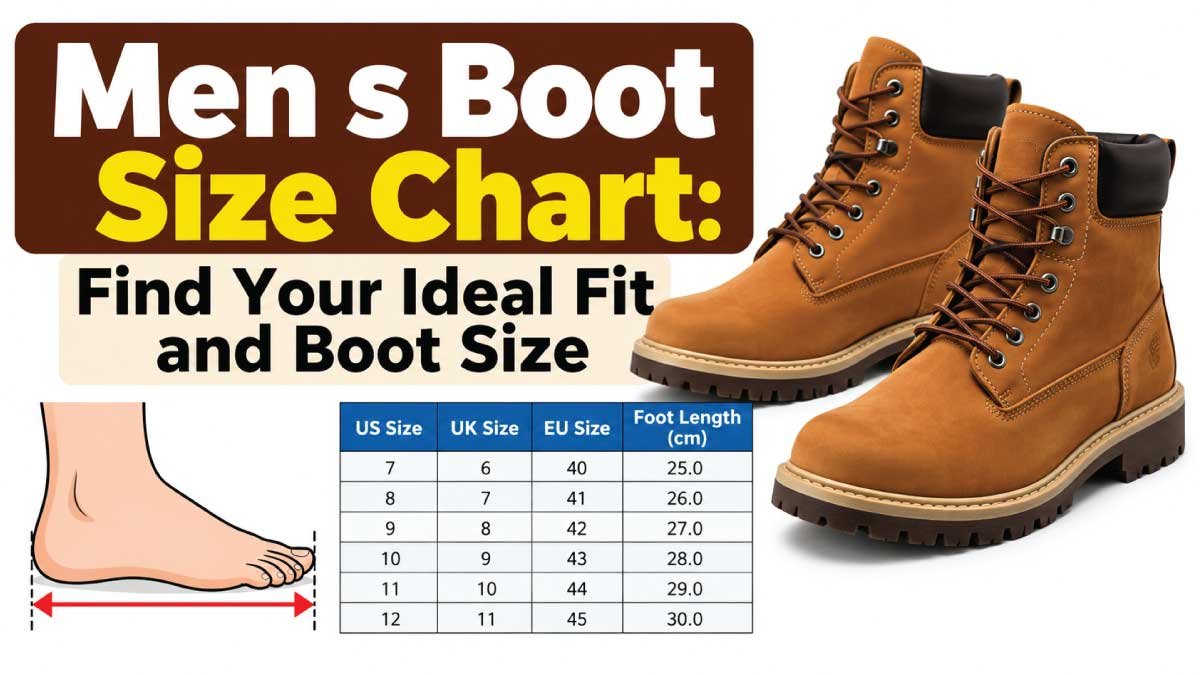
The following chart provides approximate conversions for men’s boot sizing. Use it as a starting point rather than a universal standard, because individual manufacturers may use slightly different measurements.
Men’s US, UK, and EU Boot Size Conversion Chart
| US Men’s Size | UK Men’s Size | EU Size | Approximate Foot Length (Inches) | Approximate Foot Length (CM) |
|---|---|---|---|---|
| 6 | 5 | 39 | 9.25 | 23.5 |
| 6.5 | 5.5 | 39–40 | 9.5 | 24.1 |
| 7 | 6 | 40 | 9.625 | 24.4 |
| 7.5 | 6.5 | 40–41 | 9.75 | 24.8 |
| 8 | 7 | 41 | 9.94 | 25.2 |
| 8.5 | 7.5 | 41–42 | 10.125 | 25.7 |
| 9 | 8 | 42 | 10.25 | 26.0 |
| 9.5 | 8.5 | 42–43 | 10.44 | 26.5 |
| 10 | 9 | 43 | 10.625 | 27.0 |
| 10.5 | 9.5 | 43–44 | 10.75 | 27.3 |
| 11 | 10 | 44 | 10.94 | 27.8 |
| 11.5 | 10.5 | 44–45 | 11.125 | 28.3 |
| 12 | 11 | 45 | 11.25 | 28.6 |
| 13 | 12 | 46 | 11.56 | 29.4 |
| 14 | 13 | 47–48 | 11.875 | 30.2 |
| 15 | 14 | 48–49 | 12.19 | 31.0 |
Important: Foot length measurements are approximate references, not guaranteed internal boot dimensions. Always compare your measurements with the specific brand’s size chart when available.
How to Measure Your Feet for Men’s Boots
Measuring your feet before buying boots can help you avoid common sizing mistakes. It is especially useful when shopping online, switching brands, or choosing boots designed for demanding activities.
What You Need
Gather a sheet of paper larger than your foot, a pencil, a ruler or measuring tape, and the socks you expect to wear with your boots.
Step 1: Place Your Foot on Paper
Put the paper on a hard, flat floor. Stand on it with your heel against a wall or another straight edge. Keep your weight evenly distributed so your foot spreads naturally.
Measure both feet because one may be slightly longer or wider than the other.
Step 2: Mark Your Heel and Longest Toe
Mark the point at the back of your heel and the tip of your longest toe. Your longest toe may be your second toe rather than your big toe.
Measure the distance between these marks in centimeters or inches. This gives you your foot length.
Step 3: Measure Both Feet
Repeat the process for your other foot. If one foot is longer, use the longer measurement when selecting your boot size.
For example, if one foot measures 26.5 cm and the other measures 26.8 cm, use 26.8 cm as your reference measurement.
Step 4: Measure Your Foot Width
Wrap a flexible measuring tape around the widest part of your forefoot, usually across the ball of your foot. Keep the tape comfortably snug without squeezing your skin.
Width measurements are particularly helpful if you have broad feet, bunions, high-volume feet, or difficulty finding comfortable boots.
Step 5: Compare Your Measurements With a Size Chart
Find your measured foot length in the manufacturer’s sizing guide. If your measurement falls between two sizes, check the brand’s recommendations and consider the boot’s design, width, and intended use.
Do not automatically choose a larger size simply because a boot feels stiff. Stiff leather may soften with wear, but a boot that is genuinely too short or too narrow is unlikely to become a good fit.
Men’s Boot Size Chart by Foot Length
Foot length provides a useful starting point when determining your boot size. The chart below shows approximate US men’s boot sizes and corresponding foot lengths.
US Men’s Boot Size by Centimeters and Inches
| US Men’s Size | Foot Length (CM) | Foot Length (Inches) |
|---|---|---|
| 6 | 23.5 | 9.25 |
| 6.5 | 24.1 | 9.5 |
| 7 | 24.4 | 9.625 |
| 7.5 | 24.8 | 9.75 |
| 8 | 25.2 | 9.94 |
| 8.5 | 25.7 | 10.125 |
| 9 | 26.0 | 10.25 |
| 9.5 | 26.5 | 10.44 |
| 10 | 27.0 | 10.625 |
| 10.5 | 27.3 | 10.75 |
| 11 | 27.8 | 10.94 |
| 11.5 | 28.3 | 11.125 |
| 12 | 28.6 | 11.25 |
| 13 | 29.4 | 11.56 |
| 14 | 30.2 | 11.875 |
| 15 | 31.0 | 12.19 |
These measurements are approximate and may not match every brand’s size chart exactly. If your foot length falls between two listed values, check the manufacturer’s guidance before choosing a size.
Men’s Boot Width Size Chart
Boot width is an important part of proper fit. Two men who wear the same boot length may need different widths because their feet have different shapes and volumes.
A boot can be long enough but still feel uncomfortable if it squeezes the forefoot. Conversely, a boot that is too wide may allow excessive movement inside the shoe.
Common Men’s Boot Widths
| Width Label | Common Meaning | Best Suited For |
|---|---|---|
| B | Narrow for men | Relatively slim feet |
| D | Medium or standard | Average-width feet |
| 2E or EE | Wide | Broader feet |
| 3E | Extra wide | Feet requiring additional width |
| 4E | Extra-extra wide | Very broad feet |
Width labels are not completely standardized across all manufacturers. Some brands offer only standard and wide options, while others provide several width choices.
How to Tell if You Need Wide Boots
You may need a wider boot if your feet feel squeezed at the sides, your toes are pressed together, or the upper leaves uncomfortable pressure marks around the ball of your foot.
Other signs include frequent rubbing along the little toe, difficulty wearing your usual socks, or discomfort that continues even when the boot length appears correct.
Do not solve every width problem by buying a longer boot. Increasing length may create heel slippage and reduce stability without providing the right fit across the forefoot.
How Men’s Boot Sizes Differ by Boot Type
Not all boots fit the same way. Construction, materials, toe shape, lining, and intended activity can influence which size feels most comfortable.
Work Boots
Work boots often include reinforced toes, durable uppers, supportive midsoles, and thick outsoles. Safety-toe models may have less flexible space around the toes than casual footwear.
When trying work boots, wear your normal work socks and check that your toes do not touch the protective toe cap. Your heel should remain reasonably secure, and the boot should not pinch the sides of your feet.
If you use custom insoles or orthotics, try the boots with them in place before deciding on a size.
Hiking Boots
Hiking boots should provide enough room for your toes to move, especially when walking downhill. Feet can swell during extended activity, so a boot that feels perfect while sitting may become uncomfortable after several miles.
Try hiking boots with the socks you plan to wear on the trail. Walk on an incline if possible and check whether your toes slide forward or strike the front of the boot.
A secure heel and adequate forefoot room are particularly important for reducing rubbing and blisters.
Cowboy Boots
Cowboy boots often have a distinctive toe shape, raised heel, and slip-on construction. Their fit may feel different from sneakers or lace-up boots.
A properly fitted cowboy boot generally holds the instep securely, while the heel may lift slightly when the boot is new. Excessive heel movement, painful instep pressure, or cramped toes can indicate a poor fit.
Because cowboy boots vary considerably in shape, try the specific style rather than assuming your regular shoe size will always work.
Leather Boots
New leather boots can feel firm before the leather softens and conforms to the foot. However, break-in should not require enduring sharp pain, numbness, or intense pressure.
Choose a size that feels structurally correct from the beginning. Leather may become more flexible with use, but it will not reliably compensate for insufficient length or a severely narrow fit.
Chelsea and Casual Boots
Chelsea boots and other casual slip-on styles need a secure fit around the instep and heel. Without laces, you have fewer ways to adjust the boot after putting it on.
Check that your foot slides in without excessive force and remains secure during walking. If your heel slips significantly or the boot feels loose around the instep, try another size or a different design.
Also Read:
How Much Toe Room Should Men’s Boots Have?
Toe room is one of the most important parts of boot fit. Your toes need enough space to spread naturally and move as you walk.
As a general fitting guideline, many boots work well with approximately 0.5 to 1 inch of space in front of the longest toe. The ideal amount depends on the boot’s shape, intended use, and the wearer’s preference.
For hiking boots, extra room may be useful for downhill walking and foot swelling. For work boots, the protective toe area and manufacturer’s fit guidance also matter.
However, extra space should not cause your foot to slide forward with every step. If your toes have room but your heel moves excessively, you may need a different width, lacing adjustment, or boot shape rather than a longer size.
When checking toe room, stand up and distribute your weight evenly. Sitting can make your feet appear shorter and may give you a misleading impression of fit.
Should You Size Up or Down in Men’s Boots?
Whether to size up or down depends on your foot measurements and how a particular boot fits. There is no universal rule that all men’s boots should be purchased larger or smaller than regular shoes.
When to Consider Sizing Up
Consider trying the next half size or a different width if:
- Your longest toe touches the front of the boot.
- Your toes feel compressed when standing.
- Your feet swell during normal activity.
- Your usual socks make the boot uncomfortably tight.
- The manufacturer’s size chart recommends the next size for your measurement.
Before sizing up, check whether the problem is actually boot width. A wider size in the same length may provide a better fit.
When to Consider Sizing Down
A smaller size may be worth trying if your heel slips excessively, your foot moves forward during walking, or the boot feels too long despite secure lacing.
However, heel movement can also result from a loose instep, an unsuitable heel shape, or insufficient lacing tension. Sizing down too far may create toe pressure, so assess the entire fit rather than focusing on one symptom.
What if You Are Between Sizes?
If your measurement falls between sizes, start with the manufacturer’s recommendation. Consider whether you have narrow or wide feet, wear thick socks, or plan to use the boots for long walks.
Try both sizes whenever possible. The better choice should provide comfortable toe room, secure heel placement, and no painful pressure across the foot.
Also Read:
Common Men’s Boot Sizing Mistakes
Even a useful size chart cannot guarantee a perfect fit if you overlook other factors.
Using Your Sneaker Size Automatically
Sneakers and boots can fit differently because of variations in construction, toe shape, cushioning, and sizing standards. Use your sneaker size as a starting point, not a final answer.
Measuring Only One Foot
Many people have slightly different foot lengths. Measuring only one foot can result in a boot that feels tight on the larger side.
Measure both feet and choose based on the longer one, then assess whether the shorter foot remains secure.
Ignoring Foot Width
A standard-width boot may not suit a broad foot, even when the length is correct. Check width labels and the shape of the toe box before changing the length.
Trying Boots at the Wrong Time
Feet can expand during the day, particularly after standing or walking for several hours. Trying boots later in the day can provide a more realistic assessment of everyday fit.
Choosing Boots That Are Too Tight to Break In
New boots may feel firm, but they should not cause sharp pain, numbness, or intense pressure. Do not rely on the break-in period to fix a fundamentally incorrect size.
Forgetting About Socks
Thick winter or hiking socks can change how boots fit. Always test boots with the type of socks you expect to wear regularly.
Also Read:
How to Check Men’s Boot Fit at Home
After putting on your boots, take a few minutes to evaluate their fit before wearing them for an extended period.
- Check the toe box: Your toes should not press painfully against the front or sides.
- Walk naturally: Take several steps and notice whether your foot moves excessively.
- Assess the heel: A small amount of movement can occur in some new boots, but pronounced slipping may indicate a poor fit.
- Check the instep: The top of your foot should feel supported without uncomfortable pressure.
- Test the width: Your forefoot should not feel squeezed, and the boot should not allow excessive side-to-side movement.
- Try your usual socks: Confirm that the fit remains comfortable with the socks you intend to wear.
- Check both feet: Make sure the larger foot has sufficient room while the smaller foot remains secure.
If you experience numbness, sharp pain, or persistent pressure, reconsider the size, width, or boot design.
Men’s Boot Size Chart: Frequently Asked Questions
What Is the Average Men’s Boot Size?
Men’s boot sizes vary by population, brand, and individual foot shape. In many US retail settings, sizes around 9 to 11 are common, but there is no single average size that applies to every group of men.
The best approach is to measure your feet and compare the results with the sizing chart for the boot you want to purchase.
What Is a US Men’s Size 10 in UK and EU Sizes?
A US men’s size 10 is commonly approximately a UK size 9 and an EU size 43. Exact conversions vary by manufacturer, so check the brand’s chart before ordering.
What Is a US Men’s Size 11 in European Sizes?
A US men’s size 11 commonly corresponds to approximately EU size 44. Some brands may list a slightly different conversion, so use the manufacturer’s chart for the most reliable result.
Should Men’s Boots Be the Same Size as Regular Shoes?
Not necessarily. Some men wear the same size in boots and casual shoes, while others need a different size because of the boot’s construction, width, toe shape, or intended use.
Measure your feet and try boots with your usual socks rather than relying only on your regular shoe size.
Are Work Boots Supposed to Fit Tightly?
Work boots should feel secure but not painfully tight. Your heel should remain reasonably stable, and your toes should have adequate space. Safety-toe boots must also provide appropriate room around the protective toe cap.
How Much Bigger Should Hiking Boots Be?
There is no fixed amount by which hiking boots should be larger than everyday shoes. They should provide enough room for toe movement and foot swelling without allowing your foot to slide excessively.
Check the fit while standing and walking, including on a slope when possible.
Do Men’s Boot Sizes Differ Between Brands?
Yes. Brands can differ in their lasts, toe-box shapes, width standards, and size conversions. A size 10 in one brand may not feel identical to a size 10 in another.
Use brand-specific sizing guidance and evaluate the boot’s actual fit.
How Do I Know if My Boots Are Too Wide?
Your boots may be too wide if your feet slide from side to side, your heel moves excessively, or tightening the laces does not provide a secure fit. Try a narrower width or a different boot shape.
Can I Wear Thick Socks to Make Boots Fit Better?
Thicker socks can improve comfort in boots that have a little extra room, but they are not a reliable solution for boots that are significantly too large. They can also create pressure if the boots are already snug.
Choose a size that fits properly with the socks you plan to wear.
Final Thoughts
Choosing the right men’s boot size involves more than matching a number on a chart. Foot length, width, toe-box shape, sock thickness, and the intended use of the boots all influence comfort and performance.
Use the men’s boot size chart to compare US, UK, and EU sizing systems, then measure both feet and consult the manufacturer’s specific recommendations. Pay attention to toe room, heel stability, and pressure across the forefoot when trying boots.
Whether you are buying work boots, hiking boots, cowboy boots, or everyday leather boots, a well-fitting pair should feel secure without squeezing your feet. Taking a little extra time to check your measurements can help you choose boots that offer better comfort, support, and confidence with every step.
