
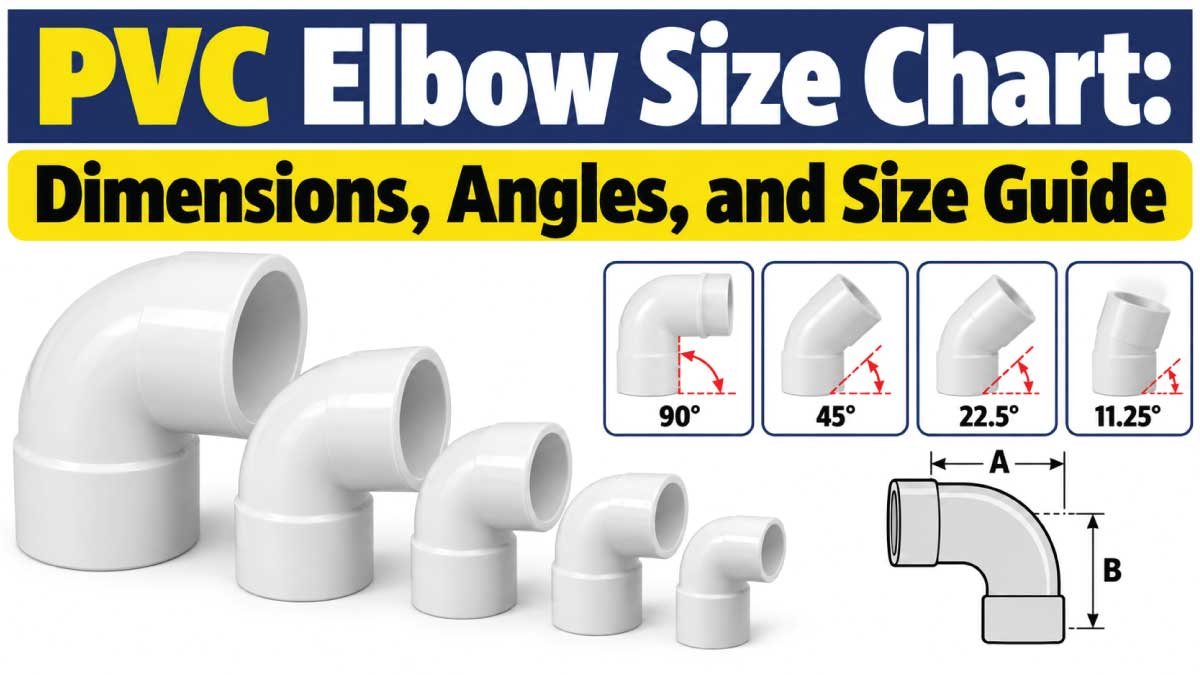
PVC elbows are essential plumbing and piping fittings used to change the direction of a pipeline without creating an unnecessarily sharp bend. They are commonly used in residential plumbing, irrigation systems, drainage networks, swimming pools, and industrial piping applications. Choosing the correct PVC elbow size is important for achieving a secure connection, maintaining proper water flow, and preventing leaks.
However, selecting a PVC elbow involves more than matching the nominal pipe size. You also need to consider the fitting’s angle, outside diameter compatibility, connection type, pressure rating, and intended application. A 90-degree elbow, for example, changes the direction of a pipe sharply, while a 45-degree elbow creates a more gradual turn.
This PVC elbow size chart explains common elbow sizes, dimensions, angles, fitting types, and measurement methods. Whether you are replacing an existing fitting or planning a new plumbing installation, this guide will help you identify the right PVC elbow for your project.
What Is a PVC Elbow?
A PVC elbow is a pipe fitting designed to connect two sections of pipe at an angle. It allows a pipeline to change direction while maintaining a continuous passage for water or other compatible fluids.
PVC stands for polyvinyl chloride, a durable plastic material widely used in plumbing and drainage systems. PVC elbows are lightweight, corrosion-resistant, and generally easy to install when paired with compatible pipes and joining methods.
These fittings are available in several sizes, angles, and connection configurations. Their exact dimensions depend on the manufacturer, pipe standard, fitting schedule, and intended application.
PVC elbows are commonly used in:
- Residential water distribution systems.
- Irrigation and agricultural pipelines.
- Drainage and wastewater systems.
- Swimming pool plumbing.
- Ventilation and plumbing vent lines.
- Industrial fluid-handling installations.
- Rainwater collection and discharge systems.
The correct fitting helps maintain a reliable connection and allows the pipeline to follow the required route around corners, walls, equipment, and other obstacles.
PVC Elbow Size Chart
PVC elbow sizes are usually identified by the nominal pipe size they accommodate. Common sizes range from 1/2 inch to 6 inches or larger, depending on the product category.
The following table provides a general reference for commonly available PVC elbow sizes and their approximate matching pipe outside diameters. Dimensions may differ between North American Schedule PVC systems and metric PVC systems.
| Nominal Pipe Size | Approx. Outside Diameter (Inches) | Approx. Outside Diameter (mm) | Common Applications |
|---|---|---|---|
| 1/2 inch | 0.840 | 21.3 | Small plumbing lines and compact connections |
| 3/4 inch | 1.050 | 26.7 | Residential water and irrigation |
| 1 inch | 1.315 | 33.4 | Plumbing branches and garden systems |
| 1 1/4 inches | 1.660 | 42.2 | Larger water distribution branches |
| 1 1/2 inches | 1.900 | 48.3 | Drainage and medium-flow applications |
| 2 inches | 2.375 | 60.3 | Drainage, irrigation, and pool plumbing |
| 2 1/2 inches | 2.875 | 73.0 | Larger flow systems |
| 3 inches | 3.500 | 88.9 | Drainage and commercial plumbing |
| 4 inches | 4.500 | 114.3 | Building drains and wastewater lines |
| 6 inches | 6.625 | 168.3 | Large drainage and industrial piping |
These outside diameters are representative of common North American nominal pipe sizes. They are not universal measurements for every PVC product.
Important: Nominal pipe size is not necessarily the actual outside diameter. Always verify the applicable pipe standard and fitting specifications before purchasing an elbow. Metric PVC systems may use different nominal designations and outside diameters.
Understanding PVC Elbow Angles
The angle of a PVC elbow determines how sharply the pipeline changes direction. Choosing the appropriate angle can affect installation space, flow characteristics, and the number of fittings needed.
90-Degree PVC Elbow
A 90-degree PVC elbow changes the direction of a pipeline by a right angle. It is one of the most widely used elbow types in residential and commercial plumbing.
Common applications include:
- Turning a pipe around a corner.
- Connecting vertical and horizontal plumbing sections.
- Routing irrigation lines around structures.
- Changing direction in pool circulation systems.
- Connecting drainage pipes where a right-angle turn is permitted.
A standard 90-degree elbow provides a compact turn. However, the internal geometry varies between short-radius, standard, and long-radius designs. Where flow efficiency is important, a sweeping elbow may be preferable to a sharp-turn fitting.
45-Degree PVC Elbow
A 45-degree elbow changes the pipe direction by 45 degrees. It creates a more gradual turn than a 90-degree elbow.
These fittings are commonly used for:
- Redirecting pipes diagonally.
- Creating gradual changes in drainage direction.
- Adjusting pipe routes around obstacles.
- Reducing abrupt changes in flow direction.
- Connecting two pipe sections that do not meet at a right angle.
Two compatible 45-degree elbows can sometimes create a 90-degree change in direction. The resulting arrangement may provide a smoother route, although it requires additional installation space and joints.
22.5-Degree PVC Elbow
A 22.5-degree elbow creates a relatively small directional change. It is useful when a pipeline needs a gradual adjustment rather than a sharp turn.
These elbows are available in certain plumbing and drainage product ranges, but they are less common than 45-degree and 90-degree fittings.
180-Degree PVC Return Bend
A 180-degree return bend reverses the direction of a pipeline. It is sometimes used in equipment connections, circulation arrangements, and specialized plumbing systems.
Availability depends on the manufacturer and fitting category. A return bend may have a larger overall footprint than a standard elbow, so its dimensions should be checked carefully before installation.
PVC Elbow Angle Comparison
| Elbow Angle | Direction Change | Typical Purpose | Space Requirement |
|---|---|---|---|
| 22.5 degrees | Small directional adjustment | Gradual routing changes | Depends on fitting design |
| 45 degrees | Moderate turn | Angled connections and smoother routing | Moderate |
| 90 degrees | Right-angle turn | Corners and vertical-to-horizontal connections | Often compact |
| 180 degrees | Complete reversal | Return connections and specialized layouts | Usually larger |
The angle alone does not determine whether a fitting is suitable for a particular system. Pipe diameter, radius, flow requirements, pressure rating, and installation standards must also be considered.
PVC Elbow Dimensions Explained
PVC elbow dimensions describe the physical measurements needed to determine whether a fitting will fit into a particular pipe layout. These measurements are especially important when replacing an existing elbow or working within a limited installation space.
Nominal Size
Nominal size is the standard size designation used to identify a compatible pipe and fitting system. Examples include 1/2 inch, 3/4 inch, 1 inch, 2 inches, and 4 inches.
The nominal size is useful for selecting fittings, but it should not be treated as the exact physical diameter of every PVC pipe.
Outside Diameter
Outside diameter, or OD, is the measurement across the exterior of a pipe. It is one of the most important measurements when checking compatibility.
For example, a nominal 2-inch PVC pipe in a common North American system has an outside diameter of approximately 2.375 inches. The actual internal diameter varies depending on the pipe wall thickness and product specification.
Inside Diameter
Inside diameter, or ID, measures the open passage through the fitting or pipe. It affects how much room is available for fluid to flow.
The inside diameter of a PVC elbow is influenced by the nominal size, wall thickness, fitting geometry, and manufacturing design. Consequently, two fittings with the same nominal size may not have identical internal dimensions.
Center-to-End Dimension
The center-to-end dimension measures the distance from the fitting’s centerline intersection to the end of one connection. It is commonly used when laying out piping and estimating how much space an elbow occupies.
This dimension varies according to the elbow angle, radius, nominal size, and manufacturer.
Socket Depth
Socket depth is the distance a pipe enters the socket of a socket-type elbow. The pipe must be inserted according to the fitting manufacturer’s instructions to create a suitable joint.
Socket depth should not be confused with the fitting’s total length or center-to-end dimension.
Overall Length
Overall length refers to the total physical extent of a fitting measured between its outermost points. This measurement can be useful when checking clearance around walls, cabinets, equipment, and other pipes.
For angled fittings, overall length is not the same as the center-to-end measurement.
PVC Elbow Size and Approximate Dimensional Reference
The table below summarizes typical pipe sizes and the dimensions that should be checked when selecting a fitting. Because elbow dimensions vary by design and manufacturer, the dimensional columns identify what to verify rather than presenting universal elbow lengths.
| Nominal Size | Approx. Pipe OD | Center-to-End Dimension | Socket Depth | Recommended Check |
|---|---|---|---|---|
| 1/2 inch | 0.840 in | Manufacturer-specific | Manufacturer-specific | Verify pipe standard |
| 3/4 inch | 1.050 in | Manufacturer-specific | Manufacturer-specific | Confirm fitting compatibility |
| 1 inch | 1.315 in | Manufacturer-specific | Manufacturer-specific | Check elbow angle |
| 1 1/4 inches | 1.660 in | Manufacturer-specific | Manufacturer-specific | Measure installation clearance |
| 1 1/2 inches | 1.900 in | Manufacturer-specific | Manufacturer-specific | Verify connection type |
| 2 inches | 2.375 in | Manufacturer-specific | Manufacturer-specific | Check pressure rating |
| 3 inches | 3.500 in | Manufacturer-specific | Manufacturer-specific | Confirm intended application |
| 4 inches | 4.500 in | Manufacturer-specific | Manufacturer-specific | Verify drainage or pressure standard |
The dimensions are intentionally manufacturer-specific because there is no single center-to-end dimension or socket depth that applies to every elbow of a given nominal size. Using an unverified dimension can lead to inaccurate pipe cuts or installation problems.
For precise measurements, consult the dimensional drawing for the exact fitting model you intend to use.
Types of PVC Elbows
PVC elbows are available in several designs. Understanding the differences can help you select a fitting that suits the pipe layout and installation requirements.
Standard PVC Elbow
A standard elbow changes the direction of a pipe at a specified angle, commonly 45 or 90 degrees. It is used in many general plumbing and irrigation installations.
Standard elbows are available in different nominal sizes and joining configurations. Their internal radius and overall dimensions depend on the product design.
Long-Radius PVC Elbow
A long-radius elbow provides a more gradual directional change than a compact elbow of the same angle.
It may be suitable for applications where smoother flow, reduced turbulence, or easier routing is desirable. However, a long-radius design generally requires more installation space.
Short-Radius PVC Elbow
A short-radius elbow provides a tighter turn. It is useful in restricted spaces where a larger sweeping fitting would not fit.
Because the directional change is more abrupt, the fitting may create greater flow resistance than a suitable long-radius alternative. The actual effect depends on the system and fitting design.
Reducing PVC Elbow
A reducing elbow connects pipes of different nominal sizes. For example, it may connect a larger pipe to a smaller pipe while changing the direction of the pipeline.
Reducing elbows can simplify installations where both a size transition and a directional change are required. The size combination must match the piping design.
Threaded PVC Elbow
A threaded elbow uses male or female threads to connect to compatible threaded components. These fittings are useful when a connection needs to be assembled or disassembled without solvent cement.
Thread type, thread size, sealing method, and material compatibility must be checked before installation. Plastic threads should not be overtightened because excessive force can damage the fitting.
Socket PVC Elbow
A socket elbow has one or more openings designed to receive compatible pipe ends. Depending on the product, the joint may be made using a specified solvent-cement system.
The pipe and fitting must be compatible with each other, and the installation procedure should follow the manufacturer’s instructions.
Slip and Adapter Elbows
Some elbows are designed for particular joining arrangements, including slip connections or combinations of socket and threaded ends. These configurations can simplify transitions between different components.
The exact terminology may vary between manufacturers, so check the product description and connection drawing before purchasing.
Also Read:
How to Measure a PVC Elbow
Measuring a PVC elbow correctly helps prevent compatibility problems and unnecessary pipe cutting. Follow these steps when checking an existing fitting or selecting a replacement.
Step 1: Identify the Nominal Pipe Size
Look for printed markings on the pipe or fitting. The marking may identify the nominal size, material, pressure rating, schedule, or applicable standard.
If no markings are visible, measure the outside diameter of a straight section of pipe using a ruler or caliper.
Do not rely only on the elbow’s outside width, because the fitting body is often wider than the pipe it connects to.
Step 2: Check the Pipe Standard
Determine whether the pipe belongs to a North American nominal-size system or a metric PVC system.
This distinction matters because products with similar size labels may have different outside diameters and connection dimensions. A fitting designed for one system may not fit another correctly.
Step 3: Determine the Elbow Angle
Inspect the fitting to identify whether it is a 22.5-degree, 45-degree, 90-degree, or another design.
If the angle is not marked, compare the fitting’s centerlines or use an angle-measuring tool where practical. Remember that the angle between the two connected pipe directions is the relevant measurement.
Step 4: Measure the Center-to-End Distance
Place the elbow on a flat surface and identify the centerline of each connection. Measure from the centerline intersection to the relevant pipe end.
For a precise installation, use the manufacturer’s dimensional drawing because the centerline may not be directly visible on the fitting.
Step 5: Check the Connection Type
Determine whether the elbow uses socket, threaded, or another connection style. Check whether both ends have the same size and connection type.
A fitting with the correct nominal size can still be incompatible if the connection style differs.
Step 6: Verify the Material and Pressure Rating
Check whether the fitting is approved for the system’s intended service. Pressure-rated water piping and non-pressure drainage piping do not necessarily use interchangeable products.
Confirm the permitted operating pressure, temperature, and fluid compatibility before installation.
Also Read:
PVC Elbow Size Chart by Application
Different applications require different fitting designs. The following table provides general guidance for matching common pipe sizes with typical uses. These are examples rather than universal installation specifications.
| Nominal Size | Typical Application | Common Elbow Angles | Selection Consideration |
|---|---|---|---|
| 1/2 inch | Small water lines and equipment connections | 45°, 90° | Confirm pressure rating and connection type |
| 3/4 inch | Residential plumbing and irrigation | 45°, 90° | Match the existing pipe standard |
| 1 inch | Water distribution and garden systems | 45°, 90° | Consider flow and available space |
| 1 1/4 inches | Medium plumbing branches | 45°, 90° | Verify the complete fitting dimensions |
| 1 1/2 inches | Drainage and equipment piping | 45°, 90° | Check drainage-system requirements |
| 2 inches | Pool plumbing and drainage | 45°, 90° | Confirm pressure or drainage classification |
| 3 inches | Larger drainage and vent systems | 45°, 90° | Use a fitting approved for the system |
| 4 inches | Building drains and wastewater lines | 45°, 90° | Check applicable plumbing codes |
The best elbow is not necessarily the smallest or least expensive option. It must meet the installation’s dimensional, performance, and code requirements.
PVC Elbows for Pressure and Drainage Systems
One of the most important distinctions when choosing a PVC elbow is whether it will be used in a pressure system or a drainage system.
Pressure-Rated PVC Elbows
Pressure-rated elbows are designed for use in compatible pressurized piping systems. Their suitability depends on material specifications, pressure class or schedule, operating temperature, and the manufacturer’s rating.
Common uses include approved water distribution, irrigation, and swimming pool circulation systems.
A pressure-rated fitting must be compatible with the pipe and the intended operating conditions. The nominal size alone does not establish its pressure capacity.
Drainage PVC Elbows
Drainage elbows are designed for systems that carry wastewater, rainwater, or other permitted drainage flows. Some drainage systems operate primarily by gravity rather than under sustained internal pressure.
Drainage fittings may have different shapes, wall thicknesses, and dimensional standards from pressure fittings. A drainage elbow should not automatically be substituted for a pressure-rated elbow.
Why the Difference Matters
Using the wrong type of fitting can result in poor joint performance, leakage, or system failure. Always select fittings according to the intended service and local plumbing requirements.
If the application involves drinking water, chemical exposure, elevated temperatures, or specialized industrial service, verify that the complete piping system is approved for those conditions.
Also Read:
PVC Elbow Size Selection: Common Mistakes to Avoid
Even a small fitting-selection error can cause installation delays or unreliable joints. Avoid these common mistakes when purchasing PVC elbows.
Choosing by Nominal Size Alone
Two fittings with similar size labels may belong to different dimensional systems. Check the pipe’s actual outside diameter and the applicable standard before purchasing a replacement.
Ignoring the Elbow Angle
A 45-degree elbow cannot always replace a 90-degree elbow without changing the pipe layout. Select the angle according to the required route and available installation space.
Confusing Outside Diameter with Inside Diameter
The outside diameter identifies the pipe’s external measurement, while the inside diameter determines the open passage. Do not use one measurement in place of the other.
Using the Wrong Connection Type
Socket and threaded fittings require different joining methods. Make sure the connection style matches the pipe and adjacent components.
Overlooking Pressure Requirements
A fitting intended for drainage may not be suitable for a pressurized water line. Verify the product rating rather than assuming all PVC elbows are interchangeable.
Forgetting Installation Clearance
An elbow may fit the pipe but still interfere with nearby walls, fixtures, or equipment. Check the center-to-end dimensions and overall footprint before cutting or joining the pipe.
Ignoring Manufacturer Instructions
Solvent-cement products, threaded joints, and specialized fittings have specific installation requirements. Follow the manufacturer’s procedures to help achieve a reliable connection.
How to Choose the Right PVC Elbow
Choosing a suitable elbow becomes easier when you evaluate the key requirements in order.
Identify the pipe size. Confirm the nominal size and actual outside diameter.
Confirm the pipe standard. Determine whether the system uses the appropriate nominal or metric dimensions.
Select the angle. Choose 45 degrees, 90 degrees, or another available angle according to the required route.
Check the fitting dimensions. Verify center-to-end distance, socket depth, and overall clearance when space is limited.
Choose the connection type. Match socket, threaded, or other connection configurations.
Confirm the intended application. Select a fitting approved for pressure, drainage, irrigation, or the relevant service.
Verify material compatibility. Ensure the fitting, pipe, and joining materials are suitable for the fluid and operating conditions.
Check local requirements. Follow applicable plumbing codes and manufacturer specifications.
For replacement work, comparing the markings and dimensions of the existing fitting can be helpful. However, do not assume an old fitting was installed correctly or meets current requirements.
PVC Elbow Installation Tips
Correct installation helps a PVC elbow provide a dependable connection and maintain the intended pipe alignment.
Prepare the Pipe Ends
Cut the pipe squarely and remove burrs or sharp edges. Clean the joining surfaces according to the instructions for the selected fitting and joining system.
Dry-Fit the Components When Appropriate
Before applying solvent cement or making a permanent connection, check the alignment and available space. Dry-fitting should be performed only as appropriate for the product and installation method.
Use Compatible Joining Materials
Use the cement, primer, sealant, or other joining material specified for the pipe and fitting. Not every PVC product uses the same joining method.
Align the Elbow Correctly
Position the elbow so the connected pipe sections follow the intended route. Confirm the angle and alignment before the joint becomes fixed.
Allow the Joint to Cure
Follow the manufacturer’s instructions for handling, curing, and pressure testing. Cure times can vary according to pipe diameter, temperature, humidity, and product formulation.
Test the Completed System
Where required, inspect and test the system using the applicable procedure. Never exceed the pressure limits specified for the pipe, fittings, and testing method.
For installations involving drinking water, gas-related systems, chemicals, or regulated plumbing work, use only products approved for the specific service and consult a qualified professional when necessary.
Frequently Asked Questions About PVC Elbow Sizes
What are the most common PVC elbow sizes?
Common PVC elbow sizes include 1/2 inch, 3/4 inch, 1 inch, 1 1/4 inches, 1 1/2 inches, 2 inches, 3 inches, and 4 inches. Larger sizes are available for commercial, drainage, and industrial applications. Availability depends on the manufacturer and fitting standard.
What is the most common PVC elbow angle?
The 90-degree elbow is widely used for right-angle turns, while the 45-degree elbow is common for more gradual changes in direction. Other angles, such as 22.5 degrees, are available in certain product ranges.
How do I know what size PVC elbow I need?
Identify the pipe’s nominal size, measure its outside diameter if necessary, and verify the pipe standard. Then match the elbow’s size, connection type, angle, and service rating to the existing system.
Is a 2-inch PVC elbow exactly 2 inches wide?
Not necessarily. In a common North American nominal pipe-size system, 2-inch PVC pipe has an outside diameter of approximately 2.375 inches. The fitting’s outside dimensions and internal opening are different measurements.
Can I use a 90-degree elbow instead of two 45-degree elbows?
Sometimes, but the two arrangements are not always equivalent for flow or installation requirements. Two 45-degree elbows can create a more gradual route, while a single 90-degree elbow takes a more compact path. Follow the design requirements and applicable plumbing codes.
Are all PVC elbows suitable for pressurized water?
No. Some PVC elbows are designed for pressure systems, while others are intended for drainage or non-pressure applications. Check the fitting’s approved use and pressure rating before installation.
What is the difference between a PVC elbow and a PVC bend?
The terms can overlap, but an elbow commonly describes a fitting with a defined directional angle, such as 45 or 90 degrees. A bend may refer to a more gradual curved section or a product with a larger radius. Manufacturer terminology varies.
Do PVC elbows reduce water flow?
An elbow can introduce resistance because the fluid changes direction. The effect depends on the angle, internal radius, fitting size, flow rate, and system design. A suitable long-radius fitting may reduce resistance compared with a tighter turn in some applications.
How do I measure a PVC elbow’s center-to-end dimension?
Identify the centerline of the fitting’s connected pipe sections and measure from the centerline intersection to the end of the relevant connection. For accurate installation planning, use the manufacturer’s dimensional drawing.
Can PVC elbows connect pipes of different sizes?
A reducing elbow can connect pipes of different nominal sizes when the fitting is designed for that combination. Verify the dimensions and intended application before selecting one.
Conclusion
A PVC elbow size chart is a useful starting point for choosing the correct fitting, but successful selection requires more than matching nominal pipe sizes. You should also consider outside diameter, elbow angle, center-to-end dimensions, socket depth, connection type, pressure rating, and intended application.
A 90-degree elbow is suitable for many compact directional changes, while a 45-degree elbow can provide a more gradual route. Reducing, threaded, socket, and long-radius elbows serve different installation needs, so the right option depends on the piping layout and system requirements.
Before purchasing or installing a PVC elbow, verify the exact product specifications and confirm compatibility with the existing pipe. Taking these steps helps prevent sizing errors, reduces installation problems, and supports a durable, dependable piping system.
