
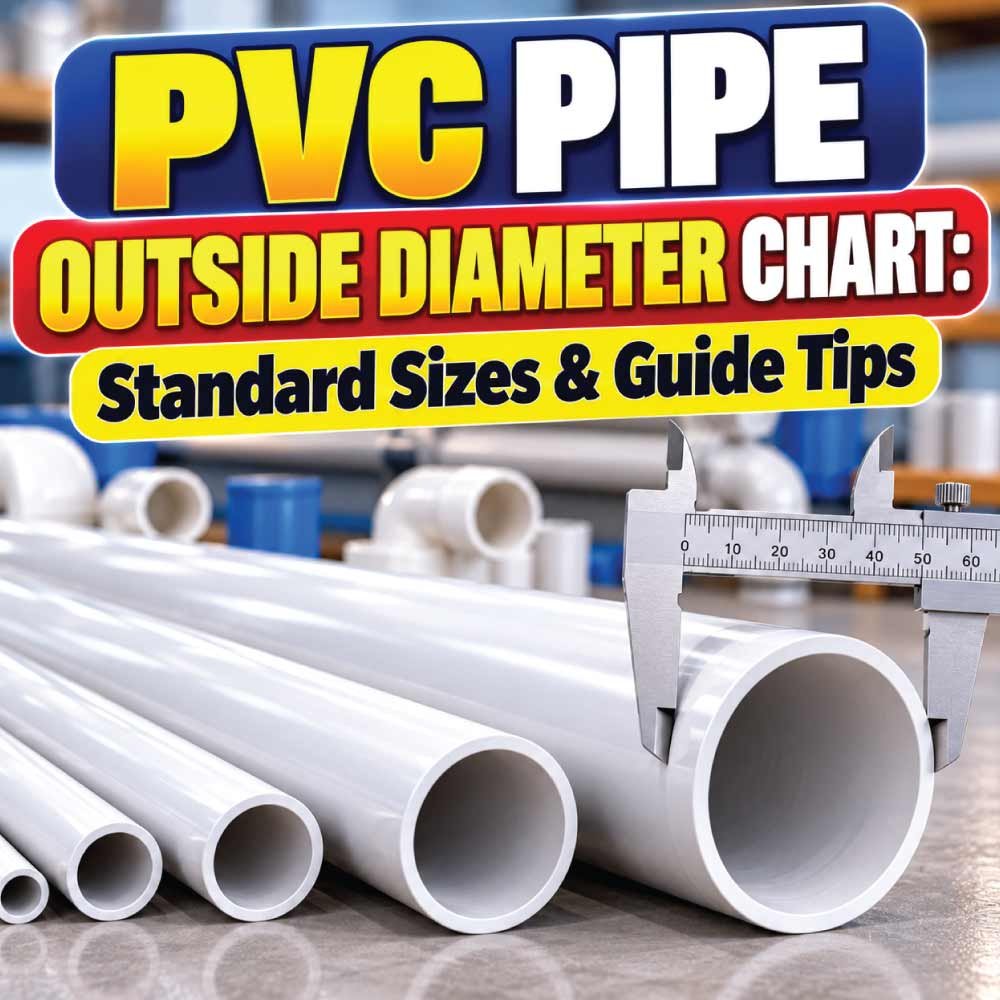
If you are trying to identify a PVC pipe, select the right fitting, or determine whether two pipes will connect, the outside diameter (OD) is one of the most useful measurements to know. However, PVC pipe sizing can be confusing because the size printed on a pipe does not always equal its actual outside diameter.
A pipe labeled 1 inch PVC, for example, does not necessarily measure exactly 1 inch across the outside. PVC pipe is generally identified by a nominal pipe size (NPS), while its actual outside diameter is standardized separately. Wall thickness can then vary according to the pipe’s schedule, pressure class, or product standard.
This PVC pipe outside diameter chart explains common nominal PVC sizes, their approximate actual outside diameters, how pipe schedules affect inside diameter, how to measure PVC correctly, and how to select compatible fittings. It also covers common sizing mistakes so you can make a more confident choice for plumbing, irrigation, drainage, and other projects.
What Is PVC Pipe Outside Diameter?
The outside diameter of PVC pipe is the distance measured straight across the outside of the pipe, passing through its center. It is commonly abbreviated as OD.
This measurement is different from:
- Inside diameter (ID): The open internal diameter of the pipe.
- Nominal pipe size (NPS): The standardized size designation used to identify the pipe.
- Wall thickness: The thickness of the PVC material between the inside and outside surfaces.
The outside diameter is particularly important when selecting fittings because fittings are designed around standardized pipe dimensions. A coupling, elbow, tee, valve, or adapter intended for a particular nominal PVC size is manufactured to fit the corresponding pipe dimensions.
For example, a common 2-inch Schedule 40 PVC pipe has an actual outside diameter of approximately 2.375 inches, rather than exactly 2 inches.
That difference is normal and is one of the most important things to understand when working with PVC.
PVC Pipe Outside Diameter Chart
The following chart shows commonly encountered PVC nominal sizes and their standard outside diameters. Dimensions are presented in inches and millimeters for easier comparison.
| Nominal PVC Size | Outside Diameter (in.) | Outside Diameter (mm) |
|---|---|---|
| 1/2 in. | 0.840 in. | 21.3 mm |
| 3/4 in. | 1.050 in. | 26.7 mm |
| 1 in. | 1.315 in. | 33.4 mm |
| 1-1/4 in. | 1.660 in. | 42.2 mm |
| 1-1/2 in. | 1.900 in. | 48.3 mm |
| 2 in. | 2.375 in. | 60.3 mm |
| 2-1/2 in. | 2.875 in. | 73.0 mm |
| 3 in. | 3.500 in. | 88.9 mm |
| 4 in. | 4.500 in. | 114.3 mm |
| 5 in. | 5.563 in. | 141.3 mm |
| 6 in. | 6.625 in. | 168.3 mm |
| 8 in. | 8.625 in. | 219.1 mm |
| 10 in. | 10.750 in. | 273.1 mm |
| 12 in. | 12.750 in. | 323.9 mm |
These are common standardized dimensions associated with NPS pipe sizing. Product standards and manufacturers should always be checked for the specific pipe you are using, particularly for larger pipe, pressure-rated products, metric products, or specialized PVC systems.
The key point is simple: nominal size and actual outside diameter are not always the same number.
PVC Nominal Size vs. Actual Outside Diameter
One of the most common PVC sizing mistakes is assuming that the number printed on the pipe represents its measured outside diameter.
It usually does not.
What Does Nominal Size Mean?
A nominal size is a standardized designation used to identify a pipe size. It provides a convenient way for manufacturers, plumbers, contractors, and suppliers to specify compatible pipe and fittings.
For many common PVC systems, the outside diameter remains standardized for a given nominal size even when the wall thickness changes.
For example:
| Nominal Size | Approx. Actual OD | Common Example |
|---|---|---|
| 1 in. | 1.315 in. | Water lines |
| 1-1/2 in. | 1.900 in. | Plumbing and irrigation |
| 2 in. | 2.375 in. | Water, irrigation, drainage |
| 3 in. | 3.500 in. | Drainage and larger plumbing |
| 4 in. | 4.500 in. | Drainage and sewer applications |
| 6 in. | 6.625 in. | Larger water and utility systems |
This is why measuring a 2-inch PVC pipe and getting approximately 2.375 inches does not mean the pipe is mislabeled.
It means 2 inches is the nominal size.
How PVC Pipe Schedule Affects Diameter
Pipe schedule is another important concept when comparing PVC dimensions.
Common schedules include Schedule 40 and Schedule 80. Schedule describes wall thickness rather than simply identifying the pipe’s nominal size.
For many standard PVC pipe systems, Schedule 80 has a thicker wall than Schedule 40.
That creates an important relationship:
Same nominal size + thicker wall = smaller inside diameter, while the outside diameter generally remains standardized.
Schedule 40 vs. Schedule 80
Consider a common 2-inch PVC pipe:
| Specification | 2 in. Schedule 40 | 2 in. Schedule 80 |
|---|---|---|
| Nominal size | 2 in. | 2 in. |
| Outside diameter | 2.375 in. | 2.375 in. |
| Wall thickness | Thinner | Thicker |
| Inside diameter | Larger | Smaller |
| Typical purpose | General-purpose applications | Higher-pressure or more demanding applications |
The exact wall dimensions and pressure ratings depend on the applicable pipe standard and material classification.
The important takeaway is that changing the schedule does not necessarily mean changing the nominal outside diameter.
This is one reason you should not identify PVC solely by measuring the opening or by estimating wall thickness.
PVC Pipe Inside Diameter vs. Outside Diameter
The inside diameter is just as important as outside diameter for applications involving water flow, air movement, drainage, or other fluids.
The basic relationship is:
Inside Diameter = Outside Diameter − (2 × Wall Thickness)
For example, if a pipe has an outside diameter of 2.375 inches and a wall thickness of 0.154 inches, its theoretical inside diameter is:
2.375 − (2 × 0.154) = 2.067 inches
This demonstrates why two pipes can have the same outside diameter but different inside diameters.
The inside diameter affects:
- Fluid flow capacity
- Pressure loss
- Velocity
- Drainage performance
- Available internal space
- Compatibility with certain internal components
For fitting selection, however, the nominal pipe size and fitting system are usually more useful than calculating the ID yourself.
Common PVC Pipe Sizes and Their Uses
PVC is available in many sizes, and the best size depends on the application.
1/2-Inch PVC
A 1/2-inch nominal PVC pipe has an outside diameter of approximately 0.840 inches.
It is often encountered in smaller plumbing, irrigation, water distribution, and specialty applications.
3/4-Inch PVC
With an outside diameter of approximately 1.050 inches, 3/4-inch PVC is another common small pipe size.
It may be used where a little more flow capacity is needed than a 1/2-inch line provides.
1-Inch PVC
A 1-inch nominal pipe measures approximately 1.315 inches outside diameter.
It is frequently used for irrigation, water distribution, and general-purpose piping systems.
1-1/2-Inch PVC
The actual outside diameter is approximately 1.900 inches.
This size is common in plumbing, drainage, irrigation, and equipment connections.
2-Inch PVC
A 2-inch nominal pipe has an outside diameter of approximately 2.375 inches.
It is one of the most frequently encountered PVC sizes and is used for applications ranging from water systems to irrigation and drainage.
3-Inch and 4-Inch PVC
These larger sizes are particularly common in drainage and waste applications.
- 3-inch PVC OD: approximately 3.500 inches
- 4-inch PVC OD: approximately 4.500 inches
Four-inch PVC is especially common for larger drain, waste, sewer, and related applications.
6-Inch and Larger PVC
Six-inch PVC has an outside diameter of approximately 6.625 inches. Larger sizes such as 8, 10, and 12 inches are also available for utility, water, drainage, and infrastructure applications.
For these larger systems, always verify the pipe’s exact standard and fitting requirements before ordering components.
How to Measure PVC Pipe Outside Diameter
If you already have a piece of PVC pipe but do not know its nominal size, measuring the outside diameter can help identify it.
Step 1: Clean the Pipe
Remove dirt, buildup, paint, or other material that could interfere with your measurement.
A clean, exposed pipe surface provides a more reliable result.
Step 2: Use a Caliper if Available
A digital or vernier caliper is one of the easiest tools for measuring outside diameter.
Place the caliper jaws around the outside of the pipe without squeezing the material excessively.
Record the measurement.
Step 3: Use a Tape Measure or Ruler
For larger pipe, you can measure across the widest point with a ruler or tape measure.
Try to measure:
- Straight across the center
- Perpendicular to the pipe wall
- Away from damaged or deformed sections
A flexible tape can also be used to measure circumference.
Step 4: Calculate OD From Circumference
If you cannot measure directly across the pipe, measure its circumference.
The relationship is:
Outside Diameter = Circumference ÷ π
Using approximately 3.1416 for π gives a useful estimate.
For example, if the circumference is approximately 7.46 inches:
7.46 ÷ 3.1416 ≈ 2.37 inches
That result suggests a nominal size close to 2-inch PVC, whose standard OD is approximately 2.375 inches.
Step 5: Compare Your Measurement With a Chart
Once you have the measured OD, compare it with a standard PVC outside diameter chart.
Do not expect every field measurement to be perfect. Small differences can result from:
- Measurement technique
- Caliper accuracy
- Pipe temperature
- Surface damage
- Manufacturing tolerances
- Dirt or coatings
- Pipe deformation
If the application is critical, confirm the manufacturer’s markings or documentation.
How to Identify PVC Size Without Markings
Sometimes old PVC pipe has faded markings or has been cut into a short piece without its original label.
You can still make a reasonable identification by combining several observations.
Use the Outside Diameter
Measure the OD as accurately as possible and compare it against a standardized chart.
For example, an outside diameter close to:
- 1.315 inches suggests 1-inch nominal PVC
- 1.900 inches suggests 1-1/2-inch nominal PVC
- 2.375 inches suggests 2-inch nominal PVC
- 3.500 inches suggests 3-inch nominal PVC
- 4.500 inches suggests 4-inch nominal PVC
Check the Wall Thickness
If the pipe’s schedule is unknown, measuring the wall can provide additional information.
However, wall thickness should be treated as a secondary identification method because PVC products can be manufactured under different standards and specifications.
Look for Printed Markings
If possible, inspect the length of pipe for manufacturer markings.
PVC pipe markings may identify information such as:
- Nominal size
- Schedule
- Pressure rating
- Material designation
- Applicable standard
- Manufacturer
- Certification information
The printed marking is generally more reliable than guessing from color or appearance.
Also Read:
PVC Pipe OD Chart in Millimeters
Many metric tools and international products use millimeters, so it can be useful to have a quick conversion reference.
| Nominal Size | OD in Inches | OD in Millimeters |
|---|---|---|
| 1/2 in. | 0.840 | 21.3 |
| 3/4 in. | 1.050 | 26.7 |
| 1 in. | 1.315 | 33.4 |
| 1-1/4 in. | 1.660 | 42.2 |
| 1-1/2 in. | 1.900 | 48.3 |
| 2 in. | 2.375 | 60.3 |
| 2-1/2 in. | 2.875 | 73.0 |
| 3 in. | 3.500 | 88.9 |
| 4 in. | 4.500 | 114.3 |
| 5 in. | 5.563 | 141.3 |
| 6 in. | 6.625 | 168.3 |
| 8 in. | 8.625 | 219.1 |
| 10 in. | 10.750 | 273.1 |
| 12 in. | 12.750 | 323.9 |
These millimeter values are conversions of the listed inch dimensions. They should not be interpreted as proof that an inch-sized PVC system is interchangeable with a metric PVC system.
PVC Pipe OD vs. Fitting Size
When buying PVC fittings, one of the most important rules is:
Match the fitting to the pipe’s nominal size and compatible standard.
Do not simply buy a fitting based on a ruler measurement that appears to match the fitting’s labeled size.
For example, a fitting labeled 2-inch PVC is intended for the standardized dimensions associated with 2-inch nominal PVC pipe. The pipe’s actual OD is approximately 2.375 inches.
Common fittings include:
- Couplings
- Elbows
- Tees
- Cross fittings
- Reducers
- Adapters
- Bushings
- Unions
- Caps
- Plugs
- Valves
The connection type also matters. A fitting may be designed for solvent-weld socket connections, threaded connections, flanged connections, or another joining method.
Why a Slightly Larger Fitting Isn’t Automatically Compatible
PVC fittings are engineered to create a specific connection.
For solvent-weld systems, the pipe and socket dimensions are designed to work together. Simply finding a fitting whose opening appears close to the pipe’s outside diameter does not guarantee a proper connection.
Compatibility depends on:
- Nominal size
- Pipe standard
- Fitting standard
- Material
- Connection type
- Pressure requirements
- Manufacturer specifications
Also Read:
PVC Pipe Size vs. CPVC and Other Pipe Materials
PVC is not the only plastic piping material.
You may also encounter CPVC, polyethylene, ABS, PEX, and other piping products. Their sizing systems and connection methods can differ.
PVC vs. CPVC
PVC and CPVC may have similar nominal sizing conventions in some applications, but they are not automatically interchangeable in every system.
CPVC is specifically formulated for applications requiring properties different from standard PVC, including certain hot-water applications.
Always confirm that the pipe, fitting, cement, and joining system are intended to work together.
PVC vs. Metric Pipe
Metric PVC systems may use dimensions expressed directly in millimeters.
A metric pipe that appears visually similar to an inch-sized pipe should not be assumed to fit an inch-sized fitting.
Metric and NPS systems should be treated as separate sizing systems unless the manufacturer explicitly provides compatible transition components.
How to Choose the Correct PVC Pipe Size
Choosing PVC involves more than measuring the outside diameter.
Consider the complete requirements of the system.
1. Determine the Application
First identify whether the pipe is being used for:
- Potable water
- Irrigation
- Drainage
- Wastewater
- Sewer service
- Industrial fluids
- Electrical conduit
- Other applications
Different applications may require different PVC products.
2. Determine Required Flow
For fluid systems, the required flow rate helps determine the appropriate pipe size.
A larger pipe generally provides more internal flow area, but the final selection also depends on system design, pressure, distance, fittings, elevation, and other factors.
3. Check Pressure Requirements
Pressure-rated PVC systems should be selected according to the required operating conditions.
Do not assume that all PVC pipe has the same pressure capacity.
The pipe’s material, dimensions, temperature, standard, and pressure classification all matter.
4. Match the Fittings
Once the pipe specification is established, select compatible fittings, valves, adapters, and joining materials.
This prevents one of the most common installation problems: purchasing components that have similar-looking dimensions but belong to different sizing systems.
5. Verify the Manufacturer’s Documentation
For important installations, the manufacturer’s technical data should take priority over a general chart.
This is especially important for:
- Large-diameter pipe
- Industrial piping
- Pressure applications
- Specialty PVC
- Metric systems
- Nonstandard products
- Critical installations
Also Read:
Common PVC Pipe Sizing Mistakes
Understanding the most common errors can save time and prevent unnecessary purchases.
Mistake 1: Assuming Nominal Size Equals OD
A 2-inch PVC pipe does not normally have a 2-inch outside diameter.
Its standardized OD is approximately 2.375 inches.
Mistake 2: Measuring Only the Inside
If you measure the opening of an unknown pipe, you are measuring its approximate ID, not its OD.
Wall thickness can make ID significantly different from the nominal size.
Mistake 3: Ignoring Pipe Schedule
Schedule 40 and Schedule 80 may share the same nominal size and outside diameter while having different wall thicknesses and inside diameters.
Mistake 4: Mixing Metric and Inch Systems
A similar-looking metric pipe is not automatically compatible with an inch-sized fitting.
Mistake 5: Choosing Fittings by Appearance
Two fittings can look nearly identical while being designed for different pipe standards or connection systems.
Always check the label and technical specification.
Mistake 6: Assuming All PVC Is Pressure Rated
Some PVC products are intended for drainage, waste, vent, conduit, or other purposes rather than pressurized fluid service.
The pipe’s intended application matters.
Tips for Accurate PVC Pipe Measurement
For the most reliable result, use a consistent measurement process.
- Measure at several points if the pipe appears damaged or distorted.
- Use a caliper when precision is important.
- Keep the measuring tool perpendicular to the pipe.
- Avoid measuring over dirt, adhesive, paint, or heavy deposits.
- Check for manufacturer markings before relying on physical measurements.
- Record measurements in either inches or millimeters and label the unit.
- Compare the measurement with a recognized dimensional chart.
- Verify the pipe standard and fitting standard before making a permanent connection.
- For pressure systems, confirm the product’s rating and application requirements.
For an existing installation, taking a clear measurement of the pipe and checking its markings together is generally much more reliable than relying on either method alone.
Frequently Asked Questions About PVC Pipe Outside Diameter
Is the outside diameter of PVC pipe the same as its nominal size?
No. Nominal size is a standardized identification number, while outside diameter is the actual standardized external dimension. For example, 2-inch nominal PVC commonly has an outside diameter of approximately 2.375 inches.
What is the OD of 1-inch PVC pipe?
The standard outside diameter of common 1-inch nominal PVC pipe is approximately 1.315 inches, or about 33.4 mm. Always verify the pipe standard when working with specialty or metric products.
What is the outside diameter of 2-inch PVC pipe?
Common 2-inch nominal PVC pipe has an outside diameter of approximately 2.375 inches, which is about 60.3 mm. The inside diameter can vary because wall thickness differs by schedule or product specification.
Does Schedule 80 PVC have a different outside diameter?
For common standard PVC pipe dimensions, Schedule 40 and Schedule 80 of the same nominal size generally have the same outside diameter. Schedule 80 has a thicker wall, resulting in a smaller inside diameter.
How do I measure PVC pipe size?
Measure the outside diameter directly with a caliper when possible. Compare your measurement with a standard OD chart, then check the pipe markings to confirm its nominal size and specification.
Can I use the outside diameter to identify PVC pipe?
Yes, OD is a useful identification method when the pipe marking is unavailable. However, use the measurement together with pipe markings, wall thickness, application, and manufacturer information whenever possible.
What is the OD of 4-inch PVC pipe?
Common 4-inch nominal PVC pipe has an outside diameter of approximately 4.500 inches, or 114.3 mm. The actual inside diameter depends on wall thickness and the pipe’s specific specification.
Why is my PVC pipe measurement slightly different from the chart?
Small differences can result from manufacturing tolerances, measurement accuracy, temperature, surface damage, coatings, or pipe deformation. For important work, verify the product specification rather than relying on a field measurement alone.
Key Takeaways From the PVC Pipe OD Chart
The most important point is that PVC nominal size is not necessarily the same as the pipe’s actual outside diameter.
For common PVC sizes:
- 1/2-inch nominal PVC has an OD of about 0.840 inches
- 1-inch nominal PVC has an OD of about 1.315 inches
- 1-1/2-inch nominal PVC has an OD of about 1.900 inches
- 2-inch nominal PVC has an OD of about 2.375 inches
- 3-inch nominal PVC has an OD of about 3.500 inches
- 4-inch nominal PVC has an OD of about 4.500 inches
- 6-inch nominal PVC has an OD of about 6.625 inches
- 8-inch nominal PVC has an OD of about 8.625 inches
When identifying an unknown pipe, measure the outside diameter, check any printed markings, determine the applicable pipe standard, and then select fittings designed for that exact system.
For routine projects, a PVC pipe outside diameter chart is an excellent quick reference. For pressure-sensitive, industrial, specialty, or critical installations, however, the manufacturer’s dimensional data and applicable standard should always be the final reference.
Conclusion
Understanding PVC pipe outside diameter makes pipe identification, fitting selection, repairs, and new installations much easier. The most important distinction to remember is that nominal pipe size is a designation, while outside diameter is an actual standardized dimension.
Use the chart to compare common sizes, measure unknown pipe carefully, and remember that schedule affects wall thickness and inside diameter. Before connecting components, confirm that the pipe and fittings use the same sizing system and compatible specifications.
With the correct PVC pipe OD, nominal size, schedule, and fitting standard, you can avoid common sizing errors and choose components with much greater confidence.
