
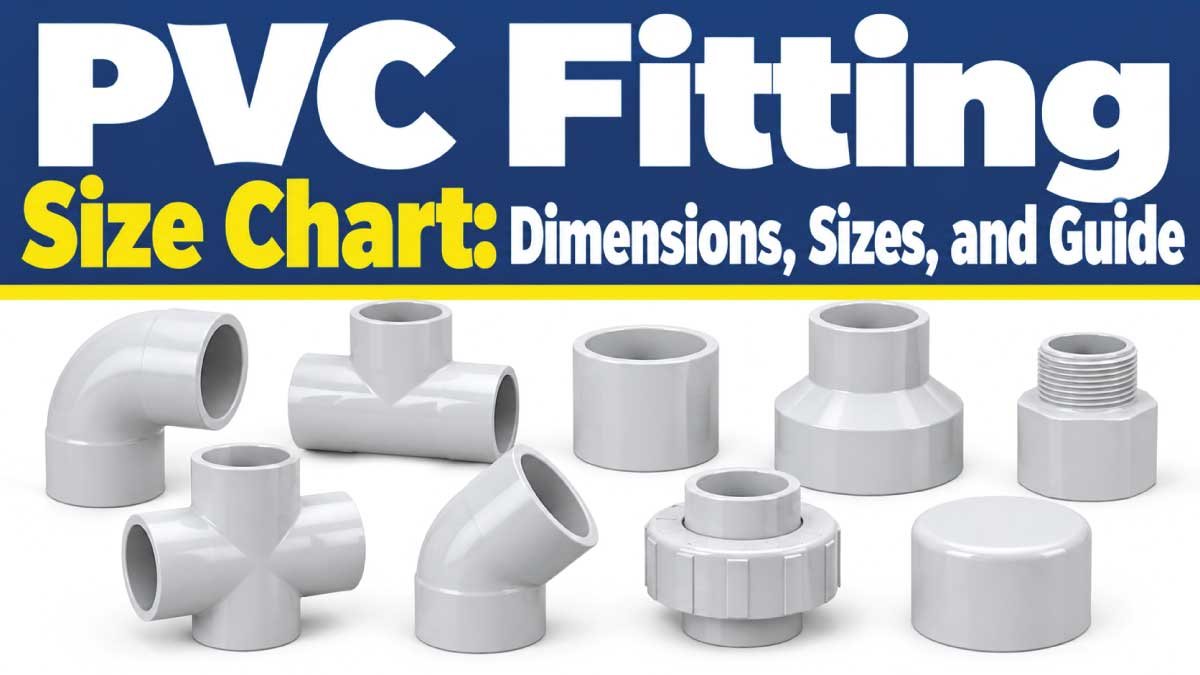
Choosing the correct PVC fitting size is essential for creating secure, leak-resistant plumbing, drainage, irrigation, and water supply systems. Whether you are connecting two pipes, changing direction, splitting a flow, or reducing a pipe diameter, the fitting must match the pipe’s size, dimensional standard, and intended application.
A PVC fitting size chart makes it easier to compare nominal pipe sizes, outside diameters, fitting types, and common connection options. However, PVC fittings are not sized by nominal measurements alone. A fitting marked 1 inch, for example, is designed to connect with compatible nominal 1-inch PVC pipe, even though the pipe’s actual outside diameter is larger than 1 inch.
This guide explains common PVC fitting sizes, standard pipe dimensions, fitting types, measurement methods, and practical selection tips. It also covers important differences between pressure-rated PVC fittings and drainage fittings so you can choose compatible components for your project.
PVC Fitting Size Chart: Common Sizes and Dimensions
PVC fittings are commonly identified by the nominal size of the pipe they connect to. For many North American PVC systems, these sizes follow the nominal pipe size (NPS) system and are associated with specific pipe outside diameters.
The following chart lists common nominal sizes and their corresponding outside diameters for IPS (Iron Pipe Size) PVC pipe. These dimensions are useful when identifying compatible fittings for applicable Schedule 40 and Schedule 80 systems.
| Nominal PVC Size (inches) | Pipe Outside Diameter (inches) | Pipe Outside Diameter (mm) | Common Applications |
|---|---|---|---|
| 1/2 | 0.840 | 21.34 | Small water lines and equipment connections |
| 3/4 | 1.050 | 26.67 | Irrigation and residential plumbing |
| 1 | 1.315 | 33.40 | Water distribution and general plumbing |
| 1-1/4 | 1.660 | 42.16 | Branch lines and larger connections |
| 1-1/2 | 1.900 | 48.26 | Drainage and water distribution |
| 2 | 2.375 | 60.33 | Irrigation and larger plumbing lines |
| 2-1/2 | 2.875 | 73.03 | Larger distribution systems |
| 3 | 3.500 | 88.90 | Drainage and commercial piping |
| 4 | 4.500 | 114.30 | Building drainage and sewer applications |
| 6 | 6.625 | 168.28 | Larger drainage and distribution systems |
| 8 | 8.625 | 219.08 | Large-scale piping systems |
| 10 | 10.750 | 273.05 | Industrial and infrastructure applications |
| 12 | 12.750 | 323.85 | Large-diameter piping systems |
These are pipe outside diameters, not fitting socket inside diameters. The chart does not mean every listed size is available in every fitting style or pressure class.
Important: Nominal pipe size is a designation, not a direct measurement of the pipe’s outside diameter. Always confirm the applicable pipe and fitting standard before purchasing components.
Understanding PVC Fitting Dimensions
PVC fitting dimensions describe the physical measurements that determine how a fitting connects to a pipe and fits within an installation. The most relevant dimensions depend on the type of fitting and the connection method.
Nominal Size
Nominal size identifies the intended pipe size for which the fitting is designed. For example, a nominal 2-inch PVC elbow is intended for compatible nominal 2-inch piping.
The nominal size does not necessarily match the actual outside diameter, inside diameter, or opening measured across the fitting.
Outside Diameter
Outside diameter (OD) is the measurement across the exterior of the pipe. It is especially important when selecting fittings that use socket connections because the socket must accommodate the specified pipe dimensions and tolerances.
For example, nominal 2-inch IPS PVC pipe has an outside diameter of 2.375 inches, or approximately 60.33 mm.
Inside Diameter
Inside diameter (ID) measures the open space inside a pipe or fitting. It varies according to wall thickness and fitting design.
Two pipes with the same nominal size can have different inside diameters if they have different schedules or wall thicknesses. Fitting geometry can also affect the internal flow path.
Socket Depth and Fitting Length
Socket depth is the distance a pipe enters a socket-style fitting. Overall fitting length is the complete outside dimension of the fitting.
These measurements matter when planning tight installations, cutting replacement pipe, and calculating how much space an elbow, tee, coupling, or adapter will occupy.
Thread Size
Some PVC fittings have threaded connections instead of solvent-weld sockets. Their nominal thread size identifies the compatible thread system, but it does not necessarily equal the actual measured diameter of the threads.
Always confirm whether the fitting uses the appropriate tapered or straight thread specification and whether the connecting component is compatible.
PVC Fitting Types and Their Sizes
Different PVC fittings perform different functions. Although many are available in common nominal pipe sizes, their shapes, dimensions, and connection options vary.
PVC Elbows
An elbow changes the direction of a pipeline. Common configurations include 45-degree and 90-degree elbows.
Elbows are used in water supply lines, irrigation networks, drainage systems, and other PVC installations. Their center-to-end dimensions and overall lengths vary by nominal size, angle, and manufacturer.
Choose an elbow that matches the pipe size, pressure requirements, and intended application.
PVC Tees
A tee creates a branch connection, usually at 90 degrees to the main pipeline. Standard tees have three openings, while reducing tees connect different nominal pipe sizes.
For example, a reducing tee may connect a 2-inch main line to a smaller branch. The exact configuration should be confirmed from the fitting’s size designation and manufacturer specifications.
PVC Couplings
A coupling joins two compatible pipe ends in a straight line. Standard couplings connect the same nominal size, while reducing couplings connect different sizes.
Couplings are useful for extending pipelines, repairing damaged sections, and connecting pipe lengths during installation.
PVC Reducers
A reducer changes the nominal size of a pipeline. Depending on the design, it may be concentric, eccentric, socket-style, or threaded.
A reducer is selected according to its larger and smaller connection sizes. Its overall length and internal profile depend on the fitting design.
PVC Unions
A union allows a pipe connection to be disconnected for maintenance without cutting the pipe. It typically has two connection ends and a removable central joining mechanism.
Union dimensions can be larger than those of an ordinary coupling of the same nominal pipe size. Allow enough clearance for installation and future removal.
PVC Adapters
Adapters connect different connection types, such as a solvent-weld socket to a threaded connection.
Common examples include male adapters and female adapters. Check both ends carefully because the pipe size and thread size may be specified separately.
Also Read:
PVC Schedule 40 vs. Schedule 80 Fitting Sizes
Schedule 40 and Schedule 80 describe pipe wall-thickness series. For standard IPS PVC pipe, the nominal size and outside diameter remain the same between these schedules, while the wall thickness and inside diameter differ.
Compatible fittings must still be selected according to the applicable dimensional and pressure requirements.
| Feature | Schedule 40 PVC | Schedule 80 PVC |
|---|---|---|
| Nominal pipe size | Standard nominal sizes | Standard nominal sizes |
| Outside diameter | Same as corresponding IPS Schedule 80 size | Same as corresponding IPS Schedule 40 size |
| Wall thickness | Generally thinner | Generally thicker |
| Inside diameter | Generally larger for the same nominal size | Generally smaller for the same nominal size |
| Typical appearance | Often white, depending on product | Often gray, depending on product |
| Fitting compatibility | Use fittings approved for the application | Use fittings approved for the application |
| Main selection factors | Pressure, temperature, and application | Pressure, temperature, and application |
Color is a common convention, not a guarantee of material, schedule, or suitability. Product markings and technical specifications should determine compatibility.
Can Schedule 40 Pipe Connect to Schedule 80 Fittings?
In many standard IPS PVC systems, compatible Schedule 40 and Schedule 80 solvent-weld fittings can connect to the same nominal pipe outside diameter. However, the fitting must be intended for the particular pipe material, dimensional standard, and service conditions.
Do not assume that every PVC fitting is interchangeable merely because the nominal sizes match. Pressure ratings, temperature limits, connection design, and applicable codes still matter.
PVC Fitting Size Chart by Application
The best fitting size depends on the system in which it will be installed. Water supply, irrigation, drainage, and industrial piping may use different product standards and dimensional conventions.
| Application | Common Fitting Types | Important Sizing Consideration |
|---|---|---|
| Residential water lines | Elbows, tees, couplings, adapters | Pressure rating and compatible pipe standard |
| Irrigation systems | Tees, elbows, reducers, couplings | Flow requirements and connection compatibility |
| Building drainage | DWV elbows, tees, wyes, reducers | Drainage standard, slope, and fitting geometry |
| Pool circulation | Elbows, tees, unions, adapters | Flow rate, pressure, and chemical compatibility |
| Industrial piping | Flanges, unions, reducers, adapters | Operating conditions and approved specifications |
| Sewer applications | Wyes, bends, couplings, adapters | Applicable sewer-pipe standard and installation requirements |
Pressure PVC vs. Drainage PVC
Pressure PVC is designed for applications involving internal pressure when used within its specified limits. Drainage, waste, and vent (DWV) fittings are designed for drainage functions and commonly use different shapes and configurations.
A fitting that physically connects to a pipe is not automatically suitable for every application. Never substitute a drainage fitting for a pressure-rated fitting unless the product is specifically approved for the intended service.
Also Read:
How to Measure PVC Fittings Correctly
Accurate measurement helps prevent purchasing incompatible fittings and reduces installation problems.
Step 1: Identify the Nominal Pipe Size
Check the pipe markings, packaging, or original product documentation. These details may identify the nominal size, material, schedule, and applicable standard.
If the markings are unavailable, measure the outside diameter and compare it with the appropriate dimensional chart. Do not rely on outside diameter alone when multiple pipe standards are possible.
Step 2: Measure the Outside Diameter
Use a caliper to measure across the pipe’s exterior. If using a ruler, ensure that the measurement crosses the center of the circular pipe rather than following a diagonal line.
Compare the result with the dimensions for the correct piping system.
Step 3: Check the Fitting Connection
Determine whether the fitting uses a socket, threaded connection, flange, or another joining method.
For socket fittings, the nominal size and applicable fitting standard determine compatibility. The socket’s inside diameter may not be identical to the pipe’s outside diameter because the connection is designed around specified dimensions and tolerances.
Step 4: Confirm the Fitting Geometry
Check the angle, branch size, overall length, and connection arrangement.
For example, a 90-degree elbow and a 45-degree elbow may share the same nominal pipe size but require different installation space. Similarly, a reducing tee must match the intended branch dimensions.
Step 5: Verify the Product Specifications
Before buying or installing the fitting, confirm:
- Nominal pipe size and dimensional standard.
- Pipe and fitting material.
- Schedule or pressure rating, where applicable.
- Connection type and compatibility.
- Temperature and chemical limitations.
- Local plumbing or building code requirements.
These checks are particularly important for pressurized water systems and industrial installations.
Also Read:
Common PVC Fitting Sizing Mistakes
Small sizing errors can lead to leaks, difficult assembly, or an unsuitable piping installation.
Treating Nominal Size as Actual Diameter
A nominal 1-inch PVC pipe does not have an outside diameter of exactly 1 inch. Use the correct dimensional chart rather than selecting a fitting based on a direct ruler measurement of the nominal label.
Mixing Different Pipe Standards
PVC, CPVC, DWV, metric-dimensioned pipe, and other piping products may use different dimensional systems. A similar-looking nominal size does not guarantee that components will fit together correctly.
Ignoring Wall Thickness and Pressure Requirements
Schedule and pressure ratings influence whether a pipe or fitting is appropriate for a specific service. Confirm the complete system’s operating conditions rather than choosing components by appearance alone.
Selecting the Wrong Threaded Adapter
Threaded fittings may use different thread standards. Check the thread type, size, and connection requirements before joining components.
Forgetting Installation Space
Large tees, unions, reducers, and elbows may need more room than expected. Review overall dimensions and socket depths when planning a compact installation or replacing an existing fitting.
Frequently Asked Questions About PVC Fitting Sizes
How do I know what size PVC fitting I need?
Identify the pipe’s nominal size and dimensional standard, then select a fitting designed for that system. Confirm the connection type, schedule, and application before purchasing.
Is PVC fitting size based on inside or outside diameter?
PVC fittings are generally identified by nominal pipe size. For standard IPS systems, pipe outside diameter is an important compatibility dimension, while socket dimensions and tolerances are specified by the fitting standard.
Are Schedule 40 and Schedule 80 PVC fittings the same size?
For corresponding standard IPS sizes, the nominal size and pipe outside diameter are the same. However, wall thickness, inside diameter, and fitting specifications can differ. Confirm that the selected fitting is approved for the intended use.
What is the difference between a PVC elbow and a tee?
An elbow changes the direction of a pipeline, while a tee creates a branch connection. Both are available in different nominal sizes and configurations.
Can I use a PVC reducer to connect different pipe sizes?
Yes, provided the reducer is designed for the relevant pipe sizes, dimensional standards, materials, and service conditions. Check whether it uses socket, threaded, or another connection type.
Are PVC and CPVC fittings interchangeable?
Not automatically. PVC and CPVC are different materials with different service characteristics and joining requirements. Use compatible components and an appropriate joining method for the specific system.
Conclusion
A PVC fitting size chart helps you compare nominal pipe sizes, outside diameters, fitting types, and common connection options. However, selecting the right component requires more than matching a number on a label.
Identify the piping standard, confirm the nominal size and outside diameter, and check the fitting’s connection type, pressure rating, and intended application. Whether you need an elbow, tee, coupling, reducer, union, or adapter, accurate measurements and compatible specifications are essential for a reliable installation.
When dimensions or application requirements are uncertain, verify the product documentation and applicable local codes before assembling the system.
