
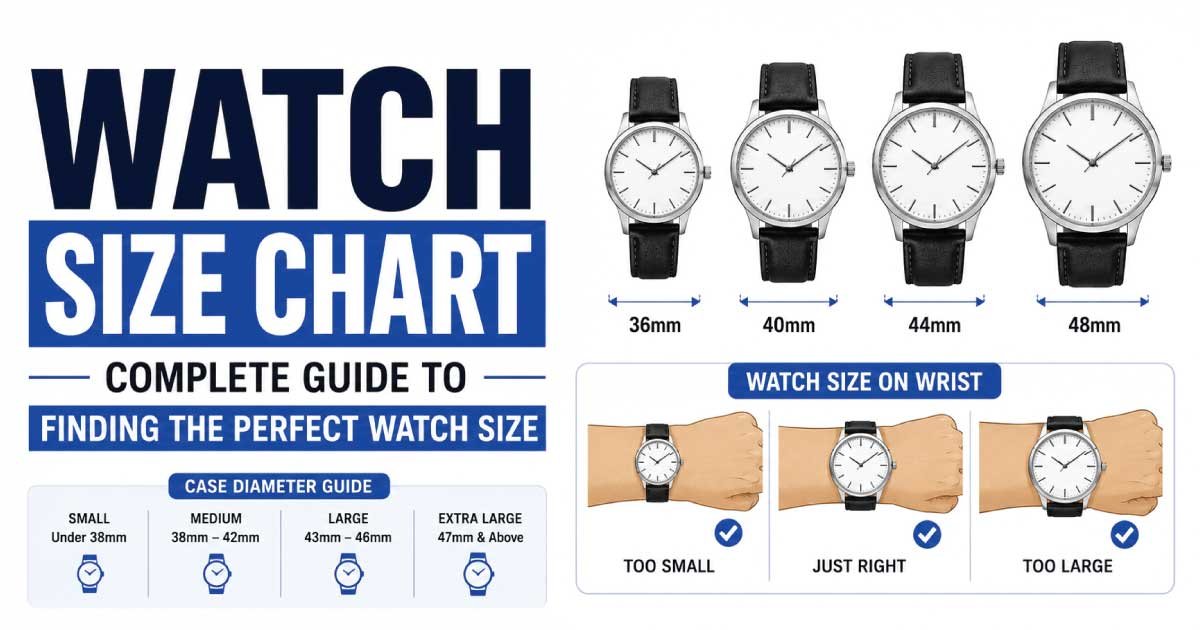
Choosing the right watch size is about more than simply picking a design you like. The size of the watch case, thickness, lug-to-lug distance, and strap width can all affect how a watch looks and feels on your wrist. A watch that is too large may look bulky, while one that is too small may appear disproportionate.
A watch size chart makes it easier to understand watch dimensions and choose a case size that suits your wrist. Whether you are shopping for a men’s watch, women’s watch, dress watch, sports watch, field watch, dive watch, or everyday timepiece, knowing your wrist size can help you make a better choice.
Unlike clothing or shoe sizes, watch sizing is not usually expressed as small, medium, or large alone. Watches are primarily measured by case diameter in millimeters (mm), although case thickness, lug-to-lug length, and strap width also matter.
In this complete guide, you will learn how watch sizes work, how to measure your wrist, standard watch size recommendations, men’s and women’s watch sizes, strap width, case thickness, and how to choose the right watch for your wrist.
Why Watch Size Matters
Watch size can significantly affect both comfort and appearance.
A large watch on a small wrist may extend beyond the sides of the wrist and look oversized. A very small watch on a large wrist may look understated or disproportionate.
The ideal watch size depends on several factors, including:
- Wrist circumference
- Wrist shape
- Case diameter
- Case thickness
- Lug-to-lug distance
- Strap width
- Watch style
- Personal preference
Two watches with the same case diameter can also look completely different because of differences in dial design, bezel width, lug shape, and case thickness.
This is why case diameter alone should not be the only measurement you consider.
How Watch Sizes Work
Watch sizes are generally measured in millimeters.
The most commonly discussed measurement is the case diameter, which refers to the width of the watch case from one side to the other, usually excluding the crown.
For example, a watch described as 40 mm has a case diameter of approximately 40 millimeters.
Common watch case sizes include:
- Under 34 mm
- 34–36 mm
- 37–39 mm
- 40–42 mm
- 43–45 mm
- 46 mm and above
However, these ranges are only general categories. The appropriate size depends heavily on wrist circumference and the overall design of the watch.
Watch Size Chart by Wrist Size
Your wrist circumference provides a useful starting point when choosing a watch case diameter.
| Wrist Circumference | Recommended Case Diameter | General Watch Size |
|---|---|---|
| 5.5–6 in | 32–36 mm | Small |
| 6–6.5 in | 34–38 mm | Small to Medium |
| 6.5–7 in | 36–40 mm | Medium |
| 7–7.5 in | 38–42 mm | Medium to Large |
| 7.5–8 in | 40–44 mm | Large |
| 8–8.5 in | 42–46 mm | Large to Extra Large |
| 8.5+ in | 44–48 mm | Extra Large |
These are general recommendations rather than strict rules. Personal style and watch design can make a smaller or larger case work well.
How to Measure Your Wrist for a Watch
Measuring your wrist is simple and takes less than a minute.
Step 1: Use a Flexible Measuring Tape
Wrap a flexible measuring tape around your wrist where you normally wear your watch.
The tape should sit comfortably against your skin without being pulled tightly.
Step 2: Record the Circumference
Read the measurement in inches or centimeters.
For example, if your wrist measures 7 inches, you can use the corresponding range in a watch size chart.
Step 3: Use String if You Don’t Have a Tape
If you don’t have a flexible measuring tape, wrap a piece of string around your wrist.
Mark where the string overlaps, then lay it flat and measure it with a ruler.
Step 4: Consider Your Wrist Shape
Two people can have the same wrist circumference but different wrist shapes.
A flatter wrist may accommodate a larger watch more easily, while a narrow, rounded wrist may make the same watch appear larger.
Watch Case Size Chart
Case diameter is one of the most important measurements when selecting a watch.
| Case Diameter | General Category | Typical Use |
|---|---|---|
| Under 34 mm | Very Small | Dress and vintage styles |
| 34–36 mm | Small | Dress and classic watches |
| 37–39 mm | Medium | Everyday and dress watches |
| 40–42 mm | Medium-Large | Everyday and sports watches |
| 43–45 mm | Large | Sports and dive watches |
| 46–48 mm | Extra Large | Large sports watches |
| 49+ mm | Oversized | Specialty and statement watches |
These categories are approximate. The overall dimensions of the watch can make a case appear larger or smaller.
What Is Watch Case Diameter?
Watch case diameter is the width of the main watch case.
It is normally measured from one side of the case to the other, excluding the crown.
For example, a 40 mm watch has a case diameter of approximately 40 mm.
Case diameter is useful for comparing watches, but it does not tell you how long the watch will sit across your wrist.
That is why lug-to-lug distance is also important.
What Is Lug-to-Lug Distance?
Lug-to-lug distance is the measurement from the end of the top lug to the end of the bottom lug.
The lugs are the extensions of the watch case where the strap or bracelet attaches.
A watch with a short lug-to-lug distance can wear smaller than another watch with the same case diameter but longer lugs.
When choosing a watch, make sure the lugs do not extend excessively beyond the edges of your wrist.
Why Lug-to-Lug Matters
For many people, lug-to-lug distance is more useful than case diameter when determining whether a watch will physically fit across the wrist.
A 42 mm watch with short, curved lugs may fit comfortably on a smaller wrist, while a 40 mm watch with long straight lugs may look larger.
Watch Case Thickness Guide
Case thickness is another important consideration.
A thin watch generally looks more refined and may slide easily under a shirt cuff. A thicker watch can have a more substantial appearance and is common among sports and dive watches.
| Case Thickness | General Appearance |
|---|---|
| Under 8 mm | Very Thin |
| 8–10 mm | Thin to Moderate |
| 10–12 mm | Moderate |
| 12–14 mm | Thick |
| 14+ mm | Very Thick |
The ideal thickness depends on the watch type and your personal preference.
A dress watch may be thin, while a dive or sports watch may be significantly thicker.
Also Read: Storage Cabinet Size Chart: Standard Sizes & Measurements
Watch Size by Wrist Circumference
5.5–6 Inch Wrist
A wrist measuring 5.5 to 6 inches generally works well with smaller watch cases.
Consider watches around 32–36 mm, depending on the style and lug-to-lug measurement.
A compact dress watch can look especially balanced on a smaller wrist.
6–6.5 Inch Wrist
A 34–38 mm case can provide a balanced appearance.
You can also wear slightly larger watches if they have short lugs or a compact case design.
6.5–7 Inch Wrist
Wrist sizes in this range can accommodate approximately 36–40 mm watches.
This is a versatile range that allows you to experiment with both classic and modern styles.
7–7.5 Inch Wrist
A 38–42 mm watch generally provides a balanced fit for this wrist size.
You may also be able to wear larger sports watches depending on their lug-to-lug dimensions.
7.5–8 Inch Wrist
Watches around 40–44 mm can work well.
Larger sports, field, and dive watches may also be suitable.
8+ Inch Wrist
A larger wrist can comfortably accommodate many watches in the 42–46 mm range and beyond.
However, watch thickness and lug-to-lug distance should still be considered.
Men’s Watch Size Chart
Men’s watches are available in a wide range of case sizes.
| Men’s Watch Size | Case Diameter | Common Style |
|---|---|---|
| Small | 34–36 mm | Dress and vintage |
| Medium | 37–39 mm | Classic and everyday |
| Large | 40–42 mm | Everyday and sports |
| Extra Large | 43–46 mm | Sports and dive |
| Oversized | 47+ mm | Statement and specialty |
These categories are not strict. Watch preferences have changed over time, and many modern men’s watches are available in smaller case sizes.
Women’s Watch Size Chart
Women’s watches also come in a broad range of case sizes.
| Women’s Watch Size | Case Diameter | Common Style |
|---|---|---|
| Extra Small | Under 28 mm | Jewelry and petite |
| Small | 28–32 mm | Dress and classic |
| Medium | 33–36 mm | Everyday |
| Large | 37–40 mm | Modern and statement |
| Extra Large | 41+ mm | Oversized styles |
There is no requirement that women wear small watches or that men wear large watches. Case size should ultimately be based on wrist proportions and personal preference.
Unisex Watch Size Guide
Many watches are designed to work across different wrist sizes and genders.
A case around 36–40 mm can be particularly versatile because it can suit a wide range of wrists depending on the design.
For a unisex watch, pay attention to:
- Case diameter
- Lug-to-lug distance
- Case thickness
- Strap width
- Wrist circumference
The overall proportions are often more important than gender-specific labels.
Watch Strap Width Guide
Strap width affects the overall appearance of a watch.
A strap that is too narrow can make a large watch look unbalanced, while an excessively wide strap may overwhelm a smaller case.
A common guideline is that strap width is approximately half the case diameter.
| Case Diameter | Approx. Strap Width |
|---|---|
| 28–32 mm | 14–16 mm |
| 33–36 mm | 16–18 mm |
| 37–40 mm | 18–20 mm |
| 41–44 mm | 20–22 mm |
| 45–48 mm | 22–24 mm |
These are general proportions. Some watch designs intentionally use wider or narrower straps.
Also Read: Shoe Cabinet Size Chart: Complete Guide With Dimensions
Watch Size for Small Wrists
If you have a smaller wrist, focus on the complete dimensions rather than simply searching for the smallest possible case.
A watch around 34–38 mm may work well, but lug-to-lug length is especially important.
A compact case with short lugs can create a better fit than a smaller-diameter watch with very long lugs.
Thin cases can also look more proportional because they reduce visual bulk.
Watch Size for Large Wrists
People with larger wrists can generally accommodate larger case diameters.
Watches around 40–46 mm may provide balanced proportions, particularly for sports and dive styles.
However, extremely large watches are not automatically better for larger wrists. The case should still sit comfortably without extending too far beyond the wrist.
How Watch Style Affects Size
The same case diameter can look very different depending on the style of the watch.
Dress Watches
Dress watches are often thinner and more understated.
A smaller or medium case can complement formal clothing and slide easily under shirt cuffs.
Field Watches
Field watches often have moderate case sizes and simple dials.
Sizes around 36–40 mm are common, although larger options are available.
Dive Watches
Dive watches tend to have larger and thicker cases because of their construction and water-resistance requirements.
Cases around 40–44 mm are common in many modern designs.
Sports Watches
Sports watches can range from compact to oversized.
The best size depends on your wrist and how you plan to use the watch.
Chronographs
Chronographs often appear larger because of their additional sub-dials and pushers.
A 40 mm chronograph can look visually larger than a simple three-hand watch with the same case diameter.
How Dial Design Affects Perceived Watch Size
Case diameter does not tell the whole story.
A watch with a large open dial can look larger than another watch with the same case diameter and a smaller visible dial.
Similarly, a wide bezel can make the dial appear smaller.
Other factors that affect perceived size include:
- Dial color
- Bezel width
- Crystal shape
- Lug design
- Case thickness
- Crown size
- Strap width
This is why trying a watch on your wrist can be useful whenever possible.
How to Choose the Right Watch Size
Start by measuring your wrist circumference.
Then consider your preferred watch style.
If you have a small wrist, look for a case that does not extend beyond the wrist edges. If you have a larger wrist, you may have more flexibility with case diameter.
Next, check the lug-to-lug distance.
Finally, consider case thickness and strap width.
The best watch size is the one that feels comfortable and looks proportionate to your wrist.
Common Watch Sizing Mistakes
Choosing Only by Case Diameter
Case diameter is important, but lug-to-lug distance can have a major effect on fit.
Ignoring Case Thickness
A thick watch can feel much larger than a thin watch with the same diameter.
Choosing Based on Gender Alone
Men and women can comfortably wear many of the same watch sizes.
Ignoring Wrist Shape
Wrist circumference does not describe the complete shape of the wrist.
Assuming Bigger Means Better
A larger watch is not necessarily more attractive or comfortable.
Ignoring Strap Width
An incorrectly proportioned strap can make the watch look unbalanced.
Also Read: Floating Shelf Size Chart: Complete Measurement Guide
How a Watch Should Fit on Your Wrist
A properly sized watch should sit securely on top of your wrist.
The case should not move excessively from side to side.
The lugs should ideally remain within the general width of your wrist rather than extending dramatically beyond the edges.
The strap or bracelet should be comfortable enough to allow normal movement without the watch constantly sliding around.
A small amount of movement is normal, but the watch should not feel loose or unstable.
Frequently Asked Questions About Watch Sizes
What is the best watch size for my wrist?
The best watch size depends on wrist circumference, watch style, case thickness, and lug-to-lug distance. As a general guide, smaller wrists often suit 32–38 mm cases, medium wrists 36–42 mm, and larger wrists 40–46 mm.
Is a 40 mm watch too big for a small wrist?
Not necessarily. A 40 mm watch can work on a smaller wrist if it has a short lug-to-lug distance, slim case, and appropriate proportions. The complete dimensions matter more than case diameter alone.
Is a 42 mm watch too big for a 7-inch wrist?
A 42 mm watch can work well on a 7-inch wrist, especially when the lugs are reasonably short. Sports and dive watches often appear larger because of their thickness and bezel design.
What watch size is best for a 6-inch wrist?
A 34–36 mm case is often a good starting point for a 6-inch wrist. However, a 37–38 mm watch may also work if it has compact dimensions and short lugs.
What watch size is best for a 7-inch wrist?
A 36–42 mm watch can generally work well for a 7-inch wrist. The ideal size depends on the watch style, lug-to-lug distance, thickness, and your personal preference.
What watch size is best for an 8-inch wrist?
An 8-inch wrist can accommodate a broad range of watch sizes. Cases around 40–44 mm are a common starting point, while larger sports watches may also work comfortably.
Does wrist circumference determine watch size?
Wrist circumference is one of the most useful measurements, but it does not determine watch size by itself. Case diameter, lug-to-lug distance, thickness, and wrist shape also influence how a watch fits.
What is lug-to-lug on a watch?
Lug-to-lug is the distance from the end of the upper lug to the end of the lower lug. It indicates how much of the watch spans across your wrist and can be more useful than case diameter when evaluating fit.
What is a good watch size for women?
There is no single ideal women’s watch size. Smaller watches around 28–34 mm are common, while 35–40 mm watches can provide a modern or unisex appearance. The best size depends on wrist proportions and personal style.
What is a good watch size for men?
Many men’s watches fall between approximately 36 and 44 mm, but there is no universal ideal. Smaller 36–39 mm watches can look classic, while 40–44 mm watches often provide a more substantial appearance.
How wide should a watch strap be?
A common proportion is for the strap width to be approximately half the case diameter. For example, a 40 mm watch often uses a strap around 20 mm wide. The exact width depends on the watch design.
Should a watch cover the whole wrist?
No. A watch should sit comfortably on top of the wrist without the case or lugs extending excessively beyond the sides. A watch that spans too much of the wrist can appear oversized and may be less comfortable.
Final Thoughts on Choosing the Right Watch Size
Choosing the right watch size is about finding the correct balance between case diameter, wrist circumference, lug-to-lug distance, case thickness, and personal style.
Start by measuring your wrist, then use a watch size chart as a general guide. For smaller wrists, compact cases can create a balanced appearance, while larger wrists may accommodate bigger sports and dive watches.
However, there are no absolute rules. A well-designed 40 mm watch can look excellent on one wrist and oversized on another. The most important thing is that the watch feels comfortable, sits securely, and looks proportional to your wrist.
When comparing watches, don’t look at case diameter alone. Check the complete dimensions, especially lug-to-lug distance and thickness. With these measurements in mind, you can confidently choose a watch that fits both your wrist and your personal style.
