
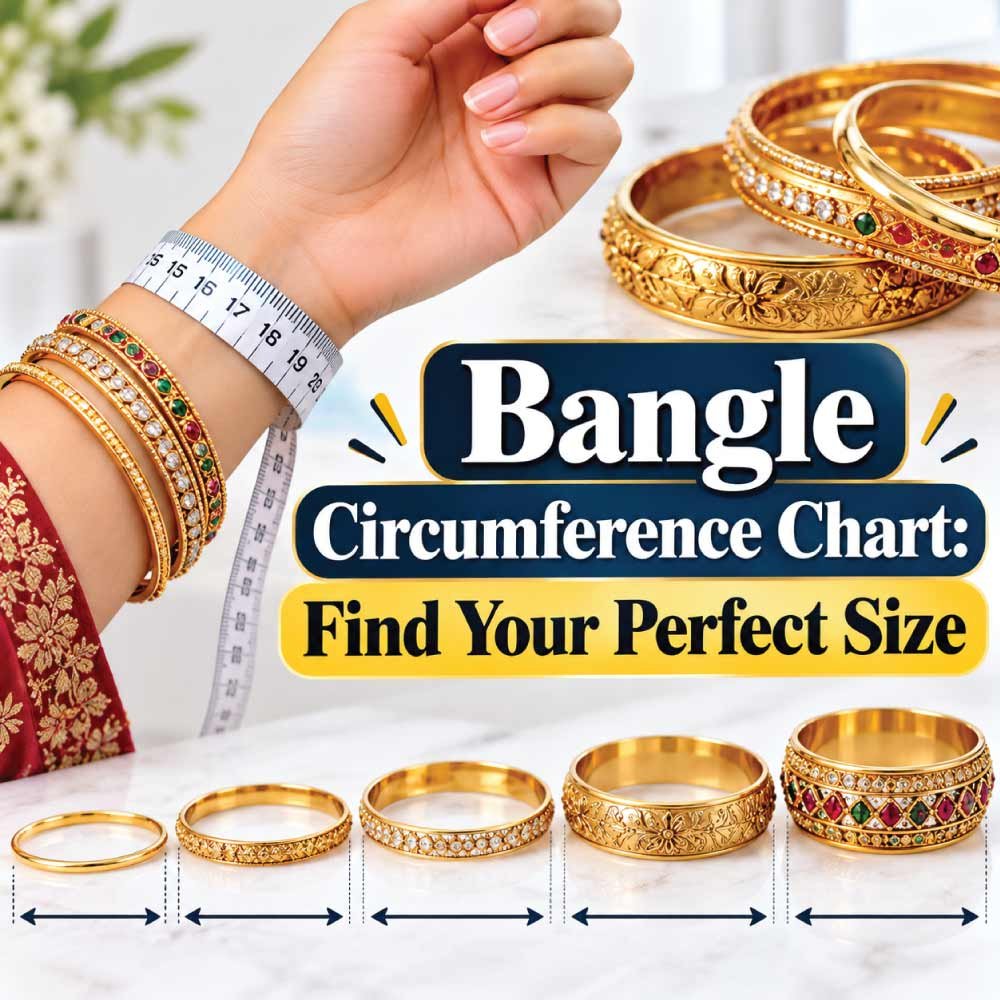
Bangles are easiest to wear when their circumference matches the size of your hand and wrist comfortably. A bangle that is too small can be difficult to put on, while one that is too large may slide excessively or fall off. This bangle circumference chart helps you compare common bangle measurements, understand the relationship between circumference and diameter, and choose a size with greater confidence.
Unlike adjustable bracelets, traditional bangles are usually rigid, so the opening must be large enough to pass over the widest part of your hand. Your wrist measurement alone is therefore not always enough. The shape and size of your hand, knuckles, and the bangle’s inside diameter all matter.
This guide explains how bangle circumference is measured, how to measure yourself at home, how to convert circumference to diameter, and how to select a comfortable bangle size.
What Is Bangle Circumference?
Bangle circumference is the distance around the inside of a bangle. It describes the length of the circular path around the bangle’s inner opening.
For sizing purposes, circumference is closely related to inside diameter, which is the straight-line distance across the inside of the bangle.
The basic relationship is:
Circumference = π × Diameter
Therefore:
Diameter = Circumference ÷ π
Using approximately 3.14 for π, a bangle with a 60 mm inside diameter has an inside circumference of about 188.5 mm.
It is important to distinguish inside circumference from the outside circumference. The outside measurement includes the thickness of the bangle and is not normally the measurement used to determine whether the bangle will fit over your hand.
Why Bangle Circumference Matters
Circumference can help you:
- Compare bangle sizes from different sellers.
- Convert between circumference and diameter.
- Understand measurements listed in millimeters, centimeters, or inches.
- Estimate the internal size of a round bangle.
- Check whether a bangle is likely to provide enough room for your hand.
- Compare a new bangle with one you already own.
However, circumference should be considered alongside hand circumference, inside diameter, wrist size, bangle shape, and personal fit preference.
Bangle Circumference Chart
The following chart shows the mathematical relationship between common inside diameters and their approximate inside circumferences. These are measurement conversions rather than universal manufacturer size standards.
| Inside Diameter | Approx. Circumference | Circumference in Inches |
|---|---|---|
| 50 mm | 157.1 mm | 6.18 in |
| 52 mm | 163.4 mm | 6.43 in |
| 54 mm | 169.6 mm | 6.68 in |
| 56 mm | 175.9 mm | 6.93 in |
| 58 mm | 182.2 mm | 7.17 in |
| 60 mm | 188.5 mm | 7.42 in |
| 62 mm | 194.8 mm | 7.67 in |
| 64 mm | 201.1 mm | 7.92 in |
| 66 mm | 207.3 mm | 8.16 in |
| 68 mm | 213.6 mm | 8.41 in |
| 70 mm | 219.9 mm | 8.66 in |
| 72 mm | 226.2 mm | 8.91 in |
| 74 mm | 232.5 mm | 9.15 in |
| 76 mm | 238.8 mm | 9.40 in |
| 78 mm | 245.0 mm | 9.65 in |
| 80 mm | 251.3 mm | 9.89 in |
The circumference values above are calculated from the inside diameter using π. Actual jewelry sizing can vary, especially for oval, square, faceted, thick, or unusually shaped bangles.
Bangle Size Chart by Circumference
Many shoppers find it easier to work with circumference than diameter, particularly when they have measured their hand with a flexible tape.
The chart below provides a practical reference for comparing circumference measurements with corresponding inside diameters.
| Approx. Inside Circumference | Approx. Inside Diameter | Diameter in Inches |
|---|---|---|
| 157 mm | 50 mm | 1.97 in |
| 163 mm | 52 mm | 2.05 in |
| 170 mm | 54 mm | 2.13 in |
| 176 mm | 56 mm | 2.20 in |
| 182 mm | 58 mm | 2.28 in |
| 188 mm | 60 mm | 2.36 in |
| 195 mm | 62 mm | 2.44 in |
| 201 mm | 64 mm | 2.52 in |
| 207 mm | 66 mm | 2.60 in |
| 214 mm | 68 mm | 2.68 in |
| 220 mm | 70 mm | 2.76 in |
| 226 mm | 72 mm | 2.83 in |
| 233 mm | 74 mm | 2.91 in |
| 239 mm | 76 mm | 2.99 in |
| 245 mm | 78 mm | 3.07 in |
| 251 mm | 80 mm | 3.15 in |
These figures are useful when a product listing gives one measurement but you need another. For example, if a bangle is listed with an inside diameter of 64 mm, its theoretical inside circumference is approximately 201 mm.
How to Measure Your Bangle Circumference
If you already own a bangle that fits well, measuring it can be one of the simplest ways to determine the size you need.
Measure the Inside Diameter
Place the bangle on a flat surface and measure directly across the inside opening from one inside edge to the opposite inside edge.
Do not measure from the outside edges.
For the most useful result:
- Place the bangle flat.
- Position a ruler across the widest part of the inner opening.
- Measure from inside edge to inside edge.
- Record the measurement in millimeters.
- Compare the measurement with the bangle circumference chart.
A digital caliper can provide greater precision, but a ruler can work well for ordinary jewelry sizing.
Calculate the Circumference
If you know the inside diameter, multiply it by π.
For example:
60 mm × 3.1416 = 188.5 mm
So a round bangle with a 60 mm inside diameter has an approximate inside circumference of 188.5 mm.
Remember that this is a mathematical circumference. It does not automatically mean that someone with a wrist circumference of 188.5 mm should wear that bangle. A rigid bangle must pass over the hand, which makes hand size especially important.
How to Measure Your Hand for a Bangle
For a traditional rigid bangle, measuring the hand can be more useful than measuring only the wrist.
The bangle needs to pass over your fingers and knuckles before it reaches your wrist. This means the widest part of your closed hand is an important sizing reference.
Step-by-Step Hand Measurement
You can measure your hand using a flexible measuring tape or a strip of paper.
- Bring your fingers together as if you were putting on a bangle.
- Fold your thumb inward across your palm.
- Wrap the measuring tape around the widest part of your closed hand.
- Keep the tape snug but not painfully tight.
- Record the circumference.
- If using paper, mark where the ends meet and measure the strip with a ruler.
- Compare your measurement with the bangle’s internal dimensions.
The hand should be positioned naturally. Do not flatten your fingers unnaturally or spread them apart, because either position can distort the measurement.
Why Wrist Circumference Alone Can Be Misleading
Suppose your wrist is relatively narrow but your hand is broad. A bangle sized only from your wrist measurement could have an opening that feels comfortable once it reaches the wrist but is too small to pass over your hand.
The reverse can also happen. Someone with a larger wrist but relatively narrow hand may need a different combination of opening size and fit.
For rigid bangles, the key question is not simply:
“What is my wrist circumference?”
It is:
“What opening size can comfortably pass over my hand and then sit correctly on my wrist?”
Bangle Circumference vs. Bangle Diameter
Circumference and diameter describe the same circular opening from different perspectives.
Diameter measures straight across the inside of the bangle.
Circumference measures around the inside of the bangle.
Diameter is often printed on jewelry size charts because it is easy to measure with a ruler. Circumference can be convenient when you are measuring your hand with a flexible tape.
Quick Conversion Formula
To convert diameter to circumference:
C = πD
To convert circumference to diameter:
D = C ÷ π
For example, if a bangle has an inside circumference of 200 mm:
200 ÷ 3.1416 ≈ 63.7 mm
So its inside diameter is approximately 64 mm.
Because jewelry measurements are often rounded to the nearest millimeter, a small difference between a calculated value and a seller’s listed value is normal.
How to Choose the Right Bangle Size
Finding the right bangle size involves more than matching one number. Consider how the bangle will go over your hand, where it will sit, and how tightly or loosely you want it to fit.
Choose a Snug Fit
A snug fit may be appropriate if you prefer a bangle that stays relatively close to your wrist.
It should still:
- Pass over your hand without excessive force.
- Avoid painful pressure around your knuckles.
- Allow normal wrist movement.
- Avoid pinching the skin.
- Feel secure without being restrictive.
Choose a Looser Fit
A looser bangle provides more movement around the wrist. Some people prefer this style because the jewelry can move naturally as they use their hands.
However, excessive looseness can make a bangle slide down the hand or potentially come off.
Consider Bangle Thickness
Two bangles can have the same nominal diameter but feel different if their construction differs.
A thick bangle, heavily textured design, or decorative interior may interact differently with your hand than a thin, smooth bangle.
Always check whether the seller specifies inside diameter, inside circumference, or another measurement.
Also Read:
Common Bangle Size Mistakes
Incorrect measurements are one of the main reasons a rigid bangle does not fit as expected.
Measuring the Outside Diameter
The outside diameter includes the bangle material itself. It is not the same as the opening available to your hand.
Always check whether the listed diameter refers to the inside diameter.
Measuring Only the Wrist
Your wrist circumference does not necessarily tell you whether a rigid bangle can pass over your hand.
Measure the widest part of your closed hand when selecting a traditional bangle.
Pulling the Measuring Tape Too Tight
A tape that is pulled tightly can produce a smaller measurement than your actual hand circumference.
The tape should be snug but comfortable.
Ignoring the Bangle’s Shape
A circular bangle is straightforward to convert between diameter and circumference. An oval or irregular bangle does not behave exactly the same way.
For unusual shapes, use the manufacturer’s fitting instructions rather than relying solely on a circular formula.
Assuming Every Brand Uses the Same Size System
Jewelry sellers may use different size labels, measurement conventions, and sizing systems.
One seller’s “medium” may not have exactly the same internal dimensions as another seller’s “medium.”
For online purchases, compare the actual measurements whenever they are provided.
Also Read:
Bangle Circumference Measurement in Inches and Millimeters
Jewelry measurements are commonly presented in millimeters, centimeters, or inches. Millimeters are especially useful because small changes in bangle diameter can affect fit.
Here are some useful conversions:
- 1 inch = 25.4 mm
- 10 mm = 1 cm
- 1 cm = 10 mm
- 1 inch ≈ 2.54 cm
For example, an inside diameter of 60 mm equals approximately 2.36 inches.
When comparing two size charts, convert both measurements to the same unit before making a decision. This reduces the chance of confusing inches with centimeters or interpreting a decimal measurement incorrectly.
How to Measure a Bangle Without a Caliper
You do not need specialized jewelry equipment to obtain a useful measurement.
A ruler with millimeter markings is generally sufficient for a basic inside-diameter measurement.
Simple Ruler Method
Place the bangle on a flat surface and position the ruler across the inner opening. Measure the widest straight-line distance from one inner edge to the other.
For example, if the opening measures approximately 62 mm, you can use the circumference formula:
62 × 3.1416 ≈ 194.8 mm
That gives an approximate internal circumference of 195 mm.
If the bangle is valuable, highly irregular, or difficult to measure accurately, professional measurement may be preferable.
Also Read:
Rigid Bangles vs. Adjustable Bracelets
Bangle circumference is most important for rigid, closed bangles because the jewelry cannot expand when you put it on.
Adjustable bracelets and flexible chain bracelets are different. Their fit is usually determined by wrist circumference plus the amount of extra length required for the desired fit.
A rigid bangle must account for both:
- The wrist where it will rest
- The hand it must pass over
This is why a wrist measurement alone is not always sufficient for bangle sizing.
Which Measurement Should You Use?
| Jewelry Type | Most Important Measurement | Why |
|---|---|---|
| Rigid round bangle | Hand and inside opening | Must pass over the hand |
| Rigid oval bangle | Hand and opening dimensions | Shape affects fit |
| Adjustable bangle | Wrist circumference | Opening can usually be changed |
| Chain bracelet | Wrist circumference | Flexible construction |
| Cuff bracelet | Wrist circumference and opening | Open design allows adjustment |
Always follow the individual seller’s sizing instructions when available.
Tips for Buying Bangles Online
Online jewelry shopping makes accurate measurement particularly important because you cannot physically try the bangle before purchasing.
Before ordering, check:
- Inside diameter
- Inside circumference, if provided
- Measurement units
- Whether the listed size refers to the inner or outer measurement
- Bangle thickness
- Shape of the opening
- Seller’s size guide
- Return or exchange policy
- Whether the design is rigid or adjustable
If you already have a bangle that fits well, compare its inside diameter with the new product’s specifications. This can be more reliable than guessing from labels such as small, medium, or large.
For handmade jewelry, also allow for small manufacturing differences when the seller indicates that measurements are approximate.
Bangle Size Selection Example
Imagine you measure the widest part of your closed hand and obtain a circumference of approximately 190 mm.
You find a round bangle with an inside diameter of 60 mm.
Its approximate internal circumference is:
60 × 3.1416 = 188.5 mm
This gives you a useful comparison, but it does not prove that the bangle will fit. The shape and flexibility of your hand, the bangle’s actual opening, and the construction of the jewelry all affect whether it can pass comfortably over your knuckles.
If the bangle is rigid and the opening is close to the maximum width of your hand, choosing based only on the mathematical circumference may produce a difficult fit. In that situation, comparing the actual inside opening with a bangle you already wear successfully can provide better practical guidance.
Frequently Asked Questions
What is the standard bangle circumference?
There is no single universal bangle circumference that fits everyone. Bangle sizes vary according to the inside diameter, hand size, wrist size, design, and sizing system used by the manufacturer or seller. Always compare actual measurements rather than relying only on labels such as small or medium.
How do I calculate bangle circumference from diameter?
Multiply the bangle’s inside diameter by π. For example, a 60 mm inside diameter multiplied by approximately 3.1416 gives an inside circumference of about 188.5 mm. This formula applies to a circular opening.
Should I measure my wrist or hand for a bangle?
For a rigid bangle, measuring the hand is particularly important because the bangle must pass over the widest part of your closed hand. Wrist circumference is also useful for understanding how the bangle will sit once it is on your wrist.
Is bangle circumference the same as wrist circumference?
No. Bangle circumference describes the distance around the bangle’s inside opening, while wrist circumference describes the distance around your wrist. They are related to fit but are not interchangeable measurements.
What is a 60 mm bangle in circumference?
A round bangle with a 60 mm inside diameter has an approximate inside circumference of 188.5 mm, or about 7.42 inches. This is a mathematical conversion and does not guarantee that the bangle will fit a particular hand.
How can I measure a bangle at home?
Use a ruler to measure straight across the widest part of the bangle’s inside opening. Record the inside diameter in millimeters. You can then multiply that number by π to estimate the inside circumference.
Why does my bangle fit my wrist but not my hand?
A rigid bangle has to pass over your hand before reaching your wrist. If your hand or knuckles are wider than the bangle opening, the bangle can be difficult or impossible to put on even when its eventual wrist fit would be comfortable.
Can I use circumference to compare different bangle sizes?
Yes. Circumference is useful for comparing round bangle openings, provided the measurements refer to the inside circumference. For unusual shapes, also compare the actual opening dimensions because a single circumference value may not fully describe the fit.
Final Tips for Getting the Perfect Bangle Fit
The best bangle size is one that balances hand clearance, wrist comfort, and the amount of movement you prefer. Start by measuring the widest part of your closed hand, then compare that measurement with the manufacturer’s actual bangle dimensions.
If you have a bangle that already fits well, measuring its inside diameter is an excellent reference point. You can then use the circumference formula to compare it with charts or product listings.
Remember these key points:
- Inside diameter measures straight across the opening.
- Inside circumference measures around the opening.
- Circumference can be calculated as π × diameter.
- Rigid bangles need to pass over your hand, not just fit around your wrist.
- Always verify whether a seller lists inside or outside measurements.
- Different brands and designs may use different sizing systems.
- For oval or irregular bangles, use the manufacturer’s specific measurements whenever possible.
With accurate measurements and a clear understanding of bangle circumference, you can compare sizes more confidently and avoid choosing a bangle that is unnecessarily tight or loose.
