
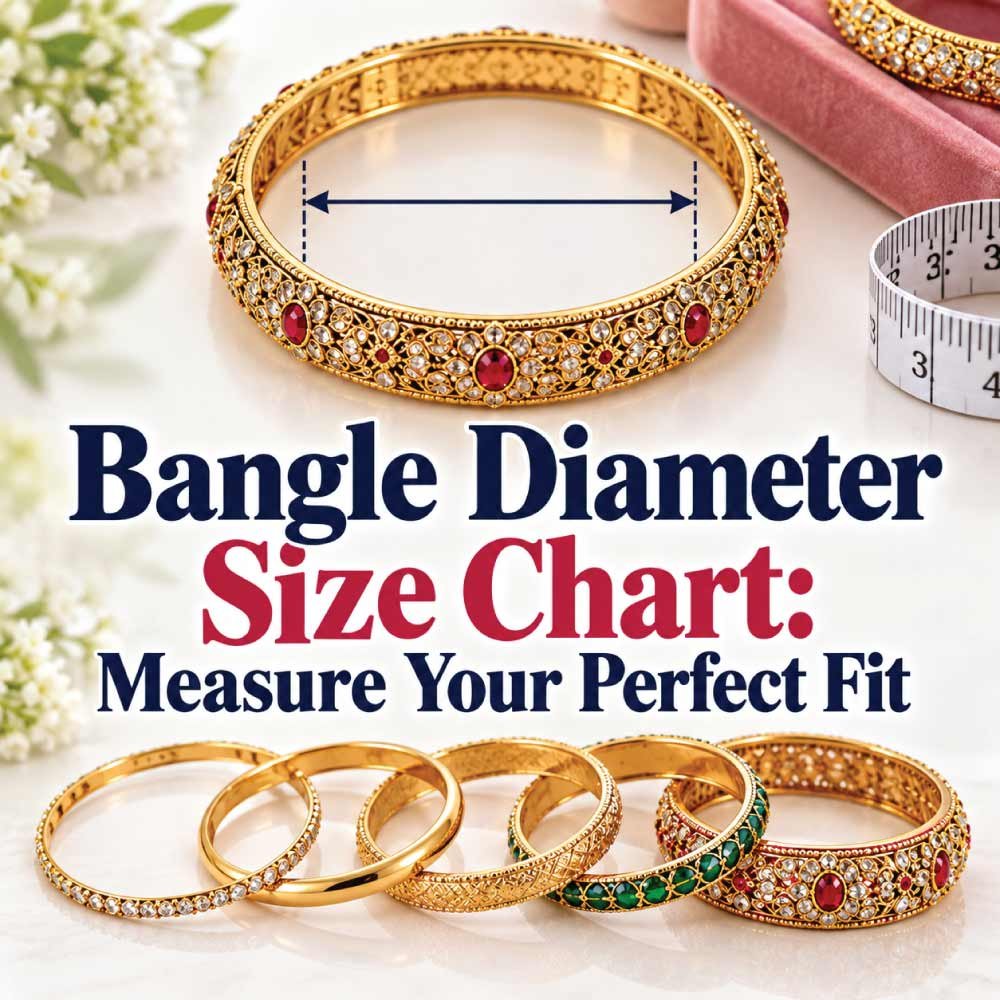
A bangle should slide comfortably over your hand without feeling loose enough to fall off or tight enough to become difficult to remove. The key measurement is often the inside diameter of the bangle, but knowing your wrist size alone is not always enough because a traditional bangle must pass over the widest part of your hand.
This bangle diameter size chart explains common bangle diameters, how diameter relates to circumference, and the easiest ways to measure your hand or an existing bangle. You’ll also learn how to choose a size when you are between measurements, how bangles differ from bracelets, and which fitting mistakes to avoid.
Whether you are buying a rigid metal bangle, a glass bangle, a wooden style, or another fixed-shape design, accurate measurements can make finding the right fit much easier.
What Is Bangle Diameter?
Bangle diameter is the straight-line distance across the inside of a circular bangle, measured through the center.
For sizing purposes, it is important to measure the inside diameter, not the outside diameter. The thickness of the bangle material adds to the outside measurement and does not tell you how much room your hand or wrist actually has.
For example, if a bangle has an inside diameter of 60 mm, the usable circular opening is approximately 60 mm across.
Bangle diameter is commonly expressed in:
- Millimeters (mm)
- Centimeters (cm)
- Inches (in)
The diameter can also be converted to an approximate inside circumference using the formula:
Circumference = Diameter × π
Since π is approximately 3.1416, a 60 mm inside diameter corresponds to an inside circumference of about 188.5 mm.
However, circumference and diameter should not be treated as interchangeable when choosing a rigid bangle. A bangle needs to pass over the hand, so hand width and hand circumference can be more important than wrist circumference for a closed bangle.
Bangle Diameter Size Chart
The following chart provides common inside-diameter measurements and their approximate circumference equivalents. Actual jewelry sizing can vary between manufacturers, regions, and sizing systems, so use the chart as a practical reference rather than a universal standard.
| Bangle Size | Inside Diameter (mm) | Inside Diameter (cm) | Approx. Circumference (mm) | Approx. Circumference (in) |
|---|---|---|---|---|
| Extra Small | 50 mm | 5.0 cm | 157.1 mm | 6.18 in |
| Small | 55 mm | 5.5 cm | 172.8 mm | 6.80 in |
| Small-Medium | 58 mm | 5.8 cm | 182.2 mm | 7.17 in |
| Medium | 60 mm | 6.0 cm | 188.5 mm | 7.42 in |
| Medium-Large | 62 mm | 6.2 cm | 194.8 mm | 7.67 in |
| Large | 65 mm | 6.5 cm | 204.2 mm | 8.04 in |
| Extra Large | 68 mm | 6.8 cm | 213.6 mm | 8.41 in |
| XXL | 70 mm | 7.0 cm | 219.9 mm | 8.66 in |
| XXXL | 75 mm | 7.5 cm | 235.6 mm | 9.28 in |
These measurements describe the inside opening, which is the most useful dimension when comparing rigid bangles.
A 60 mm bangle, for instance, has an opening roughly 6 cm across. It may be suitable for someone whose hand can comfortably pass through that opening, but wrist circumference alone cannot confirm the fit.
Bangle Diameter vs. Bangle Circumference
Diameter and circumference describe different measurements of the same circular opening.
Diameter measures straight across the center of the opening. Circumference measures around the entire inside edge.
The relationship is:
Inside circumference = Inside diameter × 3.1416
Here are several common conversions:
| Inside Diameter | Approx. Inside Circumference | Circumference in Inches |
|---|---|---|
| 50 mm | 157.1 mm | 6.18 in |
| 55 mm | 172.8 mm | 6.80 in |
| 58 mm | 182.2 mm | 7.17 in |
| 60 mm | 188.5 mm | 7.42 in |
| 62 mm | 194.8 mm | 7.67 in |
| 65 mm | 204.2 mm | 8.04 in |
| 68 mm | 213.6 mm | 8.41 in |
| 70 mm | 219.9 mm | 8.66 in |
| 75 mm | 235.6 mm | 9.28 in |
This conversion is mathematically accurate for a circular opening. However, the circumference of your hand is not necessarily equivalent to the inside circumference of the bangle you need.
That is because your hand is not a perfect circle. A rigid bangle has to move over the knuckles and the widest part of the hand before it rests around the wrist.
How to Measure Bangle Diameter
There are several practical ways to determine the correct bangle diameter.
The best method depends on whether you already own a bangle that fits or need to determine your size without one.
Method 1: Measure an Existing Bangle
If you already have a bangle that fits comfortably, measuring it is usually the simplest option.
You will need:
- A ruler or measuring tape with millimeter markings
- Your existing bangle
- A flat surface
Place the bangle flat on a table.
Measure from the inside edge on one side directly across the center to the inside edge on the opposite side.
Do not measure from the outside edges.
For example, if the inside opening measures approximately 62 mm, look for a bangle with an inside diameter close to 62 mm.
This method is particularly useful when purchasing a replacement or another bangle with a similar fit.
Method 2: Measure Your Hand
If you do not have an existing bangle, you can measure your hand to estimate the required opening.
Bring your fingers together and fold your thumb across your palm as though you were preparing to put on a traditional bangle.
Measure around the widest part of your closed hand. This measurement should represent the area that the bangle needs to pass over.
You can then compare the measurement with the bangle manufacturer’s sizing chart.
Keep in mind that this method is an estimate because hand shape, finger length, knuckle size, and bangle flexibility can all affect the final fit.
Method 3: Measure Hand Width
Another useful approach is measuring the widest horizontal part of your hand while your fingers are held together.
Use a ruler to measure across the widest part of the hand.
This measurement can help when a retailer provides an inside-diameter chart rather than a hand-circumference chart.
Because hand shapes differ, however, a hand-width measurement should be used as a guide rather than treated as an exact conversion.
How to Measure an Existing Bangle Correctly
Measuring an existing bangle sounds simple, but small mistakes can produce a noticeably different size.
Follow these steps:
- Place the bangle on a flat surface.
- Keep the bangle in a natural circular shape.
- Identify the inside edge of the opening.
- Place your ruler across the center.
- Measure straight from one inside edge to the opposite inside edge.
- Record the measurement in millimeters.
- Compare it with the new bangle’s listed inside diameter.
Do not measure the bangle diagonally. A diagonal measurement can be longer than the true diameter.
If the bangle is slightly oval rather than perfectly round, measure its shortest and longest inside dimensions. This gives you a better understanding of its actual shape and fit.
How to Choose the Right Bangle Size
Finding your size involves more than selecting the largest diameter that will fit over your hand. A bangle that is too large can move excessively, while one that is too small may be uncomfortable or difficult to remove.
Consider these factors:
Hand Size
For a traditional closed bangle, hand size is often more important than wrist size.
The bangle must first pass over the hand. If the opening is too small, the bangle may not go on even if the final wrist area would otherwise fit.
Wrist Size
Once the bangle has passed over the hand, wrist size affects how loose or snug it feels.
A smaller wrist combined with a relatively wide hand can make sizing more complicated. In that situation, choose a diameter that can comfortably pass over the hand while still giving an acceptable amount of movement around the wrist.
Bangle Thickness
Two bangles with the same listed diameter can feel different if their designs have different thicknesses, edges, or internal shapes.
A thick bangle may feel less flexible and occupy more visual and physical space around the wrist.
Desired Fit
Some people prefer bangles that move freely around the wrist. Others prefer a closer fit with less movement.
Think about your preference before selecting between two nearby sizes.
Bangle Size for a Loose, Comfortable, or Snug Fit
There is no single correct amount of looseness for every wearer.
A snug fit stays closer to the wrist and moves less.
A comfortable or standard fit allows some movement while remaining secure.
A loose fit allows the bangle to slide more freely along the wrist and may create a more traditional stacked-bangle appearance.
When deciding between two sizes:
- Choose the smaller suitable diameter if you prefer less movement.
- Choose the larger suitable diameter if you prefer a looser fit.
- Never choose a diameter so small that the bangle struggles to pass over your hand.
- Consider the bangle’s shape and thickness, not just the numerical diameter.
For rigid bangles, comfort should take priority over simply matching a number on a generic chart.
Bangle Diameter Conversion Chart
Bangle measurements may be listed in millimeters, centimeters, or inches depending on the seller.
Use this conversion table when comparing measurements.
| Diameter (mm) | Diameter (cm) | Diameter (in) |
|---|---|---|
| 50 mm | 5.0 cm | 1.97 in |
| 55 mm | 5.5 cm | 2.17 in |
| 58 mm | 5.8 cm | 2.28 in |
| 60 mm | 6.0 cm | 2.36 in |
| 62 mm | 6.2 cm | 2.44 in |
| 65 mm | 6.5 cm | 2.56 in |
| 68 mm | 6.8 cm | 2.68 in |
| 70 mm | 7.0 cm | 2.76 in |
| 75 mm | 7.5 cm | 2.95 in |
When shopping online, check whether the listed measurement refers to the inside diameter, outside diameter, bracelet length, or another dimension.
A product listing that simply says “60 mm” without identifying what is being measured can be ambiguous.
Also Read:
Common Bangle Diameter Sizes Explained
Certain diameter ranges are frequently encountered in jewelry sizing, although there is no single worldwide standard that applies to every bangle.
50–55 mm
This range represents a relatively small opening.
It may work for smaller hands, but the correct fit depends heavily on the wearer’s hand shape and the bangle design.
58–62 mm
This is a useful middle range found in many bangle sizing charts.
Because only a few millimeters separate these sizes, accurate measurement can make a meaningful difference when choosing between them.
65–70 mm
These larger diameters provide more room for the hand and wrist.
They may be appropriate for people who need a larger opening or prefer a looser fit.
75 mm and Above
Very large openings provide substantial clearance and are often selected when the wearer’s hand requires additional space.
The exact available sizes vary considerably between jewelry makers.
Also Read:
Bangle Size vs. Bracelet Size
Bangles and bracelets are related but should not always be sized in the same way.
A traditional bangle is usually rigid or nearly rigid, meaning it must fit over the hand. A conventional bracelet may have a clasp, flexible links, elastic, or another opening mechanism.
This creates an important sizing difference.
For a rigid bangle, you generally need to consider:
- Inside diameter
- Hand circumference
- Hand width
- Knuckle size
- Wrist circumference
- Desired looseness
For a flexible bracelet, wrist circumference is often the primary measurement.
This is why a wrist measurement alone may be sufficient for one jewelry type but inadequate for another.
Traditional Bangles vs. Adjustable Bangles
Not every bangle requires the same sizing approach.
Traditional Closed Bangles
Closed bangles have a fixed opening.
Their size is commonly specified by inside diameter, making accurate hand measurement especially important.
Open Bangles
Open bangles have an opening or gap that allows the wearer to place the jewelry around the wrist without passing the entire hand through a circular opening.
These styles can be more forgiving because the hand does not need to fit through a closed ring.
Adjustable Bangles
Adjustable designs may include a sliding mechanism, hinge, clasp, or flexible construction.
For these products, follow the manufacturer’s wrist-size range rather than relying exclusively on a generic bangle diameter chart.
Also Read:
Common Bangle Measurement Mistakes
A few simple errors can lead to an uncomfortable or unsuitable fit.
Measuring the Outside Diameter
This is one of the most common mistakes.
The outside diameter includes the thickness of the bangle material. What you need for sizing is generally the inside diameter.
Using Wrist Circumference Alone
Wrist circumference does not tell you whether a closed bangle will pass over your hand.
Someone can have a relatively small wrist but a wider hand, making a larger bangle opening necessary.
Measuring at an Angle
When measuring an existing bangle, the ruler should cross the opening through its center.
A diagonal measurement can overstate the diameter.
Ignoring the Manufacturer’s Chart
A retailer may use its own size labels or measurement conventions.
Always check what the seller means by “diameter,” “size,” or “circumference.”
Choosing the Smallest Possible Size
A bangle does not need to be extremely tight to be correctly sized.
If you have to force it over your hand or struggle to remove it, the opening is not appropriate for your needs.
Tips for Buying Bangles Online
Online shopping makes accurate measurements particularly valuable because you cannot try the bangle on before purchasing.
Before ordering, check:
- Whether the listed diameter is inside or outside diameter.
- Whether measurements are provided in millimeters, centimeters, or inches.
- Whether the seller provides a separate size chart.
- Whether the bangle is rigid, hinged, open, elastic, or adjustable.
- Whether returns or exchanges are available if the fit is incorrect.
- Whether the product has a specific sizing system that differs from generic labels.
If the listing provides only a size number, look for additional measurements before ordering.
A product described as “medium” by one seller may not have the same inside diameter as a “medium” bangle from another seller.
How to Measure for a Bangle Without a Ruler
If you do not have a ruler with millimeter markings, you can still estimate your measurement.
Use a flexible strip of paper or non-stretch string to measure around the widest part of your closed hand. Mark the point where the strip meets itself, then lay it flat and measure its length with a standard ruler.
Avoid stretchy material because it can change the measurement.
You can also use a ruler to measure hand width directly, but a hand-circumference measurement can provide additional information when comparing it with a retailer’s sizing instructions.
For the most reliable result, take the measurement more than once and use consistent hand positioning each time.
What to Do If You Are Between Bangle Sizes
Being between two sizes is common because bangle sizes are often separated by only a few millimeters.
If your measurement falls between available sizes, first check the manufacturer’s guidance.
Then consider:
- Smaller size: Better if it still passes comfortably over your hand and you want less movement.
- Larger size: Better if the smaller option feels difficult to put on or you prefer more movement.
- Bangle design: Thick, rigid, heavily decorated, or unusually shaped designs may require additional consideration.
- Hand shape: A measurement that looks suitable on paper may behave differently depending on your knuckles and palm shape.
Never assume that rounding up or down is automatically correct. The practical fit matters more than the mathematical midpoint.
Frequently Asked Questions About Bangle Diameter
What is the standard bangle diameter?
There is no single universal bangle diameter that fits everyone. Common inside diameters vary across jewelry makers and sizing systems, with measurements often falling across several sizes such as approximately 50–75 mm. Always compare the actual inside diameter with your hand measurements.
Is bangle size based on wrist size or hand size?
For a closed, rigid bangle, hand size is especially important because the bangle must pass over the widest part of the hand. Wrist size still affects the final fit, but wrist circumference alone cannot determine whether a fixed bangle will fit over the hand.
How do I measure bangle diameter at home?
Place an existing bangle flat and measure straight across the inside opening, from one inner edge to the opposite inner edge. Make sure your ruler passes through the center. Record the result in millimeters and compare it with the seller’s size chart.
Is 60 mm a common bangle size?
A 60 mm inside diameter is one of the useful reference points found in many general bangle sizing charts. However, “common” does not mean universally correct. The appropriate size depends on your hand, wrist, preferred fit, and the manufacturer’s sizing system.
What is the difference between bangle diameter and circumference?
Diameter measures straight across the circular opening, while circumference measures around it. For a perfect circle, circumference can be calculated by multiplying diameter by π. For example, a 60 mm diameter corresponds to approximately 188.5 mm of circumference.
Should a bangle be tight or loose?
A bangle should be comfortable and should not cause painful pressure or make removal difficult. The preferred amount of movement is personal. Some people like a closer fit, while others prefer their bangles to move freely around the wrist.
Can I use my bracelet size to choose a bangle?
Not necessarily. A flexible bracelet and a rigid closed bangle use different sizing considerations. Bracelet sizing commonly focuses on wrist circumference, while a closed bangle must also accommodate the widest part of your hand.
What if my hand is larger than my wrist?
This is completely possible and is one reason wrist measurement alone can be misleading. Choose a closed bangle based on an opening that can comfortably pass over your hand, then consider how that diameter will sit around your wrist.
Quick Bangle Measurement Checklist
Before purchasing a bangle, use this quick checklist:
- Measure the inside diameter, not the outside diameter.
- If possible, measure an existing bangle that already fits.
- For a new bangle, measure the widest part of your hand.
- Consider your wrist size after determining hand clearance.
- Check whether the product is rigid, open, hinged, or adjustable.
- Confirm the unit of measurement.
- Check the manufacturer’s specific sizing chart.
- Decide whether you prefer a snug or loose fit.
- Avoid relying only on generic labels such as small, medium, or large.
- If you are between sizes, consider both comfort and ease of putting the bangle on.
Final Thoughts
The best way to use a bangle diameter size chart is to treat it as a measurement guide rather than a universal sizing rule. The critical number for a traditional closed bangle is usually the inside diameter, but your hand shape, knuckles, wrist size, bangle construction, and preferred fit all matter.
If you already own a comfortable bangle, measuring its inside diameter is often the easiest starting point. Otherwise, measure the widest part of your closed hand and compare that measurement with the jewelry seller’s sizing instructions.
Most importantly, always confirm what a retailer means by its listed measurement. A few millimeters can make a noticeable difference in a rigid bangle, so accurate measuring is the simplest way to improve your chances of getting a comfortable, wearable fit.
