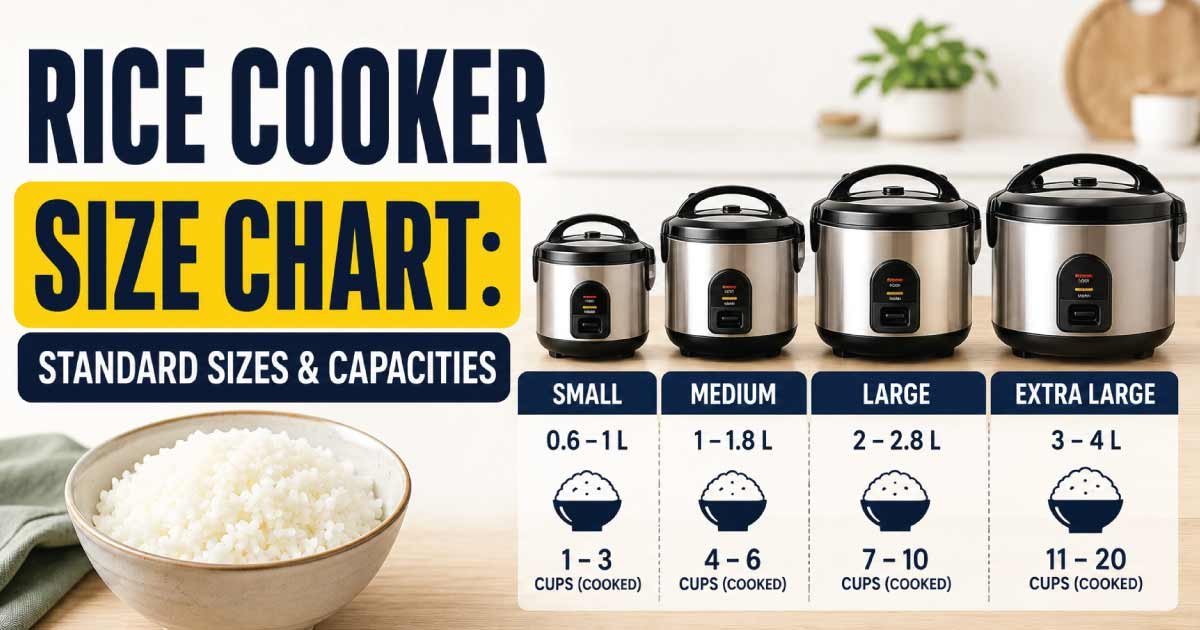
Choosing the right rice cooker size is important if you want consistent results without taking up unnecessary kitchen space. Rice cookers are available in compact personal sizes, medium household models, and large-capacity cookers designed for families or entertaining. The right choice depends on how many people you usually serve, how much uncooked rice you prepare, and whether you want the cooker for rice only or for other meals as well.
This rice cooker size chart explains common rice cooker capacities, approximate servings, dimensions, and recommended household sizes. It also explains the difference between uncooked and cooked rice capacity, which is one of the most important details to understand when comparing rice cooker sizes.
A rice cooker labeled 3 cups, for example, usually refers to 3 cups of uncooked rice, not 3 cups of cooked rice. Rice expands considerably during cooking, so the final quantity is much larger.
Rice Cooker Size Chart
Rice cooker capacities are commonly listed according to the amount of uncooked rice they can accommodate. The following chart provides a general guide.
| Rice Cooker Size | Uncooked Rice Capacity | Approx. Cooked Rice | Typical Servings | Best For |
|---|---|---|---|---|
| Mini | 1–2 cups | 2–4 cups | 1–2 people | Individuals |
| Small | 3 cups | 6 cups | 2–4 people | Couples, small households |
| Medium | 4–5 cups | 8–10 cups | 3–6 people | Small families |
| Large | 6–8 cups | 12–16 cups | 5–8 people | Families |
| Extra Large | 10 cups | 20 cups | 8–12 people | Large families |
| Commercial | 15+ cups | 30+ cups | 12+ people | Events, restaurants |
Capacities and servings are approximate. Actual cooked volume depends on the type of rice, water ratio, recipe, and serving size.
For everyday household use, 3-, 5-, and 6-cup rice cookers are among the most useful capacity ranges. A smaller cooker is convenient for one or two people, while larger models are better for families and batch cooking.
Rice Cooker Capacity: Uncooked vs. Cooked Rice
One of the biggest sources of confusion when choosing a rice cooker is the difference between uncooked and cooked rice.
How Much Does Rice Expand?
Rice generally increases significantly in volume during cooking. As a broad planning guideline, 1 cup of uncooked rice can produce approximately 2–3 cups of cooked rice, depending on the rice variety and cooking method.
For example:
| Uncooked Rice | Approx. Cooked Rice |
|---|---|
| 1 cup | 2–3 cups |
| 2 cups | 4–6 cups |
| 3 cups | 6–9 cups |
| 4 cups | 8–12 cups |
| 5 cups | 10–15 cups |
| 6 cups | 12–18 cups |
| 8 cups | 16–24 cups |
| 10 cups | 20–30 cups |
The exact yield varies, so these numbers should be used as general estimates rather than fixed measurements.
Why Rice Cooker Cups Are Different
Many rice cookers come with a small measuring cup that is approximately 180 mL, rather than the standard U.S. measuring cup of 240 mL.
This distinction matters when following recipes. If your rice cooker includes its own measuring cup, using that cup and the corresponding water markings inside the cooking pot can help produce more consistent results.
Rice Cooker Size by Number of People
Household size is one of the easiest ways to narrow down your choices.
Rice Cooker for One Person
For one person, a 1–3 cup rice cooker is usually sufficient.
A compact rice cooker is useful for:
- Individual meals
- Small portions of rice
- Meal preparation
- Small kitchens
- Dorm or office use where permitted
A mini cooker also takes less storage space and can be easier to clean.
If you regularly cook extra rice for leftovers, choosing a 3-cup model instead of a 1- or 2-cup model can provide useful additional capacity.
Rice Cooker for Two People
For two people, a 3-cup rice cooker is often a practical choice.
It provides enough capacity for regular meals without taking up the counter space required by a large family-size appliance.
If rice is a major part of your meals or you like preparing leftovers, a 4- or 5-cup cooker may be more convenient.
Rice Cooker for Three to Four People
A 4–5 cup rice cooker is a good starting range for many households of three or four.
This size offers enough capacity for family meals while remaining relatively compact.
It can be useful for cooking:
- White rice
- Brown rice
- Basmati rice
- Jasmine rice
- Mixed rice
- Rice for meal preparation
Rice Cooker for Five to Six People
For a larger family, consider a 5–8 cup rice cooker.
A 6-cup model can provide a useful balance between capacity and countertop footprint. If your household eats rice frequently or you often prepare large meals, an 8-cup model may be more suitable.
Rice Cooker for Seven or More People
Large households may benefit from a 8–10 cup rice cooker or larger.
These models are especially useful when you need to cook a large quantity of rice at once.
For parties, catering, restaurants, or other high-volume cooking, commercial rice cookers can provide considerably more capacity.
Rice Cooker Size Chart by Household
The following chart provides a quick way to compare recommended capacities.
| Household Size | Recommended Rice Cooker | Best Capacity |
|---|---|---|
| 1 person | Mini/small | 1–3 cups |
| 2 people | Small | 3 cups |
| 3–4 people | Medium | 4–5 cups |
| 5–6 people | Medium/large | 5–8 cups |
| 7–10 people | Large | 8–10 cups |
| 10+ people | Extra-large/commercial | 10–15+ cups |
These recommendations assume ordinary household servings. If your family eats large portions of rice or you frequently prepare rice for guests, choosing a larger capacity can be worthwhile.
Rice Cooker Sizes by Capacity
Rice cookers can also be categorized according to their uncooked rice capacity.
1–2 Cup Rice Cookers
Mini rice cookers are designed for small quantities.
They are ideal for:
- One-person households
- Small meals
- Limited counter space
- Occasional rice cooking
- Small portions
Their main advantage is convenience. However, they are not suitable when you regularly need to cook rice for several people.
3 Cup Rice Cookers
A 3-cup rice cooker is one of the most practical choices for individuals and couples.
Because the cooker produces several cups of cooked rice, it can provide enough for a meal plus leftovers without occupying much space.
4–5 Cup Rice Cookers
This range works well for small families.
A 5-cup cooker can provide considerably more cooked rice while remaining smaller than many large-capacity models.
For households that eat rice several times per week, this is often a versatile middle-ground option.
6–8 Cup Rice Cookers
Large household rice cookers provide more cooking capacity and are useful for families.
They can reduce the need to prepare multiple batches when you have several people to feed.
10 Cup Rice Cookers
A 10-cup rice cooker is designed for substantial quantities of rice.
It can be useful for:
- Large families
- Parties
- Holiday meals
- Meal preparation
- Frequent entertaining
- Small-scale food service
Because of their larger size, these cookers require more counter and storage space.
Rice Cooker Dimensions
Capacity is important, but the physical dimensions of the appliance also matter. A rice cooker that provides plenty of cooking capacity may be inconvenient if it does not fit comfortably in your kitchen.
Rice Cooker Width
Compact rice cookers may be around 8–10 inches wide, while larger models can exceed 12 inches.
Measure your counter space before purchasing, especially if you plan to keep the rice cooker permanently on the countertop.
Rice Cooker Depth
Depth determines how much counter space the appliance occupies from front to back.
Remember that some models have handles, control panels, steam vents, or removable components that extend beyond the main body.
Rice Cooker Height
Height is particularly important if you plan to use the cooker underneath cabinets.
Steam is released during cooking, so you should follow the manufacturer’s instructions regarding clearance and placement.
Discover More:
Rice Cooker Size and Counter Space
A large rice cooker can be convenient for families, but it also takes up more kitchen space.
Before buying, measure:
- Available countertop width
- Countertop depth
- Clearance below cabinets
- Storage space
- Distance from electrical outlets
- Room required to open the lid
Also consider where the steam will go when the cooker is operating. Avoid positioning the appliance where steam could damage cabinets or interfere with other kitchen equipment.
How Much Rice Do You Need?
Your normal serving size is another important factor.
A person who eats rice as a small side dish may need considerably less cooked rice than someone who eats rice as the main component of every meal.
For Rice as a Side Dish
If rice is mainly served alongside meat, vegetables, curry, or other foods, smaller quantities may be sufficient.
A compact or medium rice cooker may therefore meet your needs even if several people live in the household.
For Rice as a Main Dish
If rice is the main part of your meals, choose a larger cooker.
Additional capacity can be useful when preparing dishes such as:
- Fried rice
- Rice bowls
- Biryani
- Pilaf
- Rice and beans
- Meal-prep portions
The type of recipe can also affect how much space is needed inside the cooking pot.
Rice Cooker Size for Different Types of Rice
Different rice varieties can require different amounts of water and may produce different cooked volumes.
White Rice
White rice generally cooks relatively quickly and is commonly prepared in every size of rice cooker.
Brown Rice
Brown rice usually requires more cooking time and water than many white rice varieties. If brown rice is a regular part of your meals, make sure the cooker has an appropriate brown-rice setting if needed.
Basmati Rice
Basmati rice is commonly used in dishes such as biryani and pilaf. Its long grains can expand significantly during cooking, so avoid exceeding the manufacturer’s recommended maximum capacity.
Jasmine Rice
Jasmine rice is another popular long-grain variety. Follow the cooker manufacturer’s recommended water ratio rather than assuming that every rice variety requires the same amount.
Discover More:
Rice Cooker Size vs. Cooking Frequency
How often you cook can be just as important as household size.
If you cook rice once a week, a smaller cooker may be perfectly adequate.
If you cook rice every day, a larger capacity can save time by allowing you to prepare enough for multiple meals.
For Meal Prep
People who prepare meals several days in advance may benefit from a larger rice cooker.
For example, instead of preparing one small batch every day, you can cook a larger quantity and portion it into individual containers.
However, cooked rice should be cooled, stored, and reheated safely according to appropriate food-safety practices.
Rice Cooker vs. Instant Pot for Rice
A rice cooker is specifically designed around cooking rice and typically offers a straightforward cooking process.
A multi-function pressure cooker can also prepare rice while offering additional cooking functions.
| Feature | Rice Cooker | Multi-Function Pressure Cooker |
|---|---|---|
| Rice cooking | Excellent | Excellent |
| Ease of use | Simple | More settings |
| Rice-focused design | Yes | No |
| Other cooking functions | Limited or model-dependent | Many |
| Counter space | Usually moderate | Moderate to large |
| Best for | Frequent rice cooking | Multi-purpose cooking |
If rice is a staple in your household, a dedicated rice cooker can be convenient. If you want one appliance to perform many different cooking tasks, a multi-function cooker may be more versatile.
How to Choose the Right Rice Cooker Size
Before buying, consider these factors:
- Number of people you regularly serve
- Typical rice portion size
- How often you cook rice
- Whether you want leftovers
- Whether you prepare meals in batches
- Available counter space
- Storage space
- Types of rice you cook
- Other foods you want to prepare
- Available cooking settings
Don’t choose a rice cooker solely because it has the largest capacity. An oversized cooker can take up unnecessary space and may not be convenient for preparing very small portions.
Likewise, choosing a model that is too small can force you to cook multiple batches.
Discover More:
Common Rice Cooker Size Mistakes
Confusing Uncooked and Cooked Capacity
A rice cooker labeled “5 cups” usually refers to its uncooked rice capacity, not five cups of cooked rice.
Always check the manufacturer’s capacity description.
Ignoring the Included Measuring Cup
The included rice cup may not equal a standard kitchen measuring cup. Use the manufacturer’s cup and the corresponding pot markings when possible.
Overfilling the Cooking Pot
Never exceed the maximum fill line. Rice expands as it cooks, and different foods may foam or expand differently.
Buying Too Small
A tiny rice cooker may be convenient for one person but frustrating when cooking for guests or preparing several meals at once.
Buying Too Large
A large cooker can take up valuable counter space if you only prepare one or two servings at a time.
Frequently Asked Questions About Rice Cooker Sizes
What is the best rice cooker size for one person?
A 1–3 cup rice cooker is generally suitable for one person. A 1- or 2-cup model is useful for small portions, while a 3-cup cooker gives you more flexibility for leftovers or larger meals.
What size rice cooker is best for two people?
A 3-cup rice cooker is a practical choice for two people. If you regularly eat large portions or want to cook extra rice for later meals, consider a 4- or 5-cup model.
What size rice cooker is best for a family of four?
A 4–5 cup rice cooker can work well for a family of four, depending on portion sizes. If rice is served at most meals or you want substantial leftovers, an 6- or 8-cup model may be more convenient.
Is a 3-cup rice cooker enough for two people?
Yes. A 3-cup rice cooker can provide enough cooked rice for two people, particularly when rice is served as a side dish. Your required capacity will depend on serving sizes and whether you want leftovers.
How many cups of rice does a 5-cup rice cooker make?
A 5-cup rice cooker typically refers to 5 cups of uncooked rice at its stated maximum capacity. Depending on the rice variety and cooking method, this can produce approximately 10–15 cups of cooked rice.
What does a 10-cup rice cooker mean?
A 10-cup rice cooker generally refers to a maximum capacity of 10 cups of uncooked rice. The resulting cooked rice volume can be considerably larger, depending on the rice variety and water ratio.
How much rice should I cook per person?
A common planning amount is around ½ to 1 cup of uncooked rice per person, depending on appetite and whether rice is a main dish or side dish. Actual requirements vary by household and meal.
Can I cook less rice in a large rice cooker?
Some large rice cookers can cook smaller quantities, but the minimum recommended amount varies by model. Check the manufacturer’s instructions to ensure the cooker can operate properly with a small batch.
Are rice cooker cups the same as measuring cups?
Usually not. Many rice cookers include a measuring cup that is approximately 180 mL, smaller than the standard 240 mL U.S. measuring cup. Use the included cup and cooker markings when following the manufacturer’s instructions.
Conclusion
Choosing the right rice cooker size becomes much easier once you understand that capacity usually refers to uncooked rice. A 1–3 cup model is useful for individuals, a 3-cup cooker works well for couples, and 4–5 cup models are practical for many small families. Larger households can consider 6–10 cup cookers, while commercial models provide much greater capacity.
The best choice depends on more than household size. Consider your portion sizes, cooking frequency, desire for leftovers, meal-preparation habits, countertop space, and the types of rice you regularly prepare.
Use this rice cooker size chart as a starting point when comparing models, but always check the manufacturer’s exact capacity, dimensions, minimum cooking quantity, and operating instructions before purchasing. The ideal rice cooker is large enough for your normal meals without taking up more space than you actually need.
