
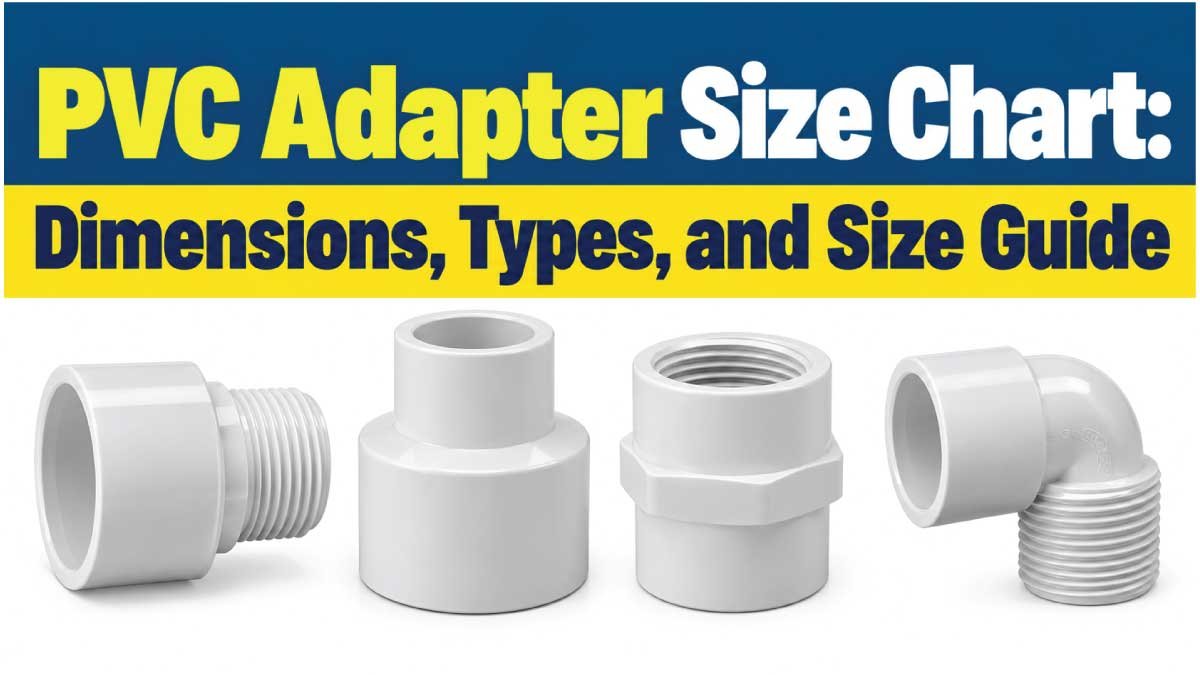
Choosing the correct PVC adapter is important when connecting pipes to threaded fittings, valves, pumps, water lines, or other plumbing components. An adapter with the wrong nominal size or thread type may not fit properly and can lead to leaks, damaged threads, or installation difficulties.
PVC adapters are available in different sizes, connection styles, and pressure ratings. Some connect a PVC pipe to a male-threaded fitting, while others connect to female threads or transition between different pipe sizes.
This PVC adapter size guide explains common nominal pipe sizes, actual pipe outside diameters, adapter types, important dimensions, and measurement methods. Whether you are working on household plumbing, irrigation, drainage, or a compatible pressure piping system, understanding these details will help you select an appropriate adapter for your project.
What Is a PVC Adapter?
A PVC adapter is a pipe fitting designed to connect a PVC pipe to another fitting, pipe connection, valve, or component with a different connection style. Depending on the design, an adapter may have a solvent-weld socket, male threads, female threads, or a combination of these connections.
PVC stands for polyvinyl chloride. It is commonly used in plumbing, irrigation, drainage, and other piping applications. Unplasticized PVC, commonly called uPVC or PVC-U, is also used in many rigid piping systems.
An adapter does not necessarily change the pipe diameter. Some adapters connect the same nominal size using different connection methods, while others provide a transition between different sizes.
Common Uses of PVC Adapters
PVC adapters are used for several purposes:
Connecting threaded components: Joining compatible PVC pipe to threaded valves, fittings, or equipment.
Connecting pipes and fittings: Transitioning from a socket connection to a threaded connection.
Irrigation installations: Connecting compatible piping to valves, filters, and other components.
Plumbing modifications: Adapting an existing connection to a different fitting style.
Equipment connections: Connecting suitable PVC piping to compatible pumps or other components.
Size transitions: Connecting different nominal pipe sizes when a suitable reducing adapter is available.
The correct adapter depends on the pipe dimensions, connection standard, thread type, and operating conditions.
PVC Adapter Size Chart for Common Pipe Sizes
PVC adapters are commonly identified by the nominal pipe size they fit. In North American PVC systems, the nominal pipe size does not necessarily equal the actual outside diameter.
The following chart lists common nominal pipe sizes and their corresponding outside diameters. These dimensions help identify compatible pipe, but they do not represent the complete external dimensions of an adapter.
| Nominal Pipe Size | Pipe Outside Diameter (inches) | Pipe Outside Diameter (mm) | Common Applications |
|---|---|---|---|
| 1/2 inch | 0.840 in | 21.34 mm | Small plumbing connections |
| 3/4 inch | 1.050 in | 26.67 mm | Residential water lines |
| 1 inch | 1.315 in | 33.40 mm | Plumbing and irrigation |
| 1 1/4 inches | 1.660 in | 42.16 mm | Larger branch connections |
| 1 1/2 inches | 1.900 in | 48.26 mm | Plumbing and drainage |
| 2 inches | 2.375 in | 60.33 mm | Irrigation and general piping |
| 2 1/2 inches | 2.875 in | 73.03 mm | Larger piping connections |
| 3 inches | 3.500 in | 88.90 mm | Drainage and commercial piping |
| 4 inches | 4.500 in | 114.30 mm | Larger drainage systems |
| 6 inches | 6.625 in | 168.28 mm | Large piping installations |
| 8 inches | 8.625 in | 219.08 mm | Commercial and industrial piping |
These measurements apply to common North American nominal pipe sizing conventions. Metric PVC systems use different nominal dimensions, so confirm the relevant system before selecting an adapter.
How to Interpret PVC Adapter Sizes
A fitting labeled 1 inch is generally designed for the corresponding 1-inch nominal pipe system. It does not mean that the pipe’s outside diameter measures exactly 1 inch.
For example, common North American 1-inch nominal PVC pipe has an outside diameter of approximately 1.315 inches.
When buying an adapter, check three details:
Pipe size: The nominal size of the pipe connection.
Connection type: Socket, male thread, female thread, or a combination.
Thread specification: The type and size of the threaded connection, where applicable.
A fitting can have the correct nominal pipe size and still be incompatible if its thread standard or connection design differs.
Types of PVC Adapters and Their Uses
PVC adapters are available in several configurations. Understanding the differences helps you choose the right fitting for your installation.
PVC Male Adapter
A PVC male adapter typically has a socket on one end and external threads on the other. The socket accepts compatible PVC pipe, while the threaded end connects to a matching female-threaded fitting.
Male adapters are commonly used to connect PVC piping to valves, threaded fittings, and compatible equipment.
Before installation, verify the thread standard and the pressure rating of the adapter. Avoid overtightening because excessive force can damage or split plastic threads.
PVC Female Adapter
A PVC female adapter usually has a socket on one end and internal threads on the other. The socket connects to compatible PVC pipe, while the female-threaded end accepts a matching male-threaded component.
Common uses include:
- Connecting PVC pipe to a male-threaded valve.
- Connecting compatible threaded fittings to a PVC line.
- Creating a threaded connection where future removal may be necessary.
Female adapters must have the correct thread dimensions and design for the component being connected.
PVC Socket Adapter
A socket adapter connects a PVC pipe to another compatible connection style. Depending on the product, it may have sockets at both ends or combine a socket with a different fitting end.
The term can vary between manufacturers, so examine the product drawing rather than relying on the name alone.
PVC Reducing Adapter
A reducing adapter connects two different nominal sizes or provides a transition between different connection configurations.
For example, a reducing adapter may connect a larger PVC pipe to a smaller compatible threaded connection.
Check both ends of the fitting carefully. A product described as 2 inches by 1 inch generally indicates two different connection sizes, but the exact end types should be confirmed.
PVC Threaded Adapter
A threaded adapter uses external threads, internal threads, or both to connect compatible threaded components.
Some adapters use tapered pipe threads, while others use parallel threads. These thread forms are not automatically interchangeable.
Use the correct thread sealant or sealing method specified for the connection. Do not assume that every threaded plastic fitting requires the same sealing material.
PVC Union and Transition Fittings
Unions and other transition fittings are sometimes considered alongside adapters because they help connect different components. However, they have different designs and purposes.
A union generally allows a connection to be disconnected without cutting the pipe. A transition fitting may connect different materials or connection systems.
Select a union or transition fitting when its specific function is needed rather than substituting an ordinary adapter.
Also Read:
PVC Adapter Dimensions Explained
Nominal size alone does not describe the complete dimensions of a PVC adapter. If space is limited or a threaded component must fit precisely, several additional measurements may matter.
Outside Diameter
The outside diameter is the distance across the outer surface of the pipe or fitting.
For socket adapters, the adapter’s outer body is generally larger than the pipe outside diameter. The exact dimension varies with the fitting’s design and size.
Socket Inside Diameter
The socket is the part designed to receive a compatible pipe. Its internal geometry is manufactured to suit the specified pipe system.
Do not attempt to select a socket adapter by measuring its opening alone. Socket entrance dimensions, internal taper, and insertion depth may affect compatibility.
Socket Depth
Socket depth is the distance from the socket opening to its internal stop, where one is provided.
This dimension affects how far the pipe enters the fitting. Follow the manufacturer’s joining instructions to establish the correct insertion and assembly procedure.
Thread Diameter and Size
Threaded adapters must match the connection’s thread specification. The nominal thread size is not necessarily equal to the measured outside diameter of the threaded section.
For example, pipe threads labeled 1/2 inch do not generally measure exactly 1/2 inch across their outermost thread diameter.
Always confirm the thread type, nominal size, and mating component.
Overall Length
Overall length measures the fitting from one end to the other. It can be important where an adapter must fit into a narrow space or connect equipment with fixed spacing.
Exact overall lengths vary by product design and manufacturer. Use a product-specific dimensional drawing when the measurement is critical.
Also Read:
PVC Male Adapter vs. Female Adapter
Male and female adapters perform similar general functions, but their threaded ends differ.
| Feature | Male PVC Adapter | Female PVC Adapter |
|---|---|---|
| Thread type | External threads | Internal threads |
| Typical pipe connection | Socket end | Socket end |
| Mating component | Compatible female-threaded fitting | Compatible male-threaded fitting |
| Common purpose | Connect PVC pipe to a female thread | Connect PVC pipe to a male thread |
| Key consideration | External thread compatibility | Internal thread compatibility |
A male adapter is not automatically better than a female adapter. The appropriate option depends on the threaded connection already present on the valve, fitting, or equipment.
For example, a PVC pipe ending near a valve with female threads may require a compatible male adapter. If the valve has male threads, a compatible female adapter may be appropriate.
In both cases, confirm the thread standard and installation requirements before joining the components.
How to Measure a PVC Adapter Correctly
Measuring the fitting can help you identify its size and confirm whether it will fit the available space. However, measurements should be used alongside product markings and specifications.
Step 1: Identify the Pipe and Fitting Material
Check whether the pipe and adapter are PVC, CPVC, or another material. Similar-looking plastic fittings are not necessarily interchangeable.
Identify any printed markings, nominal sizes, pressure ratings, or standard designations.
Step 2: Measure the Pipe Outside Diameter
Use a ruler or caliper to measure across the outside of the pipe.
Compare this measurement with the expected outside diameter for the relevant nominal pipe size. Do not assume that a measured diameter in inches directly identifies the nominal size.
Step 3: Identify the Adapter End Types
Determine whether each end is a socket, male thread, female thread, or another connection.
For a reducing adapter, record the size and connection type of both ends separately.
Step 4: Check the Thread Specification
If the adapter is threaded, determine whether it uses the appropriate tapered or parallel thread standard.
A similar-looking thread may not seal correctly if the thread forms differ. Do not force incompatible threaded parts together.
Step 5: Check Overall Dimensions
Measure the adapter’s outside diameter, overall length, socket depth, and threaded section as needed.
If the fitting must fit a tight space, compare your measurements with the manufacturer’s drawing before purchasing.
Also Read:
PVC Adapter Sizes for Plumbing and Irrigation
Different piping applications may require different adapter sizes and connection specifications.
Small Adapters for Residential Plumbing
Common smaller nominal sizes include 1/2 inch, 3/4 inch, and 1 inch. These sizes may be used for compatible branch lines, valves, and other plumbing connections.
The correct adapter depends on the type of pipe and the requirements of the particular water system.
Medium Adapters for Irrigation Systems
Sizes such as 1 1/4 inches, 1 1/2 inches, and 2 inches are used in various compatible irrigation and piping installations.
When choosing an adapter for irrigation, check the operating pressure, water conditions, and compatibility with the existing fittings.
Larger Adapters for Drainage and Commercial Piping
Larger sizes, including 3-inch, 4-inch, and 6-inch fittings, may be used in compatible drainage or larger piping systems.
For drainage applications, confirm whether the fitting is intended for non-pressure service. A fitting suitable for gravity drainage is not automatically appropriate for pressurized water.
Choosing an Adapter for Equipment
Pumps, filters, valves, and other equipment may use connection specifications that differ from those of the PVC pipe.
Check the equipment’s inlet or outlet size, thread type, sealing surface, and operating limits. Use a compatible transition fitting when the equipment connection does not match the pipe system directly.
Schedule 40 and Schedule 80 PVC Adapters
Schedule 40 and Schedule 80 describe pipe wall-thickness series used in applicable PVC piping systems. They are not simply labels for different nominal diameters.
For common North American pressure pipe, Schedule 40 and Schedule 80 PVC pipes of the same nominal size generally share the same outside diameter, while their wall thicknesses and inside diameters differ.
| Feature | Schedule 40 PVC | Schedule 80 PVC |
|---|---|---|
| Pipe wall thickness | Generally thinner | Generally thicker |
| Outside diameter at the same nominal size | Same standard OD in the applicable system | Same standard OD in the applicable system |
| Inside diameter | Generally larger | Generally smaller |
| Pressure suitability | Depends on product and operating conditions | Depends on product and operating conditions |
| Common appearance | Often white, but varies | Often gray, but varies |
Color should not be used as the only method of identification.
Although the outside diameters can be the same, adapter compatibility must still be verified. Check the fitting’s intended pipe system, connection type, pressure rating, and manufacturer’s specifications.
Common Mistakes When Selecting PVC Adapters
Choosing an adapter based only on its nominal size can lead to compatibility problems. Avoid these common mistakes:
Confusing nominal size with actual diameter: A nominal 1-inch PVC pipe does not have a 1-inch outside diameter in common North American sizing.
Ignoring the thread type: Matching nominal thread sizes does not guarantee that two thread standards are compatible.
Selecting the wrong adapter end: Male and female threaded connections have different purposes.
Overlooking reducing dimensions: A reducing adapter has separate connection sizes that must both match the intended components.
Assuming all PVC fittings are pressure-rated: Verify the intended service and pressure rating.
Using excessive tightening force: Plastic threads can crack or split when overtightened.
Ignoring temperature limits: The fitting’s allowable pressure and service conditions may depend on temperature.
Mixing incompatible materials: Confirm that the adapter, pipe, joining method, and connected components are suitable for the system.
Taking time to check these details before installation can help prevent leaks, damage, and unnecessary replacement.
Frequently Asked Questions About PVC Adapter Sizes
What Size PVC Adapter Do I Need?
Choose an adapter that matches the pipe’s nominal size, connection type, and applicable dimensional standard. If the adapter connects to threaded equipment, also verify the thread specification.
What Is the Difference Between a PVC Male and Female Adapter?
A male adapter has external threads, while a female adapter has internal threads. Both may include a socket for connecting to compatible PVC pipe.
Are PVC Adapter Sizes the Same as PVC Pipe Sizes?
Adapter labels commonly correspond to the nominal pipe size they are designed to connect to. However, nominal size is not necessarily the same as actual outside diameter, and the adapter’s full dimensions vary by design.
Can a PVC Adapter Connect Different Pipe Sizes?
Yes. A reducing adapter or another suitable transition fitting can connect compatible components of different nominal sizes. Verify both connection sizes and the type of each end.
Can PVC Adapters Be Used With Metal Threads?
Some PVC adapters are designed for compatible threaded metal components. Confirm the thread standard and follow the manufacturer’s installation and sealing instructions. Avoid excessive tightening because plastic threads can be damaged.
Are Schedule 40 and Schedule 80 PVC Adapters Interchangeable?
Some fittings may be compatible when they use the same nominal size and connection standard, but interchangeability should not be assumed for every product. Check the specific fitting’s dimensions, pressure rating, and intended application.
How Do I Prevent Leaks at a PVC Threaded Adapter?
Use compatible threaded components, follow the recommended sealing method, and tighten the connection according to the manufacturer’s instructions. Avoid overtightening and inspect the finished joint for leaks before placing the system into service.
Conclusion
Selecting the correct PVC adapter requires more than matching a number on the fitting. You need to confirm the nominal pipe size, actual pipe dimensions, adapter configuration, thread type, and intended operating conditions.
Use this PVC adapter size guide to understand common pipe dimensions, compare male and female adapters, and identify the measurements that matter during installation. Always verify exact fitting dimensions and compatibility with the manufacturer’s specifications, especially for pressurized systems or threaded connections. The right adapter helps create a secure, compatible connection for your plumbing or piping project.
