
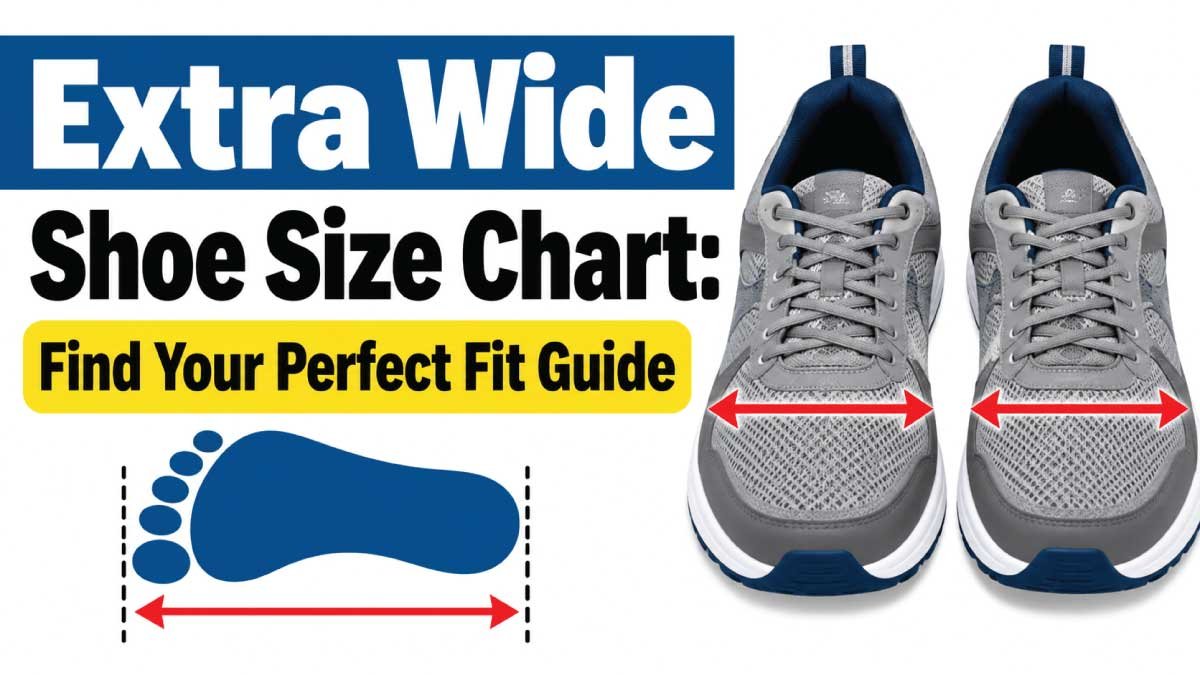
Finding shoes that fit comfortably can be challenging when standard and wide-width options still feel tight around your toes, forefoot, or sides. Shoes that are too narrow may cause rubbing, pressure, blisters, and discomfort during walking or standing. An extra wide shoe size chart helps you understand width labels, compare sizing options, measure your feet, and choose footwear that provides enough room without sacrificing stability.
Extra-wide shoes are designed for people who need more space across the foot than standard or regular-wide footwear provides. They are available in selected running shoes, walking shoes, work boots, casual footwear, and dress shoes. However, width labels vary by manufacturer, gender, and sizing system, so choosing the right fit requires more than simply selecting a larger number.
This guide covers extra-wide shoe sizes for men and women, common width labels, foot measurement techniques, sizing conversions, fitting tips, and common mistakes to avoid.
What Is an Extra Wide Shoe Size?
An extra-wide shoe size refers to footwear designed to provide more width than a standard or regular-wide shoe of a comparable length. The additional room is generally concentrated around the ball of the foot and forefoot, although the exact shape depends on the shoe’s design.
Extra-wide footwear can be particularly useful when the sides of a standard shoe press against the feet even though the length is correct.
What Do Extra Wide Shoe Width Labels Mean?
Shoe width is commonly indicated by letters, numbers, or abbreviations. These labels describe a shoe’s width category within a particular sizing system.
Common US footwear width labels include:
B: Commonly standard width for women’s shoes.
D: Commonly standard width for men’s shoes.
2E or EE: Commonly indicates a width beyond standard in men’s footwear.
4E: Commonly indicates extra-wide men’s footwear.
6E: Available in selected specialty extra-wide men’s shoe ranges.
D or 2E in women’s footwear: May represent wide or extra-wide options, depending on the brand.
These labels are not universal. For example, a D-width men’s shoe and a D-width women’s shoe do not necessarily have the same width.
Always check the sizing chart for the specific brand and shoe model before purchasing.
Who Needs Extra Wide Shoes?
Extra-wide footwear may be suitable if:
- Standard-width shoes feel tight around the ball of your foot.
- Wide shoes still squeeze your toes or the sides of your forefoot.
- You experience repeated rubbing near your little toe.
- Your feet spread noticeably when you stand.
- Your feet feel compressed even when the shoe length is correct.
- You need additional room to accommodate your natural foot shape or certain orthotic inserts.
If your toes touch the front of your shoes, however, the problem may involve shoe length rather than width. Check both measurements before choosing a new size.
Extra Wide Shoe Size Chart for Men
Men’s extra-wide shoes are commonly available in US sizing with width labels such as 2E, 4E, and, in some specialty ranges, 6E.
The following chart explains common men’s width categories. It is a general labeling guide rather than a chart of exact foot-width measurements.
| US Men’s Width Label | Common Width Category | General Fit Purpose |
|---|---|---|
| B | Narrow | For feet narrower than standard |
| D | Standard | For average-width feet |
| 2E (EE) | Wide or extra-wide | For feet needing more forefoot room |
| 4E | Extra-wide | For feet needing additional width beyond 2E |
| 6E | Specialty extra-wide | For particularly broad feet in available models |
The terms wide and extra-wide are not used consistently across every manufacturer. Some brands classify 2E as extra-wide, while others describe it as wide.
How to Choose the Correct Men’s Extra Wide Size
Start with the shoe length that fits your longer foot. Then compare standard, 2E, and 4E options if the shoe model offers them.
For example, if a men’s shoe in your correct length feels tight at the ball of the foot, trying a 2E version may improve comfort. If that still feels restrictive, a 4E model may provide more room.
Do not assume that moving to a wider width will solve every fit problem. A shoe with a narrow toe-box shape may remain uncomfortable even when its overall width label indicates extra-wide.
Extra Wide Shoe Size Chart for Women
Women’s extra-wide footwear is also available in different width categories. In many US women’s shoe ranges, B is the standard width, D indicates wide, and 2E indicates extra-wide.
| US Women’s Width Label | Common Width Category | General Fit Purpose |
|---|---|---|
| AAAA | Extra narrow | For very narrow feet |
| AA | Narrow | For narrower-than-standard feet |
| B | Standard | For average-width feet |
| D | Wide | For feet needing additional width |
| 2E (EE) | Extra-wide | For feet needing more room than a wide shoe |
| 4E | Specialty extra-wide | Available in selected women’s shoe ranges |
Not every brand offers every width, and some manufacturers use labels such as W, XW, or WW instead of letter-based designations.
Tips for Buying Women’s Extra Wide Shoes
When choosing women’s extra-wide footwear, consider these factors:
Check the width label: Confirm that the shoe is explicitly offered in a wide or extra-wide version.
Prioritize toe-box shape: A broad toe box can improve comfort when the toes spread naturally.
Check heel security: Extra room at the forefoot should not cause excessive heel movement.
Try your usual socks: Sock thickness can affect the fit.
Walk in the shoes: Test the fit while standing and moving rather than relying only on how the shoes feel while seated.
The ideal shoe should accommodate your forefoot without creating unnecessary space around the heel.
Extra Wide Shoe Size Chart by Foot Measurements
Width letters help you compare shoe options, but measuring your feet provides a more practical starting point. Foot measurements can be compared with a manufacturer’s sizing chart to identify the most suitable length and width.
| Measurement | How It Is Measured | Why It Matters |
|---|---|---|
| Foot length | Heel to longest toe | Helps determine shoe length |
| Foot width | Across the widest part of the forefoot | Helps assess width requirements |
| Ball circumference | Around the broadest part of the forefoot | Indicates forefoot volume |
| Instep circumference | Around the upper middle portion of the foot | Helps assess pressure across the top |
| Heel width | Across the heel area | Helps assess heel fit and stability |
There is no single foot-width measurement that universally defines an extra-wide shoe. The appropriate width depends on foot length, shoe construction, sizing conventions, and the manufacturer’s specifications.
Why Extra Wide Shoe Measurements Vary
A foot-width measurement cannot be interpreted independently of foot length. The same width measurement may correspond to different width categories for shoes of different lengths.
Manufacturers may also use different shoe lasts, which are the forms around which footwear is constructed. These differences affect toe-box shape, internal volume, and the way a shoe fits.
For this reason, use a brand’s combined length-and-width chart whenever possible instead of relying on a universal millimeter threshold.
How to Measure Your Feet for Extra Wide Shoes
Measuring your feet at home can help you identify the correct starting size and avoid purchasing shoes that are too narrow.
Step 1: Gather Your Measuring Tools
You will need:
- A sheet of paper larger than your foot.
- A pencil or pen.
- A ruler or measuring tape.
- The socks you normally wear with the shoes.
Measure both feet because one foot may be slightly longer or wider than the other.
Step 2: Measure Foot Length
Place the paper on a flat, hard surface and stand on it with your weight distributed naturally.
Mark the back of your heel and the tip of your longest toe. Measure the distance between the two marks.
Repeat for the other foot and record both measurements.
Use your longer foot to determine the appropriate shoe length.
Step 3: Measure Foot Width
While standing, identify the widest points on the inside and outside edges of your forefoot.
Measure the straight-line distance between those points. Keep the ruler level and avoid measuring diagonally around your foot.
Repeat the process for the other foot.
Step 4: Record Your Results
Write down your foot length and width in millimeters or centimeters.
For example, an illustrative measurement record might look like this:
| Foot | Length (mm) | Width (mm) |
|---|---|---|
| Left | 270 | 104 |
| Right | 272 | 106 |
These figures are examples only and do not establish a universal extra-wide sizing threshold. Use your actual measurements with the relevant manufacturer’s chart.
Step 5: Compare Your Measurements With the Brand’s Chart
First, identify the appropriate length. Then check which width category accommodates your measured foot.
If a brand provides foot circumference rather than straight-line width, use the specified measurement method. Circumference and width are different measurements and should not be compared directly.
Also Read:
Extra Wide vs. Wide Shoes: What’s the Difference?
Wide and extra-wide shoes both provide more space than standard-width footwear, but extra-wide models generally offer additional room.
| Feature | Standard Width | Wide Width | Extra-Wide Width |
|---|---|---|---|
| Forefoot room | Standard | Increased | Further increased |
| Toe-box room | Depends on design | Often more generous | Often more generous |
| Typical labels | B or D, depending on category | W, D, or brand-specific labels | 2E, 4E, or other labels |
| Best suited for | Average-width feet | Feet needing additional space | Feet needing substantially more space |
| Availability | Common | Brand-dependent | More limited in some ranges |
The actual difference between these categories depends on the manufacturer and shoe model. An extra-wide shoe from one brand may fit differently from a wide shoe from another.
When Should You Choose Extra-Wide Instead of Wide?
Consider extra-wide shoes if:
- Standard shoes feel tight across the forefoot.
- Wide shoes still cause pressure on the sides of your feet.
- Your toes cannot spread comfortably inside regular-width footwear.
- You need additional forefoot space without increasing shoe length.
If extra-wide shoes feel too loose around the heel, consider a different shoe shape or lacing technique rather than automatically choosing a narrower size.
Also Read:
Extra Wide Shoe Size Conversion: US, UK, and EU
US, UK, and EU shoe sizing systems use different length conventions, while width labels may also differ between regions and manufacturers.
| Sizing System | Common Width Information | Important Consideration |
|---|---|---|
| US men’s | D, 2E, 4E, sometimes 6E | Commonly uses letter-and-number width categories |
| US women’s | B, D, 2E in many ranges | Width conventions differ from men’s sizing |
| UK | Manufacturer-specific width labels | Check the individual brand’s chart |
| EU | Standard sizing with optional wider models | EU size alone does not establish shoe width |
| International retail | Standard, Wide, Extra Wide | Descriptions may not represent identical dimensions |
Can You Convert Extra Wide Shoe Sizes Directly?
There is no reliable universal conversion for extra-wide width labels across US, UK, and EU footwear.
Even when shoe length conversions are available, width designations may use different conventions. A US 4E shoe, for example, cannot automatically be translated into a particular UK or EU width label.
For international purchases:
- Measure both feet.
- Determine your length using the destination brand’s chart.
- Check the width options for the exact shoe model.
- Compare the stated measurements if available.
- Review the brand’s fitting guidance before ordering.
This approach is more reliable than choosing a width based solely on a generic conversion chart.
Also Read:
Best Types of Extra Wide Shoes
The best extra-wide shoe depends on how you plan to use it. Different footwear categories have different requirements for support, flexibility, protection, and fit.
Extra Wide Running Shoes
Running shoes should provide adequate forefoot room, a secure heel, and suitable support for your activity.
Look for models specifically offered in extra-wide widths. A wider toe box can help prevent the sensation of toes being squeezed during movement.
Extra Wide Walking Shoes
Walking shoes should feel comfortable over extended periods. Check that the upper does not press against the sides of your feet and that the heel remains secure during each step.
A suitable fit is particularly important when walking for long periods or standing throughout the day.
Extra Wide Work Boots
Work boots must balance width, stability, and job-specific protection. If your workplace requires safety footwear, confirm that the extra-wide model meets the applicable protective requirements.
Do not assume that simply buying a longer boot provides the same comfort or protection as selecting the correct width.
Extra Wide Casual Shoes
Casual shoes are available in various shapes, materials, and width options. Flexible uppers may accommodate some foot shapes more comfortably, but they cannot compensate for a shoe that is fundamentally too narrow.
Extra Wide Dress Shoes
Dress shoes often have tapered toe boxes, which can restrict wider forefeet. Look for models with a broader forefoot and evaluate the actual shape rather than relying exclusively on the width label.
Common Mistakes When Buying Extra Wide Shoes
Avoid these common mistakes to improve your chances of finding comfortable footwear.
Buying a Longer Size Instead of a Wider Width
If the shoe fits properly from heel to toe but feels tight across the sides, increasing length may cause heel slipping without solving the width problem.
Try a wider version in the correct length first.
Assuming All Extra Wide Shoes Fit the Same
Width labels are only a starting point. Shoe lasts, materials, and internal shapes differ between manufacturers and even between models from the same brand.
Always assess the individual shoe.
Ignoring Toe-Box Shape
Some shoes taper sharply toward the toes even when labeled extra-wide. Check that your toes have sufficient room to spread naturally.
Measuring Only One Foot
Your feet may differ in length or width. Measure both and use the larger measurements when identifying your starting size.
Choosing Shoes That Are Too Loose
Extra-wide shoes should not allow excessive foot movement. Too much space can cause rubbing, instability, and discomfort.
The aim is sufficient room across the forefoot combined with a secure heel and midfoot.
Ignoring Changes in Foot Size
Foot measurements can change over time. Recheck your size when buying new footwear, particularly if your current shoes have become uncomfortable or your feet have changed noticeably.
Frequently Asked Questions About Extra Wide Shoe Sizes
What does 4E mean in shoe sizes?
In many US men’s footwear ranges, 4E indicates an extra-wide width. It generally provides more room than 2E, although the precise fit depends on the brand and model.
Is 2E considered extra-wide?
In some men’s shoe ranges, 2E is described as extra-wide, while other manufacturers classify it as wide. Always check the manufacturer’s terminology.
What is the widest shoe size available?
Some specialty shoe ranges offer widths such as 6E or wider, but availability varies by brand, model, and shoe length. There is no single maximum width offered by all manufacturers.
Are extra-wide shoes longer than regular shoes?
Not necessarily. Extra-wide versions are intended to provide additional width at a comparable nominal length. Confirm the shoe’s actual sizing information rather than assuming that width changes length.
Can women wear men’s extra-wide shoes?
Yes, if the length, width, shape, and overall fit are suitable. However, men’s and women’s shoes may differ in proportions and width conventions, so compare actual measurements instead of relying on labels alone.
Do extra-wide shoes help with foot pain?
They may reduce discomfort caused by shoes that squeeze the forefoot. However, persistent pain, swelling, numbness, or other symptoms may have causes unrelated to footwear width and should be assessed by a qualified healthcare professional.
Should extra-wide shoes feel loose at first?
No. They should provide comfortable space across the forefoot while holding the heel and midfoot securely. Your toes should not feel squeezed, but your feet should not slide excessively inside the shoes.
How often should I measure my feet?
Measure your feet when purchasing new footwear if your current size no longer feels comfortable. Periodic measurements can also help account for changes in foot shape, swelling, or fit preferences.
Conclusion
An extra wide shoe size chart helps you understand width labels, compare footwear options, and identify shoes that provide sufficient space across your feet. The most reliable approach is to measure both feet, select the correct length, and then compare standard, wide, and extra-wide options using the manufacturer’s sizing information.
Whether you need extra-wide running shoes, walking shoes, work boots, or casual footwear, prioritize forefoot comfort, adequate toe-box space, and a secure heel. Choosing the correct width can make everyday walking more comfortable without sacrificing fit or stability.
