
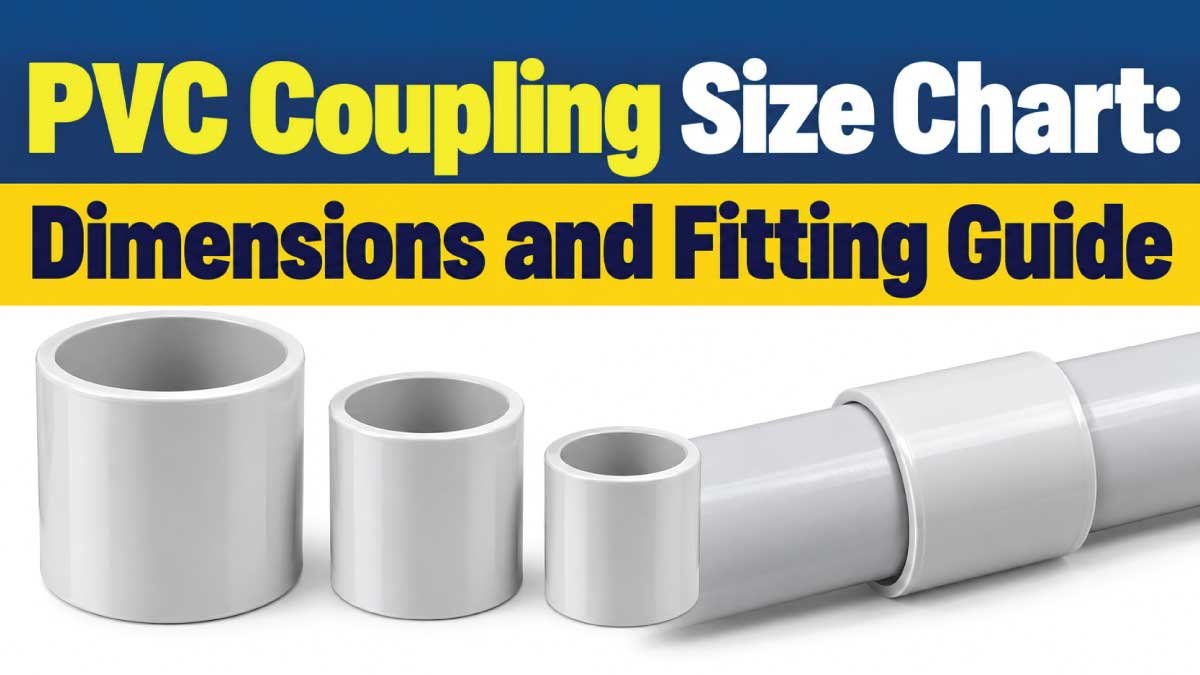
PVC couplings are essential plumbing fittings used to connect two sections of pipe in a straight line. They help extend pipe runs, repair damaged sections, and join compatible pipes in residential plumbing, irrigation, drainage, and industrial applications. Choosing the correct coupling size is important for creating a secure connection, maintaining proper alignment, and preventing leaks.
However, selecting a PVC coupling involves more than matching the nominal pipe size. You must also consider the actual outside diameter of the pipe, the fitting’s internal dimensions, connection type, material, and pressure rating. PVC couplings designed for pressure systems may differ from those intended for drainage or non-pressure applications.
This PVC coupling size chart and fitting guide explains common sizes, dimensions, coupling types, measurement methods, and selection considerations. Whether you are installing a new pipeline or replacing an existing fitting, understanding these details can help you choose the right PVC coupling for your project.
What Is a PVC Coupling?
A PVC coupling is a pipe fitting designed to connect two compatible pipe sections. A standard straight coupling typically has an opening at each end, allowing the pipes to meet inside the fitting.
PVC stands for polyvinyl chloride, a widely used plastic material known for its corrosion resistance, relatively low weight, and ease of installation. PVC couplings are available in various sizes and designs to accommodate different piping systems.
Common applications include:
- Residential water distribution systems.
- Irrigation and agricultural pipelines.
- Drainage and wastewater systems.
- Swimming pool plumbing.
- Rainwater collection systems.
- Commercial plumbing installations.
- Industrial piping applications approved for PVC.
A coupling can also be used to join two pipe sections after cutting out a damaged area. However, the replacement fitting must match the pipe dimensions, joining method, and intended service.
PVC Coupling Size Chart
PVC couplings are generally identified by the nominal pipe size they accommodate. Common sizes range from 1/2 inch to 6 inches and larger, depending on the piping system and manufacturer.
The following table lists representative North American nominal pipe sizes and their approximate matching outside diameters. These measurements are useful for identifying compatible pipe sizes, but they do not represent the complete outside dimensions or internal dimensions of a coupling.
| Nominal Pipe Size | Approx. Outside Diameter (Inches) | Approx. Outside Diameter (mm) | Common Applications |
|---|---|---|---|
| 1/2 inch | 0.840 | 21.3 | Small plumbing lines and equipment connections |
| 3/4 inch | 1.050 | 26.7 | Residential plumbing and irrigation |
| 1 inch | 1.315 | 33.4 | Water distribution branches |
| 1 1/4 inches | 1.660 | 42.2 | Medium-sized plumbing connections |
| 1 1/2 inches | 1.900 | 48.3 | Drainage and equipment piping |
| 2 inches | 2.375 | 60.3 | Pool plumbing and irrigation |
| 2 1/2 inches | 2.875 | 73.0 | Larger water distribution lines |
| 3 inches | 3.500 | 88.9 | Drainage and commercial piping |
| 4 inches | 4.500 | 114.3 | Building drains and wastewater systems |
| 6 inches | 6.625 | 168.3 | Large drainage and industrial applications |
These values apply to common North American nominal pipe-size systems. Metric PVC systems may use different nominal designations and outside diameters.
Important: Nominal size is a standardized label, not necessarily the actual diameter of the pipe. Always verify the applicable pipe standard and fitting specifications before purchasing a coupling.
Understanding PVC Coupling Dimensions
A PVC coupling has several dimensions that determine whether it fits the pipe and provides the required connection. Understanding these measurements is particularly useful when replacing a fitting or working in a restricted space.
Nominal Size
Nominal size is the standard size designation used to identify a pipe and its compatible fittings. Examples include 1/2 inch, 3/4 inch, 1 inch, 2 inches, and 4 inches.
The nominal size is the first detail to check when choosing a coupling. However, it should always be confirmed against the pipe standard because similarly named products may use different dimensional systems.
Outside Diameter
Outside diameter, or OD, measures the distance across the exterior of a pipe. It is an important measurement for identifying pipe compatibility.
For example, a nominal 2-inch PVC pipe in a common North American system has an outside diameter of approximately 2.375 inches. The coupling must be manufactured for the appropriate pipe standard and size.
Do not measure the outside of the coupling body and assume that measurement represents the pipe’s outside diameter. The coupling body is typically wider than the pipe.
Inside Diameter
Inside diameter, or ID, measures the open space within a pipe or fitting. A coupling’s internal dimensions are designed to accommodate a compatible pipe end.
The internal geometry can vary depending on the fitting type, wall thickness, socket design, and manufacturing specifications. Therefore, the inside diameter should not be estimated solely from the nominal size.
Socket Depth
Socket depth is the distance from the opening of a socket coupling to the internal stop, where one is provided. It indicates how far the pipe can enter the fitting.
Correct insertion is important for establishing a reliable joint. Follow the fitting manufacturer’s instructions for pipe preparation, insertion, and joining.
Overall Length
Overall length is the total length of the coupling measured from one outer end to the other. It affects how much room the fitting occupies along a pipeline.
This dimension is especially important when repairing a pipe section, installing a coupling inside a cabinet, or connecting pipes in a confined space.
Wall Thickness
Wall thickness describes the material between the inside and outside surfaces of a fitting. It depends on the product design and intended application.
Pressure-rated fittings and drainage fittings may differ in wall construction and other design features. Wall thickness alone does not establish a fitting’s pressure rating; the complete product specification must be checked.
PVC Coupling Dimensions by Nominal Size
Coupling length and socket depth vary among manufacturers, pressure classes, schedules, and fitting designs. The following table identifies common sizes and the dimensional details to verify when selecting a fitting.
| Nominal Size | Approx. Pipe OD | Coupling Overall Length | Socket Depth | Key Measurement to Verify |
|---|---|---|---|---|
| 1/2 inch | 0.840 in | Manufacturer-specific | Manufacturer-specific | Pipe standard and socket fit |
| 3/4 inch | 1.050 in | Manufacturer-specific | Manufacturer-specific | Outside diameter compatibility |
| 1 inch | 1.315 in | Manufacturer-specific | Manufacturer-specific | Connection type |
| 1 1/4 inches | 1.660 in | Manufacturer-specific | Manufacturer-specific | Overall fitting length |
| 1 1/2 inches | 1.900 in | Manufacturer-specific | Manufacturer-specific | Socket depth and insertion |
| 2 inches | 2.375 in | Manufacturer-specific | Manufacturer-specific | Pressure rating and fitting standard |
| 3 inches | 3.500 in | Manufacturer-specific | Manufacturer-specific | Internal dimensions |
| 4 inches | 4.500 in | Manufacturer-specific | Manufacturer-specific | Drainage or pressure classification |
| 6 inches | 6.625 in | Manufacturer-specific | Manufacturer-specific | Product specifications and clearance |
The table avoids presenting universal coupling lengths because no single overall length or socket depth applies to every fitting of a given nominal size. For precise installation work, use the manufacturer’s dimensional drawing for the exact coupling model.
Types of PVC Couplings
PVC couplings are available in several designs. Each type serves a different purpose, so understanding the differences can help you choose a suitable fitting.
Standard PVC Coupling
A standard straight coupling joins two compatible pipe sections of the same nominal size. It is one of the most common fittings in plumbing and piping systems.
Standard couplings are available in multiple sizes and connection configurations. They are useful for extending a pipe run or joining two cut sections when the pipes are properly aligned.
PVC Repair Coupling
A repair coupling is used to replace a damaged section of pipe or reconnect existing pipe ends during maintenance.
Some repair couplings have a sliding or extended design that makes installation easier when the available movement in the existing pipeline is limited. The exact design varies by manufacturer.
Before choosing a repair coupling, check the available space, pipe dimensions, joining method, and installation instructions. Some products are designed for specific repair situations rather than general-purpose connections.
PVC Slip Coupling
A slip coupling uses socket connections to receive compatible pipe ends. Depending on the product, a slip coupling may have an internal stop or a design intended to slide over pipe sections during repair.
The term can describe different product configurations, so inspect the product specifications before installation. A coupling without a central stop may require additional care to achieve the intended insertion depth and alignment.
PVC Reducing Coupling
A reducing coupling connects two pipes of different nominal sizes. For example, it may connect a larger pipe to a smaller pipe in an approved plumbing or piping arrangement.
Reducing couplings can simplify size transitions without requiring multiple separate fittings. The two connection sizes must match the intended pipe standards.
Threaded PVC Coupling
A threaded coupling connects compatible threaded pipe components. Depending on its design, it may feature internal threads at one or both ends.
Threaded couplings are useful where a connection needs to be assembled or disassembled. However, the thread type and size must match the connected components, and the specified sealing method should be followed.
Avoid overtightening plastic threaded fittings because excessive force can damage the threads or fitting body.
Flexible PVC Coupling
A flexible coupling uses a flexible sleeve, often with clamps or other securing components, to join compatible pipe ends. Certain designs can accommodate limited movement or differences between pipe materials.
Flexible couplings are available for specific applications, including some drainage and repair installations. Their approved use, size range, pressure limitations, and installation requirements must be checked carefully.
A flexible coupling should not be assumed suitable for pressurized water or buried service unless the product is specifically rated for that application.
Union Fitting
A PVC union is related to a coupling but serves a different purpose. It allows a pipe connection to be disconnected and reconnected without cutting the pipe.
Unions are particularly useful near pumps, filters, valves, and other equipment that may require maintenance. They are usually bulkier than simple straight couplings and may have specific flow and pressure limitations.
PVC Coupling Size Chart by Application
Different piping applications require different coupling designs and product specifications. The following table offers general examples of where common nominal sizes may be used.
| Nominal Size | Typical Application | Common Coupling Type | Selection Consideration |
|---|---|---|---|
| 1/2 inch | Small water lines and equipment connections | Standard or threaded | Confirm pressure rating and connection style |
| 3/4 inch | Residential plumbing and irrigation | Standard or reducing | Match the pipe standard |
| 1 inch | Water distribution and garden systems | Standard or threaded | Verify fitting compatibility |
| 1 1/4 inches | Plumbing branches and equipment piping | Standard or reducing | Check dimensional specifications |
| 1 1/2 inches | Drainage and specialized piping | Standard or repair | Confirm intended service |
| 2 inches | Pool plumbing and irrigation | Standard or repair | Check pressure or drainage classification |
| 3 inches | Commercial drainage and piping | Standard or flexible where approved | Verify applicable standards |
| 4 inches | Building drains and wastewater systems | Standard or repair | Confirm drainage-system requirements |
| 6 inches | Large drainage and industrial lines | Standard or specialized | Check product rating and installation clearance |
These examples are not universal sizing rules. The correct coupling size depends on the existing pipe, system design, product availability, and applicable plumbing requirements.
Also Read:
PVC Couplings for Pressure and Drainage Systems
One of the most important considerations when selecting a PVC coupling is whether it will be used in a pressurized system or a drainage system.
Pressure-Rated PVC Couplings
Pressure-rated couplings are manufactured for approved pressurized piping applications. Their suitability depends on the product’s rating, material, temperature limits, and compatibility with the pipe system.
Common applications include certain water distribution systems, irrigation lines, and swimming pool circulation systems.
The pressure rating of a complete pipeline is affected by all its components, including pipes, fittings, valves, joints, and operating conditions. Choosing a coupling based on nominal size alone is not sufficient.
Drainage PVC Couplings
Drainage couplings are designed for compatible drainage, wastewater, or venting applications. Many drainage systems rely on gravity rather than sustained internal pressure.
Drainage fittings may use different dimensional standards, designs, and wall constructions from pressure-rated fittings. A drainage coupling should not automatically be substituted for a pressure-rated product.
Why Pressure and Drainage Ratings Matter
Using an unsuitable coupling can lead to leakage, joint failure, or damage to the piping system. Always check the manufacturer’s approved applications and the relevant local plumbing requirements.
For drinking water, chemicals, elevated temperatures, or specialized industrial service, confirm that the complete piping system is approved for the intended conditions.
Also Read:
How to Measure a PVC Coupling
Accurate measurement helps you select a coupling that fits the existing pipe and occupies the available installation space.
Step 1: Identify the Pipe Size
Look for markings on the pipe that identify its nominal size, material, schedule, or applicable standard.
If markings are missing, measure the outside diameter of a straight pipe section using a suitable measuring tool. Avoid using the coupling body’s exterior dimensions as a substitute for the pipe measurement.
Step 2: Confirm the Pipe Standard
Determine whether the pipe uses a North American nominal-size system or a metric PVC system. Products with similar size labels may have different actual dimensions.
Confirming the standard is especially important when joining new components to older or imported piping.
Step 3: Measure the Coupling Length
If replacing an existing coupling, measure its overall length from one end to the other. Also check the available space between the two pipe ends.
A replacement coupling that is too long or too short may require changes to the pipe layout or a different repair method.
Step 4: Check Socket Depth
For a socket coupling, determine how far the pipe enters the fitting. If precise insertion depth is important, consult the manufacturer’s dimensional drawing.
Do not assume that all couplings of the same nominal size have identical socket depths.
Step 5: Identify the Connection Type
Check whether the coupling uses socket, threaded, flexible, or another connection method. Make sure the joining method is compatible with the pipe and the intended application.
Step 6: Verify the Product Rating
Confirm whether the coupling is intended for pressure, drainage, or another approved service. Check the operating conditions and applicable installation requirements before making the connection.
Also Read:
Common PVC Coupling Selection Mistakes
Avoiding common mistakes can save time and help prevent leaks or connection failures.
Choosing Only by Nominal Size
Nominal size is a useful starting point, but it does not guarantee compatibility across every pipe standard. Check the actual outside diameter and the manufacturer’s fitting specifications.
Confusing a Coupling with a Union
A standard coupling usually creates a permanent or fixed connection, depending on the joining method. A union is designed to allow disconnection for maintenance. Choose the fitting according to whether future removal is necessary.
Using a Drainage Fitting in a Pressure System
Drainage fittings are not automatically suitable for pressurized service. Verify the rating and approved application before installation.
Ignoring Socket Depth
Insufficient or incorrect pipe insertion can affect the joint. Follow the manufacturer’s instructions for preparation, insertion, and joining.
Mixing Incompatible Pipe Standards
A fitting may appear close to the correct size but still fail to connect properly if it belongs to a different dimensional system. Check the product specification rather than forcing the components together.
Overlooking Space Requirements
Couplings have different overall lengths and external dimensions. Measure the available installation space, especially when repairing a pipe between fixed structures or fittings.
Using the Wrong Joining Material
PVC pipes and fittings may require a specified solvent-cement system or another approved joining method. Use products compatible with the fitting and pipe, and follow the manufacturer’s instructions.
PVC Coupling Installation Tips
Proper installation helps create a secure connection and reduces the likelihood of leaks.
Prepare the Pipe Ends
Cut the pipe squarely and remove burrs or sharp edges. Clean the joining surfaces according to the fitting and joining-material instructions.
Check Alignment Before Joining
Confirm that the pipe sections align correctly and that the coupling fits within the available space. Follow the product’s instructions for any preliminary fitting or alignment checks.
Use Compatible Joining Materials
Use the primer, solvent cement, sealant, or other joining material specified for the product. Not every PVC fitting uses the same joining method.
Follow Insertion Instructions
Insert the pipe to the specified depth and maintain alignment as directed by the manufacturer. Avoid assuming that every socket coupling has the same internal stop or insertion requirements.
Allow the Joint to Cure
Follow the specified curing time before handling, testing, or placing the pipeline into service. Cure time may vary according to pipe size, temperature, humidity, and product formulation.
Inspect and Test the Connection
Check the completed installation for alignment, secure joints, and signs of leakage. Use the testing procedure appropriate for the system, and never exceed the pressure limits specified for the pipe and fittings.
For regulated plumbing work or specialized industrial systems, consult a qualified professional when required.
Frequently Asked Questions About PVC Coupling Sizes
What are the most common PVC coupling sizes?
Common PVC coupling sizes include 1/2 inch, 3/4 inch, 1 inch, 1 1/4 inches, 1 1/2 inches, 2 inches, 3 inches, and 4 inches. Larger sizes are also available for commercial drainage and industrial applications.
How do I know what size PVC coupling I need?
Identify the pipe’s nominal size and dimensional standard, then confirm its outside diameter if necessary. Select a coupling that matches the pipe size, connection type, and intended service.
Is a 2-inch PVC coupling exactly 2 inches long?
No. The nominal 2-inch designation refers to the compatible pipe size, not the coupling’s overall length. The actual length depends on the fitting design and manufacturer.
What is the outside diameter of a 2-inch PVC pipe?
In a common North American nominal pipe-size system, a 2-inch PVC pipe has an outside diameter of approximately 2.375 inches, or 60.3 millimeters. Other dimensional systems may differ.
What is the difference between a PVC coupling and a reducing coupling?
A standard coupling generally connects two compatible pipes of the same nominal size. A reducing coupling connects pipes of different nominal sizes.
Can PVC couplings be used for repairs?
Yes, suitable repair couplings can be used to reconnect pipe sections or replace damaged areas. The repair method depends on the coupling design, available space, pipe dimensions, and intended service.
Are all PVC couplings suitable for water pressure?
No. Some couplings are designed for pressure systems, while others are intended for drainage or non-pressure applications. Always check the manufacturer’s rating and approved use.
What is the difference between a PVC coupling and an adapter?
A coupling generally joins compatible pipe sections, often of the same nominal size. An adapter is commonly used to transition between different connection types, materials, or configurations. Product terminology can vary by manufacturer.
Can a PVC coupling connect metric and imperial pipes?
Not necessarily. Metric and North American nominal-size systems can use different outside diameters, even when their size labels appear similar. Use a specifically compatible transition fitting when joining different standards.
How long should a PVC coupling joint cure before use?
The required curing time depends on the solvent cement or joining system, pipe diameter, temperature, humidity, and operating conditions. Follow the manufacturer’s instructions before testing or placing the system into service.
Conclusion
A PVC coupling size chart helps you identify common pipe sizes and understand which measurements matter when selecting a fitting. However, nominal size alone does not guarantee compatibility. Outside diameter, coupling length, socket depth, connection type, pipe standard, and pressure rating must also be considered.
Standard couplings are useful for joining compatible pipe sections, while reducing couplings, repair couplings, threaded fittings, and unions serve more specialized purposes. Choosing the correct design can simplify installation and support a dependable piping system.
Before purchasing a PVC coupling, confirm the pipe dimensions, intended application, and manufacturer specifications. Careful measurement and correct installation help reduce sizing errors, prevent connection problems, and improve the reliability of your plumbing or piping project.
