
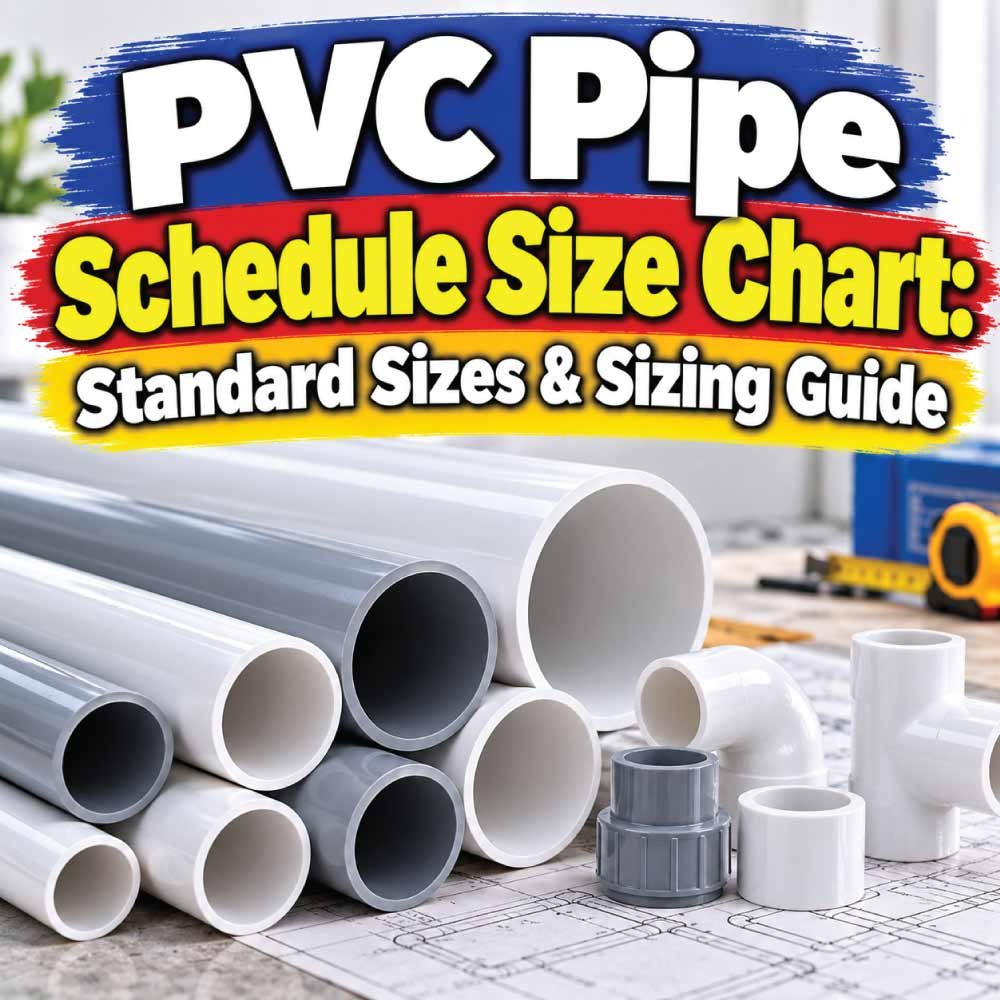
Choosing the right PVC pipe involves more than selecting a nominal diameter. The pipe schedule also affects wall thickness, inside diameter, weight, flow area, and pressure capability. For example, a 2-inch Schedule 40 PVC pipe and a 2-inch Schedule 80 PVC pipe have the same nominal size and outside diameter, but the Schedule 80 pipe has a thicker wall and smaller inside diameter.
This PVC Pipe Schedule Size Chart explains common Schedule 40, Schedule 80, and Schedule 120 PVC pipe dimensions. You will also learn what pipe schedule means, how schedule numbers affect pipe sizing, how to identify and measure PVC pipe, and how to choose the right schedule for different applications.
The dimensions provided are useful general sizing references. Exact dimensions, pressure ratings, temperature limitations, and product availability can vary by manufacturer and product specification, so critical installations should always be checked against the applicable technical documentation.
What Does PVC Pipe Schedule Mean?
A PVC pipe schedule identifies a standardized wall-thickness series. Common PVC pressure-pipe schedules include Schedule 40, Schedule 80, and Schedule 120.
The schedule number does not directly represent the actual wall thickness. Instead, it identifies a particular dimensional series.
For the same nominal pipe size:
- The outside diameter is generally the same between schedules.
- Higher schedules have thicker walls.
- Thicker walls create a smaller inside diameter.
- Heavier schedules generally provide greater pressure capability.
- Higher schedules usually weigh more.
- Material requirements and costs generally increase as wall thickness increases.
This means the schedule is an important part of pipe selection, particularly for pressure systems.
Nominal Pipe Size vs. Actual Size
One of the most important things to understand is that nominal pipe size is not necessarily the actual measured diameter.
For example, a nominal 2-inch PVC pipe has an outside diameter of approximately 2.375 inches, rather than exactly 2 inches.
The same principle applies to many other nominal pipe sizes.
This is why replacing an existing PVC pipe based only on a quick measurement can result in selecting the wrong pipe or fitting. Always compare measurements with a proper PVC pipe size chart.
PVC Pipe Schedule Size Chart
The following charts show commonly used PVC Schedule 40, Schedule 80, and Schedule 120 dimensions.
The values are presented in inches and include nominal pipe size, outside diameter, wall thickness, and approximate inside diameter.
Because Schedule 120 is less commonly stocked and is not available in every nominal size from every manufacturer, it should be treated as a specialized pipe schedule rather than a universal option.
Schedule 40 PVC Pipe Dimensions
Schedule 40 is one of the most commonly encountered PVC pressure-pipe schedules. It provides a balance between wall thickness, internal flow area, weight, and cost.
| Nominal Size | Outside Diameter (in.) | Wall Thickness (in.) | Approx. Inside Diameter (in.) |
|---|---|---|---|
| 1/2″ | 0.840 | 0.109 | 0.622 |
| 3/4″ | 1.050 | 0.113 | 0.824 |
| 1″ | 1.315 | 0.133 | 1.049 |
| 1-1/4″ | 1.660 | 0.140 | 1.380 |
| 1-1/2″ | 1.900 | 0.145 | 1.610 |
| 2″ | 2.375 | 0.154 | 2.067 |
| 2-1/2″ | 2.875 | 0.203 | 2.469 |
| 3″ | 3.500 | 0.216 | 3.068 |
| 4″ | 4.500 | 0.237 | 4.026 |
| 6″ | 6.625 | 0.280 | 6.065 |
| 8″ | 8.625 | 0.322 | 7.981 |
| 10″ | 10.750 | 0.365 | 10.020 |
| 12″ | 12.750 | 0.406 | 11.938 |
These dimensions demonstrate why nominal pipe size should not be confused with inside or outside diameter.
Schedule 80 PVC Pipe Dimensions
Schedule 80 PVC has a thicker wall than Schedule 40 for corresponding nominal sizes. The thicker wall provides additional pressure capability for suitable applications but reduces the internal opening.
| Nominal Size | Outside Diameter (in.) | Wall Thickness (in.) | Approx. Inside Diameter (in.) |
|---|---|---|---|
| 1/2″ | 0.840 | 0.147 | 0.546 |
| 3/4″ | 1.050 | 0.154 | 0.742 |
| 1″ | 1.315 | 0.179 | 0.957 |
| 1-1/4″ | 1.660 | 0.191 | 1.278 |
| 1-1/2″ | 1.900 | 0.200 | 1.500 |
| 2″ | 2.375 | 0.218 | 1.939 |
| 2-1/2″ | 2.875 | 0.276 | 2.323 |
| 3″ | 3.500 | 0.300 | 2.900 |
| 4″ | 4.500 | 0.337 | 3.826 |
| 6″ | 6.625 | 0.432 | 5.761 |
| 8″ | 8.625 | 0.500 | 7.625 |
| 10″ | 10.750 | 0.593 | 9.564 |
| 12″ | 12.750 | 0.687 | 11.376 |
The difference between Schedule 40 and Schedule 80 becomes especially noticeable in larger pipe sizes.
Schedule 120 PVC Pipe Dimensions
Schedule 120 is a heavier-wall PVC pressure-pipe series. It provides a thicker wall and smaller internal diameter than Schedule 40 and Schedule 80 for corresponding sizes.
| Nominal Size | Outside Diameter (in.) | Wall Thickness (in.) | Approx. Inside Diameter (in.) |
|---|---|---|---|
| 1/2″ | 0.840 | 0.170 | 0.500 |
| 3/4″ | 1.050 | 0.170 | 0.710 |
| 1″ | 1.315 | 0.200 | 0.915 |
| 1-1/4″ | 1.660 | 0.215 | 1.230 |
| 1-1/2″ | 1.900 | 0.225 | 1.450 |
| 2″ | 2.375 | 0.250 | 1.875 |
| 2-1/2″ | 2.875 | 0.300 | 2.275 |
| 3″ | 3.500 | 0.350 | 2.800 |
| 4″ | 4.500 | 0.437 | 3.626 |
| 6″ | 6.625 | 0.562 | 5.501 |
| 8″ | 8.625 | 0.718 | 7.189 |
Schedule 120 is less common than Schedule 40 and Schedule 80, so availability should be checked before specifying it for a project.
Schedule 40 vs. Schedule 80 vs. Schedule 120
The easiest way to understand PVC pipe schedules is to compare the same nominal pipe size.
For example, a nominal 2-inch PVC pipe has an outside diameter of approximately 2.375 inches across these schedules. What changes is the wall thickness and resulting inside diameter.
| 2-Inch PVC Specification | Schedule 40 | Schedule 80 | Schedule 120 |
|---|---|---|---|
| Outside diameter | 2.375 in. | 2.375 in. | 2.375 in. |
| Wall thickness | 0.154 in. | 0.218 in. | 0.250 in. |
| Approx. inside diameter | 2.067 in. | 1.939 in. | 1.875 in. |
| Wall thickness level | Standard | Thicker | Heavier |
| Typical use | General applications | Heavier-duty applications | Specialized applications |
The key takeaway is simple: the higher schedule does not necessarily mean a larger outside diameter.
Instead, it generally means more material is used in the pipe wall.
Does a Higher Schedule Mean a Larger Pipe?
No.
A higher schedule normally means a thicker pipe wall, not a larger outside diameter.
For example, a 2-inch Schedule 40 and 2-inch Schedule 80 PVC pipe both have an outside diameter of approximately 2.375 inches. However, the Schedule 80 pipe has a thicker wall and smaller internal opening.
This distinction is important when purchasing fittings or calculating flow.
How PVC Pipe Schedule Affects Inside Diameter
The inside diameter is especially important when PVC pipe is used to transport water or another fluid.
A basic relationship can be used to understand the dimensions:
Inside Diameter ≈ Outside Diameter − 2 × Wall Thickness
For example, using a 2-inch Schedule 40 pipe:
2.375 − (2 × 0.154) = 2.067 inches
This gives an approximate inside diameter.
When the wall becomes thicker, the internal opening becomes smaller.
That means a higher schedule can provide a stronger or higher-pressure pipe while simultaneously reducing the available internal flow area.
Why Inside Diameter Matters
Inside diameter can affect:
- Flow capacity
- Flow velocity
- Friction loss
- Pressure drop
- Pump requirements
- System efficiency
- Fitting transitions
- Internal clearance
For a basic household or irrigation project, nominal size may be sufficient for an initial selection. For engineered fluid systems, however, actual inside diameter and hydraulic calculations become much more important.
Common Uses of Different PVC Pipe Schedules
PVC schedules are selected according to the demands of the application.
Schedule 40 PVC Applications
Schedule 40 is commonly used for general-purpose PVC pressure piping.
Potential applications include:
- Water distribution
- Irrigation
- Pool systems
- General fluid piping
- Residential plumbing applications where permitted
- Certain commercial applications
- Low- to moderate-pressure systems
Its popularity comes from its combination of relatively light weight, good internal flow area, availability, and cost.
The correct application still depends on pressure, temperature, fluid type, local requirements, and the specific pipe product.
Schedule 80 PVC Applications
Schedule 80 has a thicker wall and is often selected when additional pressure capability or mechanical robustness is required.
Common applications can include:
- Industrial piping
- Chemical processing
- Higher-pressure fluid systems
- Commercial installations
- Exposed piping
- Specialized water systems
- Applications requiring heavier-wall PVC
Schedule 80 is not automatically the best choice simply because it is thicker. The smaller inside diameter and increased material usage should also be considered.
Schedule 120 PVC Applications
Schedule 120 is designed for specialized situations where a heavy-wall PVC pipe is appropriate.
Possible applications include:
- Specialized industrial piping
- Certain high-pressure systems
- Chemical-handling applications
- Industrial fluid transportation
- Systems where a heavier PVC wall is specifically required
Because Schedule 120 is less widely available, it is important to confirm pipe, fitting, and connection availability before designing an entire system around it.
Also Read:
How to Choose the Correct PVC Pipe Schedule
Selecting the right schedule requires more than looking at the pipe diameter.
1. Determine the Required Pipe Size
First determine the required nominal pipe size.
The correct diameter depends on:
- Required flow rate
- Desired flow velocity
- Acceptable pressure loss
- Pipe length
- Number of fittings
- Pump characteristics
- System inlet and outlet sizes
A larger nominal pipe does not automatically mean a better system. Oversizing can increase material costs, while undersizing can increase friction losses and reduce performance.
2. Determine Operating Pressure
The next consideration is system pressure.
PVC pressure capability depends on factors such as:
- Nominal pipe size
- Schedule
- PVC material
- Operating temperature
- Manufacturer
- Product design
- Application
Pressure ratings should therefore be taken from the specific product documentation rather than assuming that all Schedule 40 or all Schedule 80 PVC pipes have identical ratings.
3. Consider Operating Temperature
PVC pressure capability can change as temperature increases.
A pipe system designed for room-temperature service may not have the same pressure capability at elevated temperatures.
Before using PVC for warm or hot fluid service, check the manufacturer’s temperature limitations and pressure derating requirements.
4. Check Chemical Compatibility
PVC works well with many fluids, but it is not suitable for every chemical.
If the pipe will carry chemicals, check compatibility based on:
- Chemical concentration
- Fluid temperature
- Exposure time
- Pressure
- Pipe material
- Manufacturer recommendations
This is particularly important for industrial applications.
5. Check Fitting Compatibility
The pipe and fittings must work together as a complete system.
When selecting fittings, verify:
- Nominal size
- Schedule
- Connection type
- Material
- Pressure capability
- Joining method
- Application suitability
Do not select a fitting simply because its opening appears to match the pipe.
Also Read:
How to Measure PVC Pipe
If you have an existing PVC pipe and need to determine its size or schedule, several measurements can help.
Measure the Outside Diameter
The easiest measurement is usually the outside diameter.
Use a caliper when possible.
For larger pipes, measure the circumference and use:
Outside Diameter = Circumference ÷ π
For example, if the outside diameter measures approximately 2.375 inches, the pipe may correspond to a nominal 2-inch PVC pipe.
Always compare the measurement with a standard dimensional chart.
Measure the Wall Thickness
If you have access to the open end of the pipe, measure the wall thickness with a caliper.
Knowing both the outside diameter and wall thickness can help identify the schedule.
For example:
- Same outside diameter + thinner wall = lower schedule
- Same outside diameter + thicker wall = higher schedule
This is especially useful when comparing Schedule 40 and Schedule 80 PVC.
Check the Pipe Marking
Many PVC pipes have printed markings along their length.
Look for information such as:
- Manufacturer
- Nominal size
- Schedule
- Material designation
- Pressure rating
- Standard designation
- Certification information
The printed marking can often identify the pipe more reliably than measurement alone.
Also Read:
Common PVC Pipe Sizing Mistakes
Correct pipe selection becomes much easier when you know the common mistakes to avoid.
Mistake 1: Assuming Nominal Size Is Actual Diameter
A nominal 2-inch PVC pipe does not have an outside diameter of exactly 2 inches.
Always check the published outside diameter.
Mistake 2: Assuming Higher Schedule Means Larger Outside Diameter
Higher schedules generally use a thicker wall while maintaining the same outside-diameter system for corresponding nominal sizes.
The primary dimensional change is the inside diameter.
Mistake 3: Choosing the Thickest Pipe Automatically
A thicker pipe is not automatically the best pipe.
Higher schedules can provide advantages, but they can also:
- Reduce inside diameter
- Increase weight
- Increase cost
- Affect flow characteristics
- Require compatible fittings
Select the schedule according to actual system requirements.
Mistake 4: Ignoring Temperature
Pressure capability can change with temperature. Never assume a pipe’s room-temperature pressure rating applies unchanged to higher temperatures.
Mistake 5: Measuring Only the Inside Diameter
Inside diameter alone may not identify the nominal pipe size or schedule accurately.
Whenever possible, measure and record:
- Outside diameter
- Inside diameter
- Wall thickness
- Pipe markings
Mistake 6: Mixing Incompatible Products
Different PVC products can have different specifications and intended uses.
Before connecting pipes from different manufacturers or product lines, confirm that their dimensions, joining methods, materials, and application ratings are compatible.
PVC Pipe Sizing Tips for DIY and Professional Projects
A few practical habits can prevent expensive sizing errors.
- Identify nominal size before purchasing fittings.
- Measure the outside diameter rather than assuming the pipe’s nominal size.
- Check the pipe marking whenever possible.
- Compare Schedule 40 and Schedule 80 inside diameters when flow matters.
- Check pressure requirements before choosing the schedule.
- Consider operating temperature.
- Verify chemical compatibility for specialized applications.
- Use fittings designed for the selected pipe system.
- Check the manufacturer’s current technical specifications for critical projects.
- Follow applicable plumbing, building, mechanical, and engineering requirements.
For simple replacement work, the existing pipe marking and outside diameter can often make identification straightforward.
For engineered pressure systems, pipe selection should be based on the complete system design rather than a chart alone.
Frequently Asked Questions About PVC Pipe Schedule Sizes
What is a PVC pipe schedule?
A PVC pipe schedule identifies a standardized wall-thickness series. Common pressure-pipe schedules include Schedule 40, Schedule 80, and Schedule 120. For corresponding nominal sizes, higher schedules generally have thicker walls and smaller inside diameters.
Which is thicker, Schedule 40 or Schedule 80 PVC?
Schedule 80 PVC is thicker than Schedule 40 PVC for the same nominal pipe size. The outside diameter generally remains the same, while the thicker Schedule 80 wall reduces the internal diameter.
Does Schedule 80 PVC have the same outside diameter as Schedule 40?
Yes, for corresponding nominal sizes, Schedule 40 and Schedule 80 PVC generally use the same outside-diameter system. The major dimensional difference is wall thickness, which results in a different inside diameter.
What does 2-inch PVC pipe actually measure?
A common 2-inch PVC pressure pipe has an outside diameter of approximately 2.375 inches. The inside diameter depends on the schedule because wall thickness varies between Schedule 40, Schedule 80, and Schedule 120.
Is Schedule 80 PVC stronger than Schedule 40?
Schedule 80 has a thicker wall and generally provides greater pressure capability for a comparable nominal size and suitable application. However, actual performance depends on the specific product, temperature, pressure, material, and installation conditions.
Does Schedule 120 PVC have a larger diameter than Schedule 80?
No. For corresponding nominal sizes, the outside diameter generally follows the same dimensional system. Schedule 120 has a thicker wall, which results in a smaller inside diameter.
Does thicker PVC pipe provide more water flow?
No. For the same nominal size and outside diameter, a thicker wall reduces the inside diameter. This means a higher schedule can have less internal flow area than a lower schedule of the same nominal size.
Can Schedule 40 and Schedule 80 PVC be connected?
They can often be connected when compatible fittings and joining methods are used, but compatibility should be confirmed for the specific application. Pressure rating, fitting dimensions, connection method, and product specifications all matter.
Which PVC schedule should I use for water?
The correct schedule depends on system pressure, temperature, required flow, local requirements, and the specific product. Schedule 40 is commonly used for many general applications, while Schedule 80 may be appropriate where higher pressure capability or heavier-wall construction is required.
What standard covers PVC Schedule 40, 80, and 120?
ASTM D1785 is a major specification associated with PVC pipe in Schedule 40, Schedule 80, and Schedule 120 for pressure applications. Always verify the applicable standard for the specific product and project.
Conclusion
A PVC Pipe Schedule Size Chart helps explain why pipes with the same nominal size can have different wall thicknesses and inside diameters. Schedule 40, Schedule 80, and Schedule 120 generally share the same outside-diameter system for corresponding nominal sizes, while their wall thickness increases as the schedule becomes heavier.
When selecting PVC pipe, consider more than diameter. Flow requirements, pressure, temperature, chemical compatibility, fittings, installation conditions, and applicable requirements should all be evaluated.
For general projects, Schedule 40 may provide a practical balance of cost and flow area. Schedule 80 can be appropriate when heavier-wall construction or higher pressure capability is needed, while Schedule 120 is more specialized.
The best approach is to use a PVC pipe schedule chart as a starting point, then confirm the exact dimensions and ratings for the specific pipe and fittings being installed.
