
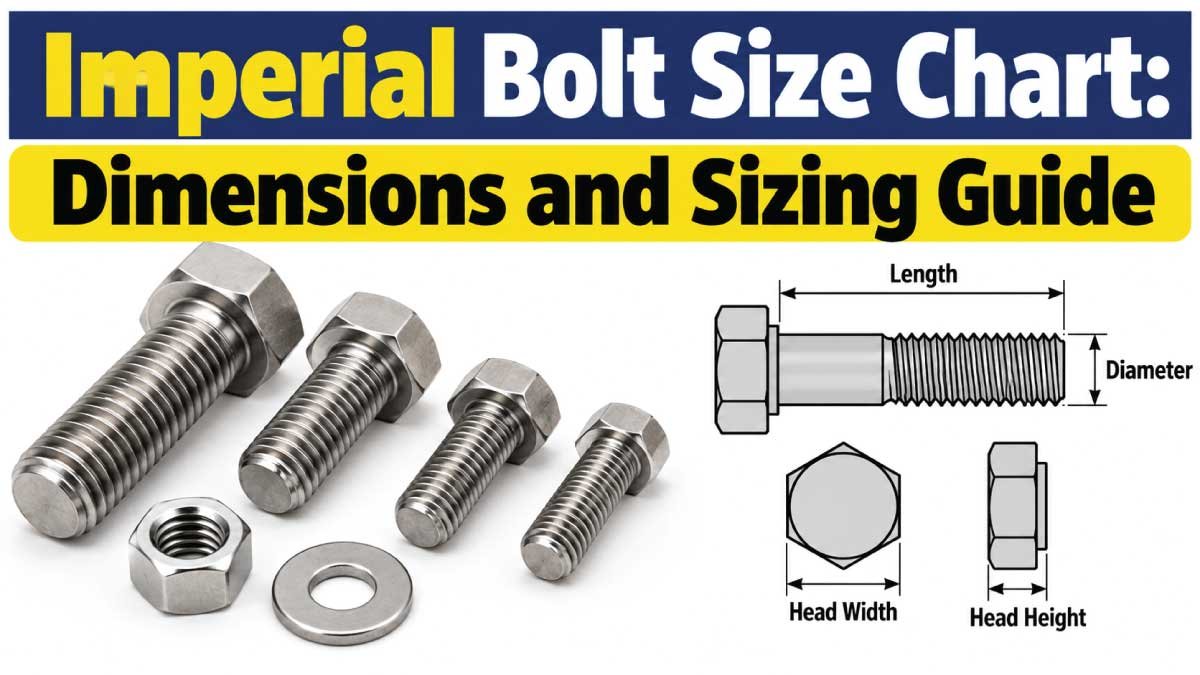
Imperial bolts are widely used in construction, automotive repairs, machinery, woodworking, metal fabrication, and industrial maintenance. These fasteners use inch-based measurements to identify their diameter, thread pitch, and length. Choosing the correct imperial bolt size is essential for creating secure connections, preventing thread damage, and ensuring compatibility with nuts, washers, and threaded holes.
Unlike metric bolts, which use millimeters, imperial bolts are commonly identified by fractional-inch diameters or numbered sizes. Their threads may follow the Unified National Coarse (UNC), Unified National Fine (UNF), or another compatible inch-based thread standard. As a result, two bolts with similar diameters may have different thread pitches and may not be interchangeable.
This imperial bolt size chart provides a practical reference for common bolt diameters, thread counts, lengths, head dimensions, and wrench sizes. It also explains how to measure imperial bolts, understand their markings, and choose the appropriate fastener for your project.
What Is an Imperial Bolt?
An imperial bolt is a threaded fastener whose dimensions are specified primarily in inches. It typically has a head at one end and external threads along part or all of its shaft. The bolt is commonly used with a compatible nut or threaded component to secure two or more parts.
Imperial fasteners are especially common in the United States and in equipment, machinery, vehicles, and structures designed around inch-based specifications.
Common applications include:
- Automotive and mechanical repairs.
- Construction and structural assemblies.
- Agricultural machinery and equipment.
- Woodworking and furniture manufacturing.
- Industrial machinery installation.
- Metal fabrication and maintenance.
- Equipment imported from countries using imperial standards.
Imperial bolts are available in different diameters, lengths, thread pitches, head styles, materials, and strength grades. Selecting the correct combination helps ensure that the fastener fits properly and performs as intended.
Imperial Bolt Size Chart
Imperial bolts are commonly identified by a diameter designation, thread count, and length. Smaller bolts may use numbered sizes, while larger bolts are frequently specified by fractional-inch diameters.
The following table provides a general reference for common imperial bolt diameters and typical coarse-thread counts.
| Bolt Size | Nominal Diameter (Inches) | Diameter (mm) | Typical UNC Threads per Inch (TPI) | Common Applications |
|---|---|---|---|---|
| #4 | 0.112 | 2.84 | 40 | Small equipment and light assemblies |
| #6 | 0.138 | 3.51 | 32 | Electronics and light fixtures |
| #8 | 0.164 | 4.17 | 32 | General hardware and small machinery |
| #10 | 0.190 | 4.83 | 24 | Equipment and furniture assemblies |
| #12 | 0.216 | 5.49 | 24 | Light mechanical applications |
| 1/4 inch | 0.250 | 6.35 | 20 | General-purpose fastening |
| 5/16 inch | 0.3125 | 7.94 | 18 | Machinery and equipment |
| 3/8 inch | 0.375 | 9.53 | 16 | Automotive and mechanical assemblies |
| 7/16 inch | 0.4375 | 11.11 | 14 | Heavy equipment and machinery |
| 1/2 inch | 0.500 | 12.70 | 13 | Construction and general machinery |
| 9/16 inch | 0.5625 | 14.29 | 12 | Mechanical and equipment assemblies |
| 5/8 inch | 0.625 | 15.88 | 11 | Heavy-duty fastening |
| 3/4 inch | 0.750 | 19.05 | 10 | Construction and industrial applications |
| 7/8 inch | 0.875 | 22.23 | 9 | Heavy machinery and structural assemblies |
| 1 inch | 1.000 | 25.40 | 8 | Large mechanical and industrial connections |
The TPI values shown are typical UNC coarse-thread specifications. They are not universal for every bolt of the same diameter. Fine-thread bolts use different thread counts, and some sizes have multiple standardized thread options.
Important: Always verify the thread series, length, material, and grade before selecting a replacement bolt. Nominal diameter alone does not establish compatibility or load capacity.
Understanding Imperial Bolt Dimensions
Imperial bolt dimensions describe the measurements needed to identify and install the correct fastener. Understanding each measurement helps prevent ordering errors and assembly problems.
Nominal Bolt Diameter
Nominal diameter is the approximate outside diameter of the bolt’s threaded shaft. It is commonly expressed as a fraction of an inch or a numbered size.
Examples include:
- 1/4-inch bolt: nominal diameter of 0.250 inches.
- 3/8-inch bolt: nominal diameter of 0.375 inches.
- 1/2-inch bolt: nominal diameter of 0.500 inches.
- 3/4-inch bolt: nominal diameter of 0.750 inches.
- 1-inch bolt: nominal diameter of 1.000 inch.
Numbered bolts use designations such as #6, #8, and #10 rather than fractional diameters. Their actual nominal diameters are smaller than 1/4 inch.
Thread Pitch and Threads per Inch
Imperial bolt threads are commonly described by threads per inch, abbreviated TPI. This measurement indicates how many thread peaks occur within one inch of the bolt’s length.
For example, a 1/2-13 UNC bolt has a nominal diameter of 1/2 inch and 13 threads per inch.
A 1/2-20 UNF bolt has the same nominal diameter but 20 threads per inch. Because their pitches differ, these bolts require compatible nuts or threaded holes.
Bolt Length
Bolt length is usually measured from the underside of the head to the end of the bolt for standard hex-head bolts. For countersunk fasteners, length is generally measured across the entire bolt, including the head.
The correct measuring method depends on the bolt’s head style. Always check the applicable product specification when comparing different designs.
Head Dimensions
Head dimensions include the head height and width across flats for hex-head bolts. These measurements determine the space required around the bolt head and the wrench or socket needed for installation.
Head dimensions can vary by bolt type, standard, and product grade. Do not assume that every bolt with the same nominal diameter has identical head dimensions.
Thread Length
Thread length describes the portion of the bolt shaft that contains external threads. Some bolts are fully threaded, while others have an unthreaded shank between the head and threaded portion.
Thread length affects how the bolt engages with the nut or threaded hole and how the joint transfers load. Choose the thread configuration specified for the application.
Shank Length and Grip Length
The shank is the portion of the bolt shaft without threads. Grip length refers to the portion of the bolt that passes through the joined materials.
In applications where joint movement, shear loading, or precise alignment matters, the shank and grip dimensions can be important. Follow the specified fastener design rather than selecting a bolt by overall length alone.
Imperial Bolt Thread Size Chart: UNC vs. UNF
Imperial bolts commonly use Unified National Coarse (UNC) and Unified National Fine (UNF) threads. Both systems use inch-based dimensions, but their thread counts differ.
| Nominal Diameter | UNC Threads per Inch | UNF Threads per Inch | Common Thread Designations |
|---|---|---|---|
| #4 | 40 | 48 | #4-40, #4-48 |
| #6 | 32 | 40 | #6-32, #6-40 |
| #8 | 32 | 36 | #8-32, #8-36 |
| #10 | 24 | 32 | #10-24, #10-32 |
| 1/4 inch | 20 | 28 | 1/4-20, 1/4-28 |
| 5/16 inch | 18 | 24 | 5/16-18, 5/16-24 |
| 3/8 inch | 16 | 24 | 3/8-16, 3/8-24 |
| 7/16 inch | 14 | 20 | 7/16-14, 7/16-20 |
| 1/2 inch | 13 | 20 | 1/2-13, 1/2-20 |
| 9/16 inch | 12 | 18 | 9/16-12, 9/16-18 |
| 5/8 inch | 11 | 18 | 5/8-11, 5/8-18 |
| 3/4 inch | 10 | 16 | 3/4-10, 3/4-16 |
| 7/8 inch | 9 | 14 | 7/8-9, 7/8-14 |
| 1 inch | 8 | 12 | 1-8, 1-12 |
These are common UNC and UNF combinations for the listed diameters. Other thread series and special specifications may exist.
What Is UNC Threading?
UNC stands for Unified National Coarse. UNC bolts have relatively coarse threads and are widely used for general-purpose fastening.
Coarse threads are often practical for everyday assembly and maintenance because they are less fine than their UNF equivalents. The appropriate thread choice still depends on the joint design, material, and operating conditions.
What Is UNF Threading?
UNF stands for Unified National Fine. UNF bolts have more threads per inch than UNC bolts of the same nominal diameter.
Fine threads may be selected for specific mechanical applications requiring particular adjustment, engagement, or strength characteristics. However, the best choice depends on the complete fastener and joint specification.
Can UNC and UNF Bolts Be Interchanged?
No. UNC and UNF bolts of the same nominal diameter have different thread pitches. A nut designed for one thread series will not correctly engage with the other.
Always match the bolt’s diameter, thread series, and pitch to the mating nut or threaded hole.
Imperial Bolt Length Size Chart
Bolt length affects how the fastener passes through the joined materials and engages with the nut or threaded hole. Imperial bolt lengths are commonly expressed in fractions of an inch.
The following table shows frequently encountered bolt lengths and their approximate millimeter equivalents.
| Bolt Length (Inches) | Approx. Length (mm) | Common Applications |
|---|---|---|
| 1/4 inch | 6.35 | Thin components and small assemblies |
| 3/8 inch | 9.53 | Compact hardware connections |
| 1/2 inch | 12.70 | General-purpose fastening |
| 5/8 inch | 15.88 | Short mechanical connections |
| 3/4 inch | 19.05 | Equipment and furniture assemblies |
| 1 inch | 25.40 | General machinery and construction |
| 1 1/4 inches | 31.75 | Thicker joined materials |
| 1 1/2 inches | 38.10 | Equipment and structural components |
| 1 3/4 inches | 44.45 | Medium-depth assemblies |
| 2 inches | 50.80 | General construction and machinery |
| 2 1/2 inches | 63.50 | Deeper assemblies |
| 3 inches | 76.20 | Longer mechanical connections |
| 4 inches | 101.60 | Thick components and specialized assemblies |
| 5 inches | 127.00 | Long-reach fastening applications |
| 6 inches | 152.40 | Heavy equipment and large assemblies |
These are common reference lengths, not a list of available lengths for every bolt diameter or style.
When selecting a bolt, account for the thickness of the connected materials, washers, and any nut or threaded engagement required. The appropriate protruding thread length depends on the design and fastener specification.
Imperial Bolt Head and Wrench Size Chart
For hex-head bolts, the wrench or socket size is usually determined by the width across flats of the head. This dimension is different from the bolt’s nominal diameter.
The following table provides representative wrench-size references for common hex-head bolts. Actual dimensions can vary by bolt standard, series, and manufacturing specification.
| Nominal Bolt Diameter | Typical Width Across Flats (Inches) | Approx. Width Across Flats (mm) | Measurement Note |
|---|---|---|---|
| 1/4 inch | 7/16 | 11.11 | Common hex-head dimensions |
| 5/16 inch | 1/2 | 12.70 | Check the applicable standard |
| 3/8 inch | 9/16 | 14.29 | Common hex-head dimensions |
| 7/16 inch | 5/8 | 15.88 | Standard-dependent |
| 1/2 inch | 3/4 | 19.05 | Common hex-head dimensions |
| 9/16 inch | 7/8 | 22.23 | Verify the bolt specification |
| 5/8 inch | 15/16 | 23.81 | Common hex-head dimensions |
| 3/4 inch | 1 1/8 | 28.58 | Check head style and standard |
| 7/8 inch | 1 5/16 | 33.34 | Standard-dependent |
| 1 inch | 1 1/2 | 38.10 | Common hex-head dimensions |
These values are representative references for common hex-head bolts, not universal wrench sizes for every imperial fastener. Some bolt standards use different head dimensions, and reduced-head or specialized bolts may require different tools.
Always measure the actual width across flats or check the product specification before selecting a wrench or socket.
Also Read:
Imperial Bolt Size Conversion Chart
Imperial bolt dimensions are specified in inches, but converting them to millimeters can be helpful when using metric measuring tools or comparing fasteners.
One inch equals exactly 25.4 millimeters. The following table converts common fractional-inch bolt diameters into approximate metric measurements.
| Imperial Diameter | Decimal Inches | Approx. Diameter (mm) |
|---|---|---|
| #4 | 0.112 | 2.84 |
| #6 | 0.138 | 3.51 |
| #8 | 0.164 | 4.17 |
| #10 | 0.190 | 4.83 |
| #12 | 0.216 | 5.49 |
| 1/4 inch | 0.250 | 6.35 |
| 5/16 inch | 0.3125 | 7.94 |
| 3/8 inch | 0.375 | 9.53 |
| 7/16 inch | 0.4375 | 11.11 |
| 1/2 inch | 0.500 | 12.70 |
| 5/8 inch | 0.625 | 15.88 |
| 3/4 inch | 0.750 | 19.05 |
| 7/8 inch | 0.875 | 22.23 |
| 1 inch | 1.000 | 25.40 |
These conversions describe nominal diameters. They do not make imperial and metric fasteners interchangeable. Thread pitch, profile, tolerances, and other specifications must also match.
Imperial Bolt Grades and Strength Markings
Bolt strength is an important consideration in any application involving significant loads, vibration, or safety requirements. Imperial bolts commonly use SAE grades or other specified material and strength classifications.
Grade 2 Bolts
Grade 2 bolts are generally used for lower-strength, general-purpose applications where the design does not require a higher-strength fastener.
Their suitability depends on the joint design and specified load. They should not be substituted for higher-grade bolts in critical assemblies without approval.
Grade 5 Bolts
Grade 5 bolts are commonly used in automotive, machinery, and general mechanical applications. They typically have three radial lines on the head to identify their grade.
The marking helps distinguish the fastener, but the exact specification should be confirmed when strength is important.
Grade 8 Bolts
Grade 8 bolts are higher-strength fasteners commonly identified by six radial lines on the head. They are used in applications requiring higher mechanical strength than typical Grade 5 bolts.
A higher grade is not automatically the correct choice for every joint. Fastener strength, ductility, fatigue behavior, corrosion resistance, and the connected materials must all be considered.
Why Bolt Grade Matters
The correct bolt grade must match the engineering or manufacturer’s specification. Replacing a specified fastener with a different grade can affect the performance and reliability of the joint.
For structural, vehicle, lifting, pressure-related, and other safety-critical applications, follow the approved design and fastener requirements.
Also Read:
How to Measure an Imperial Bolt
Accurate measurement is essential when identifying a replacement bolt. A caliper, ruler, thread-pitch gauge, and suitable measuring tools can help you determine the fastener’s dimensions.
Step 1: Measure the Bolt Diameter
Use a caliper to measure across the external threads. Compare the result with a nominal imperial diameter or numbered bolt size.
For example, a bolt measuring approximately 0.375 inches across its threads may be a nominal 3/8-inch bolt.
Do not measure the head width and mistake it for the bolt diameter.
Step 2: Determine the Thread Count
Use an imperial thread-pitch gauge to identify the threads per inch. Compare the result with the available UNC, UNF, or other applicable thread specifications.
If a gauge is unavailable, measure a known length of threaded shaft and count the thread intervals carefully. A thread gauge is generally more reliable for identifying the exact series.
Step 3: Measure the Bolt Length
For a standard hex-head bolt, measure from the underside of the head to the tip. For countersunk fasteners, the length is generally measured including the head.
Confirm the measuring convention for the particular bolt style before comparing lengths.
Step 4: Check the Head Dimensions
For a hex-head bolt, measure the width across flats to determine the appropriate wrench or socket size. Also check the head height if installation clearance is limited.
Step 5: Examine Thread Length
Determine whether the bolt is fully threaded or partially threaded. Check the length of the unthreaded shank if the connection requires a specific grip length.
Step 6: Identify the Grade and Material
Inspect the head markings and any available packaging or specification information. Determine whether the bolt is carbon steel, stainless steel, or another material.
For critical applications, use the documented specification rather than relying only on visual appearance.
Also Read:
How to Choose the Correct Imperial Bolt Size
Selecting the right imperial bolt requires matching several dimensions and performance requirements.
Identify the diameter. Determine the nominal bolt size in inches or the correct numbered size.
Confirm the thread series. Check whether the bolt uses UNC, UNF, or another specified thread system.
Select the correct length. Account for material thickness, washers, and required thread engagement.
Verify the head dimensions. Make sure the bolt head fits the available space and the required tool.
Choose the appropriate grade. Follow the load and strength requirements of the assembly.
Select a suitable material. Consider corrosion, moisture, temperature, and environmental exposure.
Match the mating hardware. Ensure the nut or threaded hole uses the same diameter and thread specification.
Follow the installation requirements. Use the specified tightening method and torque where applicable.
For equipment repairs, matching the original bolt specification is often the safest starting point. If the original fastener’s grade or thread series is unknown, consult the equipment documentation or a qualified professional before using a replacement.
Common Imperial Bolt Sizing Mistakes
Small measurement errors can result in incorrect fasteners, damaged threads, or unreliable connections. Avoid these common mistakes.
Confusing Diameter with Head Size
A 1/2-inch bolt has a nominal threaded diameter of 1/2 inch, but its hex head is much wider. Always measure the correct part of the fastener.
Ignoring Threads per Inch
Bolts with the same nominal diameter may have different thread counts. A 1/2-13 UNC bolt is not interchangeable with a 1/2-20 UNF bolt.
Measuring Length Incorrectly
Most standard hex-head bolt lengths are measured from beneath the head, while countersunk bolt lengths generally include the head. Using the wrong measuring method can result in ordering an incorrect length.
Mixing Metric and Imperial Fasteners
A metric bolt may appear close in diameter to an imperial bolt, but their threads may not match. Never force incompatible nuts and bolts together.
Assuming All Bolts Have the Same Head Dimensions
Head dimensions can vary according to the applicable standard and bolt design. Check the specification when tool clearance or wrench size is important.
Choosing the Wrong Grade
A bolt that physically fits may not meet the required strength. Follow the specified grade and material requirements, particularly for structural or safety-critical applications.
Overlooking Corrosion Resistance
A fastener used outdoors or in a corrosive environment may require a specific material or protective coating. Confirm compatibility with the surrounding materials and service conditions.
Frequently Asked Questions About Imperial Bolt Sizes
What does a 1/2-13 bolt designation mean?
The designation 1/2-13 indicates a nominal diameter of 1/2 inch and 13 threads per inch. It commonly describes a 1/2-inch UNC bolt.
What is the difference between UNC and UNF bolts?
UNC bolts use Unified National Coarse threads, while UNF bolts use Unified National Fine threads. Their thread counts differ, so each requires a compatible nut or threaded hole.
How do I know what wrench size fits an imperial bolt?
For a hex-head bolt, measure the width across opposite flat sides of the head or consult the relevant bolt standard. Wrench size is not the same as nominal bolt diameter.
What is the metric equivalent of a 1/2-inch bolt?
A 1/2-inch nominal diameter equals 12.7 mm. This is a dimensional conversion only; a 1/2-inch imperial bolt is not automatically interchangeable with an M12 metric bolt because their thread specifications differ.
How is imperial bolt length measured?
For most standard hex-head bolts, length is measured from the underside of the head to the end. Countersunk fasteners are generally measured from the top of the head to the tip.
What does Grade 5 mean on an imperial bolt?
Grade 5 is a mechanical strength classification commonly used for certain imperial bolts. It is often identified by three radial lines on the head. Always verify the required grade for the application.
Are all 3/8-inch bolts the same?
No. A 3/8-inch bolt may have different thread series, lengths, head styles, materials, and grades. Check the complete fastener specification before selecting a replacement.
Can I use a metric nut on an imperial bolt?
Not unless the nut is specifically designed for a compatible thread specification. Metric and imperial threads differ in pitch and sometimes in other dimensions. Use matching fasteners.
What does TPI mean in bolt sizing?
TPI means threads per inch. It indicates the number of thread intervals along one inch of a threaded fastener and helps identify the correct thread series.
How do I choose the right imperial bolt grade?
Follow the design specification, equipment manual, or applicable standard. Consider the required load, material compatibility, environmental conditions, and joint design rather than choosing a grade based only on appearance.
Conclusion
An imperial bolt size chart makes it easier to identify common bolt diameters, thread counts, lengths, and head dimensions. However, choosing the correct fastener requires more than matching its nominal diameter. Thread series, threads per inch, length, head style, material, and grade all contribute to compatibility and performance.
Common imperial bolt sizes range from small numbered fasteners, such as #4 and #8, to larger fractional sizes, such as 1/2 inch, 3/4 inch, and 1 inch. UNC and UNF threads are both widely used, but they are not interchangeable unless the mating components have matching specifications.
Before installing a bolt, verify its diameter, thread count, length, and strength grade. Check the dimensions of the mating nut and follow the relevant manufacturer’s or engineering requirements. Accurate sizing helps prevent thread damage, improves assembly reliability, and supports safer fastening in everyday and demanding applications.
