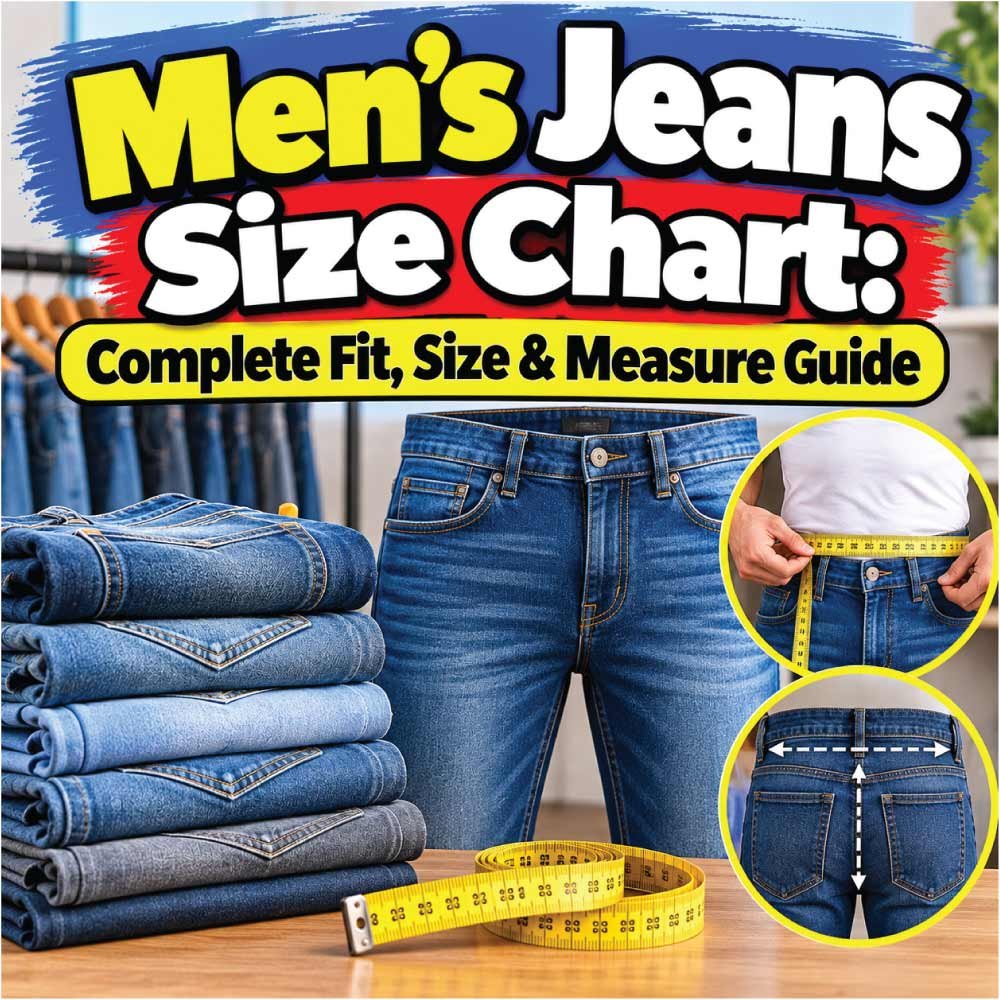
Finding the right pair of jeans is easier when you understand what the numbers actually mean. A jeans size usually combines waist measurement and inseam length, but fit, rise, fabric stretch, and the brand’s sizing system can all affect how a pair feels.
This Men’s Jeans Size Chart explains common waist and inseam sizes, how to measure yourself accurately, how jeans sizes convert between systems, and how to choose the best fit for your body. Whether you’re buying straight-leg, slim, relaxed, skinny, or stretch jeans, these guidelines can help you make a more confident choice.
Men’s Jeans Size Chart
Men’s jeans are commonly labeled using two measurements, such as 32 x 32. The first number represents the waist size in inches, while the second represents the inseam length.
The chart below provides a practical general reference. Actual measurements can vary between brands and individual styles, so always check the manufacturer’s size chart when one is available.
| Waist Size (in) | Approx. Waist (cm) | Common Letter Size | Typical Jeans Size |
|---|---|---|---|
| 28 | 71 | XS | 28 |
| 30 | 76 | S | 30 |
| 32 | 81 | M | 32 |
| 34 | 86 | M | 34 |
| 36 | 91 | L | 36 |
| 38 | 97 | XL | 38 |
| 40 | 102 | XL | 40 |
| 42 | 107 | XXL | 42 |
| 44 | 112 | XXL | 44 |
| 46 | 117 | 3XL | 46 |
| 48 | 122 | 3XL | 48 |
| 50 | 127 | 4XL | 50 |
Important: Letter sizes such as S, M, L, and XL are less precise than numerical waist measurements. For jeans, the numerical waist size is generally the more useful starting point.
Understanding Jeans Size Numbers
A label such as 34 x 32 contains two important measurements.
The First Number: Waist Size
The first number normally indicates the approximate waist size in inches.
For example:
- 30 x 30 = approximately 30-inch waist and 30-inch inseam
- 32 x 32 = approximately 32-inch waist and 32-inch inseam
- 34 x 30 = approximately 34-inch waist and 30-inch inseam
- 36 x 34 = approximately 36-inch waist and 34-inch inseam
The waist number does not always correspond exactly to the measurement of the finished garment. Some jeans may measure slightly differently because of the cut, rise, fabric, waistband construction, and brand-specific sizing.
The Second Number: Inseam Length
The second number refers to the inseam, which is the distance from the crotch area down the inside of the leg to the bottom hem.
Common men’s inseam lengths include:
| Inseam (in) | Inseam (cm) | Typical Use |
|---|---|---|
| 28 | 71 | Shorter leg length |
| 30 | 76 | Short |
| 32 | 81 | Regular |
| 34 | 86 | Long |
| 36 | 91 | Extra long |
| 38 | 97 | Very long |
Your ideal inseam depends on your height, proportions, preferred break, and the style of jeans. Two men of the same height can need different inseam lengths.
Men’s Jeans Waist Size Chart
The waist is one of the most important measurements when selecting jeans. Use the following chart as a general reference.
| Jeans Size | Waist (in) | Waist (cm) |
|---|---|---|
| 28 | 28 | 71 |
| 29 | 29 | 74 |
| 30 | 30 | 76 |
| 31 | 31 | 79 |
| 32 | 32 | 81 |
| 33 | 33 | 84 |
| 34 | 34 | 86 |
| 36 | 36 | 91 |
| 38 | 38 | 97 |
| 40 | 40 | 102 |
| 42 | 42 | 107 |
| 44 | 44 | 112 |
| 46 | 46 | 117 |
| 48 | 48 | 122 |
| 50 | 50 | 127 |
Some manufacturers use even-numbered sizes only, while others offer odd sizes such as 29, 31, 33, or 35. If your measurement falls between available sizes, consider the jeans’ fabric composition and intended fit before choosing.
Men’s Jeans Inseam Size Chart
Choosing the correct waist but the wrong inseam can make jeans look or feel uncomfortable. Your inseam should reflect both your body proportions and the look you want.
| Inseam | Approx. Length | General Description |
|---|---|---|
| 28 in | 71 cm | Short |
| 30 in | 76 cm | Short to regular |
| 32 in | 81 cm | Regular |
| 34 in | 86 cm | Long |
| 36 in | 91 cm | Extra long |
| 38 in | 97 cm | Very long |
These are general categories rather than strict height rules. The same inseam can look different depending on leg length and jean construction.
How to Measure for Men’s Jeans
Accurate measurements are more reliable than guessing your size from height or weight. You only need a flexible measuring tape and a pair of well-fitting jeans for an additional comparison.
How to Measure Your Waist
Follow these steps:
- Stand naturally without pulling your stomach in.
- Place the measuring tape around the area where you normally wear your jeans.
- Keep the tape level around your body.
- Make sure it is snug but not tight.
- Record the measurement in inches or centimeters.
Do not pull the tape tightly against your body. Jeans need enough room for normal movement and sitting.
How to Measure Your Inseam
To measure your inseam:
- Stand upright with your feet positioned naturally.
- Measure from the crotch area down the inside of your leg.
- Stop at the point where you want the jeans to finish.
- Keep the measuring tape straight.
- Record the measurement.
If measuring yourself is difficult, ask someone to help. Small measurement errors can make a noticeable difference in jeans length.
How to Measure Jeans You Already Own
A favorite pair of jeans can provide a useful reference.
Lay the jeans flat on a level surface. Smooth out wrinkles without stretching the fabric. Measure the waistband from one side to the other, then double the result to get an approximate waistband circumference.
For the inseam, measure from the crotch seam to the bottom of the inside leg.
This method is particularly helpful when buying jeans online because you can compare the measurements of a pair you already like with the measurements supplied by the retailer.
Men’s Jeans Size Conversion Chart
Jeans sizing differs across countries and manufacturers. A numerical waist measurement in inches is often easier to compare than letter sizes, but international labels can still vary.
| US/UK Jeans Size | Approx. Waist (cm) | General Letter Equivalent |
|---|---|---|
| 28 | 71 | XS |
| 30 | 76 | S |
| 32 | 81 | M |
| 34 | 86 | M |
| 36 | 91 | L |
| 38 | 97 | XL |
| 40 | 102 | XL |
| 42 | 107 | XXL |
| 44 | 112 | XXL |
| 46 | 117 | 3XL |
| 48 | 122 | 3XL |
| 50 | 127 | 4XL |
International conversion is only a general guide. European clothing sizes are not always a direct mathematical conversion of US jeans sizes, and individual brands may use their own measurements.
When shopping internationally, compare your actual waist and inseam measurements with the seller’s chart instead of relying exclusively on a converted number.
How to Choose the Right Jeans Fit
Finding the right size is only part of getting a good pair of jeans. The fit determines how the jeans sit around your waist, hips, thighs, knees, and lower legs.
Slim Fit Jeans
Slim jeans are narrower through the seat and thigh and usually taper toward the ankle.
They can work well if you prefer a streamlined appearance without the very close fit of skinny jeans. Because the cut is narrower, check the thigh and seat measurements as well as the waist.
Straight Fit Jeans
Straight-leg jeans maintain a relatively consistent width from the thigh toward the hem.
They offer a classic appearance and generally provide more room than slim styles. Straight jeans can be a versatile choice for everyday wear.
Relaxed Fit Jeans
Relaxed jeans provide additional room around the seat and thighs.
They can be useful for people who find slim or straight styles restrictive. A relaxed fit should still sit securely at the waist without excessive sagging.
Skinny Fit Jeans
Skinny jeans are designed for a close fit through most or all of the leg.
Stretch denim is commonly used in close-fitting styles because it allows greater freedom of movement. Pay particular attention to fabric composition and the garment’s actual measurements.
Bootcut Jeans
Bootcut jeans generally remain relatively fitted through the upper leg and widen toward the hem.
The additional opening is designed to accommodate footwear such as boots. When choosing bootcut jeans, inseam length is especially important because the hem should work with the shoes you plan to wear.
Tapered Jeans
Tapered jeans gradually become narrower toward the ankle.
They can provide additional room through the upper leg while maintaining a narrower opening at the bottom.
Also Read:
Low Rise, Mid Rise, and High Rise Jeans
The rise describes the distance from the crotch area to the top of the waistband. It affects where the jeans sit on your body and can change the way the same waist size feels.
Low Rise
Low-rise jeans sit lower on the body, generally below the natural waist.
They can create a different silhouette and may feel less restrictive around the upper waist, but the correct size is particularly important because the jeans need to stay securely positioned.
Mid Rise
Mid-rise jeans sit between low and high-rise styles.
They are widely used for everyday men’s jeans and can provide a balance between coverage and comfort.
High Rise
High-rise jeans sit higher on the torso.
Because the waistband is positioned differently, your usual waist measurement may not translate exactly between high-rise and lower-rise styles. Always consider where the garment is designed to sit.
Also Read:
Stretch vs. Non-Stretch Jeans
The fabric can significantly affect how jeans fit.
Traditional denim may contain little or no elastane, while stretch denim incorporates fibers that provide additional flexibility.
Stretch Jeans
Stretch jeans can provide:
- Greater freedom of movement
- A closer body fit
- More flexibility when sitting
- A comfortable feel for everyday activities
However, stretch does not mean you should automatically choose a smaller size. The garment should still fit comfortably without excessive pulling or strain.
Rigid or Non-Stretch Denim
Non-stretch jeans can provide a structured denim feel and may change less during wear than some highly flexible fabrics.
They can initially feel firmer, so comfort and intended fit should be considered before purchasing.
Also Read:
What to Do If You Are Between Jeans Sizes
Sometimes your measurement falls between two available sizes. There is no universal rule that says you should always size up or down.
Consider these factors:
- Fabric: Stretch denim may accommodate a slightly closer fit.
- Rise: A different rise can change how the waistband feels.
- Fit: Relaxed jeans naturally provide more room than slim jeans.
- Body proportions: Waist and thigh measurements may point toward different sizes.
- Personal preference: Some people prefer a close fit, while others want more room.
- Brand sizing: One manufacturer’s 32 may not fit exactly like another manufacturer’s 32.
If possible, compare the garment’s actual measurements with a pair of jeans you already own and like.
Common Men’s Jeans Sizing Mistakes
Even with a size chart, shoppers frequently choose jeans incorrectly because they focus on only one measurement.
Choosing by Height Alone
Height can help estimate inseam length, but it does not determine waist size. Men of the same height can have very different waist and leg proportions.
Ignoring the Inseam
A correct waist does not guarantee the correct overall fit. Jeans that are too long may bunch heavily around the ankle, while jeans that are too short can expose more of the lower leg than intended.
Assuming Every Size 32 Is Identical
A 32-inch label is not a guarantee that every pair will fit identically. Different brands and styles can use different patterns, rises, fabrics, and grading methods.
Buying Based Only on Letter Sizes
S, M, L, and XL are broad categories. A numerical waist and inseam measurement generally gives you more useful information when buying jeans.
Measuring Over Bulky Clothing
Measuring your waist over thick clothing can produce an inaccurate result. For the best measurement, use minimal clothing around the measurement area.
Pulling the Tape Too Tightly
The tape should be snug without compressing your body. An overly tight measurement can lead to jeans that feel restrictive.
How Men’s Jeans Should Fit
A properly fitting pair of jeans should feel secure without being uncomfortably tight.
Check these areas when trying on jeans:
- Waist: The waistband should stay in place without requiring excessive belt tension.
- Seat: The fabric should sit smoothly without excessive pulling.
- Thighs: You should have enough room for normal movement.
- Rise: The crotch should not feel excessively tight or unusually loose.
- Knees: The fabric should allow comfortable bending.
- Hem: The length should match the style and footwear.
- Movement: Sit, walk, and bend to check the fit in realistic positions.
A belt can adjust a small amount of looseness, but it should not be used to compensate for jeans that are significantly too large.
Men’s Jeans Size Chart by Common Waist Measurements
For quick reference, this simplified chart connects common waist sizes with approximate metric measurements.
| Jeans Size | Waist (in) | Waist (cm) | Typical Inseams (in) |
|---|---|---|---|
| 28 | 28 | 71 | 28–32 |
| 30 | 30 | 76 | 28–34 |
| 32 | 32 | 81 | 30–34 |
| 34 | 34 | 86 | 30–34 |
| 36 | 36 | 91 | 30–36 |
| 38 | 38 | 97 | 30–36 |
| 40 | 40 | 102 | 30–36 |
| 42 | 42 | 107 | 30–36 |
| 44 | 44 | 112 | 30–38 |
| 46 | 46 | 117 | 30–38 |
| 48 | 48 | 122 | 30–38 |
The inseam ranges shown are examples of commonly offered lengths, not a rule that every size is manufactured in every length.
How to Read a Jeans Size Chart Online
Online retailers may present sizing information in several ways. Before ordering, identify exactly what each measurement represents.
Look for:
- Waist measurement
- Inseam measurement
- Rise
- Thigh circumference or width
- Leg opening
- Fit category
- Fabric composition
- Stretch level
- Brand-specific sizing instructions
If a product page provides garment measurements rather than body measurements, do not assume they are interchangeable. Garment measurements describe the finished jeans, while body measurements describe you.
When a retailer provides both, use the instructions supplied by that retailer.
Frequently Asked Questions
What does 32 x 32 mean in men’s jeans?
A 32 x 32 jeans size generally means approximately a 32-inch waist and a 32-inch inseam. The first number refers to waist size, while the second represents the inside leg length. Actual garment measurements can vary by brand and style.
How do I know my men’s jeans size?
Measure your waist where you normally wear your jeans and measure your inseam from the crotch to your preferred hem position. Compare both measurements with the specific brand’s size chart rather than relying only on your usual size.
Is a 34-inch waist a size 34 in jeans?
Usually, a jeans size 34 is intended for an approximately 34-inch waist, but the actual fit can vary. Rise, denim stretch, construction, and brand-specific sizing may cause a size 34 to feel different between products.
What is the most common men’s jeans inseam?
A 32-inch inseam is widely offered as a regular-length option, but there is no single inseam that fits every man. Your ideal length depends on your leg proportions, height, preferred style, and how you want the jeans to break over your shoes.
Should jeans be tight or loose at the waist?
Jeans should feel secure without creating uncomfortable pressure. The waistband should stay in position during normal movement, while allowing you to sit and bend comfortably. The ideal amount of room also depends on the denim’s stretch and the intended fit.
How much can jeans stretch?
The amount jeans change with wear depends on their fabric composition, construction, and use. Stretch denim may feel more flexible during wear, but you should not depend on substantial stretching to correct an incorrectly chosen size.
Are men’s jeans sizes universal?
No. Jeans sizing is not completely standardized across all brands and styles. Two pairs carrying the same numerical size can have different measurements or fit differently because of differences in pattern, rise, fabric, and manufacturing.
How should I choose jeans if my waist and thighs need different sizes?
Look for a cut that accommodates your larger measurement without becoming excessively loose elsewhere. Relaxed or athletic-style fits may provide more room through the seat and thighs. Always compare the manufacturer’s measurements when available.
Final Tips for Choosing Men’s Jeans
Before purchasing, take a moment to check both your body measurements and the product information.
A reliable approach is to:
- Measure your waist accurately.
- Measure your inseam.
- Identify where the jeans are designed to sit.
- Choose the desired fit, such as slim, straight, relaxed, skinny, or tapered.
- Check the fabric, especially whether it contains stretch.
- Compare your measurements with the brand’s chart.
- Review the garment measurements when provided.
- Consider the shoes and style you will wear with the jeans.
Remember that a jeans size is a starting point, not a guarantee of fit. Your body proportions, the cut of the jeans, fabric, rise, and manufacturer all influence the final result.
Conclusion
The best way to use a Men’s Jeans Size Chart is to combine accurate measurements with an understanding of fit. Start with your waist and inseam, then consider rise, leg shape, denim stretch, and the way you want your jeans to sit.
A size such as 32 x 32 gives you a useful starting point, but the same labeled size can fit differently across brands and styles. For the most reliable purchase, measure yourself, compare those measurements with the manufacturer’s chart, and choose a fit that allows comfortable movement without excessive looseness or tightness.
With the right measurements and a little attention to the details, finding men’s jeans that fit well becomes much simpler.
