Shopping for kids’ t-shirts can be tricky. Children grow fast, and sizes vary between brands, countries, and styles. Choosing the right t-shirt ensures comfort, proper fit, and allows room for growth without looking oversized or baggy.
This comprehensive guide to kids’ t-shirt size charts will help you measure your child, understand fit types, convert international sizes, and avoid common mistakes.
Whether buying for toddlers, school-age children, or preteens, this guide ensures you pick the perfect t-shirt every time.
Why Kids’ T-Shirt Size Charts Matter
Unlike adults, children grow quickly, and ill-fitting clothes can affect comfort, confidence, and ease of movement. Proper sizing is especially important for:
-
Comfort: A t-shirt that fits properly allows children to move freely while playing or participating in activities.
-
Appearance: Well-fitted t-shirts look neat, avoiding a sloppy or oversized look.
-
Longevity: T-shirts that fit correctly last longer because they are less prone to stretching, tearing, or shrinking.
-
Confidence: Kids feel comfortable and confident when wearing clothes that fit properly.
By using a kids’ t-shirt size chart, you can shop with confidence and avoid constant returns or exchanges.
Key Measurements for Kids’ T-Shirts
To find the perfect t-shirt size for your child, take the following measurements:
1. Chest Measurement
The chest is the most important measurement for kids’ t-shirts. A proper fit ensures comfort across the torso without feeling tight.
How to measure:
- Have your child stand upright with arms relaxed.
- Wrap a soft measuring tape around the fullest part of the chest.
- Keep the tape snug but not tight.
- Record the measurement in inches or centimeters.
Tip: Add 1-2 inches to allow room for movement and growth.
2. Waist Measurement
The waist measurement ensures that the t-shirt fits comfortably around your child’s midsection. Many kids’ t-shirts have a straight cut, but some are slightly tapered.
How to measure:
- Find the narrowest part of the torso, usually above the belly button.
- Wrap the tape measure around the waist snugly but not tightly.
- Note the measurement.
3. Shoulder Width
Shoulder width affects how the t-shirt sits and ensures the shirt isn’t too tight across the back.
How to measure:
- Measure from the edge of one shoulder to the other across the back.
- Ensure the tape is straight.
- Make sure the shoulder seam of the t-shirt aligns with the natural shoulder.
4. Sleeve Length
Short sleeves are standard for kids’ t-shirts, but long sleeves are common for colder seasons. Proper sleeve length ensures comfort and mobility.
How to measure:
- Measure from the shoulder seam to the end of the sleeve.
- Compare with the brand’s size chart.
5. T-Shirt Length
T-shirt length determines whether it can be worn tucked in or left untucked. Children’s t-shirts are often slightly longer to allow for growth.
How to measure:
- Measure from the highest shoulder point near the collar to the hemline.
- Ensure the length is proportional to your child’s height.
Kids’ T-Shirt Size Chart by Age and Measurements
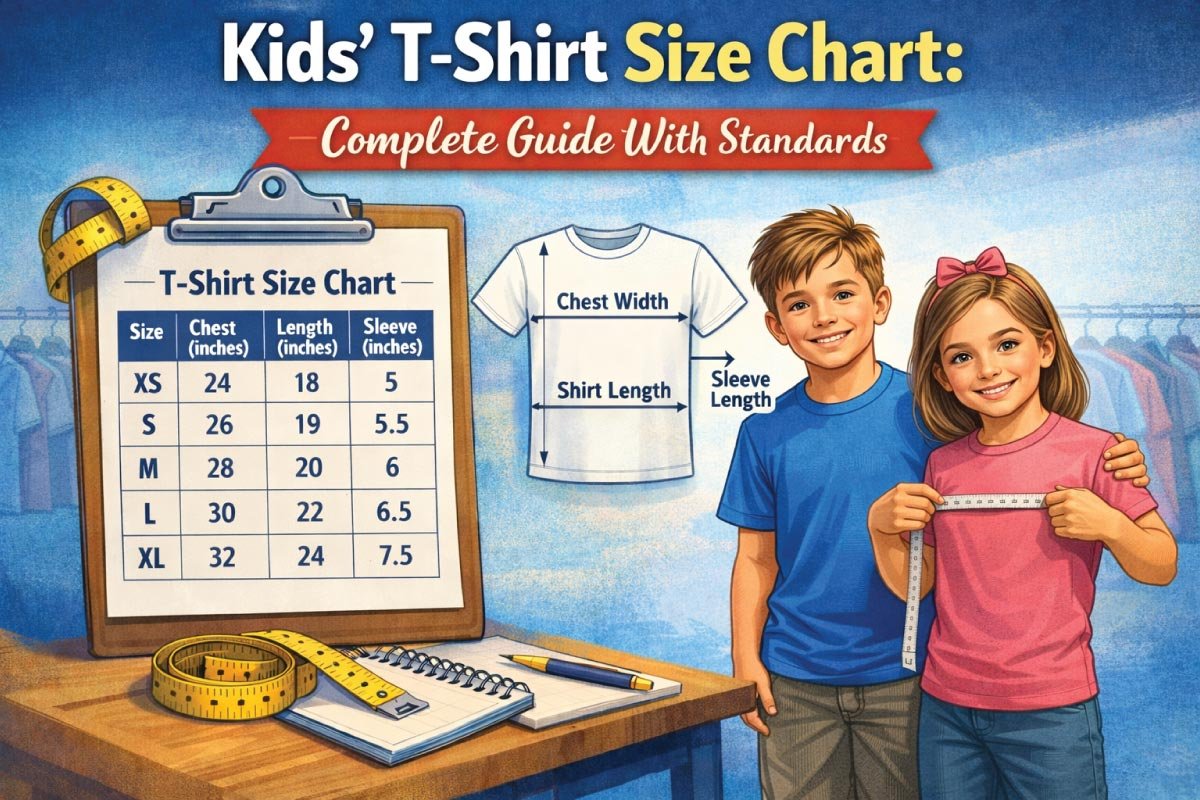
Here’s a general kids’ t-shirt size chart that covers toddlers, little kids, and preteens:
| Size (US) | Age | Chest (in) | Waist (in) | Height (in) | Shirt Length (in) | Sleeve Length (in) |
|---|---|---|---|---|---|---|
| XS / 2T | 2 | 20-21 | 19-20 | 33-35 | 14-15 | 7-7.5 |
| S / 3T | 3 | 21-22 | 20-21 | 36-38 | 15-16 | 7.5-8 |
| M / 4T | 4 | 22-23 | 21-22 | 39-41 | 16-17 | 8-8.5 |
| L / 5T | 5 | 23-24 | 22-23 | 42-44 | 17-18 | 8.5-9 |
| S / 6 | 6 | 24-25 | 23-24 | 45-47 | 18-19 | 9-9.5 |
| M / 7 | 7 | 25-26 | 24-25 | 48-50 | 19-20 | 9.5-10 |
| L / 8 | 8 | 26-27 | 25-26 | 51-53 | 20-21 | 10-10.5 |
| XL / 10 | 9-10 | 27-28 | 26-27 | 54-56 | 21-22 | 10.5-11 |
| XXL / 12 | 11-12 | 28-29 | 27-28 | 57-59 | 22-23 | 11-11.5 |
| 14 | 13-14 | 30-31 | 28-29 | 60-62 | 23-24 | 11.5-12 |
Notes:
- Sizes may vary slightly between brands. Always check the specific brand’s size chart before buying.
- Add 1-2 inches for comfort and growth, especially for active children.
- Shirt length is measured from shoulder to hemline.
Also Read:
Understanding Kids’ T-Shirt Fit Types
Children’s t-shirts come in different fit types to accommodate movement and body shape:
1. Regular Fit
- Straight cut from chest to hem
- Comfortable for daily activities
- Allows freedom of movement
2. Slim Fit
- Slightly tapered at the chest and waist
- Suitable for style-focused or semi-formal t-shirts
- Often shorter sleeves and shirt length
3. Relaxed / Loose Fit
- Extra room across chest, waist, and shoulders
- Provides maximum comfort
- Ideal for active kids or casual wear
International Kids’ T-Shirt Size Conversion
Children’s sizes differ globally. Here’s a simple international size conversion chart:
| US Size | UK Size | EU Size | Japan Size |
|---|---|---|---|
| 2T | 2-3 | 92 | 90 |
| 3T | 3-4 | 98 | 95 |
| 4T | 4-5 | 104 | 100 |
| 5T | 5-6 | 110 | 105 |
| 6 | 6 | 116 | 110 |
| 7 | 6-7 | 122 | 115 |
| 8 | 7-8 | 128 | 120 |
| 10 | 9-10 | 140 | 135 |
| 12 | 11-12 | 152 | 145 |
| 14 | 13-14 | 164 | 155 |
This helps when buying from international brands or shopping online.
Also Read:
Tips for Buying Kids’ T-Shirts Online
-
Measure Your Child: Always measure chest, waist, shoulders, and length before ordering.
-
Check Brand Size Charts: Sizes vary between brands, so refer to the specific chart.
-
Consider Growth: Children grow quickly, so adding 1-2 inches ensures the t-shirt lasts longer.
-
Read Customer Reviews: Reviews often indicate if a t-shirt runs small, large, or true to size.
-
Check Fabric: Cotton may shrink slightly after washing; blends may stretch.
-
Look at Fit Type: Regular fit is best for everyday wear, slim fit for style, and relaxed fit for comfort.
Common Mistakes When Buying Kids’ T-Shirts
-
Not Measuring Properly: Leads to ill-fitting t-shirts.
-
Ignoring Fit Type: Slim, regular, or relaxed fit requires different sizing decisions.
-
Neglecting Growth: Buying too small means the t-shirt will quickly become unusable.
-
Ignoring Fabric Shrinkage: Cotton may shrink, so plan accordingly.
-
Overlooking Sleeve Length and Shirt Length: Both affect comfort and style.
How to Ensure the Perfect Fit
-
Keep a Reference T-Shirt: Measure a favorite t-shirt your child currently wears for accurate comparison.
-
Understand Brand Differences: Each brand may have slightly different sizing, so check charts carefully.
-
Consider the Child’s Age and Activity Level: Active kids may need slightly larger sizes for comfort.
-
Prioritize Comfort: Children need room to move freely, so avoid overly tight t-shirts.
Also Read:
Conclusion
Buying the perfect t-shirt for children is easier when you understand measurements, fit types, and standard size charts. A well-fitted t-shirt ensures comfort, allows growth, and looks neat for everyday wear.
Key Takeaways:
- Measure chest, waist, shoulders, sleeve length, and overall length.
- Understand different fit types: regular, slim, or relaxed.
- Consider growth and fabric shrinkage.
- Refer to brand-specific and international size charts.
With this complete kids’ t-shirt size chart guide, you can shop confidently online or in-store, ensuring your child always wears comfortable, stylish, and appropriately sized t-shirts.
✅ Pro Tip: Keep your child’s favorite t-shirt measurements handy for quick reference when shopping for new t-shirts.
Also Read:
