
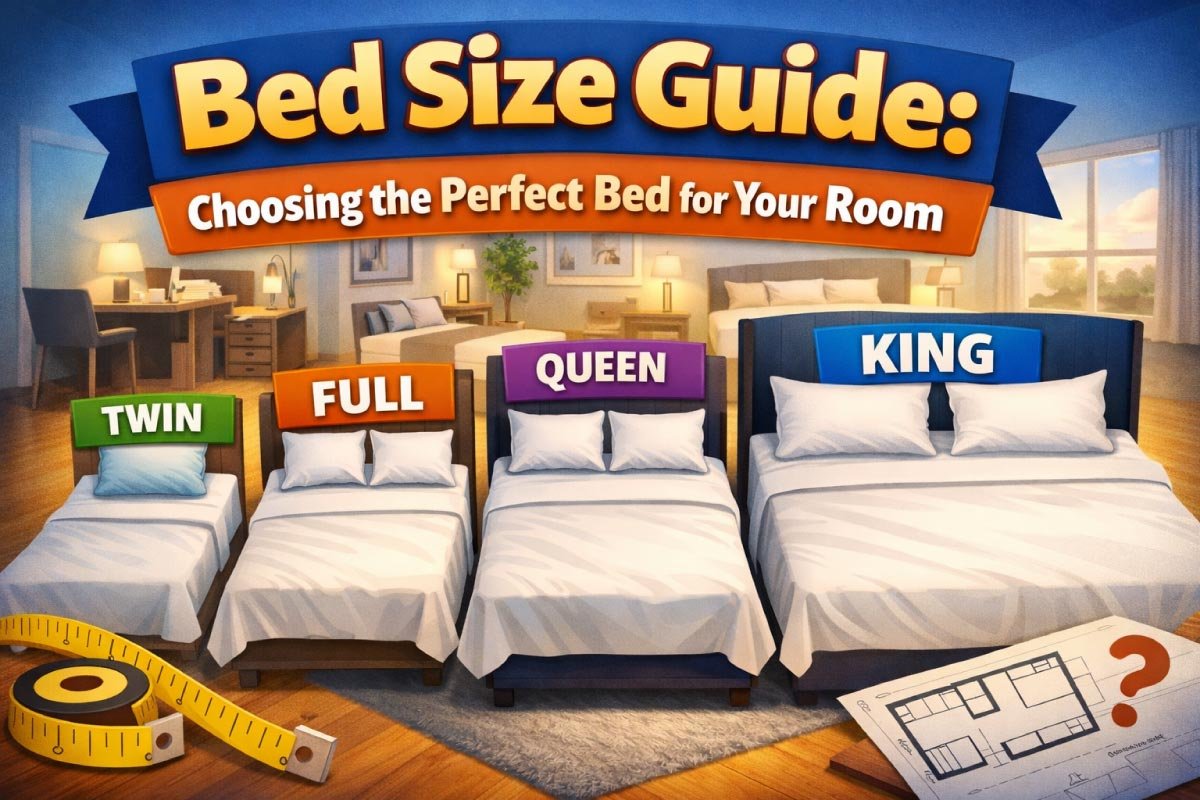
Choosing the right bed size can make a major difference in comfort, bedroom layout, and everyday usability. Whether you are furnishing a master bedroom, guest room, children’s room, or small apartment, knowing the standard bed dimensions helps you choose a mattress and frame that actually fit your space.
A bed size chart makes it easier to compare common mattress sizes by width, length, and typical use. Standard sizes such as Twin, Twin XL, Full, Queen, King, and California King each serve different needs. The best option depends on the number of sleepers, room size, sleeping habits, and available furniture space.
This guide explains standard bed sizes in inches, feet, and centimeters, compares the most common options, explains how to measure your bedroom, and helps you choose the right size without relying on guesswork.
Bed Size Chart
The following chart shows common U.S. mattress dimensions. These are mattress dimensions rather than the complete exterior dimensions of a bed frame.
| Bed Size | Width (in.) | Length (in.) | Width (cm) | Length (cm) | Typical Use |
|---|---|---|---|---|---|
| Twin | 38 | 75 | 96.5 | 190.5 | Children, teens, single adults |
| Twin XL | 38 | 80 | 96.5 | 203.2 | Taller single sleepers |
| Full | 54 | 75 | 137.2 | 190.5 | One adult, compact guest room |
| Queen | 60 | 80 | 152.4 | 203.2 | One or two adults |
| King | 76 | 80 | 193.0 | 203.2 | Two adults needing more width |
| California King | 72 | 84 | 182.9 | 213.4 | Two adults needing extra length |
These measurements are among the most commonly used standard U.S. mattress dimensions. Individual manufacturers can have small variations, so check the manufacturer’s specifications when exact fit is important.
What Are the Standard Bed Sizes?
The most common standard bed sizes are Twin, Twin XL, Full, Queen, King, and California King.
Each size has a different balance between sleeping surface and floor space. A Twin is designed primarily for one sleeper, while Queen and King sizes are commonly selected for couples.
The main differences are width and length:
- Twin: 38 × 75 inches
- Twin XL: 38 × 80 inches
- Full: 54 × 75 inches
- Queen: 60 × 80 inches
- King: 76 × 80 inches
- California King: 72 × 84 inches
Understanding these dimensions before shopping can help prevent problems with room layout, bed frames, sheets, and other accessories.
Twin Bed Size
A standard Twin mattress measures 38 inches wide by 75 inches long.
Twin beds are one of the most space-efficient options for a single sleeper. They are commonly used in children’s bedrooms, guest rooms, dormitories, and smaller living spaces.
Twin Bed Dimensions
| Measurement | Twin |
|---|---|
| Width | 38 in |
| Length | 75 in |
| Width | 96.5 cm |
| Length | 190.5 cm |
| Typical sleepers | 1 |
A Twin is usually a practical choice when floor space is limited. However, its 75-inch length may feel short for taller adults.
Twin XL Bed Size
A Twin XL has the same width as a standard Twin but adds 5 inches of length.
It measures 38 × 80 inches.
Twin vs. Twin XL
| Feature | Twin | Twin XL |
|---|---|---|
| Width | 38 in | 38 in |
| Length | 75 in | 80 in |
| Best for | Children and shorter sleepers | Taller children, teens, and adults |
The additional length makes Twin XL particularly useful for taller single sleepers who do not need the extra width of a Full or Queen mattress.
Twin XL mattresses are also commonly used in college dormitories.
Full Bed Size
A Full mattress, sometimes called a Double, measures approximately 54 inches wide by 75 inches long.
It provides substantially more width than a Twin but remains smaller than a Queen.
Who Should Choose a Full Bed?
A Full bed can work well for:
- One adult who wants extra sleeping width.
- Teenagers.
- Guest bedrooms.
- Smaller primary bedrooms.
- Couples who do not require much personal sleeping space.
A Full mattress can accommodate two people, but its 54-inch width gives each person less space than a Queen.
For a couple, a Queen is often more comfortable when the bedroom has enough available space.
Queen Bed Size
A standard Queen mattress measures 60 inches wide by 80 inches long.
It is one of the most popular choices for adults because it provides a useful balance between sleeping space and bedroom footprint.
Queen Bed Dimensions
| Measurement | Queen |
|---|---|
| Width | 60 in |
| Length | 80 in |
| Width | 152.4 cm |
| Length | 203.2 cm |
| Typical sleepers | 1–2 adults |
A Queen works well for couples who want more sleeping space than a Full provides but do not want the additional width of a King.
It is also a strong choice for a single adult who prefers a larger sleeping surface.
King Bed Size
A standard King mattress measures 76 inches wide by 80 inches long.
The King has the same length as a Queen but is significantly wider.
King Bed Dimensions
| Measurement | King |
|---|---|
| Width | 76 in |
| Length | 80 in |
| Width | 193.0 cm |
| Length | 203.2 cm |
| Typical sleepers | 2 adults |
The additional width gives couples more personal sleeping space.
A King may be especially useful when:
- Both sleepers move frequently during sleep.
- Personal sleeping space is important.
- Children or pets sometimes share the bed.
- The bedroom is large enough to accommodate it comfortably.
The main disadvantage is the amount of floor space it occupies.
California King Bed Size
A California King measures 72 inches wide by 84 inches long.
Compared with a standard King, it is 4 inches narrower but 4 inches longer.
California King vs. King
| Feature | King | California King |
|---|---|---|
| Width | 76 in | 72 in |
| Length | 80 in | 84 in |
| Best advantage | More width | More length |
| Typical sleepers | 2 adults | 2 adults |
A California King can be useful for taller sleepers who benefit from additional length.
However, bedding and bed frames must specifically match the California King dimensions.
Bed Size Comparison
Looking at the sizes side by side makes the differences easier to understand.
| Size | Dimensions | Best For |
|---|---|---|
| Twin | 38 × 75 in | Children and single sleepers |
| Twin XL | 38 × 80 in | Taller single sleepers |
| Full | 54 × 75 in | One adult or guest room |
| Queen | 60 × 80 in | Couples and single adults |
| King | 76 × 80 in | Couples wanting maximum width |
| California King | 72 × 84 in | Couples wanting extra length |
The right choice depends less on which size is “best” and more on how much sleeping space you need and how much bedroom space you have available.
Queen vs. King Bed
Queen and King beds are two of the most common choices for couples.
A Queen measures 60 × 80 inches, while a King measures 76 × 80 inches.
The biggest difference is width.
| Feature | Queen | King |
|---|---|---|
| Width | 60 in | 76 in |
| Length | 80 in | 80 in |
| Surface area | 4,800 sq. in. | 6,080 sq. in. |
| Typical sleepers | 1–2 | 2 |
A King provides considerably more sleeping surface, but it also requires more room.
Choose a Queen when preserving bedroom floor space is important. Choose a King when maximum sleeping width is a higher priority.
King vs. California King
A standard King is wider, while a California King is longer.
The choice often comes down to bedroom shape and sleeper height.
A King may be preferable when:
- You want maximum width.
- Your bedroom is relatively wide.
- Both sleepers prefer additional side-to-side space.
A California King may be preferable when:
- One or both sleepers are tall.
- Your room is longer and narrower.
- Additional mattress length is more important than width.
Always consider the complete room layout before choosing between these two sizes.
How to Choose the Right Bed Size
Choosing a bed size requires more than comparing mattress measurements.
Consider the Number of Sleepers
The first question is how many people will regularly use the bed.
For one sleeper, Twin, Twin XL, Full, or Queen can all be practical depending on available space and comfort preferences.
For two adults, Queen, King, and California King are the most common choices.
Consider Your Height
Mattress length becomes more important for taller sleepers.
A 75-inch-long Twin or Full may feel restrictive for some adults. An 80-inch Queen, King, or Twin XL provides additional length.
A California King offers 84 inches of length for those who specifically need more room.
Consider Sleeping Habits
Your sleeping position and movement can affect how much space you need.
People who spread out while sleeping may prefer a wider mattress. Couples who tend to stay close together may find a smaller option sufficient.
Consider Your Bedroom
Measure your room before buying.
A larger mattress is not automatically better if it leaves insufficient walking space or makes furniture difficult to use.
Also Read:
How Much Bedroom Space Do You Need?
The mattress dimensions tell you the sleeping surface, but the complete bed usually occupies more space.
You also need room for:
- Walking around the bed.
- Opening bedroom doors.
- Opening closet doors.
- Using drawers.
- Placing nightstands.
- Making the bed.
- Moving furniture.
- Accessing windows and other fixtures.
Plan the Bed Layout Before Buying
An easy way to test a layout is to mark the mattress footprint on the floor using painter’s tape.
For example, mark a 60 × 80-inch area if you are considering a Queen.
Then place imaginary or measured outlines for the bed frame and surrounding furniture.
Walk through the room and check whether the arrangement feels practical.
This approach is often more useful than simply comparing the mattress dimensions with the overall room dimensions.
Also Read:
Mattress Size vs. Bed Frame Size
One of the most common mistakes when shopping for a new bed is confusing mattress dimensions with frame dimensions.
A mattress may have a standard size, but the complete bed can be larger because of the frame.
A bed frame may include:
- Side rails
- A headboard
- A footboard
- Storage compartments
- Decorative edges
- Platform supports
For this reason, check both measurements before buying.
If your room has limited space, use the overall assembled bed dimensions, not just the mattress dimensions, when planning the layout.
Bed Size and Bedding Compatibility
Mattress size also affects the bedding you need.
Sheets, mattress protectors, comforters, and other accessories are commonly labeled according to mattress size.
However, fitted sheets require attention to mattress thickness as well as width and length.
Before purchasing fitted sheets, check:
- Mattress width.
- Mattress length.
- Mattress thickness.
- Fitted-sheet pocket depth.
A Queen fitted sheet is designed around the Queen mattress footprint, but pocket depth can vary.
Mattress toppers can also increase total thickness, so take them into account when selecting bedding.
Also Read:
How to Measure Your Bed or Mattress
If you are unsure which size mattress you already have, measure it instead of relying on appearance.
Step 1: Remove the Bedding
Remove sheets, blankets, mattress pads, and toppers if possible.
This gives you a more accurate measurement of the mattress itself.
Step 2: Measure the Width
Measure straight across the widest part of the mattress.
Record the measurement in inches or centimeters.
Step 3: Measure the Length
Measure from the head end to the foot end.
Do not measure the bed frame if you are trying to identify the mattress size.
Step 4: Measure the Thickness
Measure from the bottom surface to the highest point of the mattress.
Thickness is useful when selecting fitted sheets and mattress protectors.
Step 5: Measure the Frame Separately
If you are replacing the mattress but keeping the frame, measure the frame’s mattress-support area.
This helps confirm compatibility before purchasing.
Common Bed Size Mistakes to Avoid
Buying Based Only on Room Size
A mattress may fit inside a room but leave insufficient clearance around the bed.
Always consider furniture placement and walking space.
Ignoring Bed Frame Dimensions
A standard mattress does not mean every frame has the same exterior dimensions.
Check the complete frame measurements.
Choosing a Mattress Without Checking Length
Taller sleepers may need an 80- or 84-inch mattress rather than a 75-inch option.
Forgetting Mattress Thickness
Thickness can affect sheet fit, bed height, and the overall appearance of the bed.
Assuming All Countries Use the Same Sizes
Bed-size terminology can vary between countries. When purchasing internationally, verify the actual dimensions.
Frequently Asked Questions About Bed Sizes
What is the most common bed size for couples?
Queen and King mattresses are commonly used by couples. A Queen uses less room, while a King provides substantially more width.
What is the smallest standard bed size?
Twin is one of the smallest standard adult mattress sizes, measuring approximately 38 × 75 inches.
Is a Full bed bigger than a Twin?
Yes. A Full is 54 inches wide compared with 38 inches for a Twin. Both are generally 75 inches long.
Is a Queen bigger than a Full?
Yes. A Queen is 60 × 80 inches, while a Full is 54 × 75 inches.
Is a King longer than a Queen?
No. A standard King and Queen are both approximately 80 inches long. The King is wider.
Is a California King longer than a King?
Yes. A California King is approximately 84 inches long, compared with 80 inches for a standard King.
What bed size is best for a small bedroom?
The best size depends on the room layout and number of sleepers. Twin and Full sizes use less floor space, while a Queen can still work well if the room provides sufficient clearance.
Can two adults sleep on a Full bed?
Two adults can sleep on a Full, but each person gets less width than on a Queen. Couples who want more personal space may prefer a Queen or larger mattress.
Does the bed frame have the same dimensions as the mattress?
Not necessarily. The frame can be larger because of rails, headboards, footboards, storage, or decorative construction.
Conclusion
A good bed size chart makes it easier to compare mattress dimensions before purchasing a bed, frame, or bedding. Standard sizes range from the compact Twin to the spacious King and California King, with Queen offering a popular middle ground for couples and single adults.
When choosing a size, consider more than the mattress measurements. Think about the number of sleepers, your height, sleeping habits, bedroom dimensions, furniture placement, and available walking space.
For the most accurate fit, measure both the mattress and the bed frame. If you are buying bedding, also check mattress thickness and fitted-sheet pocket depth.
The best bed size is ultimately the one that provides enough sleeping space without making the bedroom difficult to use.
