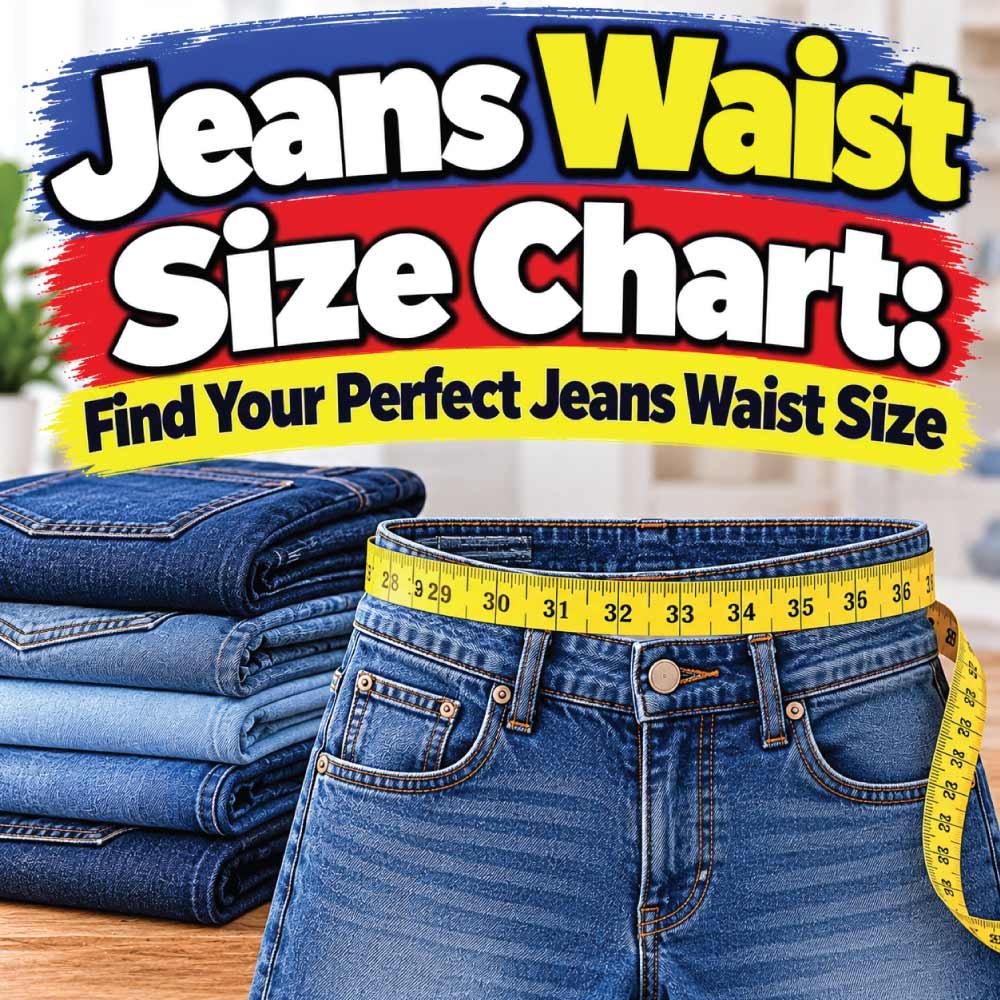
Jeans sizing can be confusing because a waist size printed on the label does not always match your actual body measurement. A pair marked 32 may fit differently from another pair marked 32 because denim brands use different patterns, rises, fabrics, and sizing systems.
A jeans waist size chart gives you a useful starting point for finding the right size. The most reliable approach is to measure your waist correctly, compare that measurement with the chart, and then consider the jeans’ rise, fit, fabric stretch, and brand-specific sizing.
This guide explains common jeans waist sizes, how waist measurements relate to jeans labels, how to measure yourself at home, how to convert between sizing systems, and what to do when you are between sizes.
Jeans Waist Size Chart
A jeans waist size generally refers to the approximate waist measurement in inches. For example, a size W32 is commonly intended for a waist around 32 inches, although the actual garment measurement can vary.
The chart below provides a general reference for adult jeans. It should be treated as a starting guide rather than a universal standard, because manufacturers can size their jeans differently.
| Jeans Waist Size | Approx. Waist (inches) | Approx. Waist (cm) | Common Letter Size |
|---|---|---|---|
| W26 | 26 in | 66 cm | XS |
| W27 | 27 in | 69 cm | XS–S |
| W28 | 28 in | 71 cm | S |
| W29 | 29 in | 74 cm | S |
| W30 | 30 in | 76 cm | S–M |
| W31 | 31 in | 79 cm | M |
| W32 | 32 in | 81 cm | M |
| W33 | 33 in | 84 cm | M–L |
| W34 | 34 in | 86 cm | L |
| W36 | 36 in | 91 cm | L–XL |
| W38 | 38 in | 97 cm | XL |
| W40 | 40 in | 102 cm | XL–XXL |
| W42 | 42 in | 107 cm | XXL |
| W44 | 44 in | 112 cm | XXL–3XL |
| W46 | 46 in | 117 cm | 3XL |
| W48 | 48 in | 122 cm | 3XL–4XL |
Important: Letter sizes such as S, M, L, and XL are much less precise than numbered waist sizes. Always check the individual manufacturer’s size chart when available.
What Does the Jeans Waist Size Mean?
Jeans are often labeled using a W/L sizing system, such as W32 L30.
The first number represents the waist size, while the second represents the inseam length.
For example:
- W30 L30 = approximately 30-inch waist and 30-inch inseam
- W32 L32 = approximately 32-inch waist and 32-inch inseam
- W34 L30 = approximately 34-inch waist and 30-inch inseam
The waist number is usually expressed in inches, even when the jeans are sold in countries that commonly use centimeters.
However, the number on the label should not be considered an exact measurement of the finished waistband. Jeans can have a waistband that measures somewhat differently because of the cut, rise, fabric construction, and intended fit.
Waist Size vs. Actual Jeans Measurement
There is an important difference between your body waist measurement and the flat measurement of a pair of jeans.
If you lay jeans flat and measure straight across the waistband, you will get a half-waist measurement. Doubling that number gives an approximate waistband circumference.
For example:
| Flat Waist Measurement | Approx. Waist Circumference |
|---|---|
| 14 in | 28 in |
| 15 in | 30 in |
| 16 in | 32 in |
| 17 in | 34 in |
| 18 in | 36 in |
| 19 in | 38 in |
| 20 in | 40 in |
This method is especially useful when buying jeans online and you already own a pair that fits well.
How to Measure Your Waist for Jeans
Taking your waist measurement correctly is one of the easiest ways to improve your chances of choosing the right jeans size.
You only need a flexible measuring tape. If you do not have one, you can use a piece of string and then measure the string against a ruler or rigid tape measure.
Step 1: Find the Right Measuring Position
Stand naturally and avoid pulling your stomach inward.
Where you measure depends partly on the style of jeans you are buying. A low-rise pair sits lower on the body than a high-rise pair, so the waistband may not sit at the same location as your natural waist.
For a general waist measurement, place the tape around the narrowest part of your torso, if that is clearly defined.
Step 2: Keep the Tape Level
Wrap the measuring tape around your body.
Make sure it remains horizontal and level rather than dipping at the back or front.
The tape should rest against your body without digging into your skin.
Step 3: Do Not Pull the Tape Too Tight
The tape should be snug but comfortable.
Do not compress your waist to obtain a smaller number. Jeans need enough room for normal movement, sitting, bending, and walking.
Step 4: Record the Measurement
Read the measurement where the end of the tape meets the scale.
If you get a measurement between whole numbers, record it as accurately as practical.
For example, if your measurement is approximately 31.5 inches, compare that result with the manufacturer’s size chart rather than automatically choosing W31.
Step 5: Measure Again
Take the measurement a second time.
If the results differ significantly, check that the tape is level and that you are measuring at the same position.
Taking two measurements can help prevent a simple measuring error from leading to the wrong size.
How to Choose Your Jeans Waist Size
Once you know your measurement, compare it with the jeans waist size chart for the brand and style you want.
Do not rely solely on a generic chart.
For example, suppose your waist measurement is around 32 inches. A general chart may suggest W32, but the best choice could vary depending on:
- The brand’s sizing
- The jeans’ rise
- The cut or fit
- Stretch content
- How tightly or loosely you prefer your jeans to fit
- Whether the measurement was taken at your natural waist or where the jeans will actually sit
Consider the Rise
The rise is the distance from the crotch area to the top of the waistband.
Common styles include:
- Low rise: Sits lower on the hips.
- Mid rise: Sits between the hips and natural waist.
- High rise: Sits higher on the torso.
A waist measurement alone does not tell you whether a particular rise will feel comfortable.
If you normally wear high-rise jeans, measuring where the waistband will sit can provide a more useful reference than measuring only the narrowest point of your torso.
Jeans Waist Size Conversion Chart
Jeans can use different sizing systems depending on the country, manufacturer, and gender-specific clothing conventions.
For jeans labeled by waist measurement, inches are often the easiest system to understand. Some retailers instead use numerical or letter sizes.
The following is a broad reference rather than a universal conversion standard.
| Waist (inches) | Waist (cm) | Approx. Letter Size |
|---|---|---|
| 26 | 66 cm | XS |
| 28 | 71 cm | S |
| 30 | 76 cm | S–M |
| 32 | 81 cm | M |
| 34 | 86 cm | L |
| 36 | 91 cm | L–XL |
| 38 | 97 cm | XL |
| 40 | 102 cm | XL–XXL |
| 42 | 107 cm | XXL |
| 44 | 112 cm | XXL–3XL |
| 46 | 117 cm | 3XL |
| 48 | 122 cm | 3XL–4XL |
Letter-size conversions are approximate because there is no single worldwide standard that makes every S, M, L, or XL identical.
When a retailer provides a specific chart, use that chart instead of converting from a generic table.
Women’s Jeans Waist Size Chart
Women’s jeans are commonly available in numerical sizes, waist sizes, letter sizes, or a combination of these systems.
Sizing can vary substantially between brands, so a women’s jeans size should not be selected from the number alone.
A general waist reference is:
| Approx. Waist | Jeans Waist Size | Approx. Letter Size |
|---|---|---|
| 26 in / 66 cm | W26 | XS |
| 28 in / 71 cm | W28 | S |
| 30 in / 76 cm | W30 | S–M |
| 32 in / 81 cm | W32 | M |
| 34 in / 86 cm | W34 | L |
| 36 in / 91 cm | W36 | L–XL |
| 38 in / 97 cm | W38 | XL |
| 40 in / 102 cm | W40 | XXL |
For women’s jeans, hip measurement can be just as important as waist measurement, particularly with fitted, skinny, or curvy styles.
If your waist corresponds to one size but your hips correspond to another, check whether the brand offers a curvy fit or provides garment measurements.
Men’s Jeans Waist Size Chart
Men’s jeans are frequently labeled directly by waist and inseam measurements.
For example, W34 L32 generally indicates a nominal 34-inch waist and 32-inch inseam.
| Jeans Size | Approx. Waist | Approx. Waist (cm) |
|---|---|---|
| W28 | 28 in | 71 cm |
| W30 | 30 in | 76 cm |
| W32 | 32 in | 81 cm |
| W34 | 34 in | 86 cm |
| W36 | 36 in | 91 cm |
| W38 | 38 in | 97 cm |
| W40 | 40 in | 102 cm |
| W42 | 42 in | 107 cm |
| W44 | 44 in | 112 cm |
| W46 | 46 in | 117 cm |
| W48 | 48 in | 122 cm |
Men’s jeans can also vary according to whether they are slim, straight, relaxed, athletic, or loose fit.
If you have larger thighs or prefer more room through the seat, choosing a different cut may improve comfort without simply increasing the waist size.
Also Read:
What If You Are Between Jeans Waist Sizes?
Being between two sizes is common.
For example, you might measure approximately 31 inches while a particular brand offers W30 and W32. In that situation, several factors should influence your decision.
Choose Based on Fabric Stretch
Jeans containing elastane or another stretch fiber generally have more flexibility than rigid denim.
Stretch jeans may feel comfortable in the smaller of two adjacent sizes, depending on the manufacturer’s fit recommendations.
Rigid or low-stretch denim generally requires more careful sizing because it has less give.
Consider the Intended Fit
Your preferred fit also matters.
If you want a close-fitting appearance, you may prefer a smaller size when the fabric and cut allow it.
For a relaxed fit, additional room may be preferable.
Do not deliberately choose an uncomfortably tight waistband simply because the smaller label seems preferable.
Check the Brand’s Measurements
The best solution is often to look for the retailer’s garment measurements.
If the website provides:
- Waist
- Hip
- Front rise
- Thigh
- Inseam
- Leg opening
you can compare these measurements with jeans you already own.
This is often more useful than comparing labels from different brands.
Also Read:
Why Jeans Sizes Differ Between Brands
One of the biggest reasons shoppers struggle with jeans sizing is that clothing sizes are not perfectly standardized across all manufacturers.
Two pairs with the same labeled waist size may have different actual measurements.
Differences can result from:
- Pattern design
- Garment construction
- Fabric composition
- Stretch level
- Rise
- Intended fit
- Manufacturing tolerances
- Brand-specific sizing practices
This is why a person who normally wears W32 might need W31 or W33 in another style.
It does not necessarily mean your body measurement changed. The jeans themselves may simply be designed differently.
How to Measure Jeans You Already Own
If you have a pair of jeans that fits exceptionally well, measuring them can be one of the most practical ways to choose another pair.
Lay the jeans flat on a smooth surface and button or zip them.
Measure the Waistband
Measure straight across the top of the waistband from one side to the other.
Keep the waistband flat without stretching it.
Multiply the flat measurement by two to estimate the waistband circumference.
Measure the Inseam
Measure from the crotch seam down the inside leg to the bottom of the leg opening.
This tells you the inseam length.
Compare Similar Styles
For the most useful comparison, measure jeans with a similar:
- Rise
- Fit
- Fabric composition
- Intended silhouette
A high-rise skinny jean and a low-rise relaxed jean should not necessarily be expected to have identical measurements even when they carry the same waist label.
Also Read:
Common Jeans Waist Sizing Mistakes
Choosing the correct jeans size is not just about reading a chart. Several common mistakes can lead to an uncomfortable fit.
Using Only Your Old Size
Your usual size is a useful reference, but it should not override the current product’s measurements.
Better approach: Check the size chart for the specific pair.
Measuring Your Waist Too Tightly
Pulling the tape tightly can produce a smaller measurement than your actual body circumference.
Better approach: Keep the tape comfortably snug.
Ignoring the Rise
A waist measurement taken at your natural waist may not correspond exactly to where low-rise or mid-rise jeans sit.
Better approach: Consider where the waistband will actually rest.
Ignoring Stretch
A rigid denim jean and a stretch denim jean may feel completely different even if both are labeled W32.
Better approach: Check the fabric composition and fit description.
Assuming Every W32 Is Identical
The label is not a guarantee that every brand’s W32 has the same garment dimensions.
Better approach: Use brand-specific measurements whenever available.
Sizing Up Instead of Changing the Cut
If jeans are tight around the thighs or hips but loose at the waist, simply choosing a larger waist size may create an oversized waistband.
Better approach: Look for a different cut, such as an athletic or curvy fit, when available.
How Should Jeans Fit Around the Waist?
A properly fitting waistband should feel secure without being painful or restrictive.
You should generally be able to:
- Sit comfortably
- Walk normally
- Bend without excessive pressure
- Fasten the waistband without forcing it
- Wear the jeans without constantly pulling them up
At the same time, excessive looseness can cause the waistband to gap or the jeans to slide down.
The ideal fit depends on the style, fabric, and personal preference, but comfort and mobility are important indicators.
Waist Size, Hip Size, and Inseam: What Matters Most?
Your jeans fit is determined by more than waist circumference.
Three measurements are particularly useful:
| Measurement | What It Helps Determine |
|---|---|
| Waist | Waistband fit |
| Hip/Seat | Room around the hips and seat |
| Inseam | Leg length |
Depending on the jeans style, thigh measurement and front rise can also be useful.
For example, someone with a 32-inch waist may need a different cut from another person with the same waist measurement if their hip or thigh proportions differ.
This is one reason body measurements plus garment measurements are more useful than relying on a size label alone.
Tips for Buying Jeans Online
Online shopping removes the opportunity to try on jeans before purchasing, making accurate measurements especially valuable.
Before ordering, check:
- The retailer’s size chart
- Waist measurement
- Hip measurement where provided
- Inseam options
- Rise
- Fabric composition
- Stretch percentage if listed
- Fit description
- Customer reviews about sizing
- Return or exchange policy
If possible, compare the retailer’s garment measurements with a pair of jeans you already own.
This approach can be especially helpful when purchasing from an unfamiliar brand.
Frequently Asked Questions About Jeans Waist Sizes
What is a 32 waist in jeans?
A W32 jean is generally intended for an approximately 32-inch waist, or about 81 cm. However, the actual fit can vary by brand, rise, fabric, and cut. Always compare your measurement with the specific manufacturer’s size chart when available.
Is W32 a medium or large?
W32 is often around a medium in men’s jeans, while the equivalent letter classification can vary in women’s jeans. Letter sizes are not standardized, so the actual waist measurement is more reliable than assuming that W32 always equals M or L.
How do I know my jeans waist size?
Measure your waist with a flexible tape, keeping it level and comfortably snug. Record the measurement in inches and compare it with the jeans manufacturer’s chart. You can also measure the waistband of a pair of jeans that already fits you well.
Should I size up or down in jeans?
It depends on the fabric, fit, rise, and the brand’s measurements. Stretch denim may accommodate a closer fit, while rigid denim generally needs more careful sizing. When between sizes, compare the product’s measurements with jeans you already own.
Is a jeans waist size the same as your body waist measurement?
Not necessarily. A jeans waist label is a sizing reference, not a guarantee of the garment’s exact waistband circumference. The difference can result from the rise, cut, fabric, construction, and brand-specific sizing.
What does W32 L30 mean on jeans?
W32 L30 generally means a nominal 32-inch waist and a 30-inch inseam. The W refers to waist and L refers to leg length or inseam. Actual garment measurements can vary by manufacturer and style.
Why do the same size jeans fit differently?
Different brands and styles use different patterns, fabrics, rises, and fits. Stretch denim can also behave differently from rigid denim. Consequently, two pairs carrying the same waist size may not feel identical.
Can I measure jeans instead of measuring my body?
Yes. Measuring a pair that already fits well can be particularly useful for online shopping. Lay the jeans flat, measure the waistband across, and double the result to estimate its circumference. Comparing similar styles produces the most useful results.
Final Thoughts on Finding Your Jeans Waist Size
A jeans waist size chart is a helpful starting point, but the most accurate sizing decision combines your body measurements with the manufacturer’s specific measurements.
Start by measuring your waist correctly. Then consider where the jeans will sit, whether they are low-, mid-, or high-rise, how much stretch the denim contains, and what type of fit you want.
If you are shopping online, measuring a pair of jeans you already love can provide an excellent comparison. Most importantly, do not assume that the same labeled size will fit identically across every brand.
The goal is not simply to find a number on a label. It is to find a pair of jeans with a comfortable waistband, suitable rise, appropriate room through the seat and thighs, and the right overall fit for your body and preferred style.
