
Choosing the right bathroom mirror size can make a major difference in both the appearance and functionality of your bathroom. A mirror that is too small may look lost above the vanity, while an oversized mirror can overwhelm the wall or interfere with lighting, cabinets, and other fixtures.
The ideal bathroom mirror size depends on the vanity width, bathroom layout, number of sinks, wall space, mirror shape, and desired visual style. Common bathroom mirrors range from compact mirrors around 20 inches wide to large double-vanity mirrors measuring 60 inches or more.
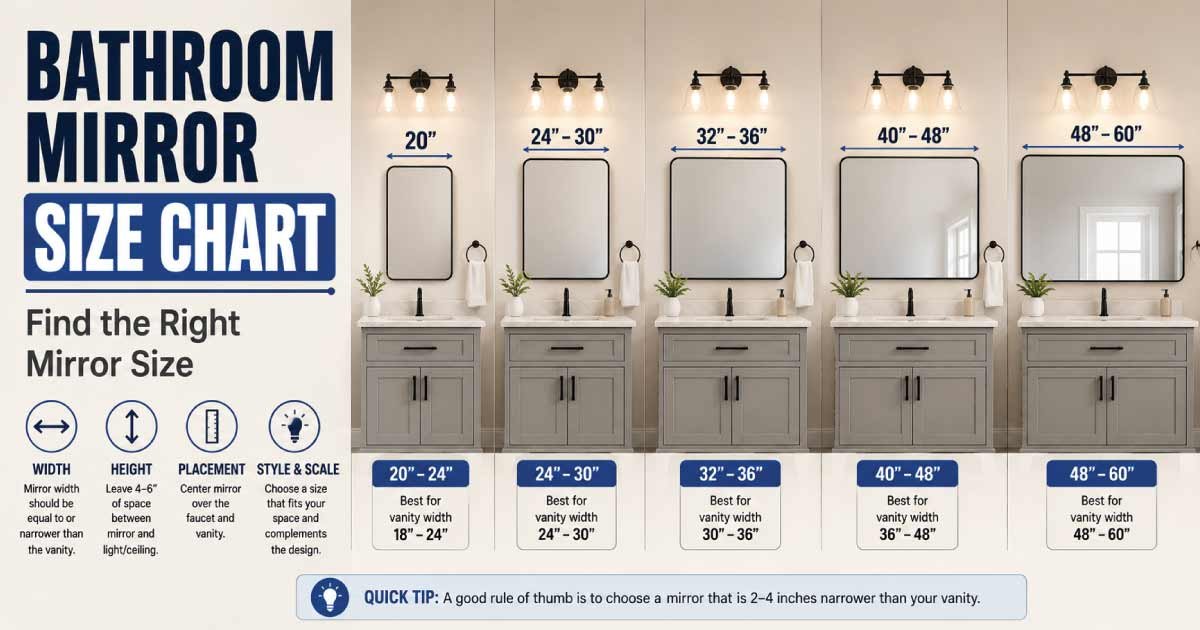
This bathroom mirror size chart explains standard mirror widths and heights, vanity-to-mirror sizing, single and double vanity recommendations, mirror placement, bathroom mirror height, and how to choose the right mirror for your space.
Bathroom Mirror Size Chart
The mirror should generally be proportional to the vanity and wall where it will be installed.
| Bathroom Vanity Width | Recommended Mirror Width | Typical Mirror Height | Best For |
|---|---|---|---|
| 18–24 in. | 16–22 in. | 24–30 in. | Small powder rooms |
| 24–30 in. | 20–28 in. | 24–32 in. | Compact bathrooms |
| 30–36 in. | 24–34 in. | 28–36 in. | Single-sink vanities |
| 42–48 in. | 32–44 in. | 28–38 in. | Larger single vanities |
| 60 in. | 50–56 in. | 30–40 in. | Double vanities |
| 72 in. | 60–68 in. | 30–42 in. | Large double vanities |
| 84+ in. | 72–80+ in. | 32–44 in. | Large bathrooms |
These are general sizing ranges. Wall space, lighting, faucet position, and mirror frame thickness can affect the ideal dimensions.
What Is a Bathroom Mirror?
A bathroom mirror is a reflective surface designed for grooming, makeup application, shaving, hair styling, and everyday personal care.
Bathroom mirrors are available in many shapes and styles, including:
- Rectangular mirrors
- Square mirrors
- Round mirrors
- Oval mirrors
- Arched mirrors
- Frameless mirrors
- Framed mirrors
- Medicine cabinet mirrors
- Backlit mirrors
- LED mirrors
Because the bathroom mirror is often positioned above the vanity, its dimensions should work with both the vanity and the surrounding wall.
Why Bathroom Mirror Size Matters
The correct mirror size can:
- Improve visibility
- Make the vanity look balanced
- Enhance the sense of space
- Reflect more light
- Complement bathroom fixtures
- Create a stronger focal point
- Provide comfortable viewing for users
A properly sized mirror should feel proportional rather than simply filling as much wall space as possible.
How Wide Should a Bathroom Mirror Be?
One of the most common bathroom design questions is how wide the mirror should be compared with the vanity.
A useful starting point is to choose a mirror that is slightly narrower than the vanity.
For example, if the vanity is 36 inches wide, a mirror around 28–34 inches wide may provide a balanced appearance.
Mirror Width vs. Vanity Width
| Vanity Width | Suggested Mirror Width |
|---|---|
| 24 in. | 20–22 in. |
| 30 in. | 24–28 in. |
| 36 in. | 28–34 in. |
| 42 in. | 34–40 in. |
| 48 in. | 38–44 in. |
| 60 in. | 50–56 in. |
| 72 in. | 60–68 in. |
| 84 in. | 72–80 in. |
The exact choice depends on the style of the bathroom.
A minimalist frameless mirror can sometimes be wider than a heavily framed mirror because its visual profile is lighter.
Bathroom Mirror Height Chart
Mirror height depends on the available wall space and the height of the people using the bathroom.
| Mirror Type | Typical Height | Recommended Use |
|---|---|---|
| Small | 20–26 in. | Powder rooms |
| Medium | 26–32 in. | Standard bathroom |
| Tall | 32–40 in. | Full grooming view |
| Extra Tall | 40–48+ in. | High ceilings and large walls |
A taller mirror can provide a larger viewing area, but it should leave adequate space for lighting, cabinets, backsplash, and other bathroom elements.
How High Should a Bathroom Mirror Be?
There is no single universal mounting height because bathroom users have different heights and vanity configurations.
A common approach is to position the mirror so that the user’s face is comfortably visible while standing at the vanity.
The mirror’s bottom edge is often positioned above the faucet and backsplash, while the top edge remains below or appropriately aligned with lighting or other fixtures.
Factors That Affect Mirror Height
Consider:
- Vanity height
- Sink height
- Faucet design
- Backsplash height
- User height
- Ceiling height
- Light fixture position
- Medicine cabinet
- Wall-mounted accessories
The mirror should be comfortable to use without creating an awkward gap or crowded appearance.
Bathroom Mirror Size for a 24-Inch Vanity
A 24-inch vanity is common in compact bathrooms and powder rooms.
A mirror around 20–22 inches wide can provide good proportions.
For a very small bathroom, a round or oval mirror can soften the appearance and make the space feel less visually crowded.
A frameless rectangular mirror can also maximize the reflective surface.
Bathroom Mirror Size for a 30-Inch Vanity
For a 30-inch vanity, consider a mirror approximately 24–28 inches wide.
This provides enough reflective area while leaving some visible vanity space around the edges.
A round mirror around 24–28 inches in diameter can also work well above a compact vanity.
Bathroom Mirror Size for a 36-Inch Vanity
A 36-inch vanity provides more flexibility.
A mirror around 28–34 inches wide can work well for a single-sink setup.
A 30-inch round mirror or a rectangular mirror with similar visual width can create a balanced arrangement.
If wall-mounted lights are placed beside the mirror, leave enough horizontal space for the fixtures.
Bathroom Mirror Size for a 48-Inch Vanity
A 48-inch vanity can accommodate a larger mirror.
A mirror approximately 38–44 inches wide can provide a balanced look.
For a single sink, one large mirror can work well.
For a wider vanity with two distinct grooming areas, you may instead consider two smaller mirrors.
Bathroom Mirror Size for a 60-Inch Vanity
A 60-inch vanity is commonly used for double-sink bathrooms.
You can choose either:
- One large mirror
- Two individual mirrors
A single mirror around 50–56 inches wide creates a unified appearance.
Two separate mirrors can provide a more customized look around each sink.
Bathroom Mirror Size for a 72-Inch Vanity
A 72-inch vanity provides substantial wall space.
A large mirror approximately 60–68 inches wide can create a strong focal point.
Alternatively, two mirrors can be placed above separate sinks.
When using two mirrors, consider the distance between the sinks and the available wall space around each mirror.
Single vs. Double Bathroom Mirrors
The number of sinks often influences mirror configuration.
| Vanity Type | Recommended Mirror Setup | Typical Approach |
|---|---|---|
| Single Sink | One mirror | Center over sink |
| Wide Single Vanity | One large mirror | Center over vanity |
| Double Sink | One large mirror | Covers both sinks |
| Double Sink | Two mirrors | One above each sink |
| Triple Sink | Multiple mirrors | Individual or large shared mirror |
Both single and multiple mirrors can work well. The choice depends on the desired appearance and wall layout.
One Large Mirror vs. Two Mirrors
A large mirror can make a bathroom feel more open because it creates a continuous reflective surface.
Advantages of One Large Mirror
- Creates a unified look
- Maximizes reflected light
- Easier visual alignment
- Works well with minimalist bathrooms
- Can make a wall appear wider
Advantages of Two Mirrors
- Defines each sink area
- Allows individual positioning
- Creates a symmetrical appearance
- Works well with separate wall lights
- Adds visual structure
Two mirrors are particularly attractive when the vanity has two distinct sinks.
Round Bathroom Mirror Size Chart
Round mirrors are measured by diameter rather than width and height.
| Vanity Width | Suggested Round Mirror Diameter |
|---|---|
| 24 in. | 20–22 in. |
| 30 in. | 24–28 in. |
| 36 in. | 28–32 in. |
| 42 in. | 30–36 in. |
| 48 in. | 32–40 in. |
| 60 in. | 36–48 in. |
| 72 in. | 40–60 in. |
Round mirrors can be particularly useful when you want to contrast the straight lines of a rectangular vanity.
Oval Bathroom Mirror Size
Oval mirrors are usually measured by their maximum width and height.
For example, an oval mirror might measure approximately 24 × 32 inches.
Oval designs can provide a softer appearance than rectangular mirrors while maintaining a relatively tall viewing area.
They work particularly well in:
- Traditional bathrooms
- Transitional bathrooms
- Vintage-style bathrooms
- Small powder rooms
- Bathrooms with curved fixtures
Arched Bathroom Mirror Size
Arched mirrors combine a rectangular lower section with a curved top.
They are available in a wide range of dimensions.
An arched mirror around 24–36 inches wide can work well over a single vanity, while larger designs can complement double vanities.
The curved top can also create visual height without requiring an extremely wide mirror.
Bathroom Mirror Size for Small Bathrooms
Small bathrooms require careful sizing.
An oversized mirror can make the vanity area feel crowded, especially when combined with wall-mounted lights or cabinets.
Good Options for Small Bathrooms
Consider:
- 20–28 inch wide mirrors
- Round mirrors
- Frameless designs
- Medicine cabinet mirrors
- Narrow rectangular mirrors
- Mirrors with integrated lighting
A mirror can also make a small bathroom appear larger by reflecting light and creating the impression of additional depth.
Bathroom Mirror Size for Large Bathrooms
Large bathrooms provide more freedom when selecting mirror dimensions.
A larger wall may look unbalanced if paired with a very small mirror.
For larger vanities, consider:
- Wide rectangular mirrors
- Oversized framed mirrors
- Large round mirrors
- Two coordinated mirrors
- Full-width vanity mirrors
- Backlit statement mirrors
The mirror should still maintain a visual relationship with the vanity rather than simply filling the entire wall.
Bathroom Mirror and Vanity Proportions
Proportion is more important than choosing a specific universal mirror measurement.
A mirror that is too narrow may make a large vanity appear visually heavy.
A mirror that is nearly the same width as the vanity can create a more substantial appearance.
A mirror that extends beyond the vanity may sometimes work, but it requires careful consideration of the surrounding wall, lighting, and fixtures.
A Simple Sizing Rule
As a starting point, choose a mirror that is 2–8 inches narrower than the vanity.
For example:
36-inch vanity → approximately 28–34 inch mirror
This isn’t a strict requirement, but it provides a useful starting point for many bathroom layouts.
Discover More:
Bathroom Mirror Frame Size
The frame affects the mirror’s overall visual and physical dimensions.
A thick frame can make a mirror appear larger than its actual reflective surface.
When measuring a framed mirror, distinguish between:
- Overall mirror dimensions
- Frame thickness
- Reflective area
If you have limited wall space, a frameless mirror may provide more usable reflective area within the same overall footprint.
Bathroom Mirror With Lighting
LED and backlit bathroom mirrors can combine illumination with reflection.
When choosing one, consider both the mirror dimensions and electrical requirements.
Make sure there is enough space for:
- Electrical connections
- Wall mounting
- Controls
- Nearby fixtures
- Door and cabinet clearance
A mirror with built-in lighting may reduce the need for separate wall sconces, but its size should still complement the vanity.
Medicine Cabinet Mirror Size
A mirrored medicine cabinet can provide both reflection and storage.
Its width should generally coordinate with the vanity.
For a single sink, a medicine cabinet around 20–30 inches wide can work well depending on the vanity.
For larger vanities, a wider cabinet or multiple cabinets may be appropriate.
Check the cabinet’s depth and installation requirements before selecting one.
How to Measure for a Bathroom Mirror
Accurate measurements make mirror selection much easier.
Step 1: Measure the Vanity
Measure the complete width of the vanity.
Step 2: Measure Available Wall Space
Determine the maximum width available between walls, cabinets, lights, and other fixtures.
Step 3: Measure Vertical Space
Measure from the top of the backsplash or vanity to the ceiling or lighting.
Step 4: Check Sink Position
For a single sink, the mirror is usually centered with the sink.
For double sinks, decide whether you want one shared mirror or two individual mirrors.
Step 5: Consider Lighting
Make sure the mirror doesn’t interfere with wall sconces, ceiling lights, or other fixtures.
Step 6: Check Door and Cabinet Clearance
Make sure nearby doors and cabinets can open without hitting the mirror.
Discover More:
Common Bathroom Mirror Size Mistakes
Choosing a Mirror Too Small for the Vanity
A tiny mirror above a wide vanity can look unbalanced.
Making the Mirror Too Wide
A mirror that extends too far may interfere with lighting, cabinets, or walls.
Ignoring Mirror Height
Width isn’t the only important measurement. Height affects both appearance and usability.
Forgetting the Frame
A thick frame adds to the overall size and reduces the reflective area.
Ignoring Lighting
Wall lights need sufficient space beside or above the mirror.
Not Considering User Height
A mirror should be comfortable for the people who use the bathroom most often.
How to Choose the Right Bathroom Mirror Size
Follow these simple steps:
- Measure the vanity width.
- Determine whether the vanity has one or two sinks.
- Measure the available wall width.
- Check the vertical space.
- Choose a mirror slightly narrower than the vanity as a starting point.
- Consider round, oval, rectangular, or arched shapes.
- Check lighting and cabinet clearance.
- Consider the height of the primary users.
- Account for the mirror frame if applicable.
- Confirm mounting requirements before purchasing.
Bathroom Mirror Size Buying Checklist
Before purchasing, check:
- Vanity width
- Vanity height
- Number of sinks
- Available wall width
- Available wall height
- Mirror width
- Mirror height
- Mirror diameter if round
- Frame thickness
- Backsplash height
- Faucet position
- Light fixture position
- Cabinet clearance
- Door clearance
- Mounting hardware
- User height
- Overall bathroom style
Discover More:
Frequently Asked Questions About Bathroom Mirror Sizes
What is the standard bathroom mirror size?
There is no single standard bathroom mirror size. Common mirrors range from approximately 20–30 inches wide for small vanities to 50–70 inches or more for large double vanities.
How wide should a bathroom mirror be compared with the vanity?
A common starting point is to choose a mirror that is slightly narrower than the vanity. For many installations, a mirror around 2–8 inches narrower than the vanity creates balanced proportions.
What size mirror should I use for a 36-inch vanity?
A mirror approximately 28–34 inches wide can work well over a 36-inch vanity. The exact size depends on the mirror shape, frame, lighting, and available wall space.
What size mirror is best for a 48-inch vanity?
For a 48-inch vanity, a mirror around 38–44 inches wide can provide good proportions. You can also use two smaller mirrors if the vanity has two sinks.
What size mirror should I use for a 60-inch double vanity?
A single mirror around 50–56 inches wide can work well over a 60-inch double vanity. Alternatively, two individual mirrors can be centered above each sink.
Should a bathroom mirror be wider than the vanity?
In many bathrooms, the mirror is slightly narrower than the vanity. However, a wider mirror can work in certain layouts if there is sufficient wall space and it doesn’t interfere with lights, cabinets, or other fixtures.
How high should a bathroom mirror be above the vanity?
The ideal height depends on the vanity, users, lighting, backsplash, and mirror dimensions. Position the mirror so that users can comfortably see their faces while standing at the vanity.
Is a round mirror better than a rectangular mirror?
Neither shape is universally better. Round mirrors can soften a bathroom with straight lines, while rectangular mirrors often maximize reflective surface and work efficiently above wider vanities.
What size round mirror should I use over a 36-inch vanity?
A round mirror approximately 28–32 inches in diameter can work well above a 36-inch vanity. The ideal diameter depends on wall space and the desired visual proportion.
Can I use two mirrors over a double vanity?
Yes. Two mirrors can provide a balanced appearance by placing one mirror above each sink. They can also make it easier to position individual lighting around each grooming area.
Should the bathroom mirror match the vanity width?
It doesn’t have to match exactly. A mirror slightly narrower than the vanity is a common approach, but the best proportion depends on the bathroom layout and surrounding fixtures.
How big should a bathroom mirror be for a small bathroom?
For a small bathroom, a mirror around 20–28 inches wide can work well depending on the vanity. Frameless, round, or vertically oriented mirrors can help maximize the visual effect without overcrowding the wall.
Final Thoughts on Bathroom Mirror Sizes
The right bathroom mirror size should complement your vanity, provide comfortable visibility, and fit naturally within the available wall space. For many single-sink vanities, choosing a mirror slightly narrower than the vanity creates a balanced appearance.
A 24-inch vanity may work well with a 20–22 inch mirror, while a 36-inch vanity can accommodate a mirror around 28–34 inches wide. Larger 60- and 72-inch double vanities can use either one large mirror or two individual mirrors.
Don’t forget to consider mirror height, frame thickness, lighting, backsplash, faucet position, cabinet clearance, and user height. A mirror that fits the vanity but interferes with a wall light or cabinet may not be the right choice.
Whether you prefer a rectangular, round, oval, or arched design, use the measurements in this bathroom mirror size chart as a starting point and adjust them to your specific bathroom.
The best mirror is one that looks proportional, provides enough reflective space, and works comfortably with the rest of your bathroom layout.
