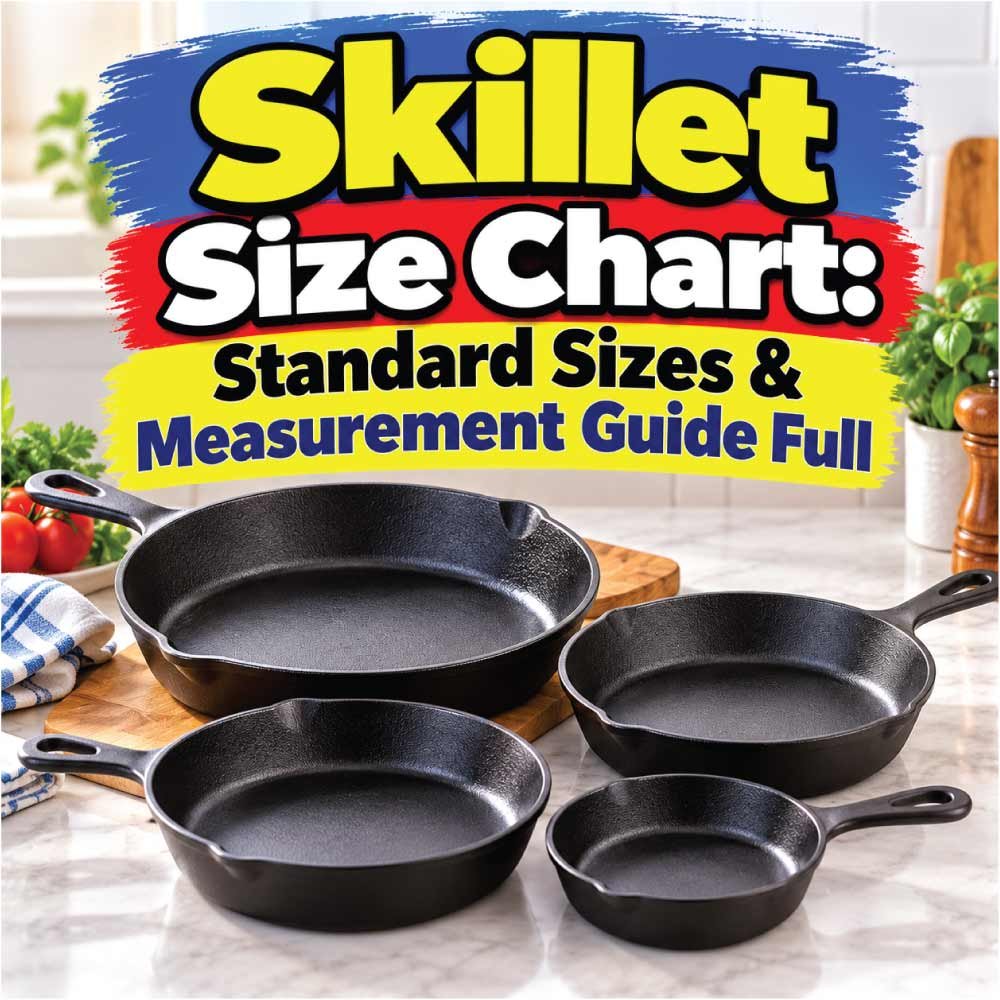
A skillet is one of the most useful pans in a kitchen, but choosing the right size is not always straightforward. A skillet size chart makes it easier to compare common diameters, understand cooking capacity, and select a pan that fits your meals, stovetop, oven, and storage space.
Skillets commonly range from compact 6-inch pans to 12-inch or larger models, with 8-, 10-, and 12-inch sizes being especially common for everyday cooking. However, the stated skillet size usually refers to the diameter across the top rim, not the actual cooking surface. The base may be smaller, and the depth, wall shape, handle, and overall weight can vary considerably.
This guide explains standard skillet sizes, actual measurements, cooking uses, capacity considerations, how to measure a skillet correctly, and how to decide which size is best for your kitchen.
Standard Skillet Size Chart
The easiest way to compare skillets is by their nominal diameter. The chart below shows common skillet sizes and their typical applications. Actual dimensions can vary by manufacturer and pan design, so use these values as practical size categories rather than exact manufacturing specifications.
| Skillet Size | Approx. Diameter | Typical Cooking Use | Best For |
|---|---|---|---|
| 6 inches | 6 in | Small portions, eggs, sauces | 1 person |
| 7 inches | 7 in | Eggs, small sautéed portions | 1 person |
| 8 inches | 8 in | Omelets, vegetables, small meals | 1–2 people |
| 9 inches | 9 in | Small family portions | 1–2 people |
| 10 inches | 10 in | Everyday cooking, frying, sautéing | 2–4 people |
| 11 inches | 11 in | Larger portions and one-pan meals | 3–4 people |
| 12 inches | 12 in | Family meals, meat, vegetables | 3–5 people |
| 13 inches | 13 in | Large meals and batch cooking | 4–6 people |
| 14 inches | 14 in | Large batches and entertaining | 5+ people |
The 10-inch and 12-inch skillet sizes are generally the most versatile choices for everyday home cooking. A smaller 8-inch pan can complement either one for quick individual portions.
What Does Skillet Size Mean?
When a skillet is advertised as 10 inches or 12 inches, the measurement normally describes its nominal diameter. This is generally measured from one side of the pan to the opposite side across the top.
That number does not necessarily tell you the exact size of the cooking surface.
For example, a 12-inch skillet can have sloped sides that make the flat bottom noticeably smaller than 12 inches. A straight-sided pan may provide a different usable surface area even when its listed diameter is the same.
This distinction matters because food cooks primarily on the flat cooking surface, not on the sloping walls.
Nominal Diameter vs. Cooking Surface
A skillet has several dimensions that can affect its practical size:
- Overall diameter: Distance across the upper rim.
- Cooking-surface diameter: Usable area inside the pan.
- Base diameter: Width of the flat portion contacting the burner.
- Depth: Vertical distance from the cooking surface to the rim.
- Overall length: Diameter plus the handle and other extensions.
- Overall height: Vertical dimension including the pan body and lid, if applicable.
Always check the manufacturer’s specifications if cabinet storage, burner compatibility, or oven clearance is important.
Common Skillet Sizes and Their Uses
Different skillet diameters work better for different quantities of food. Choosing based only on the largest meal you occasionally cook can result in a pan that feels unnecessarily heavy for everyday use.
6-Inch Skillet
A 6-inch skillet is a compact option designed for very small quantities. It is useful when you do not need the surface area of a standard frying pan.
Typical uses include:
- Cooking one or two eggs
- Heating small portions
- Preparing a small serving of vegetables
- Making individual sauces
- Cooking small amounts of food for one person
Because of its compact footprint, a 6-inch skillet can also be convenient when stovetop space is limited.
8-Inch Skillet
An 8-inch skillet offers more room while remaining relatively easy to handle. It is a practical size for one or two people.
It works well for:
- Omelets
- Fried or scrambled eggs
- Grilled sandwiches
- Small servings of vegetables
- Single portions of meat
- Reheating food
For households that already own a larger skillet, an 8-inch model is a useful complementary pan.
10-Inch Skillet
The 10-inch skillet is one of the most versatile general-purpose sizes.
It provides enough cooking area for many everyday meals without being as bulky as a 12-inch pan. It is suitable for sautéing vegetables, cooking several eggs, frying meat, making sauces, and preparing smaller one-pan meals.
A 10-inch skillet is particularly useful for small families or cooks who usually prepare moderate quantities.
12-Inch Skillet
A 12-inch skillet is a popular choice for family cooking because it offers considerably more surface area than a 10-inch pan.
It can be useful for:
- Several pieces of chicken or meat
- Larger vegetable portions
- Stir-frying
- One-pan dinners
- Cooking for several people
- Browning ingredients without excessive crowding
The trade-off is that a 12-inch skillet can be heavier and may require a larger burner and more storage space.
14-Inch Skillet
A 14-inch skillet is intended for substantially larger cooking tasks. It is useful for large families, batch cooking, entertaining, and recipes that require ingredients to spread across a broad cooking surface.
However, it may not fit comfortably on smaller stovetops or in compact ovens. Before buying one, check both your cooking appliance and storage area.
Skillet Size by Number of People
The number of people you cook for is useful when selecting a skillet, but it should not be treated as an exact sizing rule. Appetite, recipe type, ingredient volume, and whether the meal contains multiple dishes all affect the required pan size.
| Household Size | Recommended Skillet Range | Typical Use |
|---|---|---|
| 1 person | 6–8 in | Individual meals |
| 1–2 people | 8–10 in | Small everyday meals |
| 2–4 people | 10–12 in | Family cooking |
| 3–5 people | 12 in | Larger everyday meals |
| 5+ people | 12–14+ in | Batch cooking |
For many households, owning two different skillet sizes is more practical than trying to make one pan handle every recipe.
A common combination is an 8-inch skillet for small portions and a 12-inch skillet for family meals. Another versatile pairing is 10 inches plus 12 inches.
How to Measure a Skillet Correctly
If you already own a skillet and want to determine its size, you can measure it at home with a standard measuring tape or ruler.
Step-by-Step Measurement
- Place the skillet on a flat surface.
- Remove the lid, if it has one.
- Position the measuring tool across the widest part of the upper opening.
- Measure from the inside edge or across the rim according to the manufacturer’s stated convention.
- Record the measurement in inches or centimeters.
- Measure the flat cooking surface separately if you need to know the actual usable area.
The most useful measurement depends on why you are measuring the pan.
If you are replacing a 10-inch skillet, the nominal diameter helps you find a similar replacement. If you are checking whether a pan will fit a burner, the base diameter may be more relevant.
Measure the Base Too
The bottom of a skillet can be substantially smaller than its upper diameter. This is especially true for pans with sloped sides.
Measure the flat base when you need to determine:
- Whether the pan sits properly on a burner
- How much direct heat reaches the bottom
- Whether the skillet fits a cooking appliance
- How much flat surface is available for browning
Skillet Size in Inches and Centimeters
Skillets are commonly labeled in inches in the United States, while other markets may use centimeters or provide both measurements.
The basic conversion is:
1 inch = 2.54 centimeters
Here is a useful reference for common nominal skillet sizes.
| Skillet Size | Approx. Diameter in cm | Common Category |
|---|---|---|
| 6 in | 15.2 cm | Small |
| 8 in | 20.3 cm | Small |
| 9 in | 22.9 cm | Small-medium |
| 10 in | 25.4 cm | Medium |
| 11 in | 27.9 cm | Medium-large |
| 12 in | 30.5 cm | Large |
| 13 in | 33.0 cm | Extra-large |
| 14 in | 35.6 cm | Very large |
These are diameter conversions, not guarantees of the exact outside dimensions of a particular skillet.
Handles, pouring spouts, helper handles, and other features can make the total footprint larger.
10-Inch vs. 12-Inch Skillet
The 10-inch and 12-inch skillets are often compared because both are highly practical for home cooking.
A 10-inch skillet is easier to handle and generally requires less storage space. It is a strong choice for smaller households and moderate portions.
A 12-inch skillet provides more surface area and is better when you regularly cook larger quantities. It can also help prevent ingredients from becoming overcrowded.
Choose a 10-Inch Skillet If:
- You usually cook for one to three people.
- You prefer a lighter, easier-to-handle pan.
- Your stovetop has limited space.
- You prepare relatively small portions.
- Storage space is limited.
Choose a 12-Inch Skillet If:
- You regularly cook for three or more people.
- You prepare larger portions.
- You want more room for browning ingredients.
- You frequently make one-pan meals.
- You want a versatile family-size skillet.
If you are buying only one general-purpose skillet, either size can work. Your normal portion size and available storage space should determine the better choice.
8-Inch vs. 10-Inch vs. 12-Inch Skillet
The difference becomes easier to understand when the three common sizes are compared directly.
| Feature | 8-Inch | 10-Inch | 12-Inch |
|---|---|---|---|
| Nominal diameter | 8 in | 10 in | 12 in |
| Best for | Small portions | Everyday meals | Family meals |
| Typical household use | 1–2 people | 2–4 people | 3–5+ people |
| Storage requirement | Low | Moderate | Higher |
| Handling | Easy | Moderate | More demanding |
| Cooking area | Small | Medium | Large |
| Batch cooking | Limited | Moderate | Good |
The larger skillet is not automatically better. A pan that is too large for a small portion can be less convenient, particularly when you need quick heating or easy handling.
Also Read:
How Skillet Shape Affects Usable Size
Diameter is only one part of skillet sizing. The shape of the pan walls can significantly affect usable cooking area.
A skillet with gently sloped sides may provide a wide opening but a smaller flat base. This shape is helpful for tossing or turning food.
A straight-sided skillet may provide more vertical cooking space. This can be useful for recipes containing liquids or larger quantities of ingredients.
Other design factors include:
- Wall height
- Slope of the sides
- Flat-bottom diameter
- Rim diameter
- Handle length
- Helper handle
- Lid compatibility
For this reason, two 12-inch skillets can feel noticeably different during cooking.
Choosing the Right Skillet Size
Selecting the right pan involves more than counting the people at the table. Consider how you actually cook.
Consider Your Typical Recipes
Think about the foods you make most frequently.
For eggs, grilled sandwiches, and small portions, an 8-inch skillet may be enough.
For everyday sautéing and moderate meals, a 10-inch pan offers a good balance.
For family dinners, meat, vegetables, and larger one-pan recipes, a 12-inch skillet is usually more practical.
Consider Your Stovetop
The burner should provide suitable heat coverage for the pan’s base. A very large skillet on a small burner may not heat uniformly.
Check the flat bottom diameter rather than judging compatibility from the top diameter alone.
Also consider whether you need to use more than one pan at the same time. A very large skillet can occupy substantial stovetop space.
Consider Storage Space
Measure the cabinet, drawer, shelf, or cookware organizer where the skillet will be stored.
Remember that the handle contributes to the overall storage footprint. A 12-inch skillet with a long handle can require considerably more horizontal space than the pan body alone suggests.
Consider Weight
Large skillets can be significantly heavier, especially when constructed from thick or heavy materials.
If you frequently move the pan from the stovetop to the oven or need to lift it while full, handling comfort should be part of the decision.
Also Read:
Skillet Size and Cooking Performance
Pan size can affect cooking performance because it changes how ingredients are distributed across the surface.
A skillet that is too small may cause food to overlap or crowd together. Crowding can make it more difficult to achieve the desired browning because ingredients release moisture into a confined space.
A larger skillet gives food more room to spread, but an oversized pan is not always advantageous.
Avoid Excessively Crowding the Pan
When food is packed tightly into a small skillet:
- Ingredients may cook less evenly.
- Browning can become more difficult.
- Moisture may accumulate.
- You may need to cook in multiple batches.
Choosing an appropriately sized pan can therefore make a recipe easier to manage.
Avoid Oversizing for Small Portions
A very large skillet can also be inconvenient when cooking a tiny quantity. The food may occupy only a small part of the available surface.
For small meals, an 8-inch or 10-inch pan can be more practical than a 12- or 14-inch model.
Also Read:
Skillet Types and How Size Relates to Them
Skillet material and construction can influence how a particular size feels and performs.
Cast Iron Skillet
Cast iron skillets are available in many common diameters, including 8-, 10-, and 12-inch formats. Their substantial construction can make larger sizes particularly heavy.
When selecting cast iron, consider both diameter and weight.
Stainless Steel Skillet
Stainless steel skillets are commonly available in everyday sizes such as 8, 10, and 12 inches. Construction varies considerably, so two pans with the same diameter may have different weights and cooking characteristics.
Nonstick Skillet
Nonstick skillets are often chosen for eggs, delicate foods, and lower-effort cooking. Smaller sizes are convenient for individual portions, while 10- and 12-inch pans are useful for general household meals.
Carbon Steel Skillet
Carbon steel skillets are available in a range of sizes and can offer a balance between responsiveness and durability. As with other materials, larger diameters generally require more storage and handling consideration.
The material does not determine the skillet’s size. A 10-inch cast iron skillet and a 10-inch stainless steel skillet can have the same nominal diameter while differing in weight, wall thickness, and cooking-surface dimensions.
Common Skillet Sizing Mistakes
Understanding common mistakes can prevent you from buying a pan that does not suit your cooking setup.
Mistake 1: Assuming the Listed Diameter Is the Flat Base
A 12-inch label does not mean the entire bottom is 12 inches wide. Measure the base when burner compatibility matters.
Mistake 2: Choosing the Largest Pan Automatically
A larger skillet is useful for bigger meals, but it can be unnecessarily heavy and difficult to store if you usually cook small portions.
Mistake 3: Ignoring the Handle
The pan body may fit inside a cabinet while the handle does not. Check the overall length before buying.
Mistake 4: Forgetting Oven Dimensions
If you plan to transfer the skillet to an oven, check the cookware’s manufacturer specifications and compare the pan’s overall dimensions with the available oven space.
Mistake 5: Comparing Only Diameter
Depth, base diameter, wall angle, weight, and handle design can all affect practical usability.
Frequently Asked Questions About Skillet Sizes
What is the most common skillet size?
The 10-inch and 12-inch skillet sizes are among the most commonly used general-purpose options. A 10-inch pan works well for moderate portions, while a 12-inch skillet provides additional cooking area for family meals and larger recipes.
Is an 8-inch skillet too small?
An 8-inch skillet is not necessarily too small. It is useful for one or two servings, eggs, omelets, sandwiches, and other small meals. It becomes limiting when you regularly cook larger quantities or need significant surface area.
Is a 10-inch or 12-inch skillet better?
Neither is universally better. A 10-inch skillet is easier to handle and works well for moderate portions, while a 12-inch skillet provides more room for family meals. Choose according to your typical recipes, household size, storage, and stovetop space.
How is a skillet measured?
Skillet size is generally based on the diameter across the upper opening. To understand its practical cooking area, also measure the flat bottom or cooking surface. Manufacturer measurements may differ slightly, so check the product specifications when precision matters.
What skillet size is best for two people?
An 8- to 10-inch skillet is generally practical for two people, depending on the recipe and portion size. A 10-inch pan provides more flexibility if you frequently prepare complete meals rather than small servings.
What skillet size is best for a family?
A 12-inch skillet is a versatile choice for many family meals. If you regularly cook very large batches, a 13- or 14-inch skillet may provide additional surface area, provided your stovetop, oven, and storage space can accommodate it.
Can I use a 12-inch skillet on a small burner?
You can, but the heating pattern depends on the burner and the skillet’s base design. A large skillet with a much wider base than the heating area may not heat uniformly. Check your appliance and cookware specifications for the best match.
Does a deeper skillet count as a larger skillet?
Not necessarily. Skillet size generally refers to diameter, while depth is a separate dimension. Two pans can both be 12 inches wide while having different depths and capacities.
Which Skillet Size Should You Buy?
For most kitchens, there is no need to own every skillet diameter. Start with the size that matches your everyday cooking.
A simple guide is:
- 6–8 inches: Best for individual portions and small tasks.
- 8–10 inches: Good for one or two people and smaller everyday meals.
- 10 inches: A versatile all-purpose choice for moderate portions.
- 12 inches: Excellent for family meals and larger cooking tasks.
- 13–14 inches: Useful for large batches, entertaining, and high-volume cooking.
If you cook a wide variety of meals, having two complementary sizes can be more useful than buying one oversized pan. An 8- or 10-inch skillet can handle smaller jobs, while a 12-inch skillet covers larger meals.
Final Thoughts
A reliable skillet size chart helps you compare pan diameters, but the best skillet is determined by more than its advertised size. Consider the nominal diameter, flat cooking surface, base diameter, depth, weight, handle length, stovetop, storage space, and typical portion size before making a choice.
For many home cooks, a 10-inch skillet offers an excellent balance of capacity and maneuverability, while a 12-inch skillet is a stronger choice for larger meals and family cooking. Smaller 6- and 8-inch pans remain valuable for individual servings and quick tasks.
When replacing an existing pan, measure it rather than relying on appearance alone. And when buying a new skillet, always check the manufacturer’s specifications if exact dimensions, oven compatibility, or appliance fit are important.
