
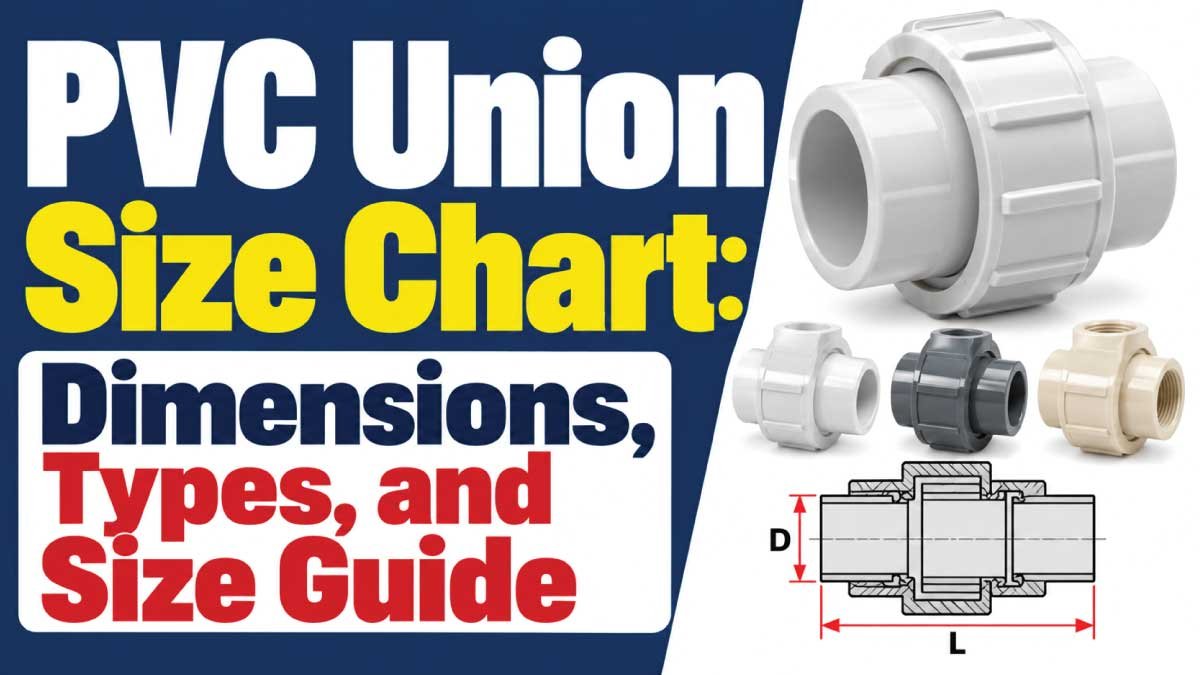
Choosing the correct PVC union size is essential for creating a reliable, leak-resistant piping system that can be disconnected for cleaning, repairs, or equipment replacement. Whether you are working on residential plumbing, irrigation, a swimming pool, or an industrial water line, understanding PVC union dimensions helps you select fittings that match your pipe and operating requirements.
This PVC union size chart explains common nominal pipe sizes, typical connection dimensions, union types, measurement methods, and important selection factors. It also covers PVC versus CPVC unions, threaded and socket connections, common sizing mistakes, and practical installation tips.
PVC union dimensions can vary by manufacturer, fitting design, pressure rating, and applicable pipe standard. Use the charts as a general selection guide and confirm exact measurements against the product specifications before purchasing or installation.
What Is a PVC Union Fitting?
A PVC union is a removable pipe fitting designed to connect two sections of piping while allowing them to be separated without cutting the pipe. Unlike a permanent solvent-weld coupling, a union can generally be disassembled by loosening its central nut.
A typical PVC union consists of several components:
Union body: The main fitting sections that connect to the pipe.
Union nut: The threaded collar that holds the two body sections together.
Sealing surface: The area where the fitting sections meet.
Gasket or O-ring: A sealing component used in designs that require one.
Pipe connection ends: Socket, threaded, or other compatible connection styles.
PVC unions are commonly used where maintenance access is important. Examples include pump installations, filter systems, irrigation manifolds, water treatment equipment, and accessible plumbing connections.
The union itself does not automatically make a piping system suitable for every liquid, pressure, or temperature. Material compatibility and the manufacturer’s operating limits must always be considered.
PVC Union Size Chart: Nominal Pipe Sizes and Dimensions
PVC unions are commonly sold in nominal pipe sizes such as 1/2 inch, 3/4 inch, 1 inch, 1-1/2 inches, and 2 inches. The nominal size identifies the compatible pipe size within a particular sizing system; it does not necessarily equal the fitting’s outside diameter or overall length.
The following chart summarizes common PVC union sizes used in water piping systems. Actual dimensions vary by product, so treat the dimensional descriptions as general guidance rather than universal specifications.
| Nominal Pipe Size (inches) | Nominal Size (mm equivalent) | Typical Connection Type | Common Applications |
|---|---|---|---|
| 1/2 in | 15 mm | Socket or threaded | Small water lines and equipment |
| 3/4 in | 20 mm | Socket or threaded | Residential plumbing and irrigation |
| 1 in | 25 mm | Socket or threaded | Water distribution and pump connections |
| 1-1/4 in | 32 mm | Socket or threaded | Medium-flow piping systems |
| 1-1/2 in | 40 mm | Socket or threaded | Pool equipment and water circulation |
| 2 in | 50 mm | Socket or threaded | Larger water lines and filtration systems |
| 2-1/2 in | 65 mm | Socket or threaded | Larger distribution systems |
| 3 in | 80 mm | Socket or threaded | Commercial and industrial piping |
| 4 in | 100 mm | Socket or threaded | Large piping and treatment equipment |
The millimeter equivalents shown are nominal size labels, not guaranteed metric outside diameters. Some markets use metric PVC pipe systems with different dimensional conventions. Always match the union to the actual pipe standard and connection type.
Understanding PVC Union Dimensions
When comparing union fittings, distinguish between the following measurements:
Nominal size: The pipe size the union is designed to fit.
Socket inside diameter: The opening that accepts the pipe in a socket-style union.
Thread size: The nominal thread designation for a threaded connection.
Overall length: The distance from one end of the assembled fitting to the other.
Body diameter: The widest outside measurement of the union body or nut.
Installation clearance: The space needed to access and turn the union nut during maintenance.
The overall length and body diameter are particularly important when fitting a union into a confined space. These dimensions are product-specific and should be checked on the manufacturer’s drawing.
Types of PVC Union Fittings
PVC unions come in different connection styles and material configurations. Selecting the correct type depends on the pipe material, installation method, maintenance needs, and operating conditions.
Socket PVC Union
A socket union has ends designed to accept compatible PVC pipe. The pipe is typically connected using the appropriate primer and solvent cement when required by the product and piping system.
Socket unions are commonly used in permanent pipe runs where the union provides a removable connection at a pump, valve, filter, or other piece of equipment.
Advantages include:
- A compact connection in many designs.
- A convenient removable joint for maintenance.
- Compatibility with suitable solvent-weld PVC piping systems.
- Availability in several nominal pipe sizes.
The socket connection itself is generally permanent after proper solvent welding. Maintenance is performed by separating the union’s central joint rather than pulling the pipe out of its socket.
Threaded PVC Union
Threaded unions use compatible threaded ends instead of socket connections. They may be useful when connecting threaded equipment or components designed for a removable threaded interface.
Before purchasing, verify the thread type. National Pipe Thread (NPT), British Standard Pipe threads, and metric threads are not interchangeable simply because their sizes appear similar.
Use only sealing methods approved for the particular fitting and application. Excessive tightening can damage plastic threads or cause the fitting to crack.
Combination PVC Union
Some unions combine different connection styles, such as a socket end on one side and a threaded end on the other. These designs can simplify connections between solvent-weld piping and compatible threaded equipment.
Check both ends individually. A combination union may have the correct nominal pipe size but still be unsuitable if its thread specification or connection arrangement does not match the equipment.
PVC Union With an O-Ring or Gasket
Many unions use an O-ring or flat gasket to create a seal when the union nut is tightened. The sealing design varies between manufacturers and models.
When replacing a worn union, inspect the seal for flattening, cracking, swelling, or damage. Use the specified replacement seal and avoid substituting a gasket with an unverified material or dimension.
PVC and CPVC Unions
PVC and CPVC are different piping materials. Although some sizes may appear similar, their temperature capabilities, material properties, and joining requirements differ.
| Feature | PVC Union | CPVC Union |
|---|---|---|
| Material | Polyvinyl chloride | Chlorinated polyvinyl chloride |
| Typical use | Suitable cold-water and compatible process applications | Applications requiring a suitable CPVC system |
| Temperature capability | Depends on the specific product and system | Often suitable for higher temperatures than comparable PVC products |
| Joining method | Compatible PVC joining system | Compatible CPVC joining system |
| Key selection factor | Pressure, temperature, and chemical compatibility | Pressure, temperature, and chemical compatibility |
Do not assume that PVC and CPVC unions are interchangeable. Confirm pipe dimensions, joining compatibility, temperature limits, and manufacturer approval for the intended application.
How to Choose the Correct PVC Union Size
Choosing the right PVC union involves more than reading the nominal size printed on the fitting. Follow these steps to reduce sizing errors.
Step 1: Identify the Pipe’s Nominal Size
Check the markings printed on the existing pipe. These may identify the nominal diameter, material, pressure classification, or applicable standard.
If the markings are missing, consult the system documentation or measure the pipe and compare the result with the correct pipe dimensional standard.
Step 2: Measure the Pipe Outside Diameter
For socket unions, pipe outside diameter is an important compatibility check.
Use a caliper or suitable measuring tool to measure across the outside of the pipe. If measuring with a tape, wrap it around the pipe and calculate the approximate diameter by dividing the circumference by 3.1416.
However, an outside-diameter measurement alone does not identify every pipe standard. Different systems may use similar measurements while requiring different fittings.
Step 3: Confirm the Connection Style
Determine whether the existing pipe or equipment uses:
- Socket connections.
- Male or female threaded connections.
- A combination of socket and threaded ends.
- A metric or another non-inch dimensional system.
The union must match the connection type at both ends.
Step 4: Check Pressure and Temperature Ratings
A fitting’s pressure rating may depend on its material, size, temperature, and design. The complete system is limited by the ratings of its individual components.
Check the manufacturer’s stated working pressure and temperature limits. Do not assume that every PVC union has the same pressure rating or that a fitting’s maximum rating applies at elevated temperatures.
Step 5: Measure the Available Installation Space
Measure the space between the adjoining components and consider the union’s overall length. Also allow room for the nut to rotate during installation and future maintenance.
A fitting that matches the pipe perfectly may still be unsuitable if it cannot be assembled or disassembled within the available clearance.
Also Read:
Common Applications of PVC Unions
PVC unions are useful wherever a piping connection may need to be opened for inspection, cleaning, repair, or equipment replacement.
Residential Plumbing
Suitable PVC systems may use unions at accessible equipment connections, water-treatment components, and compatible non-hot-water installations. Local plumbing rules determine where PVC is permitted.
Do not use a standard PVC union in a hot-water application unless the product and complete system are specifically rated and approved for that service.
Irrigation Systems
Irrigation installations often include pumps, filters, valves, and distribution manifolds. Unions can make these components easier to remove without cutting long sections of pipe.
Select the size according to the actual piping system and required flow. A larger union does not automatically improve system performance if the connected pipe and equipment remain smaller.
Swimming Pools and Filtration Systems
PVC unions are commonly used around compatible pool pumps, filters, and water-circulation equipment. Their removable design makes seasonal servicing and component replacement more convenient.
Pay attention to the operating pressure, chemical compatibility, and equipment connection specifications.
Water Treatment and Industrial Systems
Unions may also be used in compatible filtration, dosing, and process-piping systems. In these environments, the transported chemical and its concentration can influence material selection.
Confirm chemical compatibility with the manufacturer instead of assuming that PVC is suitable for every liquid.
Also Read:
PVC Union Installation and Maintenance Tips
Correct installation helps prevent leaks, thread damage, and premature wear.
Before Installation
- Confirm that the union matches the pipe material, nominal size, and connection standard.
- Inspect the fitting body, threads, sealing faces, and gasket.
- Make sure the pipe ends are clean and prepared according to the joining system’s instructions.
- Check that the connected pipes are properly aligned and supported.
- Ensure the fitting is suitable for the intended pressure, temperature, and fluid.
During Installation
For socket unions, follow the specified solvent-cement procedure and curing time. Avoid moving a freshly cemented connection before it has cured sufficiently.
For threaded connections, use compatible sealing products and avoid excessive tightening. Plastic fittings can crack under excessive force, especially when threads are misaligned.
Tighten the union nut according to the manufacturer’s instructions. A seal should not depend on applying excessive force to the nut.
During Maintenance
Before disassembling a union, isolate the system and release pressure safely. Drain the relevant section where necessary.
When reopening the joint:
- Loosen the union nut without twisting or stressing the connected pipes.
- Separate the fitting carefully.
- Inspect the gasket or O-ring and both sealing surfaces.
- Clean away suitable removable residue without damaging the plastic.
- Replace worn seals with the specified compatible component.
- Reassemble the joint and test for leaks under the system’s approved procedure.
Do not attempt to open a pressurized fitting. If a union body is cracked, badly deformed, or has damaged threads, replace the fitting rather than relying on extra tightening.
Also Read:
Common PVC Union Sizing Mistakes
Small measurement errors or assumptions about compatibility can lead to leaks and installation problems.
Confusing Nominal Size With Actual Diameter
A 1-inch nominal PVC union does not necessarily have a 1-inch opening or a 1-inch outside diameter. Nominal sizing identifies a compatible pipe size within the relevant system.
Always verify the pipe standard and the union’s connection dimensions.
Mixing Metric and Inch-Based Pipe Systems
A pipe marked with a metric size may not accept a fitting intended for an inch-based nominal pipe system, even when the labels seem close.
Confirm the actual dimensional system before ordering replacement parts.
Ignoring Thread Specifications
Two threaded fittings can have similar diameters but different thread forms or pitches. Forcing incompatible threads together may damage both components and cause leaks.
Check the thread designation, gender, and sealing requirements.
Choosing by Pressure Rating Alone
A fitting with an apparently suitable pressure rating may still be incompatible with the pipe material, temperature, fluid, or joining method.
Evaluate all operating conditions together rather than using one specification as the sole selection criterion.
Forgetting Maintenance Clearance
A union needs enough space for its nut to be loosened and the fitting halves to separate. Consider access before permanently installing adjacent equipment or piping.
Frequently Asked Questions About PVC Union Sizes
What sizes do PVC unions come in?
PVC unions are available in a range of nominal sizes, commonly including 1/2 inch, 3/4 inch, 1 inch, 1-1/4 inches, 1-1/2 inches, and 2 inches. Larger sizes are also available for some systems. Availability depends on the manufacturer, connection type, and pressure class.
How do I measure a PVC union?
Identify the nominal pipe size, measure the pipe outside diameter, and check the connection type. If you need to confirm physical fit, also measure the socket, body diameter, overall length, and thread specifications where applicable.
Is a PVC union the same as a PVC coupling?
No. A coupling generally joins two pipe sections, often through a permanent connection. A union is designed to allow the connected sections to be separated at a removable joint without cutting the pipe.
Can PVC unions be reused?
Many unions are designed for repeated disassembly and reassembly. Reuse is appropriate only when the body, threads, sealing faces, and gasket remain in suitable condition and the manufacturer permits it. Replace damaged parts before returning the system to service.
Can I use a PVC union for hot water?
Ordinary PVC unions should not automatically be considered suitable for hot-water service. Check the product’s temperature rating and applicable plumbing requirements. Use a compatible piping material and fitting system approved for the actual operating conditions.
Do PVC unions need Teflon tape?
Not every PVC union requires thread-sealing tape. The union nut and its sealing face may provide the seal independently of the pipe connection. Threaded ends may require an approved sealant, depending on their design. Follow the fitting manufacturer’s instructions rather than applying tape to every threaded component.
Why does my PVC union leak?
Common causes include a damaged or incorrectly seated gasket, dirty sealing surfaces, misaligned piping, cracked plastic, incompatible threads, or an incorrectly tightened nut. Depressurize the system before inspection and replace damaged components as needed.
Can I connect different PVC union brands?
Sometimes, but brand names alone do not establish compatibility. Verify the nominal size, connection dimensions, thread specifications, sealing design, material, and pressure rating. Even fittings labeled with the same nominal size may have different overall dimensions or sealing arrangements.
Conclusion
A PVC union size chart helps you identify the nominal pipe size and narrow down compatible fittings, but the correct choice also depends on actual dimensions, connection style, material, pressure rating, and operating temperature.
For a reliable installation, verify the pipe markings, confirm the connection standard, measure the available space, and select a union approved for the intended service. Proper installation, suitable sealing components, and routine inspection will help maintain a dependable connection that can be disconnected when maintenance is needed.
Whether you are working on irrigation, filtration equipment, or a compatible plumbing system, selecting the correct PVC union size makes installation and future repairs more straightforward.
