
Choosing the right freezer size can be surprisingly difficult. An upright freezer may look compact from the outside, but its usable storage capacity, dimensions, door clearance, and interior layout can vary significantly between models. The best choice depends on how much frozen food you store, how much floor space you have, and where you plan to install the appliance.
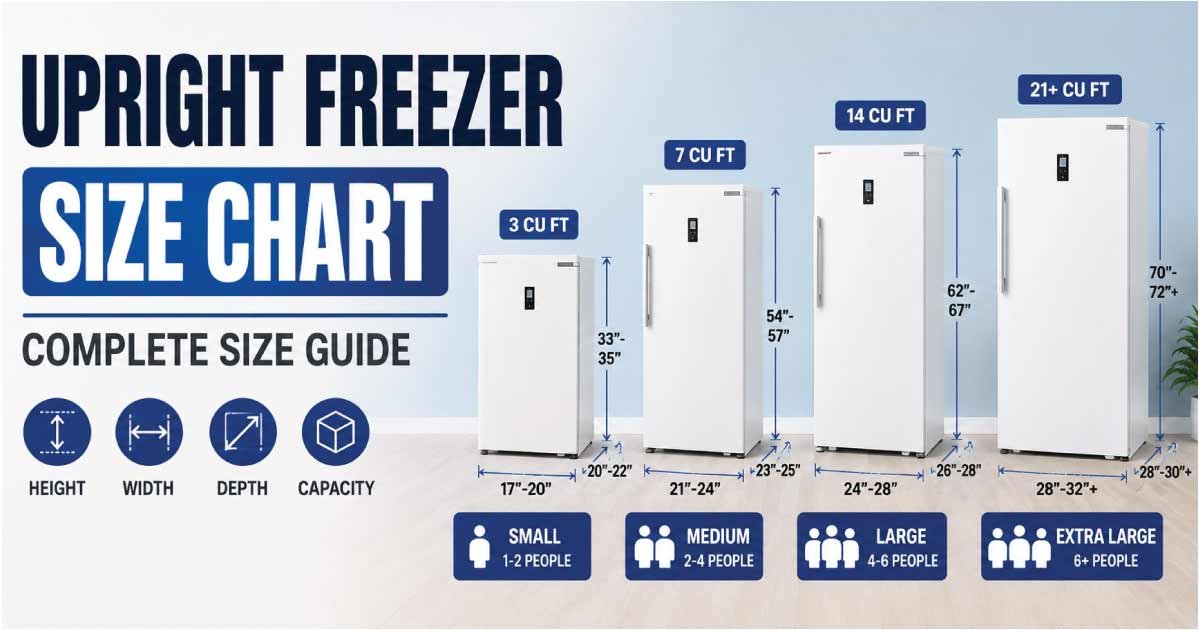
This upright freezer size chart provides a practical reference for standard freezer dimensions, capacity ranges, and household needs. Whether you need a compact freezer for a small kitchen or a large upright freezer for bulk food storage, understanding the available sizes can help you make a confident decision.
Unlike chest freezers, upright freezers have a vertical design with a front-opening door and shelves or drawers inside. This makes them easier to organize and access, especially when you regularly store different types of frozen food.
Upright Freezer Size Chart
Upright freezers are available in several sizes, from compact models designed for apartments to full-size units suitable for large households. The dimensions below represent common size ranges rather than exact measurements for every model.
| Upright Freezer Size | Approx. Width | Approx. Height | Approx. Depth | Typical Capacity | Best For |
|---|---|---|---|---|---|
| Compact | 20–24 in | 32–36 in | 22–26 in | 3–5 cu. ft. | Apartments, offices |
| Small | 24–27 in | 55–65 in | 24–28 in | 5–8 cu. ft. | 1–2 people |
| Medium | 27–30 in | 60–68 in | 26–30 in | 8–14 cu. ft. | 2–4 people |
| Large | 30–33 in | 65–72 in | 28–32 in | 14–18 cu. ft. | 4–6 people |
| Extra Large | 33–36 in | 65–75 in | 30–34 in | 18–25+ cu. ft. | Large families, bulk storage |
Dimensions are approximate. Always check the manufacturer’s specifications before purchasing or installing a freezer.
The upright freezer size you need should not be determined by capacity alone. A freezer with a large cubic-foot rating may not fit comfortably in your available space, particularly if the room has narrow doorways or limited clearance around the appliance.
Standard Upright Freezer Dimensions
When comparing freezers, three primary measurements matter: width, height, and depth. You should also consider the space required to open the door and allow proper ventilation.
Upright Freezer Width
Most upright freezers are approximately 20 to 36 inches wide, although specialized models can fall outside this range.
Compact freezers may be around 20–24 inches wide, making them useful for smaller homes, utility rooms, apartments, and garages. Larger models commonly measure 30 inches or more across and provide substantially more storage.
Width is especially important when replacing an existing freezer. Measure the available opening rather than assuming a new appliance will have the same dimensions as the old one.
Upright Freezer Height
Vertical freezers commonly range from about 32 to 75 inches in height.
Compact countertop-height or apartment-friendly models are considerably shorter. Full-size upright freezers can approach the height of a standard refrigerator.
Before selecting a tall freezer, measure from the floor to the lowest obstruction above the installation area. Consider shelves, cabinets, ceiling height, and overhead lighting.
Upright Freezer Depth
Typical upright freezer depth ranges from approximately 22 to 34 inches.
Depth is often overlooked because shoppers focus primarily on width. However, a freezer that extends too far into a walkway can make a kitchen, pantry, or utility room difficult to use.
Remember that the stated cabinet depth may not include the door, handles, hinges, or required clearance behind the appliance.
Upright Freezer Capacity Chart
Freezer capacity is usually measured in cubic feet (cu. ft.). Capacity indicates the amount of interior storage available, but the usable space can be affected by shelves, drawers, ice buildup, and the freezer’s internal configuration.
| Capacity | Approx. Storage Level | Suitable Household |
|---|---|---|
| 3–5 cu. ft. | Light | 1 person |
| 5–8 cu. ft. | Small | 1–2 people |
| 8–14 cu. ft. | Moderate | 2–4 people |
| 14–18 cu. ft. | Large | 4–6 people |
| 18–25+ cu. ft. | Very large | 5+ people or bulk storage |
A commonly used planning guideline is approximately 2–3 cubic feet of freezer capacity per person, although actual needs vary. Someone who buys frozen food frequently may need considerably more space than someone who mainly freezes leftovers.
How to Choose the Right Upright Freezer Size
The ideal freezer size depends on your household, shopping habits, available space, and the types of food you store.
For One Person
A compact or small upright freezer of approximately 3–8 cubic feet can be sufficient for an individual.
This size works well if you mainly store:
- Frozen vegetables
- Meat and poultry
- Frozen meals
- Ice cream
- Bread and baked goods
- Leftovers
A compact freezer also works well as an additional freezer when your refrigerator’s freezer compartment is too small.
For Two People
A freezer between 5 and 10 cubic feet can provide a comfortable amount of storage for many two-person households.
If you purchase meat in bulk, prepare meals ahead of time, or freeze garden produce, choosing closer to 8–10 cubic feet may be more practical.
For a Family of Three or Four
Families of three or four often benefit from an 8–14 cubic foot upright freezer.
A medium-size freezer provides room for regular frozen groceries without taking up as much floor space as an extra-large unit.
For Five or More People
Larger households may require 14–20+ cubic feet of freezer capacity.
If your family regularly purchases bulk meat, large packages, frozen produce, or prepared meals, additional capacity can reduce the need for frequent shopping.
Upright Freezer Sizes by Type
Not every upright freezer is designed for the same purpose. Size categories can also be understood according to how and where the appliance is used.
Compact Upright Freezers
Compact models generally provide around 3–5 cubic feet of storage.
They are useful for:
- Small apartments
- Dormitories where permitted
- Offices
- Guest areas
- Small kitchens
- Supplemental food storage
Their main advantage is a small footprint. However, the limited interior space means they are not ideal for families that purchase large quantities of frozen food.
Apartment-Size Upright Freezers
Apartment-size models generally fall in the 5–8 cubic foot range.
They offer more storage than compact units while remaining relatively narrow. Their vertical configuration can make better use of limited floor space.
Medium Upright Freezers
Medium upright freezers typically provide around 8–14 cubic feet.
This is one of the most versatile size categories because it offers substantial storage without requiring the footprint of a very large appliance.
Large Upright Freezers
Large models generally provide 14–18 cubic feet.
They are appropriate for households that regularly freeze meat, vegetables, prepared meals, and other groceries.
Extra-Large Upright Freezers
Extra-large upright freezers can provide 18–25 cubic feet or more.
These models are primarily useful for large families, serious bulk shoppers, home food storage, and households that need a second high-capacity freezer.
How to Measure for an Upright Freezer
Before purchasing an upright freezer, measure the installation area carefully. Do not measure only the existing appliance.
Measure the Available Width
Measure the opening from one side to the other at several points.
Walls and cabinets are not always perfectly square, so checking the top, middle, and bottom can identify potential restrictions.
Leave the clearance recommended by the manufacturer rather than choosing a freezer that exactly matches the opening.
Measure the Available Height
Measure from the floor to the lowest obstruction above the freezer.
Check for:
- Cabinets
- Shelving
- Ceiling height
- Light fixtures
- Pipes
- Trim
- Other overhead obstacles
A tall freezer may technically fit but still be difficult to install if there is insufficient room to position it upright.
Measure the Available Depth
Measure from the wall to the front edge of the available space.
Then account for the freezer’s cabinet, door, handle, and recommended rear clearance. If the freezer will sit in a narrow walkway, also consider how far the open door projects into the room.
Don’t Forget Door and Installation Clearance
An upright freezer needs more space than its listed dimensions suggest.
Door Swing Clearance
Because the door opens from the front, make sure there is enough room for it to open fully.
Check the direction of the door swing before buying. Some models allow the door to be reversed, while others have fixed hinges.
Rear Clearance
Freezers need adequate airflow around the cabinet. The exact requirement varies by model, so use the manufacturer’s installation instructions.
Insufficient clearance can affect ventilation and may make the appliance operate less efficiently.
Side Clearance
Side clearance is particularly important if the freezer door needs to open beyond 90 degrees to access shelves and drawers.
A freezer squeezed tightly between two walls may technically fit but be inconvenient to use.
Upright Freezer vs. Chest Freezer
Both freezer types provide frozen-food storage, but their designs are very different.
| Feature | Upright Freezer | Chest Freezer |
|---|---|---|
| Orientation | Vertical | Horizontal |
| Access | Front door | Top lid |
| Organization | Shelves and drawers | Baskets or open storage |
| Floor footprint | Usually smaller | Usually wider |
| Accessibility | Easy to reach | Items may be stacked |
| Vertical space | Higher | Lower |
| Best use | Organized everyday storage | Bulk storage |
An upright freezer is often preferable when convenience and organization are priorities. Shelves and drawers make it easier to separate meat, vegetables, prepared foods, and other items.
A chest freezer can offer excellent bulk-storage capacity but generally requires more floor space and can be harder to organize.
Discover More:
What Is the Best Upright Freezer Size for a Garage?
A garage can be a convenient location for an additional upright freezer, but available space and environmental conditions should be considered.
For many households, a 14–18 cubic foot freezer provides a useful balance between storage and physical size.
Before installing one in a garage, check whether the specific model is designed for the expected ambient temperatures. Garages can become significantly hotter or colder than indoor living spaces.
Also consider:
- Garage door clearance
- Vehicle parking space
- Electrical outlet location
- Walking clearance
- Door swing
- Ventilation
- Level flooring
A large freezer is only useful if you can comfortably open it and access everything inside.
How Much Food Fits in an Upright Freezer?
The amount of food a freezer can hold depends on packaging, food type, and how efficiently the shelves are arranged.
For example, a 10-cubic-foot freezer might comfortably accommodate a mixture of packaged meat, frozen vegetables, meals, bread, and desserts for a small household. However, large irregularly shaped packages can consume space much faster than compact packages.
For better organization, divide the freezer into sections.
Useful Freezer Organization Categories
- Meat and poultry
- Seafood
- Vegetables
- Fruits
- Prepared meals
- Bread and baked goods
- Desserts
- Long-term bulk storage
Using labeled containers or freezer baskets can also make smaller upright freezers feel more spacious because food is easier to locate.
Factors That Affect Upright Freezer Size
Physical dimensions are important, but several other factors should influence your choice.
Household Size
More people generally means more food storage. However, household size is only a starting point.
A two-person household that buys bulk meat may need a larger freezer than a four-person household that shops frequently.
Shopping Frequency
If you shop several times per week and purchase small quantities, you may need less freezer capacity.
If you shop once or twice a month and stock up on frozen products, a larger freezer can be more practical.
Bulk Food Storage
Bulk shoppers should consider both capacity and organization. A freezer packed tightly with large packages can become difficult to manage even when the cubic-foot capacity appears adequate.
Available Floor Space
Measure your room before deciding on capacity. A larger freezer should not block walkways, doors, cabinets, or other appliances.
Energy Efficiency
A larger freezer may provide more storage but can also consume more energy depending on its design and efficiency rating. Look for an efficient model that provides the capacity you actually need rather than simply choosing the largest available unit.
Discover More:
Tips for Buying the Right Upright Freezer
Use these practical checks before making a purchase:
- Measure the installation area before shopping.
- Compare both exterior dimensions and interior capacity.
- Check the required ventilation clearance.
- Confirm that the door can open fully.
- Check whether the door swing can be reversed if necessary.
- Measure your home’s entry doors and hallways.
- Consider how much frozen food you actually store.
- Choose additional capacity if you regularly buy food in bulk.
- Check the freezer’s temperature controls and organization system.
- Confirm that the installation location is suitable for the appliance.
One of the most common mistakes is purchasing based solely on cubic feet. A freezer may have excellent capacity but still be unsuitable because it is too wide, too deep, or difficult to install.
Upright Freezer Size Chart in Inches
For quick reference, the following chart summarizes common upright freezer dimensions.
| Category | Width | Height | Depth | Capacity |
|---|---|---|---|---|
| Compact | 20–24 in | 32–36 in | 22–26 in | 3–5 cu. ft. |
| Small | 24–27 in | 55–65 in | 24–28 in | 5–8 cu. ft. |
| Medium | 27–30 in | 60–68 in | 26–30 in | 8–14 cu. ft. |
| Large | 30–33 in | 65–72 in | 28–32 in | 14–18 cu. ft. |
| Extra Large | 33–36 in | 65–75 in | 30–34 in | 18–25+ cu. ft. |
These figures are useful for planning, but individual freezer models can differ. Always verify the manufacturer’s exact measurements before purchase.
Discover More:
Frequently Asked Questions About Upright Freezer Sizes
What is the standard size of an upright freezer?
A typical full-size upright freezer is approximately 30–36 inches wide, 65–75 inches high, and 28–34 inches deep. Capacity commonly ranges from 14 to 25 cubic feet. Compact and apartment-size models can be considerably smaller.
How many cubic feet should an upright freezer be?
Many households can start with approximately 2–3 cubic feet per person, but actual requirements depend on shopping habits. Bulk shoppers may need significantly more capacity, while households that buy frozen food frequently may need less.
What is a good size upright freezer for a family of four?
An 8–14 cubic foot upright freezer is a reasonable starting range for a family of four. If the household regularly buys meat in bulk, freezes garden produce, or prepares meals ahead, choosing a larger model may provide more convenient storage.
What is the smallest upright freezer size?
Compact upright freezers can be around 3–5 cubic feet. These models are useful when floor space is limited or when you need additional freezer storage rather than a full-size primary freezer.
Are upright freezers deeper than refrigerators?
Not necessarily. Upright freezer depth varies by model and is commonly around 22–34 inches. Some are relatively shallow, while others can project farther into a room. Always compare the complete installed depth, including the door and handle.
How much clearance does an upright freezer need?
Clearance requirements vary by manufacturer and model. You generally need space around the appliance for ventilation and enough room for the door to open properly. Always follow the installation clearance specified in the freezer’s manual.
Is a 5-cubic-foot freezer big enough?
A 5-cubic-foot freezer can work well for one person, a small household, or supplemental storage. It may become restrictive if you regularly purchase bulk meat, frozen meals, or large quantities of produce.
Is an upright freezer better than a chest freezer?
It depends on your priorities. Upright freezers are usually easier to organize and access, while chest freezers can be excellent for bulk storage. An upright model is often more convenient when you frequently access different types of frozen food.
Conclusion
Finding the right upright freezer size starts with understanding both capacity and physical dimensions. Compact models of around 3–5 cubic feet work well for limited storage, while medium models around 8–14 cubic feet suit many households. Larger 14–25+ cubic foot freezers are better for families and people who regularly purchase food in bulk.
Before buying, measure the available width, height, and depth, then check door swing, ventilation, installation clearance, and access through your home’s entrances. Capacity should also match your shopping habits rather than simply being as large as possible.
Use this upright freezer size chart as a starting point, but always compare the exact manufacturer specifications for the model you are considering. The best freezer is one that provides enough usable storage while fitting comfortably and safely into your available space.
