
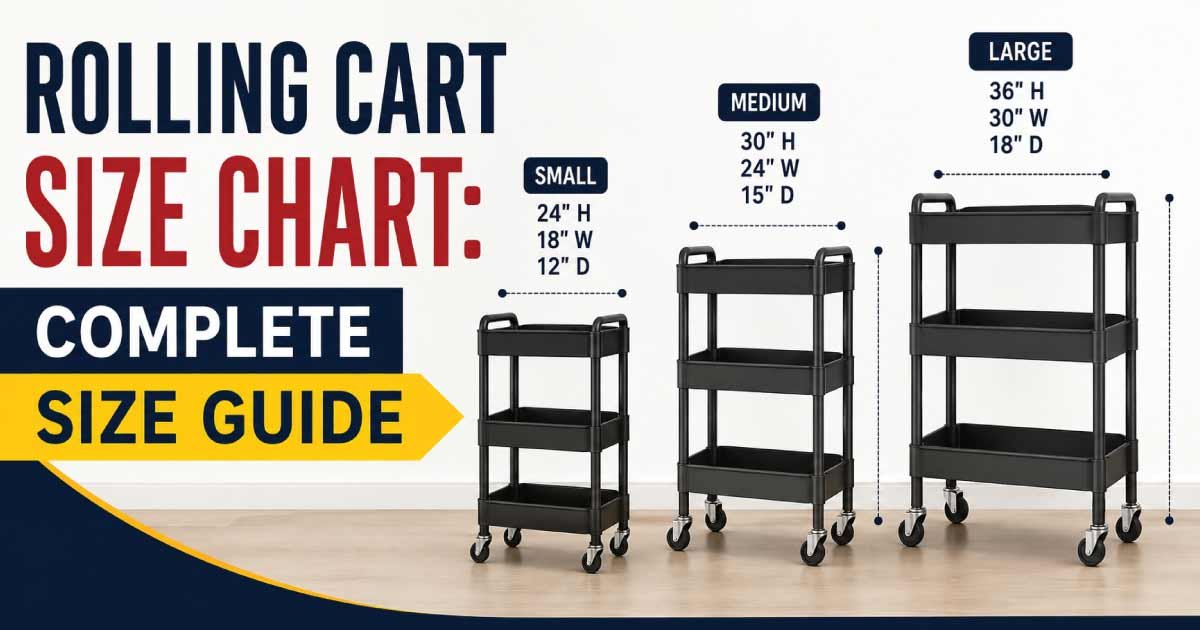
A rolling cart is a practical storage and transportation solution for kitchens, offices, workshops, classrooms, garages, salons, and many other spaces. Because rolling carts come in many different widths, depths, heights, and weight capacities, choosing the right size can be confusing.
This rolling cart size chart explains common cart dimensions, shelf sizes, weight capacities, storage needs, and recommended uses. Whether you need a narrow rolling cart for a small kitchen, a utility cart for heavy equipment, or a larger storage cart for an office or workshop, understanding the available sizes can help you choose the right option.
The best rolling cart size depends on what you plan to store, how much weight it needs to carry, where you will use it, and how much space is available for moving the cart.
Rolling Cart Size Chart
Rolling carts are available in compact, standard, large, and heavy-duty sizes. The following chart provides general dimensions for common types.
| Rolling Cart Size | Approx. Width | Approx. Depth | Approx. Height | Typical Capacity | Best For |
|---|---|---|---|---|---|
| Compact | 10–16 in | 8–14 in | 24–36 in | 50–100 lb | Small spaces |
| Small | 12–20 in | 12–16 in | 24–40 in | 75–150 lb | Kitchens, offices |
| Medium | 18–24 in | 14–20 in | 30–42 in | 100–250 lb | General storage |
| Large | 24–36 in | 18–24 in | 30–48 in | 200–400 lb | Workshops, warehouses |
| Extra Large | 30–48+ in | 20–30 in | 36–54 in | 300–600+ lb | Heavy storage |
| Heavy-Duty | 24–48+ in | 20–36 in | 30–60 in | 500+ lb | Industrial use |
Dimensions and weight capacities are approximate. Actual specifications vary by cart design, materials, wheels, shelves, and manufacturer.
For everyday household use, a small to medium rolling cart is usually enough. Larger carts are more appropriate when you need to transport bulky items or heavier loads.
Standard Rolling Cart Dimensions
The overall size of a rolling cart is determined by its width, depth, and height.
Rolling Cart Width
Width determines how much horizontal space the cart occupies and how easily it can move through doorways and between furniture.
Narrow carts may be only 10–16 inches wide, making them useful for tight spaces. Wider utility carts can exceed 30 inches and provide considerably more storage surface.
When choosing the width, consider:
- Available storage space
- Doorway width
- Hallway width
- Distance between furniture
- Size of items being stored
- Shelf dimensions
A narrow cart is convenient for small spaces, but a wider cart usually provides greater stability and usable shelf area.
Rolling Cart Depth
Depth determines how far the cart extends from front to back.
A shallow cart is easier to maneuver in narrow rooms, while a deeper cart can hold larger containers, appliances, tools, or supplies.
Measure the area where the cart will be stored and remember to allow enough space to pull it out and turn it.
Rolling Cart Height
Cart height varies considerably.
Short carts may work as mobile side tables or storage units, while taller carts can provide multiple shelves for vertical storage.
When selecting height, consider whether you want the top shelf to function as a working surface.
Rolling Cart Size by Type
Different rolling cart designs are made for different purposes.
Kitchen Rolling Cart
Kitchen carts are commonly used for food preparation, storage, appliances, and serving.
A typical kitchen rolling cart may be approximately:
- 18–36 inches wide
- 14–24 inches deep
- 30–40 inches high
Some models include drawers, cabinets, shelves, towel bars, or countertop surfaces.
A compact kitchen cart can be especially useful in apartments or kitchens with limited cabinet storage.
Utility Rolling Cart
Utility carts are designed for general-purpose transportation and storage.
They are commonly used in:
- Garages
- Offices
- Workshops
- Classrooms
- Cleaning areas
- Storage rooms
Utility carts often have open shelves that make frequently used supplies easy to access.
Three-Tier Rolling Cart
Three-tier carts are popular because they provide vertical storage without requiring a large floor footprint.
A common three-tier cart may be around 12–20 inches wide, 14–18 inches deep, and 24–40 inches high.
They are useful for:
- Craft supplies
- Kitchen items
- Bathroom products
- Office supplies
- Beauty products
- Classroom materials
Tool Rolling Cart
Tool carts are generally wider, stronger, and heavier than household carts.
They may include:
- Drawers
- Locking compartments
- Heavy-duty casters
- Metal shelves
- Tool organizers
- Reinforced frames
For workshop use, weight capacity and wheel quality are often more important than minimizing overall size.
Medical or Service Cart
Service carts are commonly designed around easy access and movement.
Their size varies depending on their intended use, but they often prioritize:
- Smooth movement
- Stable shelves
- Easy cleaning
- Secure storage
- Maneuverability
Always select a specialized cart according to its intended professional application and manufacturer specifications.
Rolling Cart Size Chart by Use
The ideal rolling cart size depends heavily on what you plan to store or transport.
| Use | Recommended Width | Recommended Depth | Typical Height |
|---|---|---|---|
| Bathroom storage | 10–16 in | 8–14 in | 24–36 in |
| Small kitchen | 12–20 in | 12–18 in | 28–40 in |
| Office supplies | 12–20 in | 12–18 in | 24–40 in |
| Crafts | 12–24 in | 12–20 in | 24–42 in |
| Classroom | 18–30 in | 14–22 in | 28–42 in |
| Garage storage | 20–36 in | 18–24 in | 30–48 in |
| Workshop tools | 24–48 in | 20–30 in | 30–48 in |
| Commercial use | 24–48+ in | 20–36 in | 30–60 in |
These are general planning ranges. The correct size should always be based on the items you need to store and the available space.
How to Choose the Right Rolling Cart Size
Choosing a rolling cart is easier when you consider its intended use first.
Consider What You Will Store
Measure your largest items before buying.
For example, a narrow cart may work perfectly for bottles, cans, stationery, or small containers but may be unsuitable for large tools or kitchen appliances.
Consider:
- Item width
- Item depth
- Item height
- Item weight
- Number of items
- Required shelf spacing
Do not select a cart based only on its exterior dimensions.
Consider How Much Weight You Need to Carry
Weight capacity is critical.
A cart with several large shelves may appear suitable, but its frame and wheels may not be designed for heavy loads.
Check both:
- Total cart capacity
- Individual shelf capacity
The maximum load may need to be distributed evenly across the shelves.
Rolling Cart Weight Capacity Chart
Weight capacity varies considerably between lightweight household carts and industrial models.
| Cart Type | Approx. Weight Capacity | Typical Application |
|---|---|---|
| Lightweight | 30–75 lb | Small household items |
| Standard | 75–150 lb | Kitchen and office storage |
| Medium-Duty | 150–300 lb | General utility |
| Heavy-Duty | 300–500 lb | Garage and workshop |
| Industrial | 500–1,000+ lb | Commercial applications |
Always use the manufacturer’s stated weight capacity. These figures are general categories rather than universal ratings.
A cart’s wheels, frame, shelf material, and construction all affect its load-bearing ability.
Rolling Cart Size for Small Spaces
A rolling cart can be an excellent storage solution when floor and cabinet space are limited.
Narrow Rolling Carts
Narrow carts can fit into spaces between:
- Refrigerators and cabinets
- Appliances
- Desks
- Shelving units
- Bathroom fixtures
- Kitchen cabinets
A cart around 10–14 inches wide can provide useful storage without occupying much floor area.
However, measure the actual gap carefully. A cart that is exactly the width of the available space may be difficult to remove or maneuver.
Vertical Rolling Carts
If floor space is limited, consider a taller cart with multiple shelves.
Vertical storage allows you to increase storage capacity without dramatically increasing the cart’s footprint.
Rolling Cart Size for Kitchens
Kitchen rolling carts are particularly versatile.
They can provide additional space for:
- Cookware
- Small appliances
- Food containers
- Pantry supplies
- Utensils
- Towels
- Serving items
A medium kitchen cart around 18–30 inches wide can provide useful workspace while remaining relatively easy to move.
If you plan to use the cart as a food-preparation surface, choose a stable design with a durable, easy-to-clean top.
Rolling Cart Size for Bathrooms
Bathrooms typically have less floor space than kitchens, making compact carts especially useful.
A narrow cart can hold:
- Towels
- Toiletries
- Cleaning supplies
- Personal-care products
- Toilet paper
- Hair-care equipment
A cart approximately 10–16 inches wide can work well in many compact bathroom spaces.
Before buying, measure door swings and the space around the toilet, vanity, shower, or bathtub.
Rolling Cart Size for Offices
Office carts can be used for documents, stationery, printers, supplies, and equipment.
A small or medium cart is generally easier to move around a desk or workstation.
Consider a cart with:
- Lockable drawers
- Cable-management features
- Adjustable shelves
- Smooth casters
- Stable construction
If you plan to place a printer or other electronic equipment on the cart, check the equipment’s dimensions and weight.
Discover More:
Rolling Cart Size for Workshops and Garages
Garage and workshop carts usually require greater strength and weight capacity.
A heavy-duty cart can be useful for:
- Hand tools
- Power tools
- Hardware
- Automotive supplies
- Gardening equipment
- Workshop materials
For these applications, consider both shelf capacity and wheel quality.
Large casters may roll more easily over uneven surfaces than small lightweight wheels, although the appropriate wheel depends on the flooring and cart design.
Rolling Cart Wheel Size
Wheel size affects maneuverability and the types of surfaces a cart can handle.
| Wheel Size | Typical Use | General Characteristics |
|---|---|---|
| 1–2 in | Light household carts | Compact, smooth floors |
| 2–3 in | General-purpose carts | Good everyday mobility |
| 3–4 in | Utility carts | Better load handling |
| 4–6 in | Heavy-duty carts | Better over thresholds and uneven surfaces |
| 6+ in | Industrial carts | Heavy loads and demanding environments |
Larger wheels generally make it easier to move a loaded cart over small thresholds and uneven surfaces, but they can also increase the cart’s overall height.
Rolling Cart Clearance and Maneuverability
A cart that fits in a storage location may not necessarily be easy to move.
Doorway Clearance
Measure the narrowest doorway the cart will need to pass through.
Also consider whether the cart will need to turn immediately after passing through the doorway.
Hallway Clearance
For narrow hallways, a compact cart may be significantly easier to maneuver.
A wider cart may work well in an open garage but become difficult to turn inside a small home.
Turning Space
Measure the area where the cart will be used.
The cart should have enough clearance to turn without hitting:
- Walls
- Cabinets
- Furniture
- Appliances
- Door frames
Rolling Cart Shelf Size
Shelf dimensions can be more important than the overall cart dimensions.
A cart may have a large exterior footprint but relatively small usable shelf areas because of its frame.
Before purchasing, check:
- Shelf width
- Shelf depth
- Shelf spacing
- Shelf lip height
- Individual shelf capacity
- Adjustable shelf positions
If you store tall bottles or containers, make sure the distance between shelves is sufficient.
Rolling Cart With Drawers vs. Open Shelves
Your storage requirements should determine the cart design.
| Design | Advantages | Best For |
|---|---|---|
| Open shelves | Easy access, visible contents | Kitchen, workshop |
| Drawers | Organized, concealed storage | Office, tools |
| Cabinets | Protects contents | Kitchen, garage |
| Baskets | Flexible organization | Crafts, bathroom |
| Mixed storage | Multiple storage options | General use |
Open shelves are usually convenient for frequently accessed items, while drawers and cabinets provide more organized or concealed storage.
How to Measure for a Rolling Cart
Before buying, take several measurements.
Step 1: Measure the Available Width
Measure the narrowest available space.
If the cart needs to fit between two objects, do not rely on an approximate measurement.
Step 2: Measure the Available Depth
Check how far the cart can extend without blocking doors, walkways, or appliances.
Step 3: Measure the Height
If the cart will be stored underneath a counter or shelf, measure the vertical clearance.
Step 4: Measure Doorways
If you need to move the cart between rooms, measure the narrowest doorway along the route.
Step 5: Measure Your Items
Measure the largest items you plan to place on the cart.
This prevents choosing a cart with shelves that are too small or too closely spaced.
Discover More:
How Much Space Should You Leave Around a Rolling Cart?
The required clearance depends on where the cart will be used.
In a kitchen or bathroom, leave enough space to open nearby doors and drawers.
In a garage or workshop, allow more room for maneuvering, especially when the cart is heavily loaded.
Do not position a rolling cart where it blocks emergency exits, electrical equipment, heating equipment, or other areas that need unobstructed access.
Are Larger Rolling Carts Better?
A larger rolling cart is not automatically better.
Advantages of Larger Carts
- More storage capacity
- Larger shelves
- Greater load capacity
- Useful for bulky items
- Better for workshops and garages
Disadvantages of Larger Carts
- Takes up more floor space
- Can be harder to maneuver
- May be heavier
- Requires wider storage areas
- May not fit through narrow doors
Choose a cart based on the space and load requirements rather than simply selecting the largest model.
Tips for Choosing the Right Rolling Cart
Before purchasing, use this checklist:
- Measure the available space.
- Measure the largest items you need to store.
- Check total weight capacity.
- Check individual shelf capacity.
- Consider wheel size.
- Measure doorway and hallway clearance.
- Check shelf spacing.
- Consider whether you need drawers or cabinets.
- Choose locking wheels if stability is important.
- Consider handle height and pushing comfort.
- Check whether the cart can be assembled easily.
- Choose materials appropriate for the environment.
For heavy-duty applications, prioritize construction quality and load capacity over appearance.
Discover More:
Common Rolling Cart Size Mistakes
Buying a Cart That Is Too Wide
A cart may fit in the storage area but fail to pass through the doorway.
Measure the entire route before purchasing.
Ignoring Wheel Width
The wheels can make the cart wider than the shelves or frame.
Always check the cart’s complete exterior dimensions.
Overloading the Cart
Never exceed the manufacturer’s weight rating.
Distribute heavy items evenly and place heavier objects on lower shelves when appropriate.
Ignoring Shelf Dimensions
The total cart size does not guarantee that your items will fit on each shelf.
Check usable shelf dimensions carefully.
Forgetting Turning Space
A cart needs room not only to move forward and backward but also to turn.
This is especially important in kitchens, bathrooms, and narrow hallways.
Frequently Asked Questions About Rolling Cart Sizes
What is the standard size of a rolling cart?
There is no single standard size. Many household rolling carts are approximately 12–24 inches wide, 12–20 inches deep, and 24–42 inches high. Utility and industrial carts can be substantially larger.
What is a good size rolling cart for a kitchen?
A 18–30-inch-wide cart can be a practical choice for many kitchens. The ideal size depends on available floor space, the items being stored, and whether the cart will also be used as a work surface.
What size rolling cart is best for a small space?
A narrow cart approximately 10–16 inches wide can work well in small spaces. Tall, multi-tier designs can increase storage capacity without requiring a large floor footprint.
How much weight can a rolling cart hold?
Capacity varies widely. Lightweight carts may support around 30–75 pounds, while heavy-duty and industrial carts can support several hundred pounds or more. Always check the manufacturer’s specified load rating.
How wide should a rolling cart be?
Choose the width according to your available space and the items you need to store. Narrow carts around 10–16 inches work well in tight areas, while wider carts provide more shelf space and stability.
What is the best rolling cart size for a garage?
A medium to large heavy-duty cart is often appropriate for garages. A width of approximately 20–36 inches and sufficient shelf capacity can provide useful storage for tools and equipment.
Are three-tier rolling carts useful?
Yes. Three-tier carts provide vertical storage while maintaining a relatively small floor footprint. They are particularly useful for kitchens, bathrooms, offices, crafts, and classrooms.
What wheel size is best for a rolling cart?
For general household use, wheels around 2–4 inches can provide a useful balance of maneuverability and stability. Heavy-duty carts may benefit from larger wheels, especially when moving over thresholds or uneven surfaces.
Should a rolling cart have locking wheels?
Locking casters can be useful when you need the cart to remain stationary during use. They are particularly helpful for carts used as work surfaces or equipment stands.
Can a rolling cart fit through a standard doorway?
Many household carts can fit through standard doorways, but you should check the cart’s complete width, including wheels and handles. Measure the narrowest doorway on the route before purchasing.
Conclusion
The right rolling cart size depends on what you need to store, how much weight the cart must support, and how much space you have available. Compact carts around 10–16 inches wide are useful for bathrooms, kitchens, offices, and other tight spaces. Medium carts provide more storage for everyday household use, while large and heavy-duty models are better suited to garages, workshops, warehouses, and commercial applications.
When comparing rolling carts, look beyond overall dimensions. Check the usable shelf size, shelf spacing, weight capacity, wheel size, handle dimensions, and maneuverability. Also measure doorways and the complete route the cart will travel.
Use this rolling cart size chart as a starting point, then compare your measurements with the manufacturer’s exact specifications. The best rolling cart is one that holds everything you need, moves comfortably through your space, and provides enough capacity without becoming unnecessarily large or difficult to maneuver.
