
Choosing the right sunglasses size is important for comfort, appearance, and proper coverage. Sunglasses that are too small can feel tight around the temples, while oversized frames may slide down your nose or extend too far beyond your face.
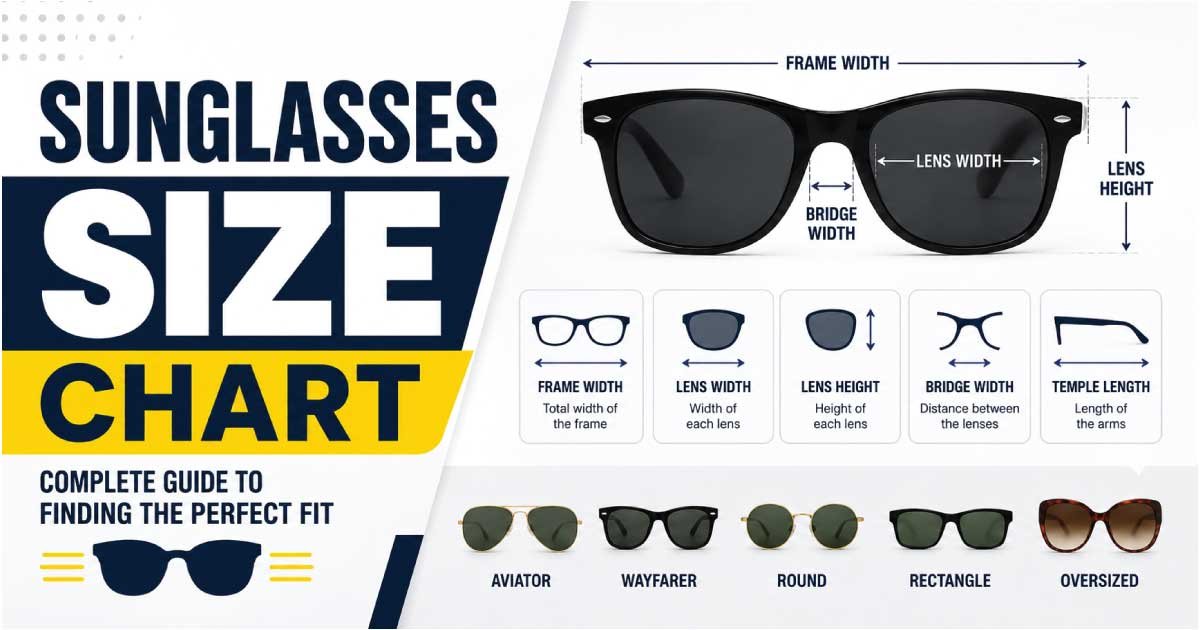
A sunglasses size chart helps you understand frame width, lens width, bridge width, and temple length so you can choose a pair that fits your face properly. Whether you are shopping for aviator sunglasses, wayfarers, round frames, square sunglasses, sports sunglasses, or everyday shades, knowing your measurements can make online shopping much easier.
Sunglasses are commonly measured in millimeters (mm). You may see measurements such as 52-18-140 printed on the inside of a frame. These numbers usually represent lens width, bridge width, and temple length.
This complete guide explains standard sunglasses sizes, how to measure your face, men’s and women’s sunglasses sizing, kids’ sunglasses sizes, frame measurements, face shapes, and how to choose the right sunglasses size.
Why Sunglasses Size Matters
The right sunglasses should feel comfortable while providing adequate coverage without overwhelming your face.
Size affects more than appearance. Properly fitted sunglasses can sit securely on the bridge of your nose, remain comfortable around your ears, and keep the lenses positioned correctly in front of your eyes.
A properly sized pair should:
- Sit comfortably on your nose
- Stay secure during normal movement
- Avoid excessive pressure on the temples
- Provide suitable eye coverage
- Keep the lenses properly aligned
- Complement your facial proportions
Sunglasses that are too large or too small can also change how your face appears. This is why frame dimensions are worth checking before buying.
How Sunglasses Sizes Work
Most sunglasses use three primary measurements:
- Lens width
- Bridge width
- Temple length
These measurements are usually expressed in millimeters.
For example, if a frame is labeled 52-18-140:
- 52 mm = lens width
- 18 mm = bridge width
- 140 mm = temple length
You may also see the total frame width listed separately. This measurement can be particularly useful because it indicates how wide the sunglasses will appear across your face.
Sunglasses Size Chart
The following chart provides a general guide to common adult sunglasses frame sizes.
| Sunglasses Size | Lens Width | Approx. Frame Width | General Fit |
|---|---|---|---|
| Extra Small | 45–49 mm | 125–130 mm | Very narrow faces |
| Small | 49–52 mm | 130–135 mm | Narrow faces |
| Medium | 52–55 mm | 135–140 mm | Average faces |
| Large | 55–58 mm | 140–145 mm | Wider faces |
| Extra Large | 58–62 mm | 145–155 mm | Very wide faces |
These measurements are general guidelines. Frame shape and construction can make two sunglasses with the same lens width fit differently.
Sunglasses Measurements Explained
Understanding the numbers printed on sunglasses makes it much easier to compare different frames.
Lens Width
Lens width is the horizontal measurement of one lens at its widest point.
For example, in a 52-18-140 frame, the first number is 52 mm.
Larger lens widths generally provide more eye coverage and can create a larger overall appearance.
Bridge Width
The bridge is the section connecting the two lenses.
Bridge width is measured across the part of the frame that rests above your nose.
A wider bridge may be more suitable for a wider nose, while a narrower bridge can provide a better fit for a narrower nose.
Temple Length
Temple length refers to the length of the arms that extend from the frame toward your ears.
Common temple lengths include approximately:
- 130 mm
- 135 mm
- 140 mm
- 145 mm
- 150 mm
The correct temple length helps the sunglasses sit comfortably behind your ears.
Frame Width
Overall frame width measures the sunglasses from the outer edge of one side to the outer edge of the other.
This can be one of the most useful measurements when shopping online because it provides a better indication of how wide the sunglasses will appear on your face.
How to Measure Your Face for Sunglasses
You do not necessarily need specialized equipment to estimate your sunglasses size.
Step 1: Measure Your Face Width
Use a ruler or flexible measuring tape to measure approximately from one temple to the other.
Try to measure across the widest part of your face.
Step 2: Check Your Existing Sunglasses
If you already own a pair that fits comfortably, look inside the temple arm.
You may find three numbers printed there.
For example:
52 □ 18 140
These numbers can help you compare new sunglasses with a frame you already know fits well.
Step 3: Compare Overall Frame Width
When shopping online, compare your current sunglasses with the listed frame width of the new pair.
This can be more useful than comparing lens width alone.
How to Read Sunglasses Size Numbers
One of the most common sunglasses size formats looks like:
54-18-140
The numbers generally mean:
- 54 mm lens width
- 18 mm bridge width
- 140 mm temple length
Sometimes there is also a fourth measurement indicating vertical lens height.
For example, you might see:
54-18-140 / 42
In that case, 42 mm may represent the lens height.
Not every manufacturer displays measurements in exactly the same format, so check the product description when necessary.
Men’s Sunglasses Size Chart
Men’s sunglasses are available in a wide variety of frame sizes.
| Men’s Frame Size | Lens Width | Approx. Frame Width |
|---|---|---|
| Small | 48–51 mm | 130–135 mm |
| Medium | 52–55 mm | 135–140 mm |
| Large | 56–59 mm | 140–146 mm |
| Extra Large | 60+ mm | 146+ mm |
These are general ranges rather than strict men’s sizing standards.
A person’s face width is more important than gender when selecting sunglasses.
Women’s Sunglasses Size Chart
Women’s sunglasses may include smaller and medium-sized frames, although larger and oversized styles are also common.
| Women’s Frame Size | Lens Width | Approx. Frame Width |
|---|---|---|
| Extra Small | 45–48 mm | 125–130 mm |
| Small | 48–51 mm | 130–135 mm |
| Medium | 51–54 mm | 135–140 mm |
| Large | 55–58 mm | 140–146 mm |
| Oversized | 58+ mm | 146+ mm |
There are no strict rules requiring women to wear smaller frames. Choose according to face width, comfort, and preferred style.
Kids’ Sunglasses Size Chart
Children need sunglasses that are appropriately sized for their smaller faces.
| Children’s Age | Approx. Frame Width | General Size |
|---|---|---|
| 0–2 years | 100–110 mm | Baby |
| 3–5 years | 105–115 mm | Toddler |
| 6–9 years | 110–120 mm | Kids |
| 10–12 years | 115–125 mm | Youth |
| 13+ years | 120–135 mm | Youth/Small Adult |
Age is only a general guide. Children’s face sizes vary, so measuring the existing frame or checking the manufacturer’s measurements is preferable.
Baby Sunglasses Size Guide
Baby sunglasses should be lightweight and properly fitted.
The frame should not press tightly against the baby’s temples or cheeks.
It should also remain securely positioned without sliding down the nose.
When choosing sunglasses for babies and young children, pay attention to:
- Frame width
- Lens coverage
- Bridge fit
- Temple length
- Lightweight construction
- Secure fit
Always follow the manufacturer’s recommended age and size range.
Also Read: Floating Shelf Size Chart: Complete Measurement Guide
How Sunglasses Should Fit
Properly fitting sunglasses should feel secure without creating pressure.
The frame should sit comfortably across the bridge of your nose, while the temple arms should rest naturally around your ears.
Signs Sunglasses Are Too Small
Your sunglasses may be too small if:
- The temples feel tight.
- The frame presses against your head.
- The lenses do not adequately cover your eyes.
- The frame leaves noticeable marks.
- The outer edges of the frame feel stretched outward.
- The arms do not sit comfortably behind your ears.
Signs Sunglasses Are Too Large
Your sunglasses may be too large if:
- They constantly slide down your nose.
- The frame extends significantly beyond your face.
- The temples feel loose.
- The lenses sit too far away from your eyes.
- The sunglasses move when you walk.
- The bridge does not sit securely.
Sunglasses Size by Face Width
Face width is one of the most useful factors when choosing sunglasses.
| Face Width | Suggested Frame Width | General Fit |
|---|---|---|
| 120–125 mm | 125–130 mm | Small |
| 125–130 mm | 130–135 mm | Small to Medium |
| 130–135 mm | 135–140 mm | Medium |
| 135–140 mm | 140–145 mm | Large |
| 140+ mm | 145+ mm | Extra Large |
These ranges are approximate because frame shape and bridge design can affect the actual fit.
Sunglasses Size for Narrow Faces
If you have a narrow face, look for frames with a smaller overall width.
Frames around 125–135 mm may provide a balanced fit for many narrow faces.
Avoid extremely wide frames unless you intentionally want an oversized appearance.
Pay particular attention to temple length and bridge width because a frame can be narrow but still fit poorly if these dimensions are inappropriate.
Sunglasses Size for Average Faces
Medium-sized sunglasses are often versatile for average-width faces.
Frames around 135–140 mm may work well for many adults.
However, face shape and personal preference still matter.
A medium frame can look different depending on whether it is round, square, rectangular, aviator, or oversized.
Also Read: Bookcase Size Chart: Ideal Dimensions Explained
Sunglasses Size for Wide Faces
People with wider faces may feel more comfortable in frames around 140–150 mm or wider, depending on their measurements.
A wider frame can prevent the temples from pressing against the sides of the head.
However, avoid selecting a frame solely because it is labeled “large.” Always check the actual dimensions.
Sunglasses and Face Shape
Frame size is important, but face shape can also influence which sunglasses look balanced.
Round Face
Angular and rectangular frames can add visual definition to a round face.
Medium-to-wide frames can often create a balanced appearance.
Square Face
Round or oval sunglasses can soften strong facial angles.
Avoid choosing frames that are excessively narrow.
Oval Face
Oval faces can often accommodate many frame shapes.
Balanced medium-sized frames are a good starting point.
Heart-Shaped Face
Frames with balanced proportions can complement a wider forehead and narrower chin.
Medium-sized round or softly angular frames may work well.
Long Face
Slightly deeper frames can help create visual balance.
Avoid extremely narrow frames if they make the face appear longer.
Aviator Sunglasses Size Guide
Aviator sunglasses often have relatively large lenses and a distinctive teardrop shape.
Because of their design, aviators can appear larger than other frames with the same overall width.
When choosing aviators, check:
- Lens width
- Bridge width
- Overall frame width
- Lens height
- Temple length
Aviators should provide good eye coverage without extending excessively beyond your face.
Wayfarer Sunglasses Size Guide
Wayfarer-style sunglasses generally have a wider, structured appearance.
They are available in small, medium, and large dimensions.
For the best fit, compare the overall frame width with the width of a pair you already own.
A properly fitted Wayfarer-style frame should sit comfortably on your nose and should not pinch the temples.
Also Read: Split King Mattress Size Chart: Complete Guide + Pdf
Round Sunglasses Size Guide
Round frames can look larger or smaller depending on lens diameter and frame thickness.
If you have a narrow face, a smaller round frame can prevent the sunglasses from overwhelming your facial proportions.
For wider faces, a larger round frame may provide better balance.
Oversized Sunglasses Size Guide
Oversized sunglasses are intentionally designed to extend beyond conventional frame proportions.
However, oversized does not mean that the sunglasses should be uncomfortable.
The frame should still:
- Sit securely on the nose
- Remain stable
- Avoid excessive temple pressure
- Provide adequate eye coverage
- Feel comfortable during extended wear
When buying oversized sunglasses, pay particular attention to the total frame width.
Sports Sunglasses Size Guide
Sports sunglasses often require a secure fit because they are designed for movement.
Look for frames that remain stable during walking, running, cycling, or other activities.
Wraparound frames may have different measurements from traditional sunglasses because they curve around the face.
For sports sunglasses, frame coverage and secure fit can be more important than following standard fashion-frame measurements.
Sunglasses Bridge Fit
Bridge width is particularly important because it determines how the frame sits on your nose.
If the bridge is too wide, the sunglasses may slide downward.
If it is too narrow, the frame may create pressure.
Some sunglasses also use adjustable nose pads, which can provide additional flexibility.
When comparing sunglasses online, check both bridge width and frame width rather than relying only on lens size.
Low Bridge vs. High Bridge Sunglasses Fit
People have different nose bridge shapes, and this can affect how sunglasses sit.
A frame designed for a lower bridge may have different nose-pad positioning or a different angle than a standard frame.
If sunglasses frequently slide down your nose even when the frame width is correct, the bridge design may be the issue.
Look for frames described as having a low-bridge fit if appropriate for your facial proportions.
How to Choose Sunglasses Online
Buying sunglasses online becomes easier when you know the dimensions of a pair that already fits you.
Start by checking the numbers printed inside your current sunglasses.
Suppose your existing pair says:
53-18-140
You can search for new sunglasses with similar measurements.
You do not necessarily need exactly the same numbers. A difference of a few millimeters can still provide a comfortable fit depending on frame design.
When shopping, compare:
- Lens width
- Bridge width
- Temple length
- Overall frame width
- Lens height
- Frame shape
Common Sunglasses Sizing Mistakes
Choosing Only by Lens Width
Lens width alone does not tell you the complete frame size.
Ignoring Overall Frame Width
A frame can have a reasonable lens measurement but still be too wide because of its design.
Choosing Based on Gender
Face width and facial proportions are more useful than gender labels.
Ignoring Bridge Width
A poorly fitting bridge can cause sunglasses to slide or create pressure.
Forgetting Temple Length
Arms that are too short or too long can affect comfort behind the ears.
Assuming One Size Fits Everyone
“One size” sunglasses may work for many people but are not guaranteed to fit every face.
Frequently Asked Questions About Sunglasses Sizes
How do I know what sunglasses size I need?
Measure your face width or check the measurements of sunglasses that already fit you well. Compare lens width, bridge width, temple length, and overall frame width with the new sunglasses. The frame should sit securely without pressing against your temples.
What do the numbers on sunglasses mean?
A typical marking such as 52-18-140 generally means 52 mm lens width, 18 mm bridge width, and 140 mm temple length. These measurements help you compare frame dimensions when choosing a new pair.
What is the most common sunglasses size?
Medium frames are commonly suitable for many adults, with overall frame widths around 135–140 mm. However, there is no universal standard size because people’s face widths and proportions vary.
What size sunglasses are best for a small face?
People with smaller or narrower faces may find frames around 125–135 mm wide more comfortable. Smaller lens widths and shorter temple lengths can also help create better proportions.
What size sunglasses are best for a wide face?
Wider faces may be more comfortable with frames approximately 140–150 mm wide or larger. The exact size depends on face width, bridge shape, and the design of the frame.
Should sunglasses cover my eyebrows?
Sunglasses do not necessarily need to cover your eyebrows. Frame height and personal style determine how much of the eyebrows are visible. The important consideration is that the sunglasses sit securely and provide suitable eye coverage.
Should sunglasses touch my cheeks?
Ideally, sunglasses should not constantly rest on your cheeks. If the frame touches your cheeks when you smile or move your face, it may be too large, too low on your nose, or incorrectly shaped for your facial proportions.
Can I use my old sunglasses to determine my new size?
Yes. If your current sunglasses fit well, look inside the temple arm for the frame measurements. Comparing those measurements with a new pair is one of the easiest ways to estimate your preferred size.
Is a 52 mm sunglasses frame small or medium?
A 52 mm lens width is generally around the small-to-medium range for adult sunglasses. However, overall frame width, bridge size, and frame shape also determine how the sunglasses fit.
What does 54-18-140 mean on sunglasses?
The numbers generally indicate a 54 mm lens width, 18 mm bridge width, and 140 mm temple length. Together, these measurements describe important dimensions of the frame.
How should sunglasses fit your face?
Sunglasses should sit comfortably on the bridge of your nose, remain stable during movement, and avoid excessive pressure around the temples. The frame should generally be proportionate to your face without extending excessively beyond its sides.
Final Thoughts on Choosing the Right Sunglasses Size
Finding the right sunglasses size becomes much easier once you understand the main frame measurements. Lens width, bridge width, temple length, and overall frame width all play an important role in determining fit.
Start by measuring your face or checking the measurements of sunglasses that already fit comfortably. Then compare those numbers with the product’s size information.
Remember that sunglasses size is not only about appearance. The correct fit should keep the frames secure, comfortable, and properly positioned on your face.
Whether you prefer aviators, Wayfarer-style frames, round sunglasses, sports shades, or oversized sunglasses, use a sunglasses size chart as a starting point and always consider the complete frame dimensions before making your final choice.
