Finding the right cap size is important for comfort, appearance, and a secure fit. A cap that is too tight can feel uncomfortable around your forehead, while a cap that is too loose may slide around or fall off when you move.
A cap size chart helps you match your head circumference with the correct cap size. Caps are available in different sizing systems, including fitted numerical sizes, letter sizes, adjustable sizes, and one-size-fits-most designs.
Whether you are looking for a baseball cap, fitted cap, snapback, trucker cap, sports cap, golf cap, or everyday casual cap, measuring your head before purchasing can help you find a much better fit.
In this complete guide, you will learn how cap sizes work, how to measure your head, men’s and women’s cap sizes, children’s cap sizes, fitted cap conversions, adjustable cap sizing, and how to choose the right cap size when shopping online.
Why Choosing the Right Cap Size Matters
A properly fitted cap should feel secure without creating excessive pressure around your head. It should stay in place when you walk, bend over, or move your head without constantly needing adjustment.
The correct cap size also affects the appearance of the cap. A cap that is too small may sit unusually high on the head, while an oversized cap can look loose and lose its intended shape.
The right cap size provides:
- Comfortable everyday wear
- A secure fit
- Better head coverage
- Less slipping
- Reduced forehead pressure
- A cleaner appearance
- Better stability during physical activities
For fitted caps, accurate sizing is especially important because there is usually no adjustment mechanism.
How Cap Sizes Work
Cap sizes generally fall into four main categories: fitted, adjustable, stretch-fit, and one-size-fits-most.
Fitted caps use specific numerical sizes such as 7, 7 1/8, or 7 1/2.
Adjustable caps use straps, buckles, snaps, or other closures that allow the wearer to change the circumference.
Stretch-fit caps use elastic materials to accommodate a range of head sizes.
One-size-fits-most caps are designed to fit a broad range of head circumferences.
Although these systems make cap shopping flexible, measurements can vary between manufacturers. Always check the brand’s specific sizing information when available.
How to Measure Your Head for a Cap
Measuring your head is the best way to determine your cap size.
Step 1: Use a Flexible Measuring Tape
Use a soft measuring tape that can comfortably wrap around your head.
Place it approximately 1 inch above your eyebrows and above your ears. This is generally the area where the cap will sit.
Step 2: Keep the Tape Level
Make sure the tape remains level around your entire head.
It should be snug enough to touch your head but should not be pulled tightly.
Step 3: Record Your Measurement
Record the circumference in inches or centimeters.
For example, if your head circumference is approximately 22 inches, you can compare that measurement with the corresponding cap size.
Step 4: Measure More Than Once
Measure your head two or three times to make sure your measurement is consistent.
If you get slightly different results, use the measurement that occurs most consistently.
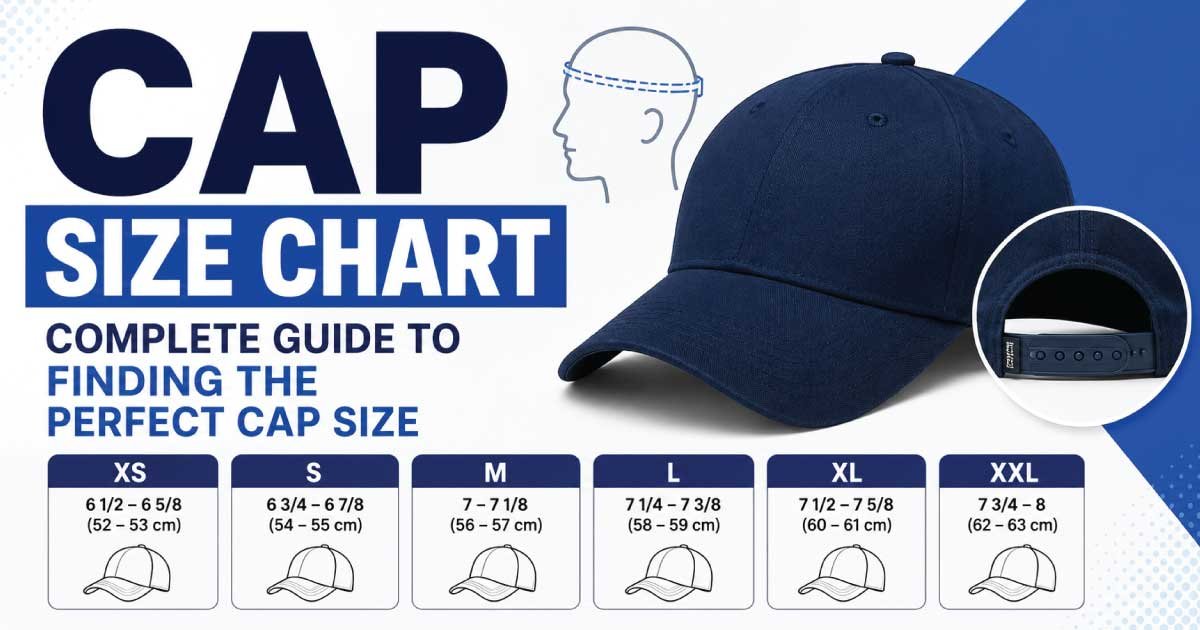
Standard Cap Size Chart
The following chart provides a general adult cap sizing reference.
| Cap Size | Head Circumference | Approx. Letter Size |
|---|---|---|
| 6 3/4 | 21 1/8 in | XS |
| 6 7/8 | 21 1/2 in | S |
| 7 | 21 7/8 in | S/M |
| 7 1/8 | 22 1/4 in | M |
| 7 1/4 | 22 5/8 in | M/L |
| 7 3/8 | 23 in | L |
| 7 1/2 | 23 1/2 in | L/XL |
| 7 5/8 | 23 7/8 in | XL |
| 7 3/4 | 24 1/4 in | XL/XXL |
| 7 7/8 | 24 5/8 in | XXL |
| 8 | 25 in | XXL |
These measurements are general guidelines. Cap manufacturers may use slightly different sizing ranges.
Cap Size Chart in Inches and Centimeters
Centimeters can be especially useful when purchasing caps from international retailers.
| Cap Size | Head Circumference (Inches) | Head Circumference (cm) |
|---|---|---|
| 6 3/4 | 21 1/8 | 53.5 cm |
| 6 7/8 | 21 1/2 | 54.5 cm |
| 7 | 21 7/8 | 55.5 cm |
| 7 1/8 | 22 1/4 | 56.5 cm |
| 7 1/4 | 22 5/8 | 57.5 cm |
| 7 3/8 | 23 | 58.5 cm |
| 7 1/2 | 23 1/2 | 59.5 cm |
| 7 5/8 | 23 7/8 | 60.5 cm |
| 7 3/4 | 24 1/4 | 61.5 cm |
| 7 7/8 | 24 5/8 | 62.5 cm |
| 8 | 25 | 63.5 cm |
When shopping online, compare your measurement directly with the manufacturer’s centimeter measurement whenever possible.
Men’s Cap Size Chart
Men’s caps are commonly available in fitted numerical sizes and letter sizes.
| Men’s Cap Size | Head Circumference | Approx. Letter Size |
|---|---|---|
| 6 7/8 | 21 1/2 in | S |
| 7 | 21 7/8 in | S/M |
| 7 1/8 | 22 1/4 in | M |
| 7 1/4 | 22 5/8 in | M/L |
| 7 3/8 | 23 in | L |
| 7 1/2 | 23 1/2 in | L/XL |
| 7 5/8 | 23 7/8 in | XL |
| 7 3/4 | 24 1/4 in | XL/XXL |
| 7 7/8 | 24 5/8 in | XXL |
| 8 | 25 in | XXL |
Men’s cap sizing is based primarily on head circumference rather than gender. People with similar measurements can generally wear similar cap sizes regardless of gender.
Women’s Cap Size Chart
Women’s caps may use small, medium, large, or adjustable sizing rather than traditional fitted numerical sizes.
| Women’s Cap Size | Head Circumference | Approx. Fitted Size |
|---|---|---|
| XS | 20–21 in | 6 1/4–6 5/8 |
| S | 21–21 1/2 in | 6 5/8–6 7/8 |
| M | 21 1/2–22 1/4 in | 6 7/8–7 1/8 |
| L | 22 1/4–23 in | 7 1/8–7 3/8 |
| XL | 23–24 in | 7 3/8–7 5/8 |
These ranges are approximate because manufacturers may design women’s caps with different proportions and size ranges.
Kids’ Cap Size Chart
Children’s cap sizes should ideally be selected according to head circumference rather than age.
| Kids’ Cap Size | Approx. Age | Head Circumference |
|---|---|---|
| XS | 1–2 years | 17–19 in |
| S | 2–4 years | 19–20 in |
| M | 4–7 years | 20–21 in |
| L | 7–12 years | 21–22 in |
| XL | 12+ years | 22+ in |
Children grow at different rates, so age ranges are only estimates.
Measure the child’s head whenever possible to get a more accurate size.
Baby Cap Size Chart
Baby caps are usually designed according to head circumference and approximate age.
| Baby Cap Size | Approx. Age | Head Circumference |
|---|---|---|
| Newborn | 0–3 months | 13–15 in |
| Small | 3–6 months | 14–16 in |
| Medium | 6–12 months | 16–18 in |
| Large | 12–24 months | 17–19 in |
A baby’s cap should be comfortable and should never create excessive pressure around the head.
Fitted Cap Size Chart
Fitted caps use specific numerical measurements rather than an adjustable strap.
| Fitted Cap Size | Head Circumference |
|---|---|
| 6 7/8 | 21 1/2 in |
| 7 | 21 7/8 in |
| 7 1/8 | 22 1/4 in |
| 7 1/4 | 22 5/8 in |
| 7 3/8 | 23 in |
| 7 1/2 | 23 1/2 in |
| 7 5/8 | 23 7/8 in |
| 7 3/4 | 24 1/4 in |
| 7 7/8 | 24 5/8 in |
| 8 | 25 in |
Because fitted caps have limited adjustability, measuring your head before buying is strongly recommended.
Also Read: Hutch Size Chart: Ideal Dimensions For Every Space
Adjustable Cap Size Guide
Adjustable caps are easier to fit because the back closure can change the size.
Common adjustment systems include:
- Snapback closures
- Buckle straps
- Fabric straps
- Hook-and-loop closures
- Metal adjustment clips
Adjustable caps are useful when you are unsure about your exact size because they can accommodate a range of head circumferences.
However, an adjustable cap should not require the strap to be completely tightened or loosened to fit properly. Ideally, you should have some adjustment room remaining.
Snapback Cap Size Guide
Snapback caps use a series of plastic snaps at the back of the cap.
The snaps allow you to adjust the circumference to fit your head.
Snapbacks are generally more forgiving than fitted caps, but the cap should still be proportionate to your head.
If you have a particularly small or large head, check the manufacturer’s recommended size range before purchasing.
Stretch-Fit Cap Size Guide
Stretch-fit caps contain elastic material that allows the cap to stretch around the head.
They are usually available in sizes such as:
- S/M
- M/L
- L/XL
Stretch-fit caps can be comfortable because they conform to the shape of your head.
However, you should still choose the correct size range. A stretch-fit cap that is too small can create pressure, while an oversized one may not remain secure.
Baseball Cap Size Guide
Baseball caps are available in fitted, adjustable, and stretch-fit designs.
For a fitted baseball cap, use your head circumference to determine the numerical size.
For an adjustable baseball cap, choose a cap whose size range includes your measurement.
The cap should sit comfortably on the forehead while leaving enough room for natural movement.
A baseball cap should not feel excessively tight around the temples or forehead.
Golf Cap Size Guide
Golf caps often use adjustable closures or stretch-fit construction.
Because golf involves outdoor activity and movement, a secure fit is important.
Your cap should stay in place while walking, bending, and swinging.
Choose a breathable material if you expect to wear the cap for extended periods in warm weather.
Trucker Cap Size Guide
Trucker caps commonly feature an adjustable snapback closure.
This makes them relatively easy to fit across different head sizes.
However, the crown depth can vary between styles. A cap may technically fit your circumference but still feel uncomfortable if the crown is too shallow or deep for your head shape.
Also Read: Display Cabinet Size Chart: Standard Cabinet Dimensions
How Should a Cap Fit?
A properly fitting cap should sit securely without excessive pressure.
The front should sit naturally against your forehead, while the back should remain stable without constantly sliding upward.
Signs Your Cap Is Too Small
Your cap may be too small if:
- It creates pressure around your forehead.
- It leaves deep marks.
- It feels uncomfortable after a short time.
- It sits unusually high.
- It feels tight around your temples.
- You frequently want to remove it because of pressure.
Signs Your Cap Is Too Large
Your cap may be too large if:
- It moves when you walk.
- It slides down over your eyes.
- It falls off when you bend over.
- It shifts when you turn your head.
- Wind easily blows it away.
- There is excessive space between your head and the sweatband.
What to Do If You Are Between Cap Sizes
If your head measurement falls between two fitted sizes, try both sizes if possible.
If you must choose without trying them on, a slightly larger size is often preferable to a cap that is uncomfortably tight.
A slightly oversized fitted cap may sometimes be adjusted using hat-sizing tape or an appropriate insert.
Avoid choosing a dramatically larger size because excessive space can cause the cap to move around.
How Cap Shape Affects Fit
Head circumference is not the only factor that influences comfort.
People can have different head shapes, including:
- Round
- Oval
- Long oval
- Wider
- Narrower
Two caps with the same circumference may feel different because their crown shapes and construction differ.
If a cap fits around your head but feels tight at the sides or front and back, the issue may be the cap’s shape rather than its numerical size.
How Cap Material Affects Fit
Different materials can affect how a cap fits and changes over time.
Cotton Caps
Cotton caps are comfortable and breathable. Depending on construction and care, some cotton materials may shrink slightly.
Wool Caps
Wool caps can provide warmth and may have some flexibility depending on their construction.
Polyester Caps
Polyester is commonly used in sports caps because it can be lightweight and durable.
Mesh Caps
Mesh panels improve airflow and are frequently used in trucker and warm-weather caps.
Stretch Fabrics
Stretch materials can accommodate small differences in head circumference and are common in athletic caps.
How to Choose a Cap Size Online
When shopping online, start by measuring your head circumference.
Check whether the product uses numerical sizes, letter sizes, or an adjustable sizing range.
Compare your measurement with the manufacturer’s chart rather than relying only on the cap size you normally wear.
Also look at the product description for terms such as fitted, adjustable, stretch-fit, low-profile, mid-profile, or high-profile.
Customer reviews may also help you determine whether the cap runs small, large, shallow, or deep.
Common Cap Sizing Mistakes
Measuring in the Wrong Position
Measure around the area where the cap will actually sit rather than around the very top of your head.
Pulling the Tape Too Tight
A tightly pulled tape can produce an artificially small measurement.
Ignoring the Closure Type
A fitted cap requires precise sizing, while a snapback or strapback provides adjustment.
Assuming All Medium Caps Are the Same
Different manufacturers can use different size ranges for medium caps.
Choosing Based Only on Appearance
A cap may look great but still be uncomfortable if it is the wrong size or shape.
Ignoring Crown Depth
Circumference may be correct while the crown still feels too shallow or deep.
Also Read: Filing Cabinet Size Chart: Standard Sizes & Measurements
Frequently Asked Questions About Cap Sizes
How do I know what cap size I need?
Measure your head circumference using a flexible measuring tape. Place it around your head approximately one inch above your eyebrows and above your ears. Compare the measurement with the manufacturer’s cap size chart to find the closest size.
What is the most common cap size?
Many adults fall within the middle of the standard cap-size range, but there is no single universal cap size. Head circumference varies considerably, so measuring your head is more reliable than choosing a size based on averages.
What size cap is 22 inches?
A 22-inch head circumference generally falls around a fitted cap size between 7 and 7 1/8, depending on the manufacturer. Always compare the exact measurement with the specific cap brand’s size chart before ordering.
What size cap is 23 inches?
A 23-inch head circumference generally corresponds to approximately a fitted size 7 3/8. However, manufacturers may have slightly different sizing standards, so use the brand’s own chart whenever possible.
Should a cap fit tight or loose?
A cap should fit securely without creating uncomfortable pressure. It should stay in place during normal movement but should not leave painful marks around the forehead or temples.
Is a fitted cap better than an adjustable cap?
Neither is universally better. Fitted caps can provide a clean, precise fit when you know your measurement, while adjustable caps offer more flexibility. Your choice depends on comfort, style, and how much adjustability you prefer.
How do I measure my head for a cap without a measuring tape?
Use a piece of string, ribbon, or similar flexible material. Wrap it around your head at the normal cap-wearing position, mark where the ends meet, and then measure the string against a ruler.
Can cap sizes vary between brands?
Yes. Cap sizing is not completely standardized. The same numerical or letter size can feel slightly different between manufacturers because of differences in construction, crown shape, materials, and sizing standards.
What should I do if my fitted cap is slightly too big?
If a fitted cap is slightly too large, sizing tape or foam inserts can sometimes reduce the internal circumference. If it is significantly too large, exchanging it for the correct size is usually the better option.
Do caps stretch over time?
Some caps may relax slightly with wear, particularly those made from flexible or stretchable materials. However, you should not depend on significant stretching to correct an incorrectly sized cap.
Final Thoughts on Choosing the Right Cap Size
Choosing the right cap size starts with an accurate head circumference measurement. Once you know your measurement, compare it with the appropriate cap size chart and then check the manufacturer’s sizing information.
Remember that fitted, adjustable, snapback, stretch-fit, and one-size caps can all fit differently. Your head shape, crown depth, cap material, and closure system can also influence comfort.
For the best fit, measure your head carefully, choose a size that provides enough room without excessive movement, and check the brand’s specific size guide before purchasing. A properly fitted cap should feel comfortable, remain secure, and look natural throughout the day.
