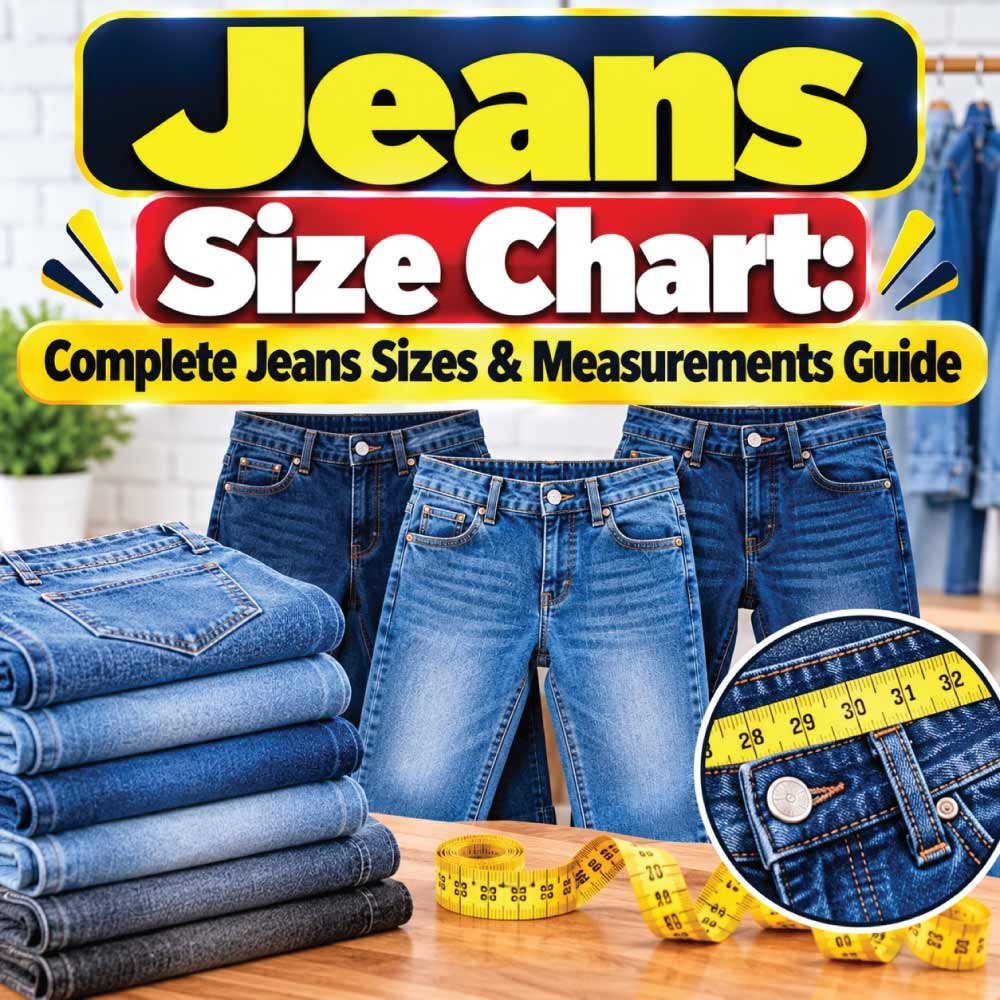
Jeans sizing can be confusing because the same labeled size does not always fit the same way across brands, styles, or countries. A pair marked W32 may fit differently from another W32, while women’s jeans may use numerical sizes such as 4, 6, 8, or 12 instead of waist measurements.
A reliable jeans size chart makes the process easier by connecting the size label with actual body or garment measurements. The most important measurements are usually waist, hips, and inseam, while rise, thigh, and leg opening can also affect how jeans feel.
This guide explains standard jeans sizes, men’s and women’s conversions, how to measure yourself correctly, how jeans should fit, and what to do when you fall between two sizes.
Jeans Size Chart
The best way to choose jeans is to compare your measurements with the manufacturer’s size chart. The table below provides a general reference for common adult jeans sizes. Actual sizing can vary by brand and style.
Men’s Jeans Size Chart
Men’s jeans are commonly labeled by waist and inseam measurements. A size such as 32×30 generally means approximately a 32-inch labeled waist and a 30-inch inseam.
| Jeans Size | Waist (in) | Waist (cm) | Common Inseam (in) |
|---|---|---|---|
| 28 | 28 | 71 | 30–32 |
| 30 | 30 | 76 | 30–32 |
| 32 | 32 | 81 | 30–34 |
| 34 | 34 | 86 | 30–34 |
| 36 | 36 | 91 | 30–34 |
| 38 | 38 | 97 | 30–34 |
| 40 | 40 | 102 | 30–34 |
| 42 | 42 | 107 | 30–34 |
| 44 | 44 | 112 | 30–34 |
| 46 | 46 | 117 | 30–34 |
| 48 | 48 | 122 | 30–34 |
| 50 | 50 | 127 | 30–34 |
These measurements are a general sizing reference rather than a universal standard. Brand-specific measurements should take priority when they are available.
Women’s Jeans Size Chart
Women’s jeans are often labeled using numerical sizes, although some brands use waist-inch sizing. The following table provides a general comparison.
| US Size | Approx. Waist (in) | Approx. Hips (in) | Approx. Waist (cm) |
|---|---|---|---|
| 0 | 24–25 | 34–35 | 61–64 |
| 2 | 25–26 | 35–36 | 64–66 |
| 4 | 26–27 | 36–37 | 66–69 |
| 6 | 27–28 | 37–38 | 69–71 |
| 8 | 28–29 | 38–39 | 71–74 |
| 10 | 29–30 | 39–40 | 74–76 |
| 12 | 30–31 | 40–41 | 76–79 |
| 14 | 31–33 | 41–43 | 79–84 |
| 16 | 33–35 | 43–45 | 84–89 |
| 18 | 35–37 | 45–47 | 89–94 |
| 20 | 37–39 | 47–49 | 94–99 |
Women’s sizing is particularly inconsistent between manufacturers, so these numbers should be treated as a general reference, not an exact conversion.
How Jeans Sizes Work
Jeans sizing usually communicates one or more measurements used to determine the garment’s proportions.
Waist Size
The waist measurement is the most familiar part of jeans sizing. Men’s jeans commonly use waist measurements such as W28, W30, W32, and W34.
A label such as W32 generally indicates a nominal 32-inch waist size. However, the actual waistband measurement of a finished garment can be slightly different because of the construction, fabric, rise, and intended fit.
Inseam Length
The inseam is the measurement from the crotch area down the inside of the leg to the bottom of the jeans.
Men’s jeans are frequently written in a format such as:
32×30
The first number represents the waist and the second represents the inseam.
Therefore:
- 32×30 = 32-inch waist and 30-inch inseam
- 32×32 = 32-inch waist and 32-inch inseam
- 34×34 = 34-inch waist and 34-inch inseam
This makes it possible to choose a waist size independently from leg length.
Rise
Rise describes the distance between the crotch and the top of the waistband. It strongly influences where jeans sit on your body.
Common rise categories include:
- Low rise: sits lower on the hips.
- Mid rise: sits around the natural waist or slightly below it.
- High rise: sits higher on the waist.
Two pairs with identical waist and inseam measurements can still feel very different because their rises are different.
Leg Opening
Leg opening refers to the circumference or width around the bottom of the jeans leg. It varies according to the cut.
Skinny jeans usually have a narrower opening, while straight, relaxed, bootcut, and wide-leg styles have progressively different silhouettes.
How to Measure for Jeans
Taking accurate measurements before buying jeans is one of the easiest ways to reduce sizing mistakes. You only need a flexible measuring tape and a few minutes.
Measure Your Waist
Stand naturally without pulling your stomach in.
Place the measuring tape around the area where you want the waistband of your jeans to sit. Keep the tape level and comfortably snug, but do not tighten it enough to compress your body.
Record the measurement in inches or centimeters.
If you normally wear mid-rise jeans, measure around the area where that style sits rather than automatically measuring the narrowest point of your torso.
Measure Your Hips
Stand with your feet together and place the tape around the fullest part of your hips and seat.
Keep the tape horizontal and avoid pulling it tightly.
The hip measurement is particularly important for women’s jeans because different body shapes can have substantially different waist-to-hip proportions.
Measure Your Inseam
For an accurate inseam measurement:
- Stand upright with your feet approximately shoulder-width apart.
- Measure from the crotch area down the inside of your leg.
- Stop at the point where you want the jeans to end.
- Record the measurement in inches or centimeters.
You can also measure a pair of jeans that already fits you well. Lay the jeans flat and measure the inside seam from the crotch intersection to the hem.
Measure a Pair of Jeans You Already Own
A favorite pair can provide a useful reference when shopping online.
Lay the jeans flat without stretching them. Measure the waistband, rise, inseam, and leg opening. Then compare those measurements with the garment measurements provided by the retailer.
This can sometimes be more useful than relying only on a size label because a familiar garment gives you a real-world fit reference.
Jeans Size Conversion Chart
International sizing can make jeans shopping more complicated. US, UK, EU, and other sizing systems do not always follow a simple mathematical conversion.
Women’s Jeans Size Conversion
The following chart provides a general comparison of women’s US and UK numerical sizing.
| US Size | UK Size | General Category |
|---|---|---|
| 0 | 4 | XXS/XS |
| 2 | 6 | XS |
| 4 | 8 | S |
| 6 | 10 | S |
| 8 | 12 | M |
| 10 | 14 | M |
| 12 | 16 | L |
| 14 | 18 | L |
| 16 | 20 | XL |
| 18 | 22 | XL |
| 20 | 24 | XXL |
These categories are only broad references. A brand may classify a particular size differently, and stretch denim can produce a different fit from rigid denim.
Waist-Inch Sizing
Some women’s jeans are sold using waist-inch sizing rather than numerical US sizes. For example, a retailer may offer:
- W26
- W27
- W28
- W29
- W30
- W31
- W32
This system can make shopping easier because it relates more directly to a measurement, but the actual fit can still vary depending on the cut and fabric.
How Jeans Should Fit
The correct jeans size is not simply the smallest size you can button. Good-fitting jeans should allow comfortable movement while maintaining the intended shape of the style.
Waist Fit
The waistband should feel secure without digging painfully into your skin.
You should not need to constantly pull the jeans upward, but you also should not rely on a belt to prevent a major gap.
For rigid denim, allow enough room for normal movement. Stretch denim can feel snug initially because the fabric has more give.
Seat and Hips
Look at the back and side profile.
Jeans that are too tight may create excessive pulling, horizontal stress lines, or discomfort around the seat. Jeans that are too loose may sag or create excess fabric.
The ideal amount of ease depends on whether the jeans are skinny, slim, straight, relaxed, or wide-leg.
Thighs
You should be able to sit, walk, bend, and climb stairs without the fabric feeling excessively restrictive.
If the waist fits correctly but the thighs feel tight, the problem may not be the size itself. You may need a different cut, such as a athletic, relaxed, or roomier fit.
Length
The correct length depends on the jeans style and the look you want.
A shorter inseam may work well with cropped or ankle-length jeans, while a longer inseam can be appropriate for certain bootcut or wide-leg styles.
Shoes also influence how the hem looks.
Also Read:
Jeans Fits and Cuts Explained
Size and fit are not the same thing. Two pairs can have identical measurements at the waist but create completely different silhouettes.
Skinny Jeans
Skinny jeans are designed to fit closely through the hips, thighs, and legs. Stretch fabric is common because it allows the close-fitting design to remain comfortable.
If skinny jeans feel restrictive around your thighs or calves, changing the cut may be more effective than simply choosing a larger waist size.
Slim Jeans
Slim jeans are narrower than straight jeans but generally provide more room than a skinny cut.
They create a fitted appearance without necessarily hugging the entire leg.
Straight-Leg Jeans
Straight jeans maintain a relatively consistent leg shape from the thigh toward the hem.
They are a versatile option when you want a classic silhouette without the close fit of skinny denim.
Relaxed Jeans
Relaxed jeans provide additional room through areas such as the seat and thigh.
They can be useful for people who find slim cuts restrictive, particularly when their waist measurement does not accurately represent the amount of room they need through the lower body.
Bootcut Jeans
Bootcut jeans are generally narrower through the upper leg and gradually widen toward the hem.
Their longer, shaped silhouette is often designed to work with boots or other footwear.
Wide-Leg Jeans
Wide-leg jeans have significantly more room through the leg. Their overall appearance depends on the rise, waist, fabric weight, and width of the leg.
Because the silhouette is intentionally loose, a roomy fit does not necessarily mean the jeans are too large.
Also Read:
What to Do If You Are Between Jeans Sizes
It is common for your measurements to fall between two sizes. Do not automatically choose the larger or smaller option without considering the fabric and fit.
Choose Based on the Most Important Measurement
If the waistband is the main problem, prioritize the waist.
If the waist fits but the hips or thighs are too tight, consider a different cut rather than simply increasing the size.
If the waist and hips fit but the legs are too long, choose a different inseam when available.
Consider Stretch Denim
Stretch jeans can accommodate small differences in body measurements. Denim containing elastane or another stretch fiber may feel more flexible than rigid denim.
However, stretch should not be used as a reason to buy jeans that are uncomfortably tight.
Consider the Intended Fit
A slim pair is expected to fit differently from a relaxed pair.
Before changing sizes, check whether the problem is actually related to the cut, rise, or leg shape.
Also Read:
Common Jeans Sizing Problems
Many fitting issues are caused by choosing jeans based only on the number printed on the label.
The Waist Fits but the Thighs Are Tight
This can happen when your body proportions do not match the cut of the jeans.
Try:
- Athletic or relaxed fits
- Jeans with more room through the thigh
- Stretch denim
- A different rise
The Waist Is Loose but the Hips Fit
This is often a waist-to-hip proportion issue.
Women’s jeans may fit the hips correctly while leaving extra room at the waistband. Look for styles designed with a more contoured waistband or consider alterations.
Jeans Feel Tight After Washing
Some denim can change dimensions after washing and drying. Always follow the garment’s care instructions.
Avoid assuming that every pair of jeans will shrink by the same amount. Fabric composition, finishing, construction, and care methods all affect the result.
The Jeans Look Too Long
Check the inseam before changing the waist size.
A shorter inseam may solve the problem without affecting the fit around your body.
The Size Is Correct but the Jeans Still Feel Wrong
This is an important distinction: correct size does not guarantee correct fit.
The rise, cut, fabric, stretch, pocket placement, waistband shape, and leg silhouette all contribute to comfort and appearance.
Jeans Size Chart: Body Measurements vs. Garment Measurements
When shopping online, you may encounter either a body size chart or a garment measurement chart.
Body Measurement Charts
A body chart tells you what body measurements are intended for each size.
For example, it may state that a particular size is designed for a specific waist and hip range.
Use your own measurements when comparing with this type of chart.
Garment Measurement Charts
A garment chart gives measurements taken directly from the finished jeans.
These measurements are not necessarily identical to body measurements because the garment needs to account for fit and construction.
For this reason, do not compare a garment measurement directly with your body measurement without understanding what the retailer’s chart means.
Tips for Buying Jeans Online
Online shopping removes the ability to try on jeans before purchase, so preparation matters.
Before ordering:
- Measure your waist and hips.
- Measure your preferred inseam.
- Check whether the listed measurements refer to the body or garment.
- Read the product description for the fit and rise.
- Check the fabric composition, especially the amount of stretch.
- Compare the retailer’s chart rather than assuming your usual size is universal.
- Look at the return or exchange policy before ordering.
- Compare the measurements with a pair of jeans you already own if garment measurements are available.
Do not rely entirely on customer reviews saying that a product “runs small” or “runs large.” Such comments can be useful, but personal body proportions and preferred fit differ from person to person.
How to Find Your Jeans Size Quickly
If you want a simple process, use these five steps:
- Measure your waist where the jeans will sit.
- Measure your hips at the fullest point.
- Measure your inseam from the crotch to your preferred hem length.
- Identify your preferred fit, such as skinny, slim, straight, relaxed, bootcut, or wide-leg.
- Compare all measurements with the brand’s chart before selecting the size.
For men’s jeans, the result may look like W32 L32.
For women’s jeans, you may need to match your waist and hip measurements to a numerical size.
Frequently Asked Questions About Jeans Sizes
What does W32 L32 mean in jeans?
W32 L32 generally means a jeans size with a nominal 32-inch waist and 32-inch inseam. The first number refers to the waist and the second to the inside leg length. Actual garment measurements can vary between brands and styles.
Is a 32 waist actually 32 inches?
A W32 label is intended to represent a 32-inch waist size, but the finished waistband may measure somewhat differently. Rise, fabric stretch, construction, and brand sizing can all influence how a W32 pair fits.
How do I know what jeans size I wear?
Measure your waist, hips, and inseam, then compare those measurements with the specific brand’s jeans size chart. Your usual size is a useful starting point, but it should not replace current measurements.
Should jeans be tight when you first buy them?
Jeans should feel secure but should not cause significant discomfort or restrict normal movement. Stretch denim may relax somewhat with wear, but buying jeans that are painfully tight is generally not a good sizing strategy.
What is the difference between jeans size and jeans fit?
Size generally refers to measurements such as waist and inseam, while fit describes the shape and amount of room through the hips, seat, thigh, knee, and leg. A correct size can still have the wrong fit for your body or preference.
Why do jeans from different brands fit differently?
There is no single universal jeans pattern used by every brand. Differences in pattern construction, fabric, rise, stretch, intended silhouette, and sizing systems can make the same labeled size fit differently.
Should I size up or down in stretch jeans?
Do not use stretch alone to decide. Start with your measurements and the manufacturer’s chart. If you are between sizes, consider the intended fit and the amount of stretch in the fabric before choosing.
How should women’s jeans fit at the waist?
The waistband should sit securely where the jeans are designed to sit without excessive pinching or a large gap. The ideal fit also depends on the rise and whether the jeans are intended to be fitted or relaxed.
What inseam should I choose?
Your ideal inseam depends on your height, leg proportions, jeans style, desired hem position, and footwear. Measuring a pair of jeans that already fits well can provide a practical starting point.
Why do my jeans fit my waist but not my thighs?
Your body proportions may not match the pattern of that particular cut. Instead of automatically increasing the waist size, consider a roomier thigh, athletic, relaxed, or stretch fit.
Final Thoughts
Finding the right pair of jeans is about more than reading the number on a label. A useful jeans size chart should be considered alongside your waist, hip, inseam, rise, and preferred fit.
Start with accurate measurements, then compare them with the specific brand’s sizing information. Remember that men’s jeans are often labeled by waist and inseam, while women’s jeans commonly use numerical sizing. Neither system is perfectly universal.
If you are between sizes, look beyond the label. Fabric stretch, rise, leg cut, and body proportions can all affect how jeans fit. When shopping online, comparing your measurements with the manufacturer’s chart—and, when possible, with a pair you already own—is one of the most reliable ways to choose confidently.
