
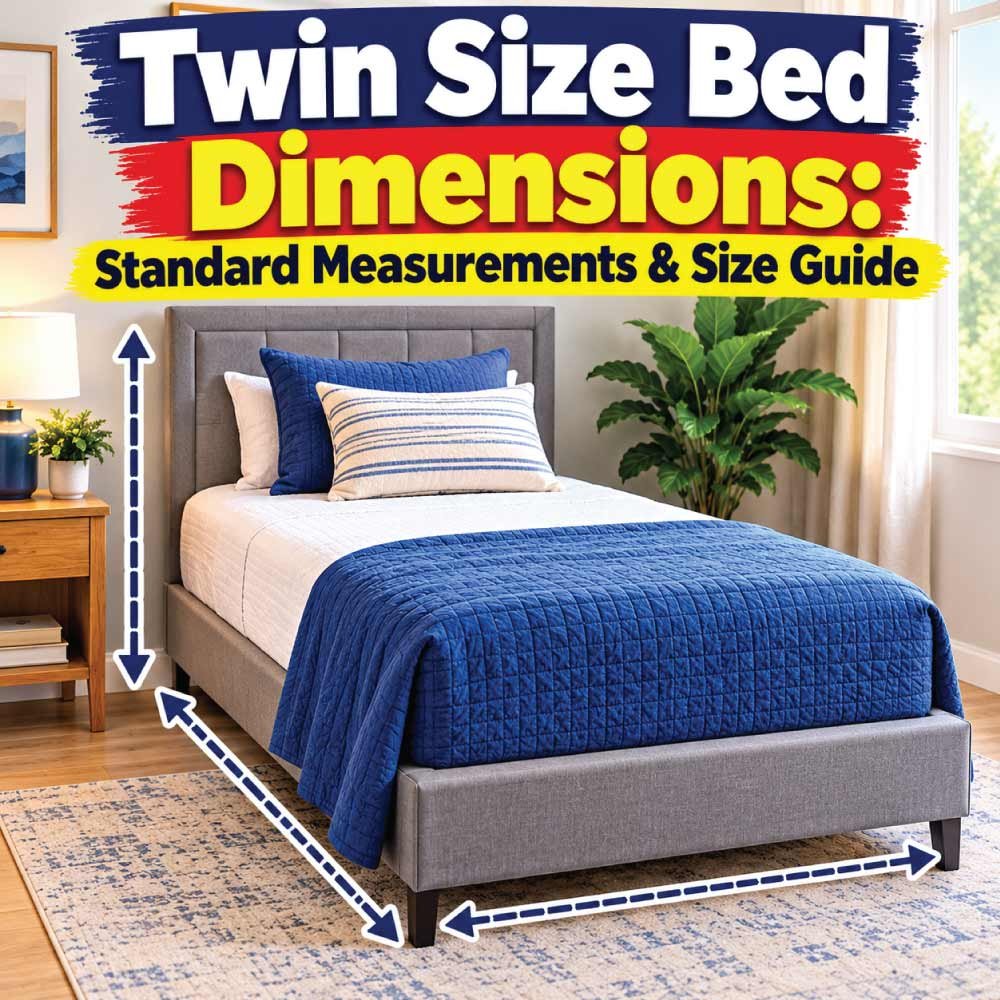
Twin beds are one of the most versatile bed sizes for bedrooms, guest rooms, children’s rooms, dorms, and compact living spaces. But knowing the mattress size alone is not always enough. A bed frame can extend several inches beyond the mattress, while headboards, footboards, drawers, and other features can require additional space.
The standard twin size bed dimensions are approximately 38 inches wide by 75 inches long (96.5 × 190.5 cm) for the mattress. However, the complete bed can be larger depending on its frame design.
This guide explains twin mattress dimensions, standard twin bed sizes, frame measurements, recommended room space, twin vs. twin XL differences, how to measure your available space, and how to choose the right setup for your room.
What Are Standard Twin Size Bed Dimensions?
A standard twin mattress measures 38 inches wide and 75 inches long. It is one of the most compact standard mattress sizes available and is designed primarily for one person.
The name “twin” can sometimes cause confusion because it does not describe a special mattress shape. It simply refers to a standard single-person mattress size that is commonly sold as part of a matching pair.
| Measurement | Standard Twin Mattress |
|---|---|
| Width | 38 in (96.5 cm) |
| Length | 75 in (190.5 cm) |
| Surface Area | 2,850 sq in (1.84 m²) |
| Sleeper Capacity | 1 person |
| Common Use | Children, teens, adults, guest rooms |
The 38 × 75 inch measurement applies to the mattress itself. A complete twin bed—including the frame—may have larger overall dimensions.
For example, a simple platform bed may add only a few inches to the mattress footprint, while an ornate bed with a wide headboard or footboard can take up considerably more room.
Twin Mattress vs. Twin Bed Dimensions
It is important to distinguish between mattress dimensions and bed dimensions.
A twin mattress is generally 38 × 75 inches, but a bed frame might measure approximately 40–45 inches wide and 77–82 inches long, depending on construction.
There is no single universal frame size because manufacturers use different materials and designs.
When planning a bedroom, therefore, use the actual outside dimensions of the bed frame, not just the mattress dimensions.
Twin Mattress Size in Feet and Centimeters
Converting twin bed measurements into different units can make room planning easier, especially when comparing furniture from different manufacturers.
A standard twin mattress is:
- 38 inches wide
- 75 inches long
- Approximately 3.17 feet wide
- Approximately 6.25 feet long
- Approximately 96.5 cm wide
- Approximately 190.5 cm long
The mattress is relatively narrow, making it suitable for bedrooms where floor space is limited.
| Unit | Twin Width | Twin Length |
|---|---|---|
| Inches | 38 in | 75 in |
| Feet | 3.17 ft | 6.25 ft |
| Centimeters | 96.5 cm | 190.5 cm |
| Meters | 0.965 m | 1.905 m |
These are mattress dimensions rather than guaranteed overall bed-frame dimensions.
How Big Is a Twin Bed With a Frame?
The overall dimensions of a twin bed depend on the frame. This is one of the most important considerations when deciding whether a bed will fit into a particular room.
A basic twin platform frame may stay relatively close to the mattress footprint. A traditional frame with a headboard and footboard can be wider or longer.
Typical Twin Bed Frame Considerations
When shopping for a frame, check these measurements:
- Overall width: The distance from the outer edge of one side of the frame to the other.
- Overall length: The complete front-to-back measurement.
- Headboard height: Important when placing the bed beneath windows or wall features.
- Footboard height: Relevant for visual space and clearance.
- Under-bed clearance: Important if you plan to use storage boxes.
- Side rail dimensions: These can add width beyond the mattress.
Never assume that a 38-inch-wide mattress means the finished bed will be exactly 38 inches wide.
If the room is tight, look for the manufacturer’s assembled dimensions before purchasing.
How Much Room Does a Twin Bed Need?
A twin mattress can technically fit into a relatively small area, but a comfortable bedroom needs more than enough space for the mattress itself.
You need room to walk around the bed, open doors and drawers, change bedding, and use nearby furniture.
For practical planning, consider three different areas:
- The mattress footprint
- The bed frame footprint
- Walking and furniture clearance
A twin bed placed against a wall may need less clearance on one side than a freestanding bed. However, accessibility and comfort are usually better when there is usable space around the bed.
Minimum Room Size for a Twin Bed
There is no single universally required minimum bedroom size for a twin bed. Local building codes, furniture arrangements, doors, windows, closets, and accessibility requirements can all affect what works.
A compact bedroom around 7 × 10 feet can potentially accommodate a twin bed, depending on the room’s layout and other furniture.
A larger room, such as 10 × 10 feet, generally provides more flexibility for a twin bed, dresser, desk, nightstand, or additional storage.
The key is not simply the room’s square footage. The placement of doors, closets, windows, and other furniture can matter just as much as the total room size.
Recommended Clearance Around a Twin Bed
Clearance is the space between the bed and nearby walls or furniture. It determines how easily you can move through the room.
For everyday bedroom use, many people find approximately 24–30 inches of walking space comfortable where circulation is needed. Smaller clearances may work in compact rooms, but they can make the space feel crowded.
Consider leaving enough room for:
- Walking around the bed
- Opening drawers
- Opening closet doors
- Changing sheets
- Accessing electrical outlets
- Moving furniture
- Getting in and out of bed comfortably
You do not necessarily need equal clearance on every side. For example, placing one long side of a twin bed against a wall can save valuable floor space in a child’s or guest bedroom.
Twin vs. Twin XL Bed Dimensions
One of the most important comparisons is between a standard twin and a Twin XL.
Both mattresses are approximately 38 inches wide, but the Twin XL is longer.
| Bed Size | Width | Length | Best For |
|---|---|---|---|
| Twin | 38 in | 75 in | Children, teens, compact rooms |
| Twin XL | 38 in | 80 in | Taller teens, adults, dorm rooms |
The extra 5 inches of length can make a meaningful difference for taller sleepers.
A standard twin may feel short for an adult who is tall, particularly when the sleeper prefers to stretch out fully.
Who Should Choose a Twin XL?
Twin XL is often a better choice when:
- The sleeper is tall.
- The room can accommodate five additional inches of length.
- The bed will be used by an adult.
- You are furnishing a dorm-style room.
- You want a narrow mattress without sacrificing as much legroom.
Remember that Twin XL mattresses require Twin XL sheets and a Twin XL-compatible frame. Standard twin bedding is generally not interchangeable.
Twin vs. Full Bed Dimensions
A full-size mattress is wider than a twin while having the same standard length of 75 inches.
| Bed Size | Width | Length | Sleeper Capacity |
|---|---|---|---|
| Twin | 38 in | 75 in | 1 |
| Full | 54 in | 75 in | 1–2 |
The full mattress provides approximately 16 additional inches of width.
That extra space can make a full bed more comfortable for an adult, but it also takes up substantially more floor area.
A twin is usually the better option when space efficiency is the priority.
Twin vs. Queen Bed Dimensions
A queen mattress is considerably larger than a twin.
| Bed Size | Width | Length |
|---|---|---|
| Twin | 38 in | 75 in |
| Twin XL | 38 in | 80 in |
| Full | 54 in | 75 in |
| Queen | 60 in | 80 in |
A queen gives a single sleeper substantially more room and can accommodate two adults comfortably, but it requires a larger bedroom and more floor space.
For a child’s bedroom, compact guest room, or shared room with multiple beds, twin mattresses can be significantly easier to arrange.
Twin Bed Dimensions for Different Uses
Twin beds are useful because their relatively small footprint allows them to serve many purposes.
Twin Beds for Children’s Rooms
A twin bed is a common choice for children because it provides a full-length sleeping surface without taking up as much floor space as larger mattresses.
It can leave room for:
- A desk
- Toy storage
- Dresser
- Bookshelf
- Play area
- Nightstand
When furnishing a child’s room, consider the entire furniture layout rather than placing the largest possible bed in the available space.
Twin Beds for Guest Rooms
A twin mattress works well in a small guest bedroom, particularly when overnight visitors usually stay alone.
Two twin beds can also be useful when the room needs to accommodate siblings, friends, or guests who prefer separate sleeping surfaces.
Twin Beds in Shared Bedrooms
Two twin beds are often easier to arrange than two larger beds.
Common layouts include:
- Beds positioned on opposite walls
- Beds placed parallel to each other
- Beds separated by a nightstand
- Beds arranged in an L-shaped layout
- Bunk-bed configurations
The best arrangement depends on doors, windows, closets, heating or cooling equipment, and available circulation space.
How to Measure for a Twin Bed
Measuring before buying is one of the easiest ways to avoid an expensive furniture mistake.
Step 1: Measure the Room
Measure the room’s:
- Length
- Width
- Ceiling height if using a tall bed or bunk
- Door openings
- Closet openings
- Window locations
Record measurements in inches or centimeters and keep the same unit throughout your planning.
Step 2: Mark the Bed Footprint
Use the twin mattress size of approximately 38 × 75 inches as a starting point.
Then add the expected frame dimensions.
For a more accurate visualization, use painter’s tape on the floor to mark the approximate outside dimensions of the bed.
This makes it easier to see how much walking space remains.
Step 3: Account for Furniture
Mark the locations of:
- Dressers
- Nightstands
- Desks
- Chairs
- Shelving
- Wardrobes
- Storage cabinets
Also account for the space required to open drawers and doors.
Step 4: Check the Mattress and Frame Separately
If you already own a mattress, measure it directly.
If you are buying both mattress and frame, check the manufacturer’s listed dimensions for each item.
A frame can be wider or longer than the mattress, and some headboards can extend substantially beyond the sleeping surface.
Step 5: Check Delivery Access
A bed that fits in the bedroom can still be difficult to get into the home.
Measure:
- Entry doors
- Hallways
- Staircases
- Elevator doors
- Tight corners
This is especially important for bulky assembled furniture.
Also Read:
How to Choose the Right Twin Bed Frame
The mattress size is only one part of the decision. The frame affects the bed’s footprint, height, appearance, storage capacity, and usability.
Platform Bed Frames
Platform frames generally provide a simple, low-profile design and can be suitable for modern bedrooms.
They are often useful when you want to keep the overall visual footprint relatively compact.
Twin Bed Frames With Storage
Storage beds can include drawers underneath or built-in compartments.
They are especially useful in smaller rooms because they combine sleeping space with additional storage.
However, remember that drawers need room to open. Measure the clearance in front of the drawers before positioning the bed.
Twin Bunk Beds
Bunk beds use vertical space rather than simply increasing the floor footprint.
They can be practical for shared children’s bedrooms, but their overall dimensions and height vary significantly by design.
For bunk beds, check the manufacturer’s safety requirements and recommended mattress specifications rather than assuming that any twin mattress will be appropriate.
Twin Daybeds
A twin daybed can function as both seating and sleeping furniture.
Because the frame may have substantial side and back panels, its overall dimensions can differ noticeably from the mattress size.
Does a Twin Mattress Fit a Twin Bed Frame?
A standard twin mattress is designed to fit a standard twin frame, but exact compatibility should still be confirmed.
Mattress and frame dimensions can vary slightly by manufacturer, and specialized frames may use different construction tolerances.
Before buying, verify:
- Mattress dimensions
- Frame dimensions
- Supported mattress size
- Slat spacing or platform requirements
- Maximum supported weight
- Whether a box spring is required
For a Twin XL setup, both the mattress and frame must specifically be designed for Twin XL dimensions.
Do not buy a standard twin frame simply because the mattress looks similar. The additional five inches of Twin XL length require a compatible frame.
Also Read:
Twin Bed Height: What to Consider
Unlike mattress width and length, bed height does not have one universal standard.
The final sleeping height depends on:
- Mattress thickness
- Foundation or box spring
- Bed frame
- Platform height
- Adjustable base
- Topper
A low-profile frame can make a small bedroom appear more open, while a taller frame can provide easier access to under-bed storage.
When selecting a bed, think about both sleeping comfort and storage requirements.
For children, extremely high sleeping surfaces may not be appropriate depending on the bed type. Follow the manufacturer’s safety recommendations for the specific frame.
How Much Floor Space Does a Twin Bed Use?
The mattress footprint of a standard twin is approximately 19.8 square feet.
That calculation comes from:
38 inches × 75 inches = 2,850 square inches
Dividing by 144 gives approximately 19.8 square feet.
However, the actual floor area occupied by the complete bed can be greater because of the frame, headboard, footboard, side rails, and other components.
This distinction matters when planning a compact bedroom.
A bed may technically fit into a particular area while leaving too little usable space for walking or opening furniture.
Also Read:
Best Twin Bed Layouts for Small Rooms
The most efficient layout depends on the shape of the room and where doors and windows are located.
Bed Against the Long Wall
Placing the long side of the twin bed against a wall can conserve space and create a larger open area on the opposite side.
This arrangement can work well in narrow bedrooms.
Bed in a Corner
A twin bed placed into a corner uses floor space efficiently.
This setup can be particularly useful for children’s rooms where a central play area is valuable.
Two Twin Beds
For two sleepers, twin beds can be arranged separately rather than using one large mattress.
This provides flexibility and can make it easier to rearrange the room later.
Twin Bed With a Desk
A twin bed can leave enough space for a compact desk in a small bedroom if the room is planned carefully.
Keep the desk away from areas where doors, drawers, or closet panels need to open.
Common Twin Bed Measurement Mistakes
Even when shoppers know the standard twin mattress dimensions, several mistakes can lead to poor furniture choices.
Mistake 1: Measuring Only the Mattress
A 38 × 75 inch mattress does not mean the complete bed will have those exact outside dimensions.
Always check the frame’s assembled dimensions.
Mistake 2: Forgetting Door Clearance
A dresser may fit beside a bed on paper but become unusable if its drawers cannot open fully.
Mistake 3: Confusing Twin and Twin XL
The widths are similar, but Twin XL is 5 inches longer.
Using the wrong frame or bedding can create compatibility problems.
Mistake 4: Ignoring Headboard Dimensions
A headboard can extend beyond the mattress on both sides or rise significantly above it.
Measure the complete headboard, especially in rooms with windows or sloped ceilings.
Mistake 5: Forgetting Under-Bed Access
If you plan to use storage boxes, make sure there is enough clearance beneath the frame and enough room to remove the containers.
Frequently Asked Questions About Twin Bed Dimensions
What are the standard twin bed dimensions?
A standard twin mattress measures approximately 38 inches wide by 75 inches long (96.5 × 190.5 cm). The overall bed frame can be larger depending on its construction, headboard, footboard, and side rails.
Is a twin bed the same as a single bed?
In many contexts, “twin” and “single” refer to a similar one-person mattress size. However, terminology varies by country and manufacturer. Always check the actual mattress dimensions rather than relying only on the name.
How wide is a twin bed?
A standard twin mattress is approximately 38 inches wide. The complete bed can be wider because the frame, rails, or headboard may extend beyond the mattress.
How long is a twin bed?
A standard twin mattress is approximately 75 inches long. The complete frame can be slightly longer, particularly when it includes a headboard or footboard.
Is a Twin XL longer than a twin?
Yes. A standard Twin XL is approximately 80 inches long, compared with approximately 75 inches for a standard twin. Both are generally about 38 inches wide.
Can two adults sleep on a twin bed?
A standard twin is designed primarily for one sleeper. Two adults would have very limited sleeping space, so a larger mattress such as a full or queen is generally more appropriate for two people.
Will twin sheets fit a Twin XL mattress?
Standard twin sheets are not designed for the additional length of a Twin XL mattress. Use bedding specifically labeled for Twin XL to ensure proper fit.
Is a twin bed good for a small bedroom?
Yes. Its approximately 38 × 75 inch mattress footprint makes it one of the more space-efficient standard bed sizes. The actual suitability depends on the room layout and the dimensions of the frame and other furniture.
How much space should I leave around a twin bed?
For comfortable circulation, approximately 24–30 inches of walking clearance is often useful where space permits. A smaller clearance may be workable in compact rooms, but doors, drawers, closets, and accessibility should also be considered.
Can a twin mattress fit on any twin frame?
Not necessarily. Most standard twin mattresses are intended for standard twin frames, but frame construction and dimensions vary. Always verify compatibility with the frame manufacturer’s specifications before purchasing.
Twin Bed Dimensions at a Glance
For quick reference, these are the most important measurements to remember:
| Feature | Standard Twin | Twin XL |
|---|---|---|
| Mattress Width | 38 in (96.5 cm) | 38 in (96.5 cm) |
| Mattress Length | 75 in (190.5 cm) | 80 in (203.2 cm) |
| Approx. Width in Feet | 3.17 ft | 3.17 ft |
| Approx. Length in Feet | 6.25 ft | 6.67 ft |
| Primary Advantage | Compact footprint | Extra legroom |
| Typical Use | Children, guests, compact rooms | Tall sleepers, teens, dorms |
These mattress measurements are useful for initial planning, but the manufacturer’s actual frame dimensions should be used when determining whether a complete bed will fit.
Final Tips for Choosing a Twin Bed
The standard twin mattress size is relatively simple: 38 inches wide by 75 inches long. The challenge comes from planning the complete sleeping area around it.
Before buying a twin bed, remember to:
- Measure the room first.
- Check the actual frame dimensions, not only the mattress size.
- Leave practical walking space around the bed.
- Account for doors, drawers, closets, and windows.
- Choose Twin XL if additional length is important.
- Confirm mattress-to-frame compatibility.
- Measure delivery paths for large or assembled furniture.
- Consider under-bed storage if floor space is limited.
- Check manufacturer specifications for specialized frames and bunk beds.
For most compact bedrooms, children’s rooms, and single-sleeper guest rooms, a twin bed offers an excellent balance between sleeping space and efficient use of floor area. If the sleeper is taller or the room can accommodate additional length, Twin XL may be the more comfortable alternative.
The best choice ultimately depends on mattress dimensions, frame size, available floor space, sleeper height, furniture placement, and how the room will be used.
Conclusion
Understanding twin size bed dimensions makes it easier to select the right mattress, frame, bedding, and bedroom layout. A standard twin mattress is approximately 38 × 75 inches, while a Twin XL keeps the same width but adds five inches of length.
When planning your room, do not stop at the mattress measurements. Check the complete bed’s outside dimensions and allow enough clearance for walking, furniture, doors, and everyday use. With accurate measurements and thoughtful placement, a twin bed can provide a comfortable sleeping area without overwhelming a small bedroom.
