
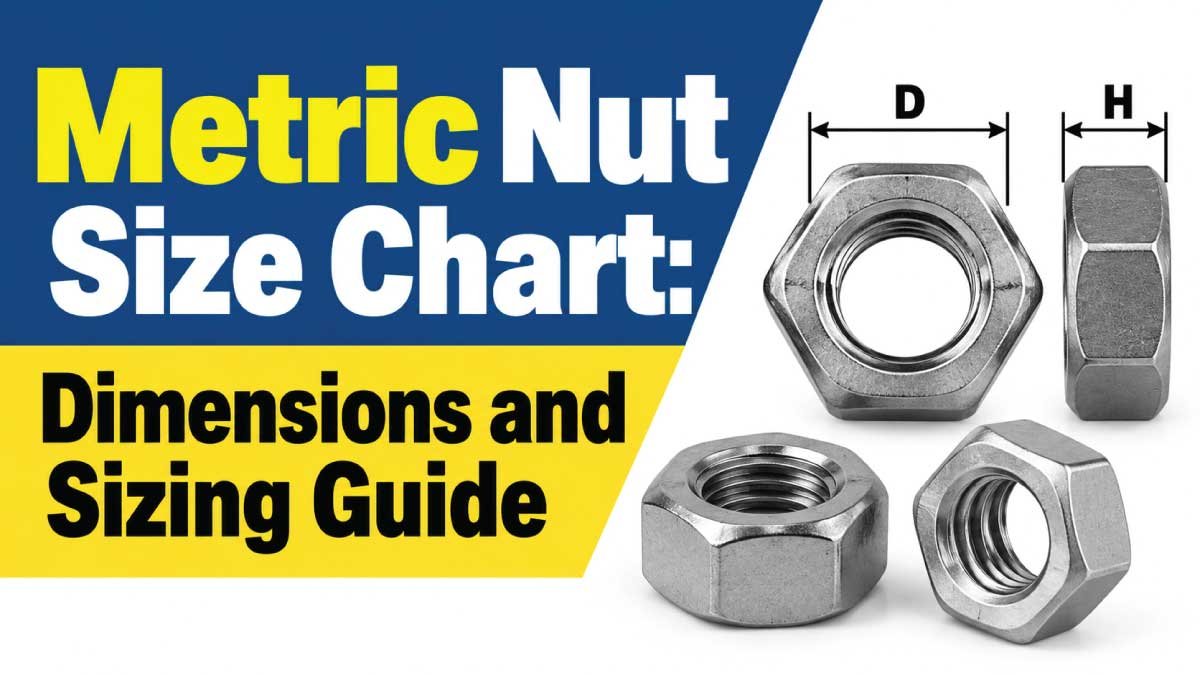
Metric nuts are essential fasteners used to secure bolts, threaded rods, and machine screws in construction, automotive repairs, machinery, furniture assembly, and countless industrial applications. Choosing the correct metric nut size is important for creating a secure connection, maintaining proper thread engagement, and preventing damage to fasteners or connected components.
Metric nuts are typically identified by the letter M followed by a number, such as M6, M8, M10, or M12. This number represents the nominal thread diameter in millimeters. However, selecting the right nut involves more than matching its diameter. You also need to consider thread pitch, nut width across flats, thickness, material, strength grade, and the applicable fastener standard.
This metric nut size chart explains common metric nut dimensions, standard thread sizes, measurement methods, and selection tips. Whether you are replacing a nut, assembling machinery, or organizing fasteners for a workshop, this guide will help you identify the right metric nut for your application.
What Is a Metric Nut?
A metric nut is a threaded fastener designed to work with a compatible metric bolt or threaded rod. It typically has an internally threaded hole that engages with the external threads of the mating fastener.
Metric nuts are manufactured according to standardized metric dimensions. Their sizes are expressed in millimeters, making it easier to identify compatible fasteners across many applications.
Common uses include:
- Automotive maintenance and repairs.
- Machinery and equipment assembly.
- Construction and metal fabrication.
- Furniture and cabinet assembly.
- Electrical equipment installation.
- Agricultural machinery.
- Industrial maintenance and manufacturing.
Metric nuts come in different shapes, materials, thicknesses, and strength grades. Hex nuts are among the most common because their six-sided shape allows them to be tightened with a suitable wrench or socket.
Other types include lock nuts, flange nuts, wing nuts, cap nuts, and square nuts. Each design serves a particular purpose, so the appropriate nut depends on the mechanical requirements of the connection.
Metric Nut Size Chart
The following metric nut size chart provides representative dimensions for common coarse-thread hex nuts. The nominal size refers to the matching bolt thread diameter, while the width across flats and thickness describe the nut’s external dimensions.
| Metric Nut Size | Thread Diameter (mm) | Typical Coarse Thread Pitch (mm) | Common Width Across Flats (mm) | Typical Nut Thickness (mm) |
|---|---|---|---|---|
| M3 | 3 | 0.50 | 5.5 | 2.4 |
| M4 | 4 | 0.70 | 7 | 3.2 |
| M5 | 5 | 0.80 | 8 | 4 |
| M6 | 6 | 1.00 | 10 | 5 |
| M8 | 8 | 1.25 | 13 | 6.5 |
| M10 | 10 | 1.50 | 16 or 17 | 8 |
| M12 | 12 | 1.75 | 18 or 19 | 10 |
| M14 | 14 | 2.00 | 21 or 22 | 11 |
| M16 | 16 | 2.00 | 24 | 13 |
| M18 | 18 | 2.50 | 27 | 15 |
| M20 | 20 | 2.50 | 30 | 16 |
| M22 | 22 | 2.50 | 32 or 34 | 18 |
| M24 | 24 | 3.00 | 36 | 19 |
| M27 | 27 | 3.00 | 41 | 22 |
| M30 | 30 | 3.50 | 46 | 24 |
| M33 | 33 | 3.50 | 50 | 26 |
| M36 | 36 | 4.00 | 55 | 29 |
These values are general reference dimensions for commonly encountered hex nuts, not universal specifications for every metric nut. Width across flats and thickness can vary according to the nut’s product standard, style, strength class, and manufacturer.
For precision work, consult the relevant dimensional standard or the manufacturer’s specification sheet before choosing a replacement fastener.
Understanding Metric Nut Sizes
Metric nut dimensions can seem confusing when you first encounter different markings and measurements. Understanding the main terms makes selecting compatible hardware much easier.
Nominal Thread Diameter
The nominal thread diameter is the number following the letter M in a metric fastener designation.
For example:
- M6 nuts fit compatible M6 external threads.
- M8 nuts fit compatible M8 external threads.
- M10 nuts fit compatible M10 external threads.
- M12 nuts fit compatible M12 external threads.
- M16 nuts fit compatible M16 external threads.
The number represents the nominal thread diameter in millimeters. It does not indicate the nut’s outside width or overall thickness.
An M8 nut, for example, is designed for an approximately 8 mm nominal thread diameter, but its width across flats is typically 13 mm for a common standard hex nut.
Thread Pitch
Thread pitch is the distance between corresponding points on adjacent threads, measured parallel to the fastener’s axis. For metric fasteners, pitch is expressed in millimeters.
A designation such as M10 × 1.5 indicates a nominal diameter of 10 mm and a thread pitch of 1.5 mm.
Metric fasteners commonly use coarse threads, but fine-thread versions are also available. A nut and bolt must have matching thread diameters and pitches to engage properly.
Width Across Flats
Width across flats, abbreviated AF, is the distance between two opposite flat faces of a hex nut.
This dimension determines the wrench or socket size needed to tighten or loosen the nut. It is different from the nominal thread diameter.
For example, a common M10 hex nut may have a width across flats of 16 or 17 mm, depending on the applicable standard and design.
Nut Thickness
Nut thickness is the distance between the two main bearing faces of the nut, measured along its axis.
Standard hex nuts have a specified thickness based on their size and product standard. Thin nuts and jam nuts are generally thinner than standard nuts, while specialized designs may be thicker.
Nut thickness affects thread engagement and the amount of space needed for the connection.
Corner-to-Corner Dimension
Corner-to-corner dimension measures the distance between opposite corners of a hex nut. It is larger than the width across flats.
This measurement can help identify whether a nut will fit within a confined space. However, wrench and socket selection is normally based on the width across flats.
Metric Nut Dimensions by Thread Pitch
Metric nuts are available with different thread pitches. Coarse threads are common for general-purpose fastening, while fine threads may be selected for particular mechanical or adjustment requirements.
The following table lists common coarse-thread pitches and examples of fine-thread alternatives. Availability depends on the fastener size and standard.
| Metric Size | Common Coarse Pitch (mm) | Example Fine Pitch (mm) | Typical Use Consideration |
|---|---|---|---|
| M4 | 0.70 | 0.50 | Small mechanical assemblies |
| M5 | 0.80 | 0.50 | Equipment and component fastening |
| M6 | 1.00 | 0.75 | General machinery and fixtures |
| M8 | 1.25 | 1.00 | Automotive and mechanical assemblies |
| M10 | 1.50 | 1.25 or 1.00 | Machinery and structural components |
| M12 | 1.75 | 1.50 or 1.25 | Vehicle and equipment fastening |
| M14 | 2.00 | 1.50 | Specialized mechanical applications |
| M16 | 2.00 | 1.50 | Machinery and heavy-duty assemblies |
| M18 | 2.50 | 2.00 or 1.50 | Specialized fastening applications |
| M20 | 2.50 | 2.00 or 1.50 | Mechanical and industrial equipment |
| M24 | 3.00 | 2.00 | Larger mechanical connections |
Fine pitches shown are examples of common standardized options, not a statement that every pitch is available for every nut size.
Important: Never assume that two nuts with the same nominal diameter are interchangeable. Check both the thread diameter and pitch before assembly.
Metric Nut Size Chart in Millimeters and Inches
Metric nut dimensions are normally specified in millimeters, but inch measurements can be useful when working with imported tools or mixed measurement systems.
The following table converts representative metric dimensions into approximate inch equivalents.
| Metric Size | Thread Diameter (mm) | Thread Diameter (in) | Typical Width Across Flats (mm) | Approx. Width Across Flats (in) |
|---|---|---|---|---|
| M3 | 3 | 0.118 | 5.5 | 0.217 |
| M4 | 4 | 0.157 | 7 | 0.276 |
| M5 | 5 | 0.197 | 8 | 0.315 |
| M6 | 6 | 0.236 | 10 | 0.394 |
| M8 | 8 | 0.315 | 13 | 0.512 |
| M10 | 10 | 0.394 | 16 | 0.630 |
| M12 | 12 | 0.472 | 18 | 0.709 |
| M16 | 16 | 0.630 | 24 | 0.945 |
| M20 | 20 | 0.787 | 30 | 1.181 |
| M24 | 24 | 0.945 | 36 | 1.417 |
| M30 | 30 | 1.181 | 46 | 1.811 |
| M36 | 36 | 1.417 | 55 | 2.165 |
Inch values are rounded conversions for reference. The metric dimensions remain the primary specifications.
Metric and imperial fasteners use different thread systems. A metric nut should not be assumed compatible with an imperial bolt simply because the diameters appear similar.
Common Metric Nut Types and Their Dimensions
Although hex nuts are widely used, other metric nut designs may be more suitable for specific applications.
Hex Nuts
Hex nuts have six flat sides and are designed for tightening with a wrench or socket. They are commonly used in machinery, construction, automotive work, and general fastening.
Their dimensions are determined by the nominal thread size and applicable nut standard. Width across flats and thickness are especially important when choosing replacement hex nuts.
Lock Nuts
Lock nuts are designed to resist loosening under certain conditions. Depending on their design, they may use a nylon insert, an all-metal locking feature, or another locking mechanism.
A nylon-insert lock nut can have a different overall height from a standard hex nut of the same thread size. Always check the dimensions and temperature suitability of the locking feature.
Lock nuts do not eliminate the need for correct installation torque or an appropriate joint design.
Flange Nuts
Flange nuts have an integrated flange at the bearing surface. The flange distributes the clamping load over a wider area and may reduce the need for a separate washer.
Some flange nuts have serrations intended to resist loosening, while others have smooth bearing surfaces. The flange diameter and overall height vary by design.
Wing Nuts
Wing nuts have two projecting wings that allow hand tightening and loosening. They are useful where frequent adjustment is required and high tightening torque is not necessary.
Their overall width is much greater than that of a standard hex nut, so they may require additional clearance.
Cap Nuts
Cap nuts, also called acorn nuts, have a closed end that covers the exposed end of a bolt. They are often used for appearance, protection, and reducing exposure to sharp thread ends.
The available internal depth must be sufficient for the bolt’s protruding thread length.
Square Nuts
Square nuts have four sides and provide a larger flat bearing surface than many similarly sized hex nuts. They are used in certain machinery, channels, older assemblies, and specialized fastening systems.
Their width across flats and thickness differ from those of standard hex nuts.
Jam Nuts
Jam nuts are thinner than standard nuts and are often used with another nut to help secure an adjustment or threaded connection. They may be installed in applications where space is limited.
A jam nut should not automatically be treated as a direct replacement for a full-height structural nut. Confirm the intended use and required thread engagement.
Also Read:
How to Measure a Metric Nut
Measuring a nut correctly helps you identify its size and choose a compatible replacement. Use a caliper, ruler, thread gauge, and suitable measuring tools where available.
Step 1: Measure the Thread Diameter
If the matching bolt is available, measure its outside thread diameter using a caliper.
A measurement close to 8 mm may indicate an M8 bolt, while a measurement close to 10 mm may indicate an M10 bolt. Because wear and measurement errors can affect the result, verify the nominal size rather than relying only on a rough measurement.
Step 2: Identify the Thread Pitch
Use a metric thread-pitch gauge to determine the distance between adjacent threads. Match the measured pitch to the appropriate metric thread designation.
For example, an M8 coarse-thread fastener commonly uses a 1.25 mm pitch, while an M10 coarse-thread fastener commonly uses a 1.5 mm pitch.
Do not force a nut onto a bolt to test compatibility. If the threads do not engage smoothly by hand, stop and verify the size and pitch.
Step 3: Measure Width Across Flats
Place the caliper jaws against two opposite flat faces of the nut. The result is the width across flats.
This measurement helps determine the required wrench or socket size. Compare the measurement with the applicable standard because different nut designs may use different widths.
Step 4: Measure Nut Thickness
Measure the distance between the nut’s two bearing faces. Avoid measuring across chamfers or decorative features when determining the main body thickness.
Compare the result with the specification for the particular nut type.
Step 5: Identify the Nut Type
Determine whether the fastener is a standard hex nut, lock nut, flange nut, wing nut, cap nut, square nut, or jam nut.
Different designs can have substantially different external dimensions even when their threads are compatible.
Step 6: Check the Material and Strength Grade
Identify the nut material, coating, and property class where applicable. These details matter for corrosion resistance, temperature suitability, and load-bearing performance.
For critical mechanical or structural connections, use a nut that meets the specified standard and strength requirements.
Also Read:
Metric Nut Size and Wrench Size Chart
The wrench size is usually determined by the nut’s width across flats rather than its nominal thread diameter. The following table provides common reference values for standard metric hex nuts.
| Metric Nut Size | Typical Wrench Size (mm) | Common Socket Size (mm) | Measurement Note |
|---|---|---|---|
| M3 | 5.5 | 5.5 | Check the exact nut standard |
| M4 | 7 | 7 | Common standard hex nut |
| M5 | 8 | 8 | Verify nut design |
| M6 | 10 | 10 | Common standard hex nut |
| M8 | 13 | 13 | Some standards use different dimensions |
| M10 | 16 or 17 | 16 or 17 | Depends on the nut standard |
| M12 | 18 or 19 | 18 or 19 | Check product specification |
| M14 | 21 or 22 | 21 or 22 | Standard-dependent |
| M16 | 24 | 24 | Common standard hex nut |
| M18 | 27 | 27 | Confirm exact dimensions |
| M20 | 30 | 30 | Common standard hex nut |
| M22 | 32 or 34 | 32 or 34 | Standard-dependent |
| M24 | 36 | 36 | Common standard hex nut |
| M27 | 41 | 41 | Verify the specified standard |
| M30 | 46 | 46 | Common standard hex nut |
| M36 | 55 | 55 | Confirm the nut specification |
These wrench sizes are common reference values, not a guarantee for every nut style or standard. Reduced-width nuts, heavy hex nuts, flange nuts, and other specialized designs may require different tools.
Use a correctly sized wrench or socket to reduce the risk of rounding the nut’s flats.
Metric Nut Standards and Compatibility
Metric nuts are manufactured according to different international and national standards. These standards define dimensions, thread requirements, tolerances, materials, and other characteristics.
Common standards and specification families include ISO standards for metric hex nuts and DIN standards used in many European fastener catalogs. The exact standard depends on the nut type and application.
Why Standards Matter
Two nuts may have the same nominal thread diameter and pitch but different external dimensions. For example, their width across flats, thickness, chamfer, or tolerances may differ.
These differences can affect tool fit, available clearance, bearing surfaces, and compatibility with a specified assembly.
Standard Hex Nuts Versus Heavy Hex Nuts
Standard hex nuts are commonly used in general mechanical applications. Heavy hex nuts have larger external dimensions and are used in certain engineered or structural connections.
A heavy hex nut should not be selected solely because it appears stronger. The complete assembly must follow the specified fastener standard, grade, and design requirements.
Metric Nuts and Imperial Fasteners
Metric fasteners use metric thread dimensions and pitches, while imperial fasteners may use Unified or other inch-based thread systems.
A nut that appears close in diameter to an imperial fastener may still have an incompatible thread profile or pitch. Always match the thread system and specification.
Also Read:
How to Choose the Right Metric Nut
Selecting the correct nut involves several checks beyond identifying the nominal size.
Match the nominal diameter. Choose a nut designed for the bolt’s metric thread diameter.
Confirm the thread pitch. Ensure the internal thread matches the bolt’s external thread.
Check the nut type. Choose a hex, lock, flange, wing, cap, square, or jam nut according to the application.
Verify the dimensions. Check width across flats, thickness, and available clearance.
Select the correct material. Consider steel, stainless steel, or another suitable material based on the environment.
Check the strength class. Use the specified nut property class for the intended load and bolt assembly.
Consider corrosion protection. Coatings and stainless steel grades may be appropriate for particular environments.
Follow the assembly specification. Use the specified tightening method and torque where required.
For structural, automotive, pressure-related, or safety-critical applications, do not substitute a nut based only on apparent size. Follow the engineering specification and applicable standards.
Common Metric Nut Sizing Mistakes
Avoiding common sizing errors can prevent thread damage, poor tool fit, and unreliable fastener connections.
Confusing Thread Diameter with Wrench Size
An M10 nut does not normally require a 10 mm wrench. A common M10 hex nut may require a 16 or 17 mm wrench, depending on its standard.
Ignoring Thread Pitch
A nut with the correct nominal diameter may still be incompatible if its pitch differs from the bolt’s pitch.
Assuming Every Nut Has the Same Thickness
Standard nuts, jam nuts, lock nuts, and heavy hex nuts can have different heights. Confirm the dimensions of the exact nut type.
Mixing Metric and Imperial Threads
Metric and imperial fasteners are not automatically interchangeable. Match the thread diameter, pitch, and applicable thread standard.
Choosing the Wrong Strength Class
A nut may fit the bolt but still be unsuitable for the intended load. Follow the required property class and fastener assembly specification.
Using an Incorrect Wrench
A wrench that is too large can slip and round the nut’s flats. A wrench that is too small may not fit properly. Use the specified tool size.
Frequently Asked Questions About Metric Nut Sizes
What does M8 mean on a metric nut?
M8 indicates a nominal metric thread diameter of 8 mm. A common M8 coarse-thread nut uses a 1.25 mm pitch, although fine-thread versions also exist.
What size wrench fits an M10 nut?
A common standard M10 hex nut may use a 16 mm or 17 mm wrench, depending on the applicable standard and nut design. Check the actual width across flats before selecting a tool.
What is the difference between M6 and M8 nuts?
An M6 nut is designed for a nominal thread diameter of 6 mm, while an M8 nut is designed for an 8 mm nominal thread diameter. Their thread pitches and external dimensions also differ.
How do I know whether a metric nut is coarse or fine thread?
Measure the thread pitch using a metric pitch gauge or check the product designation. Coarse-thread pitches are common, but fine-thread versions are available for many metric diameters.
Are all M10 nuts interchangeable?
No. M10 nuts may have different thread pitches, external dimensions, materials, strength classes, and designs. Match the nut to the bolt and application requirements.
What does M12 × 1.75 mean?
This designation indicates a nominal thread diameter of 12 mm and a pitch of 1.75 mm. It is a common coarse-thread specification for M12 fasteners.
Can I use a stainless steel nut with a steel bolt?
It depends on the application, material compatibility, corrosion environment, and required strength. Stainless steel and carbon steel fasteners may behave differently under load and in corrosive conditions. Use the specified materials for critical assemblies.
What is the difference between a lock nut and a standard nut?
A standard nut provides a threaded connection, while a lock nut incorporates a feature intended to resist loosening. Locking mechanisms vary, and their suitability depends on operating temperature, vibration, and installation requirements.
How do I measure metric nut thickness?
Measure the distance between the nut’s two bearing faces using a caliper. Compare the result with the dimensional specification for the relevant nut standard and type.
Can I replace an M10 nut with an M12 nut?
No, not on the same M10 bolt. An M12 nut has a larger nominal thread diameter and will not correctly engage an M10 external thread. Use a nut that matches the bolt’s diameter and pitch.
Conclusion
A metric nut size chart makes it easier to identify common fastener dimensions and select compatible hardware. However, the nominal M-size is only one part of the selection process. Thread pitch, width across flats, thickness, nut design, material, and strength class also matter.
For general reference, common metric sizes include M3, M4, M5, M6, M8, M10, M12, M16, M20, and M24. Each size has its own thread specifications and typical external dimensions, which may vary according to the applicable standard.
Before purchasing or installing a metric nut, verify the bolt’s diameter and pitch, check the nut dimensions, and follow the requirements for the intended application. Correct sizing helps protect threads, improve tool fit, and support secure, reliable fastener connections.
