
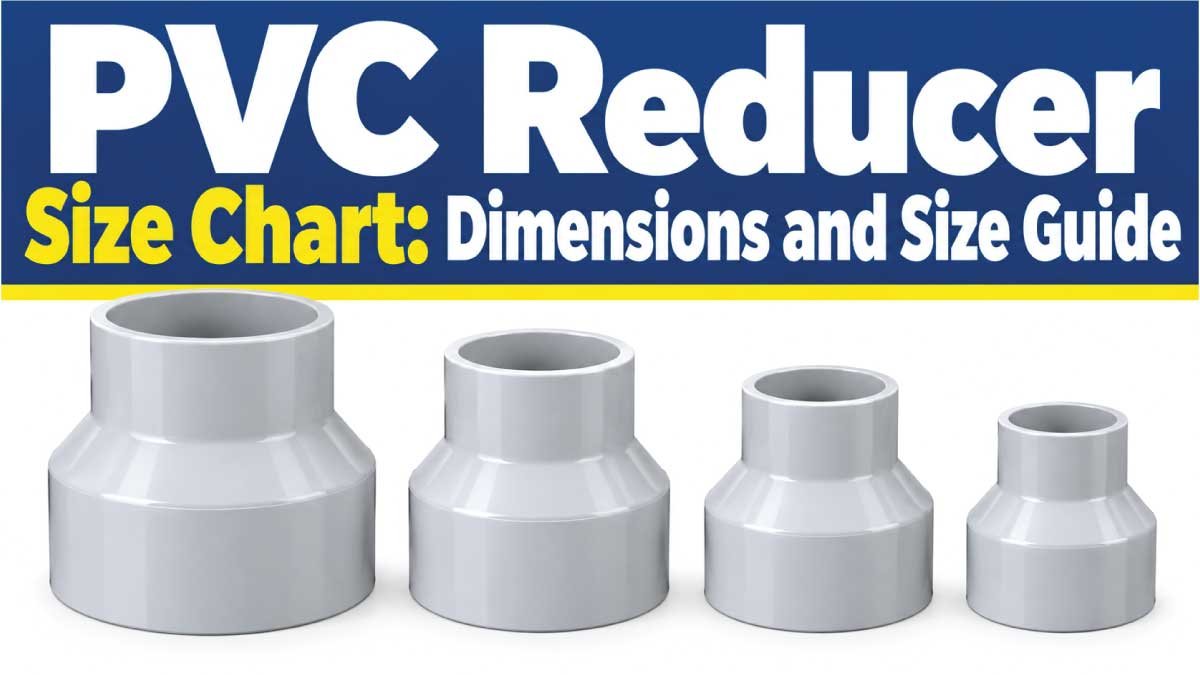
PVC reducers are pipe fittings used to connect two pipes of different nominal sizes. They help transition from a larger pipe to a smaller one or connect piping components with different connection diameters. PVC reducers are widely used in plumbing, irrigation, drainage, water distribution, and industrial piping systems.
Choosing the correct PVC reducer size is important for connection compatibility, flow performance, and installation reliability. A reducer must match both pipe sizes, the connection type, the applicable dimensional standard, and the system’s operating requirements.
This PVC reducer size chart explains common size combinations, fitting dimensions, reducer types, and measurement methods. You will also learn the difference between reducer bushings and straight reducers, how Schedule 40 and Schedule 80 affect compatibility, and which mistakes to avoid when selecting a fitting.
PVC Reducer Size Chart: Common Sizes and Dimensions
A PVC reducer connects two different nominal pipe sizes. For example, a 2-inch × 1-inch reducer connects a compatible nominal 2-inch pipe connection to a nominal 1-inch connection.
The following chart provides common reducer size combinations for general reference. These are nominal connection sizes rather than exact physical dimensions of the reducer body. Availability depends on the fitting type, pipe standard, and manufacturer.
| Reducer Size (inches) | Larger Connection (inches) | Smaller Connection (inches) | Typical Application |
|---|---|---|---|
| 3/4 × 1/2 | 3/4 | 1/2 | Small water and irrigation lines |
| 1 × 1/2 | 1 | 1/2 | Branch connections and equipment lines |
| 1 × 3/4 | 1 | 3/4 | Residential plumbing and irrigation |
| 1-1/4 × 3/4 | 1-1/4 | 3/4 | Reduced supply connections |
| 1-1/4 × 1 | 1-1/4 | 1 | Branch piping |
| 1-1/2 × 1 | 1-1/2 | 1 | Water distribution |
| 1-1/2 × 1-1/4 | 1-1/2 | 1-1/4 | Medium-sized piping transitions |
| 2 × 1 | 2 | 1 | Irrigation and distribution branches |
| 2 × 1-1/2 | 2 | 1-1/2 | Larger branch connections |
| 3 × 2 | 3 | 2 | Commercial piping and drainage |
| 4 × 2 | 4 | 2 | Larger drainage connections |
| 4 × 3 | 4 | 3 | Building drainage and distribution |
These combinations are commonly encountered, but not every reducer is available in every connection style. Always confirm that the listed dimensions correspond to the correct PVC product and piping standard.
PVC Pipe Outside Diameter Chart for Reducer Selection
Nominal pipe size is not the same as actual outside diameter. This distinction matters when identifying compatible PVC reducers, particularly when replacing an existing fitting or connecting pipes from different systems.
The following dimensions apply to common North American IPS PVC pipe sizes.
| Nominal Pipe Size (inches) | Outside Diameter (inches) | Outside Diameter (mm) |
|---|---|---|
| 1/2 | 0.840 | 21.34 |
| 3/4 | 1.050 | 26.67 |
| 1 | 1.315 | 33.40 |
| 1-1/4 | 1.660 | 42.16 |
| 1-1/2 | 1.900 | 48.26 |
| 2 | 2.375 | 60.33 |
| 2-1/2 | 2.875 | 73.03 |
| 3 | 3.500 | 88.90 |
| 4 | 4.500 | 114.30 |
| 6 | 6.625 | 168.28 |
| 8 | 8.625 | 219.08 |
These measurements describe the pipe’s outside diameter, not the reducer’s socket opening or internal flow diameter. Metric PVC systems and other dimensional standards may use different measurements, so verify the pipe markings before selecting a fitting.
Understanding PVC Reducer Dimensions
PVC reducer dimensions describe the physical measurements that determine how the fitting connects to the larger and smaller pipes. The exact dimensions depend on the reducer design, nominal sizes, connection method, and applicable product standard.
Nominal Size
Nominal size identifies the intended pipe connection. A reducer marked 2 × 1 inch typically connects a nominal 2-inch pipe to a nominal 1-inch pipe.
The designation does not mean that the fitting’s openings measure exactly 2 inches and 1 inch across.
Outside Diameter
Outside diameter (OD) measures across the exterior of a pipe. For standard IPS PVC, the nominal 2-inch pipe has an outside diameter of approximately 2.375 inches.
This measurement helps identify the compatible pipe and fitting system. It should not be confused with the reducer’s outside body diameter.
Inside Diameter
Inside diameter (ID) measures the open space inside a pipe or fitting. It influences the available flow area and depends on wall thickness and internal geometry.
Two pipes with the same nominal size can have different inside diameters when their wall thicknesses differ. A reducer’s internal passage also depends on its design.
Overall Length
Overall length is the distance from one end of the reducer to the other. A longer or shorter fitting can affect the amount of pipe needed and the space available during installation.
There is no single overall length for every 2 × 1-inch PVC reducer. Straight reducers, bushings, and different manufacturer designs can have different dimensions.
Socket Depth and Connection Dimensions
Socket depth describes how far the pipe enters a socket-style fitting. Some reducers have two socket connections, while others use a socket on one side and a spigot connection on the other.
Threaded reducers require additional attention to thread size and specification. Always use the manufacturer’s dimension drawing when precise physical measurements are necessary.
Types of PVC Reducer Fittings
PVC reducers are available in several configurations. Understanding the differences helps you select a fitting that matches your piping layout.
1. Straight PVC Reducer
A straight reducer connects two different nominal pipe sizes while maintaining a generally straight pipeline arrangement. Depending on the product, it may have socket, spigot, or other compatible connections.
Straight reducers are used in water distribution, irrigation, and other piping systems where a change in pipe diameter is required.
When selecting one, verify the larger and smaller connection sizes, the end configuration, and the fitting’s approved application.
2. PVC Reducer Bushing
A reducer bushing is a compact fitting designed to fit into a larger compatible socket or opening while providing a smaller connection.
For example, a 1 × 1/2-inch reducer bushing may fit a compatible nominal 1-inch socket and provide a nominal 1/2-inch connection.
Reducer bushings are useful when installation space is limited. However, they may reduce the internal flow area differently from a full-size straight reducer.
3. Concentric PVC Reducer
A concentric reducer reduces the diameter while keeping the larger and smaller ends aligned along the same centerline.
This shape is useful in many piping arrangements where a centered transition is appropriate. Its suitability depends on the system layout, flow direction, and applicable installation requirements.
4. Eccentric PVC Reducer
An eccentric reducer has an offset profile, meaning the centerlines of the two ends do not align in the same way as a concentric reducer.
Eccentric configurations can be useful in certain horizontal piping arrangements where maintaining a relatively flat top or bottom is important. The correct orientation depends on the application and engineering requirements.
Not every PVC product range includes eccentric reducers, so confirm availability and suitability before specifying one.
5. Threaded PVC Reducer
Threaded reducers connect components through compatible threaded openings. Depending on the design, they may reduce a pipe size while also adapting between connection types.
Before installation, confirm the nominal thread size and thread standard. Use an appropriate thread sealant where permitted by the manufacturer and application, and avoid overtightening plastic fittings.
Also Read:
PVC Reducer Size Chart by Fitting Type
Different reducer types can connect the same nominal pipe sizes while having different physical dimensions. This comparison helps clarify which type may suit a particular installation.
| Reducer Type | Connection Arrangement | Main Purpose | Important Consideration |
|---|---|---|---|
| Straight reducer | Larger and smaller ends | Changes pipe diameter | Check overall length and end type |
| Reducer bushing | Fits a larger socket or opening | Provides a smaller connection | Verify socket compatibility |
| Concentric reducer | Centered transition | Reduces diameter along a common centerline | Check layout and flow requirements |
| Eccentric reducer | Offset transition | Reduces diameter with an offset profile | Confirm correct orientation |
| Threaded reducer | Threaded connection or connections | Adapts size and connection type | Match thread specifications |
The best option depends on the type of pipe connection, available installation space, flow requirements, and product specifications.
Schedule 40 vs. Schedule 80 PVC Reducers
Schedule 40 and Schedule 80 refer to different wall-thickness series for applicable PVC piping. For corresponding standard IPS pipe sizes, both schedules have the same nominal size and outside diameter, but their wall thicknesses and inside diameters differ.
| Feature | Schedule 40 PVC | Schedule 80 PVC |
|---|---|---|
| Nominal pipe size | Standard nominal sizes | Standard nominal sizes |
| Outside diameter | Same as corresponding IPS size | Same as corresponding IPS size |
| Pipe wall thickness | Generally thinner | Generally thicker |
| Pipe inside diameter | Generally larger | Generally smaller |
| Common color convention | Often white | Often gray |
| Selection factors | Pressure, temperature, and application | Pressure, temperature, and application |
Color is a convention rather than a guarantee of material or pressure rating. Product markings and technical documentation should be used to identify the actual fitting specifications.
Can Schedule 40 and Schedule 80 Reducers Be Interchanged?
Some compatible Schedule 40 and Schedule 80 socket fittings can connect to corresponding IPS pipes of the same nominal size because the outside diameter is the same.
However, you should not assume that all reducers are interchangeable. Verify the fitting standard, connection type, material, pressure rating, and intended service.
The pressure rating of a complete piping system depends on its components, temperature, installation conditions, and other applicable limits. Use fittings specifically approved for the intended application.
Also Read:
How to Choose the Correct PVC Reducer Size
Selecting a reducer becomes easier when you identify both pipe sizes and confirm how the fitting will connect to the existing system.
Identify Both Pipe Sizes
Determine the nominal size of the larger pipe and the smaller pipe. Check the pipe markings or original product information whenever possible.
For example, if the main pipe is nominal 2 inches and the smaller pipe is nominal 1 inch, a compatible 2 × 1-inch reducer may be suitable.
Confirm the Pipe Standard
Identify whether the piping uses standard IPS dimensions, metric dimensions, or another system. Nominal sizes from different standards are not automatically interchangeable.
Measure the outside diameter if necessary, but also verify the pipe material and applicable dimensional standard.
Select the Connection Type
Determine whether the reducer needs socket, spigot, threaded, or another connection configuration.
A reducer bushing may fit into an existing socket, while a straight reducer may be more appropriate for connecting two separate pipe ends. Confirm the product’s connection arrangement before ordering.
Consider Pressure and Temperature
For pressure applications, check the reducer’s approved pressure rating and temperature limitations. Pressure capacity may decrease as operating temperature increases, depending on the product.
For drainage applications, verify that the reducer is suitable for the intended system and permitted by local plumbing requirements.
Check Flow Requirements
Reducing pipe diameter changes the available flow area. The effect on flow rate, velocity, and pressure loss depends on the entire piping system.
Do not choose a reducer solely because its ends match the pipes. Confirm that the reduced section is appropriate for the required flow and operating conditions.
Also Read:
How to Measure an Existing PVC Reducer
If you are replacing a reducer or matching an existing fitting, accurate measurements can help you identify the correct product.
Inspect the markings: Look for nominal sizes, material, schedule, and product identification.
Measure the larger connection: Check the pipe outside diameter or identify the nominal size from the markings.
Measure the smaller connection: Repeat the process for the smaller pipe or opening.
Identify the fitting type: Determine whether it is a straight reducer, bushing, concentric reducer, eccentric reducer, or threaded fitting.
Measure overall length: Use a ruler or caliper to record the distance between the ends if matching the physical dimensions is important.
Check connection details: Confirm socket depth, spigot dimensions, or thread specifications as applicable.
Verify the product standard: Ensure the replacement matches the piping system and intended service.
For socket-style fittings, do not assume the socket’s measured inside diameter must equal the pipe’s outside diameter exactly. The connection is designed around the relevant fitting dimensions and tolerances.
Common PVC Reducer Sizing Mistakes
A reducer may have the correct nominal sizes but still be unsuitable if the connection type or dimensional standard is wrong.
Confusing Nominal Size With Actual Diameter
A nominal 2-inch IPS PVC pipe has an outside diameter of approximately 2.375 inches. Selecting a reducer by assuming the pipe measures exactly 2 inches across can lead to an incorrect choice.
Choosing the Wrong Reducer Configuration
A reducer bushing and a straight reducer may connect similar nominal sizes but have different physical designs. Check how each end attaches to the existing pipe or fitting.
Mixing Metric and IPS Fittings
Metric and inch-based pipe systems can have different outside diameters and connection dimensions. Always verify compatibility instead of relying on similar labels.
Ignoring Wall Thickness and Pressure Ratings
The correct nominal size does not guarantee that a fitting can withstand the system’s pressure and temperature. Confirm the complete assembly’s operating requirements.
Overlooking Internal Flow Restrictions
A compact reducer bushing may have a different internal profile from a straight reducer. Where flow performance matters, consider the fitting’s internal passage and the requirements of the overall system.
Frequently Asked Questions About PVC Reducer Sizes
What is a PVC reducer used for?
A PVC reducer connects two different nominal pipe sizes. It allows a piping system to transition from a larger pipe to a smaller pipe or connect components with different connection diameters.
How do I read a PVC reducer size?
A reducer marked 2 × 1 inch generally connects a nominal 2-inch pipe to a nominal 1-inch pipe. Confirm the manufacturer’s size designation and connection type before buying.
What is the difference between a reducer and a reducer bushing?
A straight reducer typically connects two pipe ends through its respective connections. A reducer bushing fits into a compatible larger socket or opening and provides a smaller connection. Their physical dimensions and installation methods differ.
Are PVC reducer dimensions universal?
No. Dimensions depend on the applicable piping standard, fitting type, connection design, and manufacturer. Nominal size combinations may be similar while overall length and socket dimensions differ.
Can I use a Schedule 40 reducer with Schedule 80 pipe?
Some compatible IPS socket fittings can connect to either schedule when the nominal size and connection dimensions match. Verify the product specifications, pressure rating, and intended application before combining components.
Does a PVC reducer affect water flow?
Yes. Reducing the pipe diameter changes the available flow area and can affect velocity and pressure loss. The actual effect depends on the pipe sizes, flow rate, fitting geometry, and system design.
How do I choose between a concentric and eccentric reducer?
A concentric reducer keeps the connection centerlines aligned, while an eccentric reducer has an offset profile. The appropriate type depends on the piping layout, drainage or flow requirements, and applicable design specifications.
Conclusion
A PVC reducer size chart helps you compare common nominal sizes and identify the appropriate connection for a piping system. However, selecting the right reducer also requires attention to the fitting type, outside diameter, connection arrangement, pressure rating, and intended application.
Before purchasing, identify both pipe sizes, confirm the applicable dimensional standard, and check the manufacturer’s specifications. Whether you need a straight reducer, reducer bushing, concentric reducer, eccentric reducer, or threaded reducer, compatibility and correct installation are essential for a reliable connection.
