
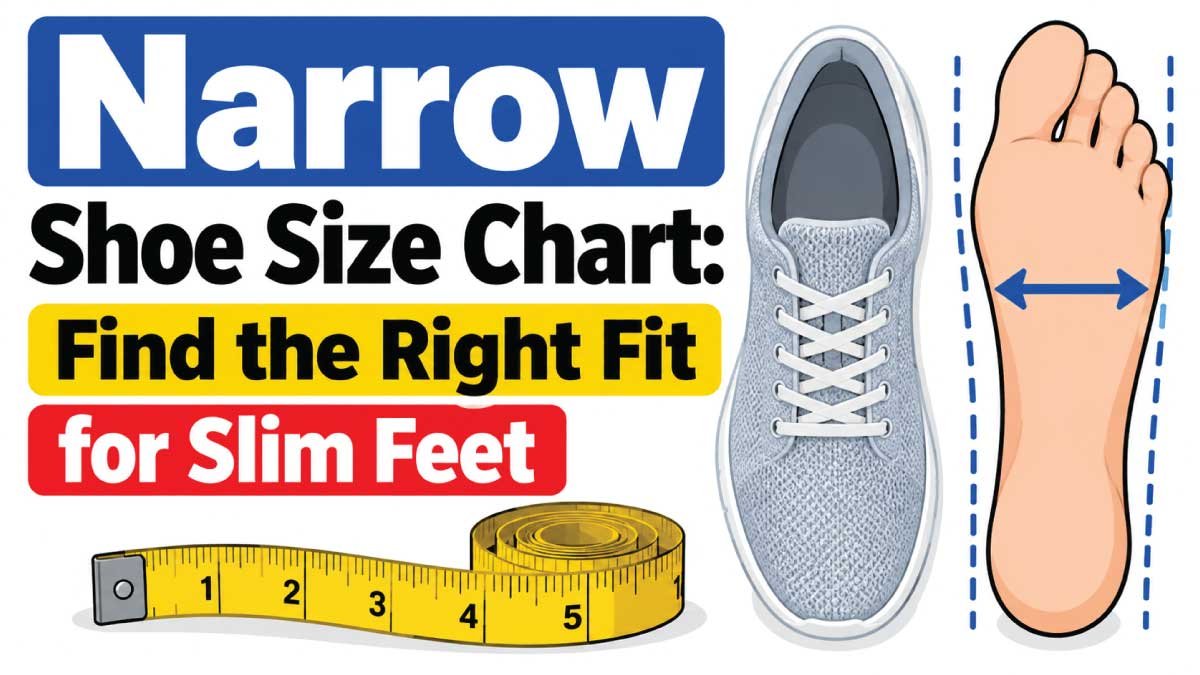
Finding shoes that fit slim feet can be challenging when standard-width footwear feels loose around the heel, midfoot, or forefoot. Shoes that are too wide may allow your feet to slide, create friction, and make walking less comfortable, even when the shoe length is correct. A narrow shoe size chart helps you understand width labels, compare sizing options, measure your feet, and choose footwear that provides a secure, comfortable fit.
Narrow shoes are designed for feet that need less width than standard footwear offers. They are available in selected running shoes, walking shoes, dress shoes, casual footwear, and specialty styles. However, narrow-width labels vary by manufacturer, gender, and sizing system, so choosing the right shoe requires more than selecting a smaller size.
This guide explains narrow shoe sizing for men and women, common width designations, how to measure your feet, and how to avoid common fitting mistakes.
What Is a Narrow Shoe Size?
A narrow shoe size refers to footwear designed with less width than a standard-width shoe of a comparable length. The difference may be noticeable around the forefoot, ball of the foot, heel, or midfoot, depending on the shoe’s construction.
Narrow shoes are intended to provide a closer fit for people whose feet move excessively inside standard-width footwear.
What Do Narrow Shoe Width Letters Mean?
Shoe width is commonly represented by letters or abbreviations. These designations indicate how narrow or wide a shoe is within a particular sizing system.
Common US shoe width labels include:
AAAA or 4A: An extra-narrow width in certain footwear ranges.
AAA or 3A: A very narrow option in selected brands.
AA or 2A: Commonly indicates narrow width, especially in women’s shoes.
B: Commonly standard width for women’s shoes.
D: Commonly standard width for men’s shoes.
These conventions are not universal. Some manufacturers use different labels, and a narrow width in one brand may fit differently from the same label in another.
Always check the specific brand’s sizing chart before ordering.
Who Should Consider Narrow Shoes?
Narrow shoes may be suitable if:
- Your heel slips even when the shoe length is correct.
- Your foot moves from side to side inside standard-width shoes.
- You need to tighten the laces excessively to secure your feet.
- The sides of the shoe feel too roomy around your forefoot.
- Your feet appear noticeably slimmer than the shape of standard footwear.
- You experience rubbing caused by excessive movement inside your shoes.
However, loose shoes do not always mean that you need a narrow width. The problem may be caused by the wrong shoe length, an unsuitable heel shape, or a design that does not match your foot.
Narrow Shoe Size Chart for Women
Women’s narrow shoes are commonly identified using US width labels such as AA and AAA. Some brands also offer AAAA widths for particularly slim feet.
The following chart explains common women’s width designations.
| US Women’s Width Label | Common Width Category | General Fit Purpose |
|---|---|---|
| AAAA (4A) | Extra narrow | For particularly slim feet |
| AAA (3A) | Very narrow | For feet narrower than typical narrow options |
| AA (2A) | Narrow | For narrower-than-standard feet |
| B | Standard | For average-width feet |
| D | Wide | For feet requiring additional width |
Note: Width availability and terminology vary by manufacturer. Not every brand offers AAA or AAAA widths, and some use alternative labels such as N for narrow.
How to Choose the Correct Women’s Narrow Shoe
Start by identifying the length that fits your longer foot. Then compare standard and narrow options in the same shoe model.
For example, if a women’s shoe fits comfortably from heel to toe but feels loose around the sides, an AA version may provide a more secure fit.
If the heel still slips, consider whether the shoe’s heel shape is appropriate for your foot. A narrower forefoot does not automatically mean that every part of your foot is equally narrow.
When trying narrow shoes, check that:
- Your toes have enough room to move naturally.
- The heel remains secure when walking.
- The shoe does not squeeze the sides of your foot.
- The upper holds your foot without excessive pressure.
- You can walk comfortably without needing to overtighten the laces.
Narrow Shoe Size Chart for Men
Men’s narrow-width footwear is less widely available than standard and wider options in some brands. Depending on the manufacturer, narrow men’s shoes may use labels such as B, C, or N.
| US Men’s Width Label | Common Width Category | General Fit Purpose |
|---|---|---|
| A or 2A | Very narrow or specialty narrow | Available in selected ranges |
| B | Narrow | For narrower-than-standard feet |
| C | Narrow-to-medium or specialty width | Meaning varies by manufacturer |
| D | Standard | For average-width feet |
| 2E (EE) | Wide or extra-wide | For broader feet |
The exact meaning of each label depends on the brand and footwear category. This is particularly important when shopping for men’s dress shoes, athletic shoes, or work footwear.
Tips for Buying Men’s Narrow Shoes
When shopping for men’s narrow shoes:
- Look for a model specifically offered in a narrow width.
- Check whether the manufacturer uses B, C, or another narrow designation.
- Prioritize a secure heel and midfoot fit.
- Avoid choosing a shorter shoe simply to reduce excess width.
- Consider lace-up designs that allow you to adjust the fit.
- Compare the brand’s measurements when available.
A correctly fitted narrow shoe should hold the foot securely without compressing the toes or creating pressure along the sides.
Narrow Shoe Size Chart by Foot Measurements
Width labels are useful for comparing shoe options, but foot measurements provide additional information. Measuring your feet can help you determine whether a narrow-width model is worth trying.
| Measurement | How It Is Measured | Why It Matters |
|---|---|---|
| Foot length | Heel to longest toe | Determines the appropriate length range |
| Foot width | Across the widest part of the forefoot | Helps assess width requirements |
| Ball circumference | Around the broadest part of the forefoot | Indicates forefoot volume |
| Instep circumference | Around the upper middle portion of the foot | Helps assess upper fit |
| Heel width | Across the heel area | Helps assess heel security |
There is no universal foot-width measurement that automatically corresponds to every narrow shoe size. The appropriate category depends on foot length, shoe construction, sizing conventions, and manufacturer specifications.
Why Narrow Shoe Measurements Vary
Foot width must be considered in relation to foot length. The same measured width can correspond to different shoe-width categories for different lengths.
Manufacturers also use different shoe lasts, which are forms used to shape footwear. These affect the shoe’s internal dimensions, heel shape, toe-box proportions, and overall volume.
For this reason, use the manufacturer’s length-and-width chart whenever possible instead of relying on a single universal measurement.
How to Measure Your Feet for Narrow Shoes
Measuring your feet at home is a practical way to identify the correct starting size before buying narrow-width footwear.
Step 1: Prepare Your Measuring Tools
Gather the following:
- A sheet of paper larger than your foot.
- A pencil or pen.
- A ruler or measuring tape.
- The socks you normally wear with your shoes.
Measure both feet because they may differ slightly in length or width.
Step 2: Measure Foot Length
Place the paper on a flat, hard surface and stand on it with your weight distributed naturally.
Mark the back of your heel and the tip of your longest toe. Measure the distance between these points.
Repeat the process for the other foot.
Use the longer measurement when determining your starting shoe length.
Step 3: Measure Foot Width
While standing, identify the widest points along the inside and outside edges of your forefoot.
Measure the straight-line distance between these points. Keep the ruler level rather than measuring diagonally around the foot.
Repeat the measurement for your other foot.
Step 4: Record Your Measurements
Write down your foot length and width in millimeters or centimeters.
For example, the following is an illustrative measurement record:
| Foot | Length (mm) | Width (mm) |
|---|---|---|
| Left | 265 | 94 |
| Right | 267 | 95 |
These figures are examples only. They do not establish a universal narrow-width threshold because width categories vary by shoe length, brand, and sizing system.
Step 5: Compare Measurements With the Brand’s Chart
Find your appropriate length first. Then compare your foot-width measurement with the manufacturer’s available width categories.
If the manufacturer provides ball circumference rather than straight-line width, follow its measurement instructions. These measurements are different and should not be compared directly.
Narrow vs. Standard vs. Wide Shoes
Understanding the differences between shoe-width categories can help you avoid purchasing footwear that is too loose or restrictive.
| Feature | Narrow Width | Standard Width | Wide Width |
|---|---|---|---|
| Forefoot space | Less than standard | Standard for the category | More than standard |
| Heel fit | Often designed for a closer fit | Depends on shoe shape | Depends on shoe shape |
| Typical labels | AA, AAA, B, or N | B for many women’s shoes; D for many men’s shoes | D for many women’s shoes; 2E for many men’s shoes |
| Suitable for | Slimmer feet | Average-width feet | Broader feet |
| Availability | Brand-dependent | Widely available | Brand-dependent |
The labels shown are common US conventions, not universal rules. The actual fit depends on the shoe’s shape and the manufacturer’s sizing system.
When Should You Choose Narrow Shoes?
Consider narrow footwear if your correctly sized standard shoes allow excessive side-to-side movement or repeatedly slip around your heel.
However, if the heel slips but the forefoot feels comfortable, a different heel shape or lacing method may solve the problem without requiring a narrower shoe throughout.
Also Read:
Best Types of Shoes for Narrow Feet
Different shoe styles provide different fitting options. Choosing the right construction can help you achieve a secure fit without discomfort.
Narrow Running Shoes
Running shoes should hold the heel and midfoot securely while allowing the toes to move naturally.
Look for models specifically available in narrow widths. Adjustable lacing can improve the fit, but it should not be used to compensate for a shoe that is substantially too wide.
Narrow Walking Shoes
Walking shoes should provide consistent support without allowing the foot to slide excessively.
Check the heel fit and midfoot hold during walking. The shoe should remain secure without requiring unusually tight laces.
Narrow Dress Shoes
Dress shoes may be available in narrower widths, particularly in selected formal footwear ranges.
Pay attention to the heel counter, instep, and toe-box shape. A pointed toe may look narrow without providing a genuinely secure fit around the entire foot.
Narrow Work Shoes
Work shoes must provide the appropriate fit while meeting job-specific safety requirements.
If protective footwear is required, verify that the narrow-width version retains the necessary protective features and applicable certification.
Narrow Casual Shoes
Casual footwear comes in many shapes and materials. Some models offer narrower versions, while others have adjustable laces or straps that help secure the foot.
Choose a design that holds your foot comfortably without creating pressure points.
Also Read:
Tips for Getting a Better Fit With Narrow Shoes
The right shoe width is important, but other fit characteristics can also affect comfort.
Choose Adjustable Lacing
Lace-up shoes allow you to customize tension around the midfoot. Certain lacing techniques can help reduce heel movement when the shoe otherwise fits well.
Avoid overtightening the laces to compensate for excessive overall volume.
Check the Heel Counter
The heel counter is the part of the shoe that supports the rear of the foot. A shoe with an appropriate heel shape can improve stability and reduce unwanted movement.
If your heel slips in several different widths, try a model with a different heel design.
Consider the Shoe Last
A shoe last determines much of the shoe’s shape and internal volume. Some models have a narrow heel but a roomy forefoot, while others are tapered throughout.
Choose a shape that matches your actual foot rather than relying only on the width label.
Try Shoes at the Right Time
Feet can change size slightly throughout the day. Trying shoes later in the day can help you evaluate fit under ordinary conditions.
Wear the socks you expect to use with the footwear.
Walk Before Deciding
Stand, walk, and turn in the shoes before deciding whether they fit properly.
Check for heel slipping, side-to-side movement, pressure on the toes, and rubbing. A comfortable fit should feel secure without restricting natural foot movement.
Also Read:
Common Mistakes When Buying Narrow Shoes
Avoid these mistakes when selecting narrow footwear.
Buying a Smaller Length to Reduce Width
A shorter shoe may squeeze your toes and create pressure without solving the underlying width problem.
Choose the correct length first, then assess the width.
Assuming All Brands Fit the Same
Narrow-width labels and shoe shapes vary by manufacturer. Compare the specific model rather than assuming that a particular letter guarantees an identical fit.
Ignoring Heel Slippage
Excessive heel movement may indicate that the shoe is too wide, but it can also result from an unsuitable heel shape or poor lacing.
Evaluate the entire shoe before deciding which adjustment is necessary.
Choosing Shoes That Are Too Tight
Narrow shoes should not pinch your toes or compress the sides of your feet. A slim fit means reduced excess space, not restricted circulation or painful pressure.
Ignoring Changes in Foot Shape
Your foot dimensions and preferred fit may change over time. Recheck your measurements if previously comfortable shoes begin to feel loose or tight.
Frequently Asked Questions About Narrow Shoe Sizes
What does AA mean in shoe sizes?
AA commonly indicates a narrow width in US women’s footwear. Its exact meaning depends on the manufacturer and shoe category.
What is the narrowest shoe width available?
Some manufacturers offer AAAA or 4A widths, while others offer AAA or AA as their narrowest options. Availability varies by brand, size, and shoe style.
What does B mean in shoe width?
B commonly represents standard width in US women’s shoes and may indicate a narrow width in certain men’s shoe ranges. Always check the relevant manufacturer’s chart.
Are narrow shoes shorter than regular shoes?
No. Narrow shoes are designed primarily to reduce width at a comparable nominal length. Choosing a shorter size is not a reliable way to obtain a narrower fit.
Can men wear women’s narrow shoes?
They can if the shoe’s length, width, shape, and overall proportions are suitable. However, men’s and women’s footwear sizing conventions differ, so compare actual measurements instead of relying only on size labels.
How do I know if I need narrow shoes?
You may need narrow shoes if the correct shoe length still leaves excessive room around your forefoot or heel, or if your foot slides inside standard-width footwear. Measure both feet and compare your results with the brand’s sizing chart.
Can narrow shoes prevent blisters?
A properly fitted narrow shoe may reduce friction caused by excessive foot movement. However, blisters can have several causes, including poor shoe shape, unsuitable socks, and excessive moisture.
Should narrow shoes feel tight when new?
No. Narrow shoes should feel secure without pinching, painful pressure, or restricted toe movement. They should not require a break-in period to correct a fundamentally poor fit.
Conclusion
A narrow shoe size chart helps you understand width labels and compare footwear options for slimmer feet. To find the right fit, measure both feet, determine the correct length, and then compare narrow and standard widths using the manufacturer’s sizing information.
Whether you need narrow running shoes, walking shoes, dress shoes, or casual footwear, prioritize a secure heel, comfortable midfoot hold, and sufficient room for your toes. The right narrow shoe should reduce unnecessary movement without squeezing your feet or compromising stability.
