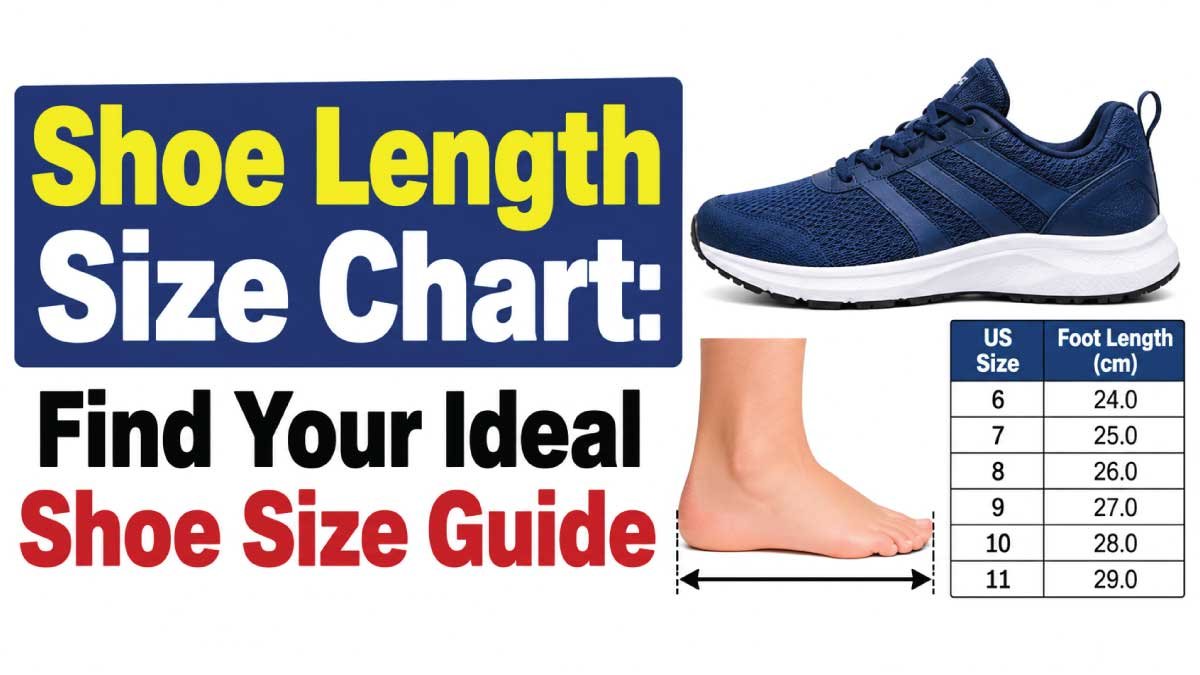
Finding the right shoe size starts with knowing your foot length. Shoes that are too short can press against your toes, while shoes that are too long may allow your feet to slide, causing discomfort and an unstable fit. A shoe length size chart helps you compare your foot measurements with common shoe sizing systems and choose a suitable size.
Whether you are shopping for sneakers, running shoes, dress shoes, boots, or casual footwear, measuring your feet correctly can make the process easier. This guide explains how shoe length is measured, how to use a shoe size chart, how US, UK, and EU sizes differ, and how to select the right fit for everyday comfort.
What Is Shoe Length in Shoe Sizing?
Shoe length refers to the front-to-back dimension of a shoe, measured along its length. When selecting footwear, the most useful starting point is your foot length, which is the distance from the back of your heel to the tip of your longest toe.
Foot length and shoe length are related, but they are not identical. A shoe needs additional internal space so your toes can move comfortably while walking. The amount of space available depends on the shoe’s design, shape, construction, and intended use.
A shoe length size chart connects your measured foot length to a recommended shoe size. Depending on the chart, sizes may be expressed in US, UK, or European (EU) sizing.
Why shoe length matters:
Toe comfort: Sufficient length helps prevent your toes from pressing against the front of the shoe.
Walking stability: A suitable length helps reduce excessive movement inside the footwear.
Everyday comfort: Proper sizing can make standing, walking, and daily activities more comfortable.
Activity-specific fit: Running shoes, hiking boots, and formal shoes may require different fitting considerations.
Consistent shopping: Accurate measurements make it easier to compare sizes across different brands.
The correct size is not necessarily the number you usually wear. Different manufacturers may use different sizing scales, so measuring your feet and checking the relevant brand chart is a more reliable approach.
Shoe Length Size Chart: US, UK, and EU Sizes
Shoe sizing systems use different numbering conventions. A US size does not directly equal the same number in UK or EU sizing, and men’s and women’s US sizes may differ even when the numbers look similar.
The following chart provides a general overview of common adult shoe sizes. It is intended as a starting point rather than a universal conversion standard.
| US Men’s Size | US Women’s Size | UK Size (Approx.) | EU Size (Approx.) |
|---|---|---|---|
| 6 | 7.5 | 5.5 | 39 |
| 7 | 8.5 | 6.5 | 40 |
| 8 | 9.5 | 7.5 | 41–42 |
| 9 | 10.5 | 8.5 | 42–43 |
| 10 | 11.5 | 9.5 | 44 |
| 11 | 12.5 | 10.5 | 45 |
| 12 | 13.5 | 11.5 | 46 |
| 13 | 14.5 | 12.5 | 47–48 |
Important: These conversions are approximate and may differ by manufacturer, shoe model, and sizing convention. Some brands use different relationships between US, UK, and EU sizes. Always consult the manufacturer’s official size chart before ordering.
How to Read a Shoe Length Chart
Start by measuring your foot length in centimeters or inches. Find the measurement on the manufacturer’s chart and identify the corresponding shoe size.
If the chart lists separate measurements for men’s and women’s footwear, use the section that matches the shoe you intend to purchase.
For example, someone with a measured foot length of approximately 26 cm should look for the size associated with that measurement on the specific brand’s chart. The appropriate US, UK, or EU size may differ between manufacturers.
Do not rely on a general conversion chart when the manufacturer provides exact foot-length recommendations.
Foot Length Measurement Chart in Centimeters and Inches
Measuring your foot in centimeters or inches gives you a consistent reference when comparing shoe sizes. The table below converts common foot-length measurements between the two units.
| Foot Length (cm) | Foot Length (inches) |
|---|---|
| 22.0 cm | 8.66 in |
| 22.5 cm | 8.86 in |
| 23.0 cm | 9.06 in |
| 23.5 cm | 9.25 in |
| 24.0 cm | 9.45 in |
| 24.5 cm | 9.65 in |
| 25.0 cm | 9.84 in |
| 25.5 cm | 10.04 in |
| 26.0 cm | 10.24 in |
| 26.5 cm | 10.43 in |
| 27.0 cm | 10.63 in |
| 27.5 cm | 10.83 in |
| 28.0 cm | 11.02 in |
| 28.5 cm | 11.22 in |
| 29.0 cm | 11.42 in |
| 29.5 cm | 11.61 in |
| 30.0 cm | 11.81 in |
These figures are unit conversions, not direct shoe size assignments. To determine your shoe size, match the measured foot length to a manufacturer’s sizing chart.
To convert centimeters into inches, divide the measurement by 2.54. To convert inches into centimeters, multiply by 2.54.
How to Measure Your Foot Length at Home
You can measure your feet at home using a few simple items. The process takes only a few minutes and can help you make more informed footwear decisions.
Step 1: Gather Your Materials
You will need:
- A sheet of paper larger than your foot.
- A pencil or pen.
- A ruler or measuring tape.
- The socks you normally wear with the shoes you plan to buy.
Place the paper on a hard, level floor rather than a carpet. A firm surface makes it easier to trace your foot accurately.
Step 2: Stand on the Paper
Place one foot on the paper and stand naturally with your weight distributed comfortably. Keep your heel positioned firmly on the surface.
Standing is useful because your foot may spread slightly under body weight. If possible, ask someone to help you trace the outline while you remain standing.
Step 3: Mark Your Heel and Longest Toe
Use a pencil to mark the point at the back of your heel and the tip of your longest toe. Your longest toe may be the big toe or the second toe, depending on your foot shape.
You can also trace around the entire foot, keeping the pencil upright and close to the edge without angling it underneath your foot.
Step 4: Measure the Distance
Use a ruler to measure the straight-line distance between the heel mark and the mark at the tip of your longest toe.
Record the measurement in centimeters or millimeters. If you use inches, write down the result consistently rather than rounding too early.
For example, if the distance measures 25.6 cm, record 25.6 cm instead of automatically rounding it to 26 cm. Small differences may affect which size you choose on a particular brand’s chart.
Step 5: Repeat for the Other Foot
Measure your second foot using the same method. It is normal for the two feet to differ slightly in length.
Use the measurement of the longer foot when checking the shoe size chart. Your footwear should accommodate both feet comfortably without making the smaller foot feel excessively loose.
Step 6: Match Your Measurement to a Size Chart
Find the foot-length range on the manufacturer’s official chart. Select the recommended size and check any instructions about measurements, fit, or sizing between two sizes.
If the brand recommends a particular sizing method, follow it rather than combining measurements from unrelated charts.
Practical tip: Measure your feet later in the day if they tend to swell after standing or walking. This can help you evaluate footwear under conditions similar to normal daily use.
How Much Space Should Be in Front of Your Toes?
A shoe should not fit so tightly that your toes press against the front when you stand or walk. At the same time, excessive space can cause your foot to slide forward and make the shoe feel unstable.
For many everyday shoes, approximately 0.5 to 1.0 cm of space in front of the longest toe can be a useful initial fitting guideline. However, this is not a universal rule. The ideal amount depends on the footwear type, toe-box shape, activity, and manufacturer’s fitting recommendations.
Signs Your Shoe Length Is Too Short
Your shoes may be too short if:
- Your longest toe touches the front while standing.
- Your toes feel compressed when walking downhill or moving forward.
- Your toenails experience repeated pressure from the shoe.
- You feel persistent pressure at the front despite having adequate width.
- Your toes cannot move naturally inside the toe box.
If these problems occur, try a longer size or a shoe with a more suitable toe-box shape.
Signs Your Shoe Length Is Too Long
Your shoes may be too long if:
- Your feet slide forward or backward during walking.
- Your heels lift excessively despite suitable lacing.
- The shoe bends at a point that does not match your foot’s natural movement.
- You need to tighten the shoe excessively to keep it secure.
- You have more space in front of your toes than you can comfortably manage.
Excessive movement can also result from an unsuitable width or heel shape, so consider the entire fit rather than length alone.
Also Read:
US vs. UK vs. EU Shoe Sizes: What Is the Difference?
US, UK, and EU sizing systems use different scales. Because the numbering systems do not match directly, you should not assume that the same number represents the same foot length.
US Shoe Sizes
The US system commonly separates men’s and women’s sizing. As a result, the same numerical size can represent different recommended foot lengths depending on the category and manufacturer.
When using a US shoe size chart, check whether the chart is specifically for men’s, women’s, or unisex footwear.
UK Shoe Sizes
UK sizes generally use a different numbering scale from US sizes. Although conversion charts often show a difference between corresponding US and UK numbers, the exact relationship can vary by brand.
Check the UK size and corresponding foot-length measurement instead of relying on a fixed numerical subtraction.
EU Shoe Sizes
EU sizing typically uses a numerical scale that differs from both US and UK sizing. European size labels are common in international footwear, including sneakers, boots, and dress shoes.
EU sizes are not universally interchangeable across manufacturers. If the brand provides foot-length measurements alongside EU sizes, use those measurements as your primary guide.
Which Shoe Size System Should You Use?
Choose the sizing system used by the manufacturer or retailer. If you are buying internationally, check whether the displayed size is US, UK, or EU.
For online purchases, the most useful information is usually the brand’s recommended foot length for each size, combined with its guidance about how the shoe fits.
Also Read:
Does Shoe Length Vary by Brand and Footwear Type?
Yes. Two shoes labeled with the same size can feel different because their internal dimensions, toe-box shapes, and construction are not identical.
Running Shoes
Running shoes should provide sufficient toe room for comfortable movement during exercise. Your feet may swell during longer runs, so test the fit while standing and walking in the socks you normally use.
Pay attention to the heel and midfoot as well. A longer shoe is not necessarily a better choice if it allows excessive movement.
Casual Sneakers
Sneakers vary in cushioning, lining, upper materials, and internal shape. A flexible fabric upper may feel different from a structured leather or synthetic design, even when both shoes have the same size label.
If a sneaker feels short, compare the brand’s length chart and consider whether the toe box suits your foot shape.
Dress Shoes
Dress shoes often have structured uppers and different toe shapes. Pointed styles may offer less usable toe space than round-toe designs.
Check the fit while standing and walking. Do not assume that strong pressure at the front will disappear after the shoes are broken in.
Boots
Boots may have thicker linings, heavier construction, or space requirements related to socks and intended use.
When choosing work boots or hiking boots, follow the manufacturer’s fitting guidance and consider how the footwear will feel during extended wear.
Also Read:
Common Shoe Length Sizing Mistakes to Avoid
A few simple mistakes can lead to uncomfortable shoes, even when you use a shoe length size chart.
Measuring only one foot: Measure both feet and use the longer measurement when selecting a size.
Measuring while seated only: Your foot may spread differently when bearing weight.
Rounding measurements too early: Record the actual measurement before comparing it with a size chart.
Confusing foot length with shoe length: The two measurements are related but not identical.
Using one conversion chart for every brand: Manufacturers may use different sizing conventions.
Ignoring toe-box shape: A shoe may have adequate overall length but still feel restrictive at the front.
Buying a bigger size to solve every fit problem: If the shoe is too narrow, increasing length may create heel slippage without resolving the width issue.
Ignoring the socks you wear: Thick socks can affect how much space remains inside the shoe.
Choosing by size label alone: The shoe should fit comfortably when you stand and walk, not merely match the number on the box.
When buying footwear online, review the retailer’s return and exchange policy before ordering. If possible, compare the manufacturer’s measurements with a pair of shoes that already fits you comfortably.
Frequently Asked Questions About Shoe Length Size Charts
How Do I Find My Correct Shoe Size?
Measure both feet from the back of the heel to the tip of the longest toe. Use the longer measurement and compare it with the manufacturer’s shoe size chart. Check the fit by standing and walking in the shoes.
Is Foot Length the Same as Shoe Length?
No. Foot length is the distance from your heel to your longest toe. Shoe length refers to the shoe’s length, while the usable internal space depends on its construction and shape. A shoe needs enough room to accommodate your foot comfortably.
Should I Size Up If I Am Between Shoe Sizes?
Check the manufacturer’s guidance first. Depending on the shoe’s design and fit, you may need to choose the next size up. Try the available options if possible and ensure that the longer size does not create excessive heel movement.
How Often Should I Measure My Feet?
Measure your feet when buying unfamiliar brands, when your usual size begins to feel uncomfortable, or when your footwear needs change. Foot dimensions can change over time, so an old size label may not always reflect your current fit.
Can I Use a Shoe Size Chart for Online Shopping?
Yes. A shoe size chart is particularly useful when shopping online because you cannot try on the shoes before ordering. Use the brand’s own chart, compare your measured foot length, and review its return policy in case the fit is unsuitable.
What If My Feet Are Different Sizes?
Use the longer foot as the starting point for your shoe size. Ensure that the shoe also fits securely around the smaller foot. If the difference is significant or causes persistent fit problems, consider professional fitting advice.
Does Shoe Length Affect Shoe Width?
Length and width are different measurements, but they interact in the overall fit. Changing the shoe size can also change its width and internal proportions. If a shoe feels tight across the sides but has enough length, consider trying a wider width rather than automatically sizing up.
Conclusion: Find Your Ideal Shoe Size With Confidence
A shoe length size chart makes it easier to compare foot measurements with common US, UK, and EU sizing systems. For the most reliable result, measure both feet while standing, record the length of your longer foot, and check the manufacturer’s chart before choosing a size.
Remember that size conversions are approximate and that shoe designs vary between brands. The right fit should provide comfortable space for your toes, a secure heel, and enough room for natural foot movement without excessive sliding.
By understanding your foot length and checking the correct sizing guide, you can make more informed footwear choices and improve your chances of finding comfortable shoes for everyday activities, exercise, and work.
