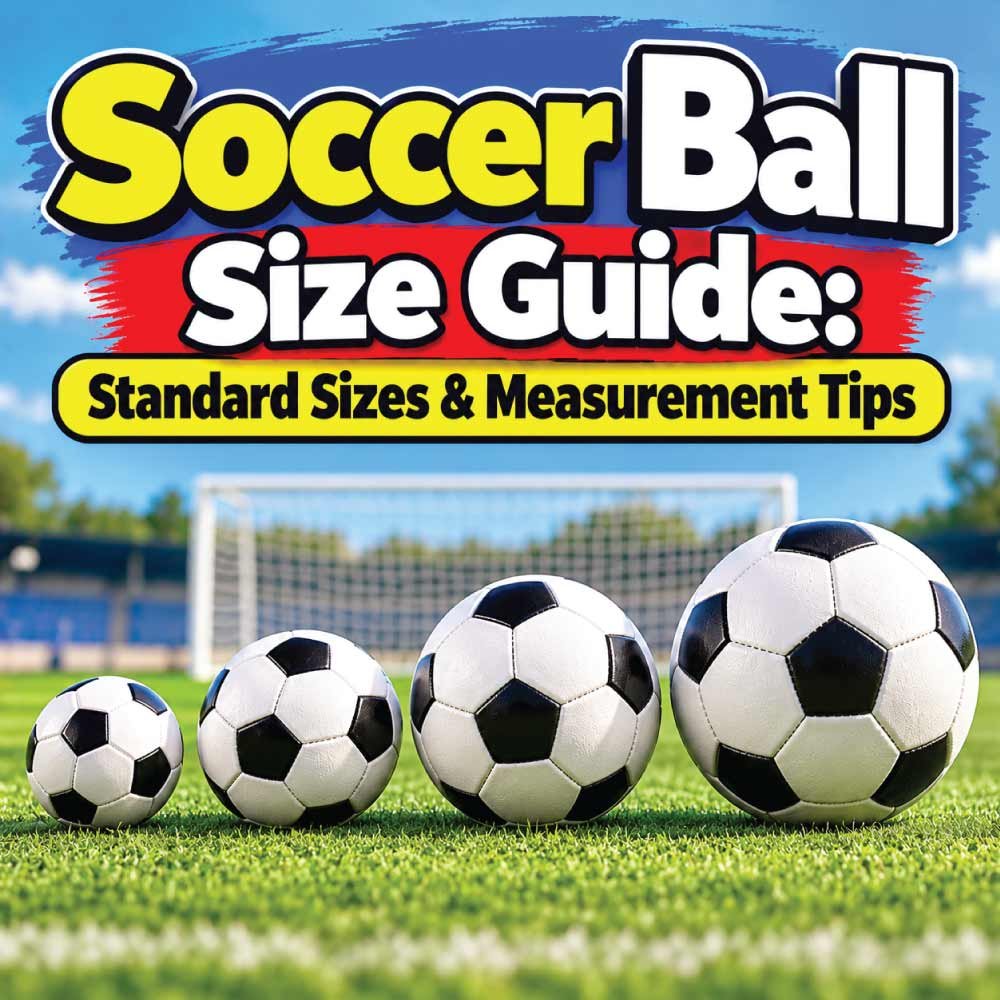
Choosing the right soccer ball is easier when you understand how ball sizes differ by circumference, weight, age group, and playing level. A ball that feels perfect for an adult match can be too large or heavy for a young player, while a smaller training ball may not be appropriate for competitive play.
This Soccer Ball Size Guide explains the standard size 3, size 4, and size 5 soccer balls, including their measurements, typical age ranges, uses, and key differences. You will also learn how to measure a soccer ball yourself, how to choose the right size for a player, and which common sizing mistakes to avoid.
Whether you are buying a soccer ball for a child, youth team, training session, or adult match, the charts below provide a practical starting point.
Soccer Ball Size Chart
Soccer balls are commonly identified by numbers from size 1 through size 5, with size 5 being the standard full-size ball used for adult soccer. Sizes 3 and 4 are primarily used for younger players, while sizes 1 and 2 are generally smaller skill or promotional balls rather than the main match sizes.
The following chart shows the commonly recognized dimensions for the three principal playing sizes.
| Soccer Ball Size | Circumference | Approx. Diameter | Weight | Typical Use |
|---|---|---|---|---|
| Size 3 | 58.5–61 cm | 18.6–19.4 cm | 300–320 g | Young children |
| Size 4 | 63.5–66 cm | 20.2–21.0 cm | 350–390 g | Youth soccer |
| Size 5 | 68–70 cm | 21.6–22.3 cm | 410–450 g | Older youth and adults |
Circumference is the most useful measurement for identifying soccer ball size. Diameter values in the table are approximate because a soccer ball is not a perfect mathematical sphere and its shape can vary slightly depending on inflation and construction.
For competitive play, always check the rules of the specific league, federation, or competition because approved ball specifications can vary.
What Are the Different Soccer Ball Sizes?
The most important soccer ball sizes are size 3, size 4, and size 5. Each is designed around a different stage of player development.
Size 3 Soccer Ball
A size 3 soccer ball is the smallest of the commonly used youth playing balls. Its circumference is typically around 58.5 to 61 cm, and it weighs approximately 300 to 320 grams.
It is commonly selected for young children because its smaller circumference makes it easier to control with smaller feet and legs.
Size 3 balls are useful for:
- Young children’s soccer practice
- Beginner ball-control exercises
- Basic passing and dribbling
- Recreational play
- Developing confidence with the ball
A size 3 ball can also be useful for skill work even when a player eventually needs to move to a larger ball.
Size 4 Soccer Ball
A size 4 soccer ball is an intermediate youth ball. It generally measures 63.5 to 66 cm in circumference and weighs about 350 to 390 grams.
It provides a useful transition between the smaller size 3 and the full-size size 5 ball.
Size 4 is often used for:
- Youth soccer
- Junior training
- Developing players
- Technical drills
- Small-sided games
- Players who are not yet ready for a full-size ball
Because it is larger and heavier than size 3, it requires more strength and coordination while still being easier to manage than a size 5.
Size 5 Soccer Ball
The size 5 soccer ball is the standard full-size soccer ball. It generally has a circumference of 68 to 70 cm and a weight of approximately 410 to 450 grams.
This is the size most adults and older youth players use.
A size 5 ball is typically appropriate for:
- Adult soccer
- Professional and competitive soccer
- Older youth competitions
- High-level training
- Full-size matches
- Players transitioning to adult soccer
If you are buying a ball for a standard adult match, size 5 is normally the correct choice, unless the competition rules specify otherwise.
Soccer Ball Size by Age Chart
Age is one of the most common ways people decide which soccer ball to buy. However, age recommendations are not universal. Different leagues, clubs, schools, and governing bodies can establish their own equipment requirements.
The following chart should therefore be treated as a general selection guide, not a substitute for your league’s rules.
| Typical Age Group | Recommended Ball Size | Circumference | General Use |
|---|---|---|---|
| Under 8 | Size 3 | 58.5–61 cm | Introductory and youth play |
| Around 8–12 | Size 4 | 63.5–66 cm | Youth development |
| Around 12+ | Size 5 | 68–70 cm | Older youth and adult play |
Some programs may use different age cutoffs. For example, a youth organization may move players to a size 5 ball earlier or later depending on its competition structure.
The competition’s equipment rules should always take priority over a general age chart.
Size 3 vs Size 4 vs Size 5 Soccer Balls
The differences between soccer ball sizes are not simply about circumference. A larger ball is also generally heavier, which affects how it feels during kicking, passing, trapping, and dribbling.
| Feature | Size 3 | Size 4 | Size 5 |
|---|---|---|---|
| Circumference | 58.5–61 cm | 63.5–66 cm | 68–70 cm |
| Approx. Weight | 300–320 g | 350–390 g | 410–450 g |
| Player Level | Young children | Youth | Older youth/adults |
| Control Difficulty | Lower | Moderate | Higher for beginners |
| Common Purpose | Introduction | Development | Match and advanced play |
Size 3 vs Size 4
The main difference is the increase in both circumference and weight.
A child who finds a size 3 easy to handle may need time to adjust when moving to size 4. The larger ball can change the way the player approaches:
- First touches
- Passing
- Shooting
- Dribbling
- Ball control
- Coordination
For younger players, using a manageable ball can help make basic technical exercises less frustrating.
Size 4 vs Size 5
The transition from size 4 to size 5 is more noticeable because the size 5 is both larger and heavier.
Players moving to size 5 may initially notice differences in:
- Shooting power
- Passing distance
- Trapping the ball
- Aerial control
- Dribbling
- Ball speed
Regular practice with the new size generally helps the player adapt.
How to Measure a Soccer Ball
If you already own a soccer ball and want to determine its approximate size, measuring the circumference is the simplest method.
You do not need specialized equipment. A flexible measuring tape is usually enough.
Step-by-Step Soccer Ball Measurement
Follow these steps:
- Inflate the ball properly. An underinflated ball can produce a misleading measurement.
- Wrap a flexible measuring tape around the widest part of the ball.
- Keep the tape snug but do not compress the ball.
- Record the circumference in centimeters.
- Compare the measurement with a standard soccer ball size chart.
For example, if your ball measures approximately 69 cm around its circumference, it falls within the normal range for a size 5 soccer ball.
If it measures close to 65 cm, it is likely a size 4.
A measurement around 60 cm generally indicates a size 3.
Can You Measure a Soccer Ball Without a Measuring Tape?
Yes. If you do not have a flexible measuring tape, you can use a piece of string.
Wrap the string around the ball’s widest point and mark where the ends meet. Then lay the string flat and measure its length with a ruler or straight measuring tape.
This method is less convenient but can provide a reasonable circumference measurement.
How to Calculate Soccer Ball Diameter
Circumference is the standard measurement used for identifying soccer ball sizes, but you may sometimes want to estimate the ball’s diameter.
For a roughly spherical object, the basic mathematical relationship is:
Diameter ≈ Circumference ÷ π
For example, a soccer ball with a circumference of 69 cm has an estimated diameter of:
69 ÷ 3.1416 ≈ 22 cm
This explains why a size 5 soccer ball has an approximate diameter of about 22 cm.
However, do not use calculated diameter as the primary method for selecting a soccer ball. Soccer balls are constructed from panels and can change shape slightly depending on inflation pressure and construction. Circumference is the more practical measurement.
How to Choose the Right Soccer Ball Size
Selecting a soccer ball involves more than simply choosing the smallest ball a player can kick. Consider the player’s age, competition requirements, experience, and intended use.
1. Check the Player’s Age Group
Start by checking the player’s age category and the rules used by their league or club.
A general guide is:
- Young children: Size 3
- Youth players: Size 4
- Older youth and adults: Size 5
But remember that league requirements can differ.
2. Consider the Player’s Skill Level
A beginner may benefit from practicing with an appropriately sized ball that is easy to control.
The goal is not simply to find the smallest ball possible. Players should eventually become comfortable with the size required for their level of competition.
3. Consider the Purpose
Think about how the ball will be used.
A ball for:
- Backyard play
- Technical training
- Youth practice
- Competitive matches
- School activities
may have different requirements.
If the ball will be used in an official competition, prioritize the competition’s approved size and specification.
4. Check the Ball’s Construction
Size is important, but construction also affects performance.
Look at factors such as:
- Outer cover material
- Panel construction
- Bladder type
- Stitching or bonding
- Surface texture
- Durability
- Intended playing conditions
A properly sized ball that is poorly suited to the intended playing surface may not perform as expected.
Also Read:
Soccer Ball Size and Player Development
Ball size plays an important role in youth development because the relationship between the player’s body and the ball affects control.
A ball that is too large or heavy can make certain technical movements more difficult for a young player. Conversely, continuing to use a very small ball when the player has progressed to a larger competition size may not provide enough practice with the equipment they will eventually use.
Why the Correct Size Matters
Using an appropriate ball can support practice in areas such as:
- Passing accuracy
- First touch
- Dribbling
- Shooting
- Ball manipulation
- Coordination
- Confidence
- Receiving the ball
For younger players, the objective should be to develop technique and enjoyment rather than simply using the largest available ball.
When Should a Player Move to a Larger Ball?
There is no single age that applies to every player.
A move to a larger ball may be determined by:
- League rules
- Club training policy
- Age category
- Player development
- Competition requirements
- Coach recommendations
If a player is preparing for a league where a specific ball size is mandatory, practicing with that size before competition can help the transition feel more natural.
Also Read:
Soccer Ball Sizes 1 and 2
Although size 3, 4, and 5 receive most of the attention, you may also see size 1 and size 2 soccer balls.
These smaller balls are often used for skill development, recreational activities, collectibles, promotional purposes, or specialized training.
They should not automatically be treated as smaller versions of official match balls.
Size 1 Soccer Ball
A size 1 ball is commonly called a mini soccer ball. It is much smaller than a standard match ball and is often used for:
- Ball-control practice
- Recreational games
- Gifts
- Collecting
- Promotional products
Because size 1 balls can vary by manufacturer and intended use, check the product’s stated specifications rather than assuming one universal measurement.
Size 2 Soccer Ball
Size 2 balls are also smaller training or skill balls. They can be useful for:
- Young players
- Technical drills
- Recreational practice
- Ball mastery
- Small-space training
As with size 1, specifications can vary, so the manufacturer’s stated measurements are more useful than relying on a generic size assumption.
Soccer Ball Size vs Match Standards
Not every soccer ball labeled “size 5” is automatically approved for every competition.
A ball can have the correct general size while differing in other characteristics such as construction, performance, or certification.
For organized competition, check the applicable rules for:
- Circumference
- Weight
- Shape
- Construction
- Inflation requirements
- Certification or approval markings
- Competition-specific equipment requirements
This distinction is especially important for clubs, schools, tournament organizers, and players competing under formal rules.
Size describes the general dimensions of the ball; approval describes whether that particular ball meets the requirements for a specific competition.
Also Read:
How Soccer Ball Inflation Affects Measurement
Inflation can affect both the shape and feel of a soccer ball.
An underinflated ball may feel softer, deform more easily, and measure differently from a properly inflated ball. An improperly inflated ball can also change the way it responds when kicked.
When checking circumference:
- Inflate the ball according to the manufacturer’s recommended pressure.
- Allow the ball to settle into its normal shape.
- Measure around the widest point.
- Avoid squeezing the ball while measuring.
For official play, use the inflation range specified by the competition or ball manufacturer.
It is also useful to check the manufacturer’s recommendations rather than assuming every ball should be inflated to exactly the same pressure.
Common Soccer Ball Sizing Mistakes
Choosing a soccer ball sounds simple, but several mistakes are common.
Choosing by Age Alone
Age is helpful, but it is not the only factor. A league may have rules that differ from general age-based recommendations.
Better approach: Check the player’s competition requirements first.
Assuming Every Size 5 Ball Is Identical
Size 5 identifies a general ball category, but construction, materials, quality, and certification can vary.
Better approach: Check the full product specifications.
Measuring an Underinflated Ball
A soft ball may not retain its intended shape.
Better approach: Inflate it correctly before measuring.
Confusing Diameter With Circumference
A ball measuring approximately 22 cm across is not a 22 cm soccer ball in the standard sizing sense. Soccer ball sizes are generally classified using circumference.
Better approach: Measure around the ball rather than straight across it.
Buying a Smaller Ball for Convenience
A smaller ball may seem easier to control, but that does not necessarily make it appropriate for a player’s competition.
Better approach: Practice with the size the player will actually use in matches.
Soccer Ball Size Buying Checklist
Before purchasing a soccer ball, use this quick checklist:
- Identify the required size.
- Check the player’s age group.
- Confirm league or tournament requirements.
- Check circumference and weight specifications.
- Consider whether the ball is for training or competition.
- Choose construction appropriate for the playing surface.
- Check manufacturer inflation instructions.
- Look for required certification or approval when applicable.
- Avoid choosing solely on appearance or price.
For most buyers, determining the correct size first eliminates the biggest potential mistake.
Frequently Asked Questions About Soccer Ball Sizes
What is the standard soccer ball size?
The standard full-size soccer ball is size 5, with a typical circumference of 68–70 cm and weight of approximately 410–450 grams. It is generally used for older youth and adult soccer, although competition rules should always be checked.
What size soccer ball is best for a 5-year-old?
A size 3 soccer ball is commonly suitable for young children around this age. However, youth programs may establish their own equipment requirements, so check the child’s club or league rules before purchasing.
What size soccer ball is used for adults?
Adults generally use a size 5 soccer ball. It has a circumference of approximately 68–70 cm and a typical weight of 410–450 grams. This is the standard full-size category used in adult soccer.
What size soccer ball is used for youth players?
Youth players commonly use size 3 or size 4, depending on their age group and league. Older youth players may transition to size 5. Always check the specific competition rules because age cutoffs can vary.
How big is a size 4 soccer ball?
A size 4 soccer ball generally has a circumference of 63.5–66 cm and weighs approximately 350–390 grams. It is commonly used for youth soccer and player development.
How big is a size 5 soccer ball?
A size 5 soccer ball typically measures 68–70 cm in circumference and weighs around 410–450 grams. Its approximate diameter is about 21.6–22.3 cm when calculated from circumference.
How do I know what size my soccer ball is?
Measure the ball’s circumference with a flexible measuring tape. A measurement around 60 cm suggests size 3, around 65 cm suggests size 4, and around 69 cm suggests size 5.
Can children use a size 5 soccer ball?
They can physically use one, but whether they should depends on their age, development, training goals, and competition rules. Younger players often use smaller balls because they are easier to control.
Is a size 5 soccer ball too big for beginners?
Not necessarily, but it may be more challenging for young beginners. The appropriate choice depends on the player’s age and the size required by their training or competition program.
Does soccer ball size affect performance?
Yes. Ball circumference and weight affect how the ball feels during passing, shooting, dribbling, and receiving. Using the appropriate size helps players develop skills with equipment suited to their level.
Final Thoughts on Soccer Ball Sizes
The easiest way to understand soccer ball sizing is to focus on circumference, weight, player age, and intended use. Size 3 is generally associated with younger players, size 4 with youth development, and size 5 with older youth and adult soccer.
For the most accurate selection, do not rely on age alone. Check the rules of the player’s league, measure an existing ball by its circumference when necessary, and consider whether the ball is intended for casual play, training, or official competition.
If you are buying a full-size ball for adult soccer, size 5 is normally the right starting point. For younger players, choosing the appropriate youth size can make practice more manageable while supporting technical development.
The right soccer ball is ultimately the one that matches the player, competition requirements, and intended use rather than simply the one that looks or feels most convenient.
