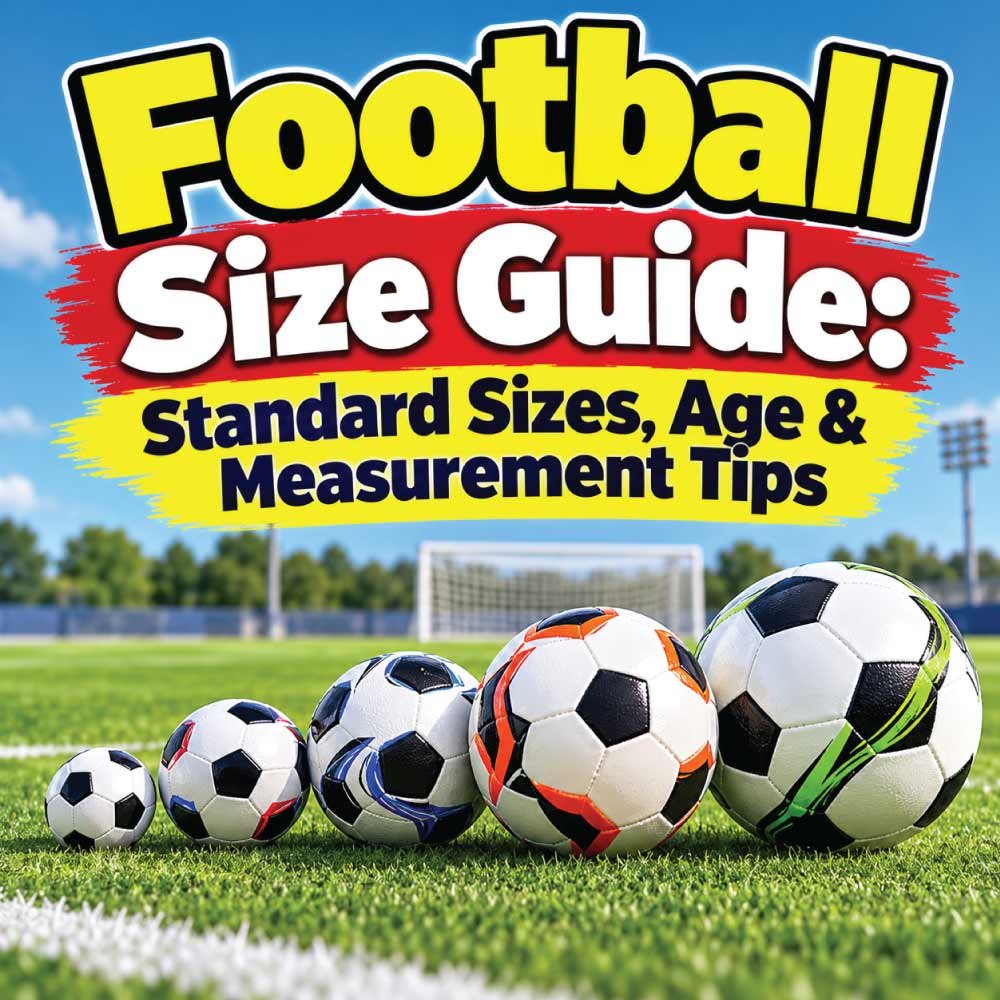
Choosing the right football size is important for comfortable handling, accurate passing, controlled shooting, and skill development. A ball that is too large or heavy can be difficult for a young player to control, while a ball that is too small may not provide the feel needed for older players and competitive matches.
The most common football sizes are Size 3, Size 4, and Size 5. Size 3 is generally used for younger children, Size 4 is common for youth players, and Size 5 is the standard full-size football used by older youth and adults.
This football size guide explains the standard ball dimensions, recommended age ranges, circumference and weight, how to measure a football, and how to select the right ball for training, recreation, or competition.
Football Size Chart
Football sizes are determined mainly by circumference and weight, rather than age alone. The table below provides a practical comparison of the three most commonly used sizes.
| Football Size | Circumference | Weight | Common Age Range | Typical Use |
|---|---|---|---|---|
| Size 3 | 58.5–61 cm | 300–320 g | Under 8 | Young children, beginner training |
| Size 4 | 63.5–66 cm | 350–390 g | 8–12 | Youth football, junior training |
| Size 5 | 68–70 cm | 410–450 g | 13+ | Competitive, adult and full-size play |
The age ranges are general recommendations, not universal rules. Youth leagues, schools, clubs, and governing bodies may specify their own ball sizes. Always check the rules of the competition if the ball is being used for organized matches.
For adult and senior competition, Size 5 is the standard football size.
What Are the Different Football Sizes?
Football manufacturers produce several ball sizes for different players and purposes. The most important distinction is between Size 3, Size 4, and Size 5.
Size 3 Football
A Size 3 football is the smallest of the three commonly used youth football sizes. It is designed primarily for younger children.
Its smaller circumference makes the ball easier for small hands and feet to control. The lower weight can also make kicking, passing, and dribbling more manageable for beginners.
Size 3 footballs are commonly used for:
- Young children’s football programs
- Beginner training
- Basic ball-control exercises
- Small-sided games
- Recreational play
- Early skill development
The smaller ball does not mean it is only a toy. A properly manufactured Size 3 football can be a useful training tool for developing fundamental techniques.
Size 4 Football
A Size 4 football sits between youth and full-size balls. It is larger than Size 3 but smaller and lighter than Size 5.
It is commonly associated with junior players and youth competitions. The slightly larger circumference allows players to develop skills with a ball that begins to feel closer to a full-size football without requiring them to handle the complete adult size.
Size 4 balls are often used for:
- Youth football
- Junior club training
- School football
- Skill-development sessions
- Intermediate players
- Recreational youth games
The exact age at which a player moves from Size 4 to Size 5 depends on the player’s league and local rules.
Size 5 Football
Size 5 is the standard full-size football. It is the ball most people associate with professional, senior, and adult football.
It has a circumference of 68–70 cm and a weight of 410–450 g when used under the standard full-size match specifications.
Size 5 footballs are suitable for:
- Adult players
- Senior youth players
- Competitive football
- Professional-level play
- Club training
- General adult recreation
Because Size 5 is the standard full-size ball, players who intend to compete at senior level eventually need to become comfortable controlling it.
Football Size by Age
Age is one of the easiest ways to choose a football size, particularly for children. However, it should be treated as a starting point rather than an absolute rule.
Football Size Guide by Age
| Age | Recommended Ball Size | Typical Player Stage |
|---|---|---|
| Under 8 | Size 3 | Beginner and younger players |
| 8–12 | Size 4 | Junior and youth players |
| 13 and older | Size 5 | Full-size youth, senior and adult play |
These ranges are commonly used as a practical guide, but youth football organizations can use different age brackets.
For example, a league may require a particular ball size for a specific age group regardless of what a general retail chart recommends. For official competition, league regulations should always take priority over a general football size chart.
Why Age Alone Is Not Enough
Two players of the same age can have different physical abilities and experience levels. A child who is just beginning to learn football may benefit from practicing with an appropriately sized youth ball, while another player of the same age may already be comfortable with a larger ball.
Consider:
- League requirements
- Player age
- Physical development
- Skill level
- Training objectives
- Competition requirements
For casual practice, comfort and control are especially important. For competitive play, the required competition specification is more important.
Football Circumference and Weight Explained
Football size is not simply a label such as “3,” “4,” or “5.” Each size corresponds to a range of physical dimensions.
Size 3 Measurements
A Size 3 football typically has:
- Circumference: 58.5–61 cm
- Weight: 300–320 g
Its smaller dimensions make it appropriate for younger players who may find a full-size ball difficult to control.
Size 4 Measurements
A Size 4 football typically has:
- Circumference: 63.5–66 cm
- Weight: 350–390 g
This provides an intermediate step between the smallest youth ball and a standard Size 5.
Size 5 Measurements
A Size 5 football used for standard full-size play has:
- Circumference: 68–70 cm
- Weight: 410–450 g
The Size 5 specification is particularly important for competitive football because players are expected to develop skills around a consistent full-size ball.
How to Measure a Football
If you already own a football and want to determine its approximate size, measuring the circumference is one of the most useful methods.
You do not need specialized equipment. A flexible measuring tape works best.
Step 1: Find the Widest Part
Place the football on a flat surface and identify its widest section.
Because a football is spherical, the circumference should be measured around the maximum diameter of the ball.
Step 2: Wrap the Measuring Tape Around the Ball
Take a flexible tape measure and wrap it completely around the ball.
Keep the tape:
- Snug against the surface
- Straight around the center
- Neither excessively tight nor loose
Avoid using a rigid ruler to measure around the ball because it will not follow the curved surface accurately.
Step 3: Record the Circumference
Read the measurement where the tape meets itself.
Compare the result with the football size chart.
For example, a circumference close to 69 cm falls within the standard Size 5 range.
Step 4: Check the Weight if Necessary
Circumference alone does not confirm every specification. If you need to verify a football for competition, weigh it using an accurate scale and compare both measurements with the applicable rules.
Keep in mind that inflation pressure can influence how a ball feels and can affect its measured circumference and weight slightly.
Football Size vs Diameter
Some people prefer to think about football dimensions in terms of diameter rather than circumference. The relationship between the two is straightforward.
For a roughly spherical ball:
Diameter = Circumference ÷ π
For example, a Size 5 football with a circumference of 69 cm has an approximate diameter of:
69 ÷ 3.1416 ≈ 22.0 cm
This is an approximate geometric conversion rather than a separate football-sizing standard.
| Football Size | Typical Circumference | Approximate Diameter |
|---|---|---|
| Size 3 | 58.5–61 cm | 18.6–19.4 cm |
| Size 4 | 63.5–66 cm | 20.2–21.0 cm |
| Size 5 | 68–70 cm | 21.6–22.3 cm |
The circumference is generally more useful when comparing footballs because football standards and product specifications commonly state circumference rather than diameter.
Which Football Size Should You Choose?
The best football size depends on who will use it and where it will be used.
For Young Children
Choose Size 3 when buying for younger children or beginners who need a smaller, easier-to-control ball.
A smaller ball can make introductory exercises less frustrating and allow young players to concentrate on basic techniques such as:
- Dribbling
- Passing
- Receiving
- Shooting
- Ball manipulation
For Youth Players
Size 4 is often the appropriate choice for players in the middle youth age groups.
It provides a useful balance between manageable size and realistic football handling. However, check the player’s league requirements before purchasing a match ball.
For Teenagers and Adults
For older youth players and adults, Size 5 is generally the appropriate choice.
This is particularly important for players preparing for senior football because their passing, shooting, first touch, and dribbling techniques eventually need to work with a full-size football.
For Competitive Matches
When buying a ball for an official match, do not choose solely by age. Instead, check:
- Required ball size
- Competition regulations
- Circumference
- Weight
- Required certification or approval, if applicable
- Inflation requirements
- Manufacturer specifications
A football can have the correct size number but still be unsuitable for a particular competition if it does not meet the required specifications.
Also Read:
Football Size 3 vs Size 4 vs Size 5
Understanding the differences between the three common sizes makes selection much easier.
| Feature | Size 3 | Size 4 | Size 5 |
|---|---|---|---|
| Primary users | Young children | Youth players | Older youth and adults |
| Circumference | 58.5–61 cm | 63.5–66 cm | 68–70 cm |
| Weight | 300–320 g | 350–390 g | 410–450 g |
| General age | Under 8 | 8–12 | 13+ |
| Best for | Early development | Youth development | Full-size play |
| Competitive senior use | No | No | Yes |
The key difference is not only circumference. Weight also increases as football size increases, which affects how the ball feels when passing, shooting, receiving, and dribbling.
Does Football Size Affect Performance?
Yes. Ball size influences how a player interacts with the football.
A smaller ball can be easier for a young player to manipulate. A larger ball requires greater control and may feel different when striking or receiving it.
Ball Control
A correctly sized football allows players to practice controlling the ball without unnecessary physical difficulty.
For younger players, using an oversized ball may make basic exercises harder than they need to be.
Passing and Shooting
The ball’s mass and dimensions influence how it responds to a kick. Players need to become accustomed to the size and weight used in their competition.
This is one reason older players should eventually train regularly with the same general ball size used in their matches.
Skill Development
Using an age-appropriate football can support development of:
- First touch
- Close control
- Dribbling
- Passing accuracy
- Shooting technique
- Ball receiving
- Coordination
The ball is only one part of development, but using an appropriate size removes an unnecessary obstacle.
Also Read:
Football Inflation and Size
Football size and inflation are related but should not be confused.
A football must be inflated within the pressure range specified by the applicable rules or manufacturer. Underinflation can make a ball feel soft and less responsive, while excessive inflation can make it feel unusually hard.
A ball that does not feel right may therefore have an inflation problem rather than a sizing problem.
Before judging the size of a football, check:
- Its circumference
- Its weight
- Its inflation pressure
- Its condition
- The manufacturer’s specifications
For match use, follow the relevant competition requirements rather than relying on how firm the ball feels by hand.
Football Size for Training vs Matches
A training football and a match football can be the same size, but they may differ in construction, durability, materials, and certification.
Training Footballs
Training balls are designed to withstand repeated use. They may be exposed to:
- Artificial turf
- Grass
- Harder playing surfaces
- Frequent kicking
- Repeated practice drills
For everyday practice, durability may be more important than premium match characteristics.
Match Footballs
Match balls are generally manufactured to meet specific performance and dimensional requirements.
If you are purchasing a ball for organized competition, look beyond the size number and check whether it meets the requirements of the relevant governing body or league.
Also Read:
Common Football Sizing Mistakes
Choosing the wrong ball is often caused by relying on one factor instead of considering the complete situation.
Mistake 1: Choosing Only by Age
Age is useful, but youth organizations do not necessarily follow one universal age-to-ball-size system.
Better approach: Check the rules of the league or club.
Mistake 2: Assuming Bigger Means Better
A Size 5 football is not automatically better than a Size 3 or Size 4.
The correct size depends on the player.
Mistake 3: Ignoring Weight
Two footballs may look similar but have different weights.
For competition and structured training, check the stated specifications.
Mistake 4: Measuring an Inflated Ball Incorrectly
Wrapping a tape around the wrong part of the football can produce an inaccurate circumference.
Measure around the widest point and keep the tape level.
Mistake 5: Buying Without Checking League Rules
This is especially important for children’s football.
A general size chart cannot replace the specific regulations of a tournament, school, club, or governing organization.
How to Choose the Right Football
If you are unsure which ball to purchase, use this simple process.
1. Identify the Player’s Age Group
Start with the general Size 3, Size 4, or Size 5 age recommendation.
2. Check Competition Requirements
If the ball will be used in an organized league, confirm the required size before buying.
3. Consider the Playing Surface
Think about where the ball will be used most often. A training ball intended for frequent practice may need a different construction from a premium match ball.
4. Check the Specifications
Look at:
- Circumference
- Weight
- Recommended inflation pressure
- Construction
- Intended use
- Certification or approval where required
5. Match the Ball to the Player
The best football is not necessarily the most expensive one. It should be the appropriate size, properly inflated, durable enough for its intended use, and suitable for the player’s level.
Football Size FAQs
What is the standard football size?
Size 5 is the standard full-size football. It has a circumference of approximately 68–70 cm and a weight of 410–450 g under standard full-size specifications. It is commonly used for senior, adult, and professional football.
What size football is best for a 7-year-old?
A Size 3 football is generally suitable for children around this age. However, the correct size can vary by league and program, so check the rules of the child’s football organization before purchasing a match ball.
What size football is used for 10-year-olds?
Size 4 is commonly used for players around 8–12 years old. A 10-year-old will therefore often use a Size 4 football, although local youth competition rules may specify a different size.
What size football do adults use?
Adults normally use a Size 5 football. This is the standard full-size ball for senior and adult football and is also the size used in major professional competitions.
Is Size 4 football smaller than Size 5?
Yes. A Size 4 football has a circumference of approximately 63.5–66 cm, while a Size 5 has a circumference of approximately 68–70 cm. Size 4 is also lighter.
Can adults train with a Size 4 football?
Yes. Adults can use a Size 4 football for specific training exercises if a coach chooses it. However, players preparing for full-size competition should regularly practice with a Size 5 football because that is the standard match size.
How do I know what size my football is?
Measure its circumference around the widest part using a flexible tape measure. Compare the result with the standard Size 3, Size 4, and Size 5 ranges. Checking the manufacturer’s label can also provide the intended size.
What is the difference between a training ball and a match ball?
Both can be the same size, but their construction and performance characteristics can differ. Training balls are generally designed for repeated use and durability, while match balls are produced to meet the requirements of organized competition.
Does football size affect kicking distance?
Ball size, weight, inflation, construction, kicking technique, and playing conditions can all affect how a football travels. A larger and heavier ball can feel different from a youth ball, but size alone does not determine kicking distance.
Final Thoughts
Choosing the right football size is straightforward when you consider age, competition requirements, circumference, weight, and intended use.
As a general guide, Size 3 is suited to younger children, Size 4 is commonly used for youth players, and Size 5 is the standard full-size football for older youth and adults.
For casual play, choose a ball that the player can comfortably control. For organized football, always follow the specific requirements of the league or competition. When measuring an existing football, use its circumference around the widest point and compare the result with the appropriate size range.
The right football size can make training more comfortable, support skill development, and help players prepare for the type of football they actually play.
