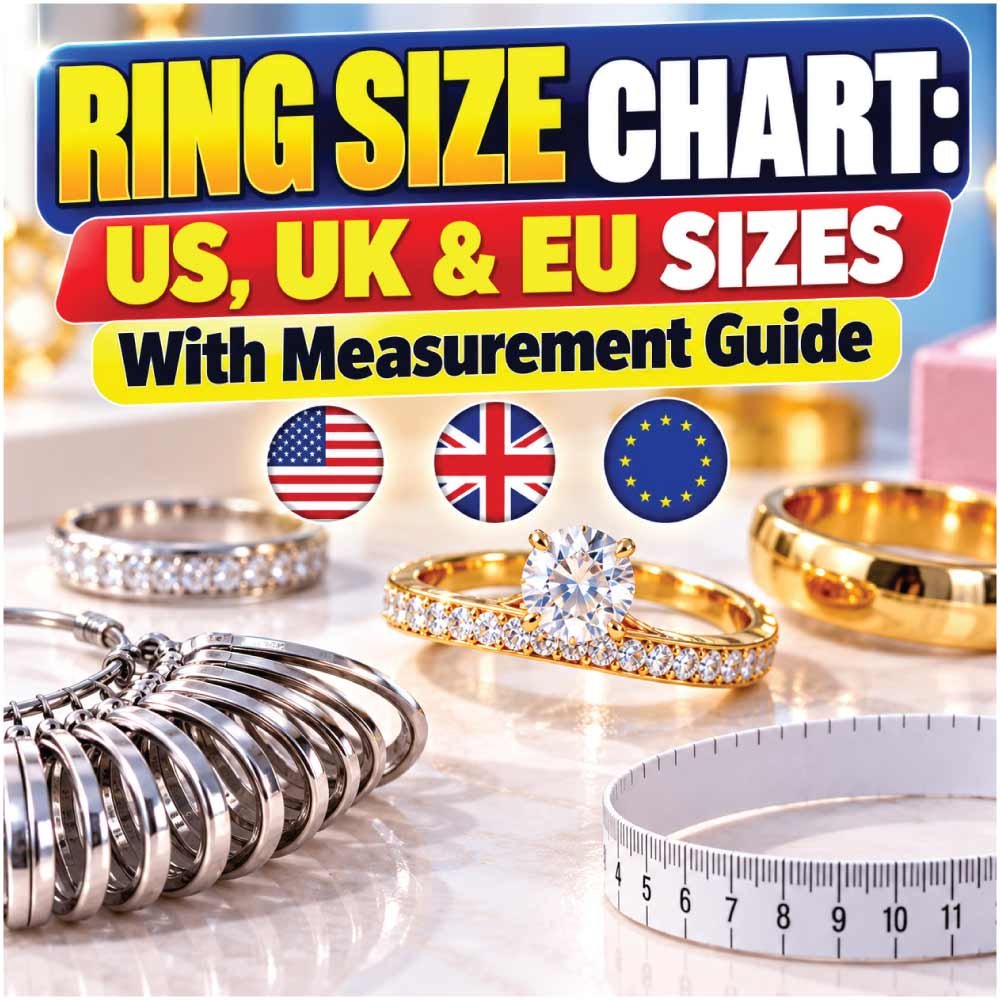
Finding the right ring size is easier when you know how different sizing systems relate to each other. A ring size chart helps you compare US, UK, and EU sizes using measurements such as finger circumference and ring diameter.
Whether you are buying a wedding ring, engagement ring, fashion ring, or everyday band, the correct size should feel secure without being painfully tight. A ring that is too small can be uncomfortable and difficult to remove, while one that is too large may spin or slip off.
This guide explains US, UK, and EU ring sizes, shows how ring measurements correspond, and provides simple ways to measure your finger at home. It also covers wide bands, temperature changes, between-size measurements, and common sizing mistakes.
US, UK & EU Ring Size Chart
Ring sizes are not universal. The US and Canada generally use numerical ring sizes, while the UK commonly uses an alphabetical system. Many European sizing systems use a numerical measurement based on the inside circumference of the ring, although practices can vary by country and jeweler.
The following chart provides a practical comparison of commonly used sizes.
| US Size | UK Size | EU Size | Inside Diameter (mm) | Inside Circumference (mm) |
|---|---|---|---|---|
| 3 | F | 44 | 14.1 | 44.2 |
| 3.5 | G | 45 | 14.5 | 45.5 |
| 4 | H | 47 | 14.9 | 46.8 |
| 4.5 | I | 48 | 15.3 | 48.0 |
| 5 | J | 49 | 15.7 | 49.3 |
| 5.5 | K | 51 | 16.1 | 50.6 |
| 6 | L | 52 | 16.5 | 51.9 |
| 6.5 | M | 53 | 16.9 | 53.1 |
| 7 | N | 54 | 17.3 | 54.4 |
| 7.5 | O | 55 | 17.7 | 55.7 |
| 8 | P | 57 | 18.1 | 57.0 |
| 8.5 | Q | 58 | 18.5 | 58.3 |
| 9 | R | 59 | 18.9 | 59.5 |
| 9.5 | S | 61 | 19.4 | 60.8 |
| 10 | T | 62 | 19.8 | 62.1 |
| 10.5 | U | 63 | 20.2 | 63.4 |
| 11 | V | 65 | 20.6 | 64.6 |
| 11.5 | W | 66 | 21.0 | 65.9 |
| 12 | X | 67 | 21.4 | 67.2 |
| 12.5 | Y | 68 | 21.8 | 68.5 |
| 13 | Z | 69 | 22.2 | 69.7 |
EU sizing and UK letter conversions can vary slightly among jewelers and sizing standards. For an important purchase, use the seller’s own conversion chart when available.
What Do Ring Sizes Mean?
A ring size describes how large the inside of a ring needs to be to fit comfortably around a particular finger.
Two measurements are especially useful:
- Inside diameter: The straight-line distance across the inside of the ring.
- Inside circumference: The distance around the inside edge of the ring.
Your finger is measured around its circumference, while an existing ring can be measured across its internal diameter. These measurements can then be compared with a ring size chart.
US Ring Sizes
US ring sizes are numerical and commonly include half and quarter sizes. For example, a person might wear a US size 6, 6.5, or 7.
US sizing is widely used in the United States and Canada and is often the system shoppers see when purchasing rings from North American retailers.
UK Ring Sizes
UK ring sizes normally use letters rather than the numerical system used in the US. Depending on the sizing system, half sizes can also be represented with combinations such as a letter followed by a fraction.
Because the progression is different from US sizing, it is better to use a conversion chart than to try to estimate the equivalent letter.
EU Ring Sizes
European ring sizing commonly uses numbers related to the ring’s internal circumference in millimeters. For example, an EU size around 52 corresponds to an inside circumference of approximately 52 mm.
However, European sizing conventions are not completely identical everywhere. Always check the retailer’s stated sizing method before ordering.
Ring Size Conversion: US to UK and EU
If you know your ring size in one country but are shopping from another, conversion becomes important.
For example, a US size 7 is approximately equivalent to a UK size N and an EU size 54. A US size 10 is approximately a UK T and an EU 62.
These conversions should be treated as practical equivalents rather than absolute measurements because manufacturers and jewelers may use slightly different standards.
Common Ring Size Conversions
| US Size | Approx. UK Size | Approx. EU Size |
|---|---|---|
| 4 | H | 47 |
| 5 | J | 49 |
| 6 | L | 52 |
| 7 | N | 54 |
| 8 | P | 57 |
| 9 | R | 59 |
| 10 | T | 62 |
| 11 | V | 65 |
| 12 | X | 67 |
| 13 | Z | 69 |
If a retailer provides its own US to UK ring size conversion chart, use that chart as the final reference, especially for expensive or custom-made jewelry.
How to Measure Your Ring Size at Home
You can estimate your ring size at home using a strip of paper, a flexible measuring tape, or a piece of non-stretch string. A professional ring sizer is usually more reliable, but home measurement can give you a useful starting point.
Method 1: Measure Your Finger With Paper
This method requires only a narrow strip of paper and a ruler.
- Cut a thin strip of paper approximately 5–10 mm wide.
- Wrap it around the base of the finger where the ring will sit.
- Keep the paper comfortably snug without squeezing your finger.
- Mark the point where one end overlaps the other.
- Lay the paper flat.
- Measure from the starting edge to the marked point in millimeters.
- Compare the circumference with a ring size chart.
The measurement should be snug enough to represent the fit of a ring but not so tight that it compresses the skin.
Method 2: Use String
String can work, but it has a major limitation: it can stretch.
If you use string:
- Choose a thin, non-stretch material.
- Wrap it around the finger without pulling tightly.
- Mark the overlap point.
- Measure the string against a ruler.
- Record the measurement in millimeters.
- Repeat the measurement several times.
If the results differ significantly, use a less flexible measuring material or have the finger measured professionally.
Method 3: Measure an Existing Ring
If you already own a ring that fits the same finger comfortably, measuring its inside diameter can be useful.
Place the ring on a flat surface and measure the inside diameter, not the outside diameter. Measure straight across the center from one inside edge to the opposite inside edge.
Then compare that measurement with the diameter column in a ring size chart.
This method works best when:
- The existing ring fits the intended finger.
- The ring has a similar width to the new ring.
- The ring is circular and has not become distorted.
- You measure only the internal opening.
How to Choose the Correct Ring Size
Getting an accurate measurement is only part of the process. You also need to consider how the ring will actually fit throughout the day.
A properly fitted ring should:
- Slide over the knuckle with moderate resistance.
- Sit comfortably at the base of the finger.
- Stay securely on the finger during normal movement.
- Not cause persistent pressure or pain.
- Not feel loose enough to slip off easily.
- Allow normal circulation without creating excessive tightness.
Consider Your Knuckle Size
Some people have relatively large knuckles compared with the base of the finger. In this situation, a ring needs to be large enough to pass over the knuckle but should not be excessively loose once it reaches the base.
This is one reason circumference measurement alone may not perfectly predict comfort.
If your knuckle is substantially wider than the base of your finger, professional sizing can be especially helpful.
Consider Ring Width
Ring width can affect perceived tightness.
A narrow band may feel more flexible around the finger, while a wide band can feel tighter even when both rings have the same nominal size.
For a wide wedding band or substantial statement ring, you may need to discuss the appropriate fit with the jeweler rather than automatically choosing the same size you use for a narrow ring.
Best Time to Measure Your Finger
Finger size changes naturally during the day. Temperature, activity, hydration, and other ordinary conditions can affect how your fingers feel.
For a more useful measurement:
- Measure when your hands are at a normal, comfortable temperature.
- Avoid measuring immediately after exposure to extreme cold or heat.
- Take measurements more than once.
- Measure at different times if your finger size appears inconsistent.
- Do not measure immediately after strenuous exercise.
- Avoid pulling paper or string tightly around the finger.
The goal is to find a measurement that represents your normal wearing conditions rather than an unusual temporary state.
Ring Size by Finger: Does It Matter?
Yes. Your ring size can differ significantly from one finger to another.
For example, your index finger may require a different size from your ring finger. Even the same finger on the opposite hand may not be exactly the same size.
This means you should measure the specific finger on which you plan to wear the ring.
Do not assume that a ring that fits your right-hand ring finger will automatically fit your left-hand ring finger.
Finger-Specific Measurement Tips
When measuring:
- Identify the exact finger for the new ring.
- Measure close to the base of the finger.
- Check that the measurement also allows the ring to pass over the knuckle.
- Consider the width of the intended ring.
- Measure both hands separately if you are comparing them.
Also Read:
What to Do If You Are Between Ring Sizes
Sometimes your measurement falls between two standard sizes. This is common because fingers do not always correspond perfectly to standardized ring measurements.
If you are between sizes, consider:
- The width of the ring.
- The shape of the band.
- Your knuckle size.
- How snugly you prefer jewelry to fit.
- Whether the ring is intended for everyday wear.
- The jeweler’s sizing recommendations.
A wide band can feel tighter than a narrow band of the same nominal size. A very loose ring, on the other hand, may rotate or slide around the finger.
For a valuable ring, it is better to have a professional jeweler assess the fit than to rely solely on an approximate home measurement.
Also Read:
Ring Size Chart by Inside Diameter
If you have an existing ring and can accurately measure its internal diameter, this chart can help you estimate the corresponding US size.
| US Size | Inside Diameter (mm) | Approx. Circumference (mm) |
|---|---|---|
| 4 | 14.9 | 46.8 |
| 5 | 15.7 | 49.3 |
| 6 | 16.5 | 51.9 |
| 7 | 17.3 | 54.4 |
| 8 | 18.1 | 57.0 |
| 9 | 18.9 | 59.5 |
| 10 | 19.8 | 62.1 |
| 11 | 20.6 | 64.6 |
| 12 | 21.4 | 67.2 |
| 13 | 22.2 | 69.7 |
The relationship between diameter and circumference comes from the geometry of a circle. Because jewelry measurements are usually taken in millimeters, even small measurement differences can affect the closest ring size.
Common Ring Sizing Mistakes
A few simple mistakes can lead to an uncomfortable fit.
Measuring the Wrong Finger
One of the most common errors is measuring one finger and ordering a ring for another.
Always measure the actual finger that will wear the ring.
Pulling the Measuring Material Too Tight
Paper or string should not be wrapped tightly enough to compress the skin. Doing so can produce a circumference that is smaller than your natural finger size.
Using Stretchy String
Stretchy material can give an artificially small measurement. A rigid or non-stretch measuring strip is preferable.
Ignoring the Knuckle
A ring must pass over the widest relevant part of the finger. Measuring only the base can result in a ring that fits the base but cannot comfortably pass over the knuckle.
Relying on One Measurement
A single measurement can be affected by temporary conditions. Taking several measurements gives you a better idea of your normal size.
Confusing Inside and Outside Diameter
When measuring an existing ring, measure the inside opening. Measuring from the outer edges will produce a diameter that is too large.
Also Read:
How Ring Fit Should Feel
The correct ring size is not necessarily the loosest or tightest size you can wear.
A good fit should feel secure while remaining comfortable. You should normally be able to remove the ring without extreme difficulty, but it should not fall off easily during ordinary hand movement.
A ring that leaves a temporary impression after extended wear is not automatically too small. However, persistent pain, numbness, discoloration, or significant swelling indicates that the ring should be removed and the fit reassessed.
For rings worn continuously, comfort is particularly important because finger size can vary throughout the day.
Ring Size Tips for Engagement and Wedding Rings
Engagement and wedding rings often have design features that make sizing more important.
A ring with a large center setting may have a different balance and movement than a simple band. A wedding band may also be wider than an engagement ring.
When purchasing a set, consider how the rings will fit together, not only individually.
Ask the jeweler about:
- The width of each band.
- Whether the rings are designed to sit together.
- The recommended size for the specific design.
- Whether the ring can be resized later.
- Any limitations created by stones, settings, or unusual construction.
For custom jewelry, the manufacturer’s or jeweler’s sizing recommendation should take priority over a generic online conversion chart.
How Accurate Are Online Ring Size Charts?
A ring size chart is useful for comparison, but it should not be treated as a guarantee of fit.
Several factors can create differences between the calculated size and the size that feels most comfortable, including:
- Measurement technique.
- Ring width.
- Finger shape.
- Knuckle size.
- Temperature.
- Manufacturing tolerances.
- Different regional sizing conventions.
- Individual preference for a snug or relaxed fit.
For inexpensive fashion jewelry, an approximate size may be sufficient. For an engagement ring, wedding band, heirloom, or custom ring, professional measurement is a better choice.
Ring Size Chart: Quick Reference
If you need a simple starting point, these commonly used sizes provide a quick comparison.
| US | UK | EU | Diameter | Circumference |
|---|---|---|---|---|
| 5 | J | 49 | 15.7 mm | 49.3 mm |
| 6 | L | 52 | 16.5 mm | 51.9 mm |
| 7 | N | 54 | 17.3 mm | 54.4 mm |
| 8 | P | 57 | 18.1 mm | 57.0 mm |
| 9 | R | 59 | 18.9 mm | 59.5 mm |
| 10 | T | 62 | 19.8 mm | 62.1 mm |
| 11 | V | 65 | 20.6 mm | 64.6 mm |
| 12 | X | 67 | 21.4 mm | 67.2 mm |
Use this table as a general conversion reference, then compare the result with the specific retailer’s sizing information.
Frequently Asked Questions About Ring Sizes
What is the most common ring size?
There is no single ring size that fits everyone. Ring size varies according to finger, hand, anatomy, and individual preference. Rather than selecting a size based on what is supposedly common, measure the specific finger for the intended ring.
How do I measure my ring size without a ring sizer?
Use a narrow strip of non-stretch paper, wrap it around the base of the intended finger, mark the overlap, and measure the length in millimeters. Compare that circumference with a reliable ring size chart.
Is US ring size the same as EU ring size?
No. US and EU systems use different sizing scales. For example, a US size 7 is approximately an EU size 54. Always use a conversion chart or the retailer’s own sizing guide when changing between systems.
What is the difference between ring diameter and circumference?
Diameter is the straight-line distance across the inside of a circular ring. Circumference is the distance around the inside edge. Both can be used to determine ring size, but circumference is particularly useful when measuring the finger directly.
Should a ring be tight or loose?
A ring should be comfortably snug rather than painfully tight or excessively loose. It should stay securely on the finger while still being removable without excessive force.
Can my ring size change during the day?
Yes. Finger size can vary because of normal temperature and activity changes. Measuring under normal conditions and repeating the measurement can help you get a more representative result.
Should I size up for a wide ring?
A wide band can feel tighter than a narrow band because more material contacts the finger. However, automatically sizing up is not always correct. The exact design and jeweler’s recommendation should be considered.
Can I use an existing ring to determine my size?
Yes, if the ring fits the same finger comfortably. Measure its inside diameter accurately and compare it with a ring size chart. Make sure you measure the internal opening rather than the outside of the ring.
What if my measurement falls between two sizes?
Consider the ring’s width, your knuckle size, and your preferred fit. For expensive or custom jewelry, professional sizing is recommended because the best choice may depend on the particular ring design.
Are UK and EU ring sizes interchangeable?
No. UK letter sizes and EU numerical sizes are different systems. A conversion chart can show approximate equivalents, but individual retailers may use slightly different conversion practices.
Final Thoughts
A reliable ring size chart makes it much easier to compare US, UK, and EU sizing systems, but the most important step is obtaining an accurate measurement of the actual finger that will wear the ring.
Measure the finger at a comfortable temperature, use millimeters for greater precision, consider the knuckle and ring width, and repeat the measurement when possible. If you are buying valuable or custom jewelry, have the size confirmed by a professional jeweler and check the retailer’s own sizing chart before ordering.
With the right measurement and a clear understanding of US, UK, and EU ring sizes, you can choose a ring that feels secure, comfortable, and suitable for everyday wear.
