
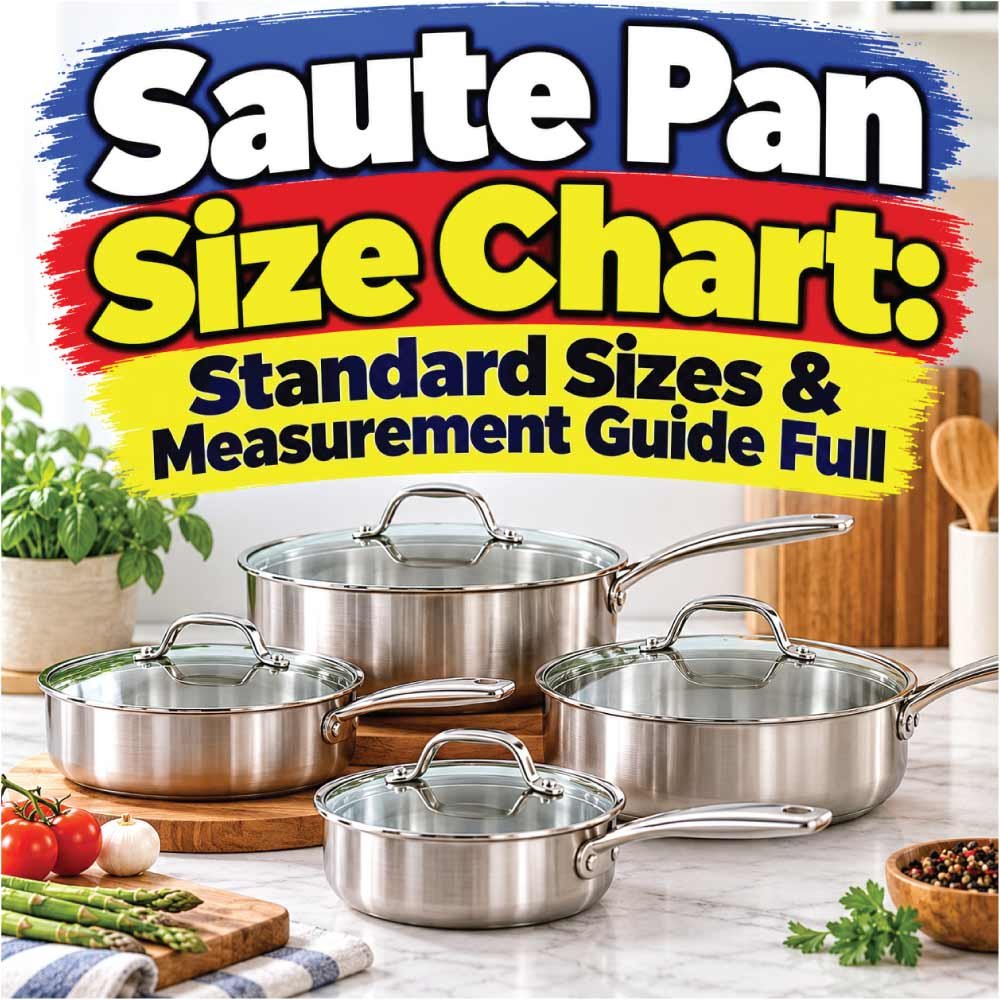
A sauté pan is one of the most useful pieces of cookware for searing, browning, sautéing, braising, simmering, and preparing one-pan meals. However, choosing the right size can be confusing because sauté pans are commonly described by diameter, while their actual cooking capacity also depends on depth and shape.
This sauté pan size chart explains common pan diameters, approximate capacities, typical uses, and practical size differences. You will also learn how to measure a sauté pan correctly, how size affects cooking performance, and how to choose the best sauté pan for your household.
Whether you need a compact pan for one or two people or a larger sauté pan for family meals, understanding the dimensions first makes comparison much easier.
Sauté Pan Size Chart
Sauté pans are generally identified by their diameter across the top of the pan. Common household sizes range from about 8 to 14 inches, although manufacturers may offer smaller or larger options.
The table below provides practical size categories. Exact capacity and dimensions can vary by brand, wall height, cooking surface, and handle design, so treat the capacities as general guides rather than fixed specifications.
| Sauté Pan Size | Approx. Diameter | Typical Capacity | Best For |
|---|---|---|---|
| Small | 8 inches | 2–3 qt | 1–2 people, small portions |
| Medium | 10 inches | 3–4 qt | 2–3 people, everyday cooking |
| Large | 12 inches | 4–6 qt | 3–5 people, family meals |
| Extra Large | 14 inches | 6–8+ qt | Large families, batch cooking |
A 10-inch sauté pan is often a practical choice for smaller households, while a 12-inch sauté pan provides more cooking surface for family-size portions. A 14-inch model can be useful for large batches but may require a larger cooktop and more storage space.
The capacity figures above are approximate because two pans with the same diameter can hold different amounts depending on their depth.
What Is a Sauté Pan?
A sauté pan is a wide, relatively shallow cooking vessel with a flat bottom and straight or nearly straight sides. Most models have a long handle and may include a helper handle on the opposite side.
Its broad cooking surface makes it particularly useful when ingredients need room to spread out instead of being piled deeply.
Sauté pans are commonly used for:
- Sautéing vegetables
- Browning meat
- Searing chicken or fish
- Preparing sauces
- Simmering foods
- Deglazing after browning
- Braising smaller cuts of meat
- Cooking pasta sauces
- Preparing one-pan meals
- Reducing liquids
The straight sides distinguish a sauté pan from many traditional frying pans or skillets. The deeper walls can also make it easier to contain sauces and larger quantities of food.
Standard Sauté Pan Sizes Explained
Understanding what each common size can realistically handle is more useful than choosing a diameter based on numbers alone.
8-Inch Sauté Pan
An 8-inch sauté pan is a compact option designed for small portions. It is suitable when you do not need a large cooking surface.
It can work well for:
- One-person meals
- Cooking small vegetable portions
- Preparing sauces
- Sautéing a small amount of aromatics
- Reheating or finishing small dishes
Its smaller footprint makes it easy to store, but the limited surface area can make it unsuitable for larger quantities of food.
If you regularly cook for several people, moving up to a 10- or 12-inch pan will usually provide greater flexibility.
10-Inch Sauté Pan
A 10-inch sauté pan offers a useful balance between cooking surface and compactness. It is often appropriate for one to three people, depending on the food being prepared.
This size can be useful for:
- Vegetables
- Chicken portions
- Small stir-fry-style meals
- Pasta sauces
- Fish fillets
- Sautéed mushrooms
- Small braises
A 10-inch model can also be easier to handle than a large pan, especially when moving food from the stovetop to the oven or serving area.
12-Inch Sauté Pan
A 12-inch sauté pan is one of the most versatile sizes for general household cooking. Its larger base provides enough room for ingredients to brown without excessive crowding.
It is especially useful for:
- Family dinners
- Several chicken breasts
- Larger vegetable portions
- Pasta dishes
- Braising
- Pan sauces
- One-pan meals
- Batch cooking
For many households, a 12-inch sauté pan is the best all-purpose option when storage and cooktop space are not major concerns.
14-Inch Sauté Pan
A 14-inch sauté pan provides substantial cooking space and capacity. It is most appropriate for larger households, entertaining, meal preparation, or cooking large batches.
Potential uses include:
- Large vegetable batches
- Family-size meals
- Multiple servings of protein
- Large pasta preparations
- Batch cooking
- Large braises
The main limitation is practicality. A 14-inch pan may be heavy when full and may not fit comfortably on smaller cooktops or in standard kitchen cabinets.
Sauté Pan Diameter vs Capacity
Diameter and capacity are not the same measurement.
A pan’s diameter describes its width, while capacity describes how much volume it can hold. Two 12-inch sauté pans can have noticeably different capacities if one has taller sides.
For example, a relatively shallow 12-inch pan may hold less than a deeper 12-inch model. The cooking surface may be similar, but the available volume will differ.
When comparing pans, consider all three dimensions:
- Diameter: Determines much of the usable cooking surface.
- Depth: Influences how much food and liquid the pan can hold.
- Overall dimensions: Affect storage, handling, and cooktop compatibility.
This is why choosing a sauté pan solely by its advertised diameter can sometimes produce an unexpected result.
How to Measure a Sauté Pan
Knowing how cookware is measured helps you compare different brands accurately.
Measure the Cooking Diameter
Place the pan on a flat surface and measure straight across the opening from one inside edge to the opposite inside edge.
For cookware sizing, manufacturers commonly use the nominal diameter of the pan opening rather than the length of the handle.
Do not measure from the end of the handle to the opposite edge when determining whether a pan is 10, 12, or 14 inches.
Measure the Depth
To determine depth, place a straightedge across the top of the pan and measure vertically from the cooking surface to the straightedge.
Depth is important because it affects capacity and how much liquid the pan can accommodate.
Measure the Overall Width
If you are checking whether the pan will fit inside a cabinet, oven, or other storage location, measure its complete width, including handles where applicable.
The overall width can be substantially greater than the cooking diameter.
Measure the Overall Length
For storage and handling, measure from the end of the long handle to the opposite edge or helper handle.
This measurement is particularly important for compact ovens, drawers, shelves, and hanging storage.
Sauté Pan Size by Number of People
The number of people you cook for is one of the simplest ways to narrow down your ideal pan size.
| Household Size | Suggested Pan Size | Typical Use |
|---|---|---|
| 1 person | 8–10 inches | Small meals and portions |
| 2 people | 10 inches | Everyday cooking |
| 2–3 people | 10–12 inches | Larger portions and one-pan meals |
| 3–5 people | 12 inches | Family-size meals |
| 5+ people | 12–14 inches | Large batches and entertaining |
These recommendations are not strict rules. A person cooking small meals for five people may prefer a different size than someone preparing large portions for two.
The type of food matters just as much as the number of servings.
Choosing the Right Sauté Pan Size
The best sauté pan size depends on how you cook, not simply how many people live in your household.
Consider Your Typical Recipes
Think about the foods you prepare most frequently.
If you mostly cook sauces, vegetables, and small portions, an 8- or 10-inch pan may be sufficient.
If you regularly prepare family dinners, chicken dishes, braises, or large vegetable portions, a 12-inch pan is generally more practical.
For meal preparation and entertaining, consider a larger model.
Consider Cooking Surface Area
A wide cooking surface gives ingredients more room to spread out.
This matters when searing or browning because overcrowding can cause ingredients to release moisture and cook differently from food that has adequate space.
A larger pan is therefore not simply about holding more food. It can also provide more usable surface area.
Consider Your Cooktop
Before purchasing a large sauté pan, check your stovetop.
The pan should sit securely on the cooking surface, and the burner should be appropriate for its base. An oversized pan on a small burner may not heat as evenly as a properly matched pan.
For induction cooking, also verify that the pan’s base is compatible with your induction cooktop.
Consider Storage Space
Large cookware can be difficult to store.
A 14-inch sauté pan may offer excellent capacity but require substantially more cabinet space than a 10-inch model. Handles can also make storage more challenging.
Measure your cabinet, shelf, or drawer before buying unusually large cookware.
Sauté Pan Size Comparison
A sauté pan is often compared with a skillet, frying pan, and saucepan. Although these pieces of cookware overlap in their uses, their shapes influence how they perform.
| Cookware Type | Typical Shape | Main Advantage | Common Uses |
|---|---|---|---|
| Sauté Pan | Wide with straight sides | Surface area + depth | Sautéing, braising, sauces |
| Skillet | Wide with sloped sides | Easy stirring and flipping | Frying, searing, browning |
| Frying Pan | Wide, relatively shallow | Quick cooking | Frying, eggs, searing |
| Saucepan | Narrower with taller sides | Liquid capacity | Sauces, boiling, simmering |
A sauté pan is particularly useful when you want the broad cooking surface of a skillet but need taller, straighter sides for sauces, liquids, or larger quantities.
Sauté Pan vs Skillet: Which Size Is Better?
The choice between a sauté pan and skillet often comes down to cooking technique.
A skillet’s sloped sides make it convenient for tossing food, flipping ingredients, and reducing liquids quickly. A sauté pan’s straighter sides provide additional containment.
For example, if you frequently make:
- Stirred sauces
- Braised dishes
- Chicken with pan sauce
- Vegetable-and-protein combinations
- Dishes containing substantial liquid
a sauté pan may be more versatile.
If your cooking focuses on eggs, pancakes, quick frying, flipping, or foods that benefit from easy access at the sides, a skillet may be more convenient.
Many kitchens benefit from having both because they perform different tasks particularly well.
Also Read:
Sauté Pan Depth and Why It Matters
Diameter gets most of the attention, but depth is an important part of sauté pan sizing.
A deeper pan can accommodate more liquid and ingredients without spilling. This makes it useful for braising, simmering, and preparing dishes with sauces.
However, more depth does not automatically mean better cooking performance.
A pan that is excessively deep for a particular task may provide less exposed cooking surface relative to its volume. Conversely, a very shallow pan may not contain enough liquid for certain recipes.
For general-purpose cooking, look for a combination of:
- Adequate diameter
- Practical side height
- Flat cooking surface
- Comfortable handles
- Suitable capacity
- Compatible cooktop base
Also Read:
How Much Food Fits in Different Sauté Pan Sizes?
Pan capacity is usually expressed in quarts in the United States, although manufacturers may provide liters in other markets.
A useful approximate relationship is:
| Pan Size | Approximate Capacity Range | Typical Cooking Situation |
|---|---|---|
| 8 inches | 2–3 qt | Small portions |
| 10 inches | 3–4 qt | Everyday meals for 1–3 |
| 12 inches | 4–6 qt | Family meals |
| 14 inches | 6–8+ qt | Large batches |
Actual capacity varies considerably by pan depth and manufacturer.
Also remember that maximum volume is not the same as practical cooking capacity. You should not assume that a pan needs to be filled to its maximum volume for effective cooking.
Leaving sufficient space can make stirring easier and help prevent spills.
Also Read:
Best Sauté Pan Size for Common Foods
Different foods benefit from different amounts of cooking surface.
Vegetables
A 10- to 12-inch sauté pan is generally suitable for many household vegetable preparations. A larger pan can be useful when cooking bulky vegetables in batches.
Chicken
A 12-inch sauté pan provides useful space for several portions while still being manageable in many kitchens.
If you need to brown multiple pieces, surface area becomes especially important.
Fish
A 10- or 12-inch pan can work well depending on the size and number of fillets. Avoid selecting a pan that is so small that the fish pieces overlap.
Pasta Sauces
A 10- or 12-inch sauté pan can provide enough room for sauce and other ingredients. A deeper model is particularly useful when combining pasta with sauce.
Braising
For braising, both diameter and depth matter. A 12-inch or larger sauté pan can be useful for larger portions, provided the pan is deep enough for the required liquid.
Advantages of a Larger Sauté Pan
Choosing a larger pan can provide several practical benefits.
- More cooking surface: Ingredients have more room to spread out.
- Greater capacity: Useful for family meals and batch cooking.
- More flexibility: Can handle both moderate and larger portions.
- Better for entertaining: Large quantities can often be prepared in one pan.
- Useful for one-pan meals: More space is available for combining ingredients.
However, bigger is not always better.
A large pan may be heavier, harder to store, slower to handle, and less convenient on a small cooktop.
Advantages of a Smaller Sauté Pan
Smaller pans also have important benefits.
- Easier to lift and maneuver
- Require less storage space
- Convenient for one- or two-person meals
- Useful for small quantities
- Often easier to clean
- Practical for sauces and side dishes
The downside is limited surface area. If the pan becomes crowded, it may be difficult to brown food effectively.
Common Sauté Pan Size Mistakes
Choosing cookware based only on the number printed on the packaging can lead to mistakes.
Mistake 1: Confusing Diameter With Capacity
A 12-inch pan is not automatically the same capacity as every other 12-inch pan.
Depth and shape also influence volume.
Mistake 2: Ignoring Handle Dimensions
The cooking diameter may fit your cabinet, but the full pan may not.
Always consider the overall dimensions when storage is limited.
Mistake 3: Buying the Largest Pan Available
A very large pan can be inconvenient for everyday meals.
Choose the largest size that is genuinely useful for your cooking habits rather than simply choosing the biggest option.
Mistake 4: Ignoring Cooktop Size
A pan should be compatible with the cooking surface beneath it. Check your cooktop and cookware manufacturer’s recommendations, particularly for unusually large pans.
Mistake 5: Overlooking Weight
Cookware becomes significantly harder to handle when filled with food and liquid.
If you frequently transfer a sauté pan from stovetop to oven or table, consider both empty weight and expected loaded weight.
What Size Sauté Pan Should You Buy?
For many households, the decision can be simplified into three practical choices.
Choose an 8- to 10-inch sauté pan if you primarily cook small portions or meals for one or two people.
Choose a 10- to 12-inch sauté pan if you want a versatile everyday pan for typical household cooking.
Choose a 12- to 14-inch sauté pan if you frequently cook for several people, prepare large meals, or batch-cook.
If you are buying only one sauté pan, a 12-inch model is often a strong all-purpose starting point because it offers substantial surface area without reaching the size of the largest cookware.
Still, check the actual manufacturer’s diameter, depth, capacity, base dimensions, and handle length before purchasing.
How to Choose Between 10-Inch and 12-Inch Sauté Pans
The 10-inch versus 12-inch decision is one of the most common comparisons.
A 10-inch pan is easier to handle and store. It is well suited to smaller meals and compact kitchens.
A 12-inch pan provides more cooking surface and capacity. It is usually the better choice when you frequently cook several portions at once.
Consider these differences:
| Feature | 10-Inch Pan | 12-Inch Pan |
|---|---|---|
| Cooking area | Smaller | Larger |
| Portion size | Small to moderate | Moderate to large |
| Storage | Easier | Requires more space |
| Handling | Generally easier | Generally heavier |
| Family meals | Limited | Better suited |
| Batch cooking | Less convenient | More convenient |
Neither size is universally better. The right choice depends on your recipes, household size, cooktop, and storage space.
Tips for Getting the Most From Your Sauté Pan
Once you have selected the correct size, good cooking practices can make the pan much more effective.
- Avoid overcrowding: Give ingredients enough space when browning.
- Preheat appropriately: Follow the cookware and recipe recommendations.
- Use the correct burner: Match the pan base to a suitable cooking zone.
- Do not ignore the handles: Handles can become hot depending on cookware design and cooking method.
- Check oven compatibility: If you plan to transfer the pan to the oven, verify the manufacturer’s temperature and handle limitations.
- Follow cleaning instructions: Different materials and finishes require different care.
- Use the lid when appropriate: A matching lid can increase the versatility of a deeper sauté pan.
The goal is not simply to own a large pan but to use a pan whose dimensions match the food being prepared.
Frequently Asked Questions About Sauté Pan Sizes
What is the most common sauté pan size?
A 12-inch sauté pan is a common versatile size for household cooking. It provides a relatively large cooking surface and useful capacity for family meals. However, 10-inch models can be more practical for smaller households or kitchens with limited storage.
Is a 10-inch or 12-inch sauté pan better?
A 10-inch sauté pan is generally easier to handle and suits smaller portions, while a 12-inch pan offers more cooking surface and capacity. For general family cooking, the 12-inch option usually provides greater flexibility.
What size sauté pan is best for two people?
A 10-inch sauté pan is often sufficient for two people, particularly when preparing moderate portions. A 12-inch model can be preferable if you want extra room for vegetables, proteins, sauces, or one-pan meals.
What size sauté pan is best for a family?
For many families, a 12-inch sauté pan offers a useful balance of surface area, capacity, and handling. Larger households or people who frequently cook in batches may prefer a 14-inch model if their cooktop and storage space can accommodate it.
How is a sauté pan measured?
The nominal size is generally based on the pan’s diameter across the top opening. Measure straight from one edge to the opposite edge rather than including the handle. Also check depth and overall dimensions when comparing cookware.
Does a deeper sauté pan hold more food?
Generally, greater depth increases a pan’s volume when other dimensions remain similar. However, capacity depends on both diameter and depth. Always check the manufacturer’s stated capacity when an exact volume is important.
Can a sauté pan replace a skillet?
A sauté pan can perform many tasks normally associated with a skillet, including sautéing, searing, and browning. However, the straight sides of a sauté pan make it especially useful for dishes containing sauces or larger amounts of liquid.
Is a 14-inch sauté pan too large?
Not necessarily. A 14-inch sauté pan can be useful for large households and batch cooking. It may be impractical, however, if your cooktop, oven, cabinet, or storage area is too small for it.
Final Takeaway
The best sauté pan size is the one that provides enough cooking surface and capacity for your typical meals without becoming unnecessarily difficult to handle or store.
For small portions, an 8- or 10-inch pan can be practical. A 12-inch sauté pan is a versatile choice for many households, while a 14-inch model is better suited to large batches and bigger cooking jobs.
When comparing cookware, look beyond the diameter. Check the depth, capacity, cooking surface, base dimensions, overall size, weight, handle design, cooktop compatibility, and storage requirements.
Most importantly, remember that stated dimensions and capacities can vary between manufacturers. If an exact fit or specification matters, use the manufacturer’s product documentation before making your final purchase.
