Choosing the right hockey stick size can have a major impact on handling, shooting, passing, and overall control. A stick that is too long can make puck control difficult, while one that is too short may reduce reach and affect shooting mechanics. The ideal hockey stick depends on several factors, including the player’s height, age, position, playing style, and preferred flex.
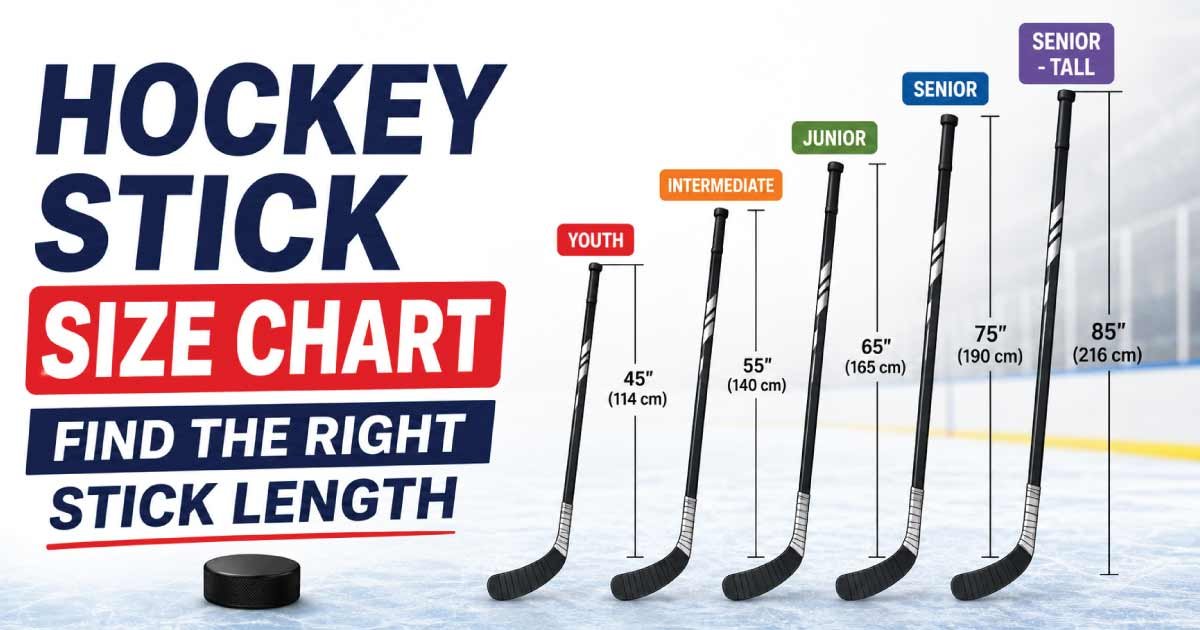
This hockey stick size chart provides a simple reference for choosing the right stick length for children, youth, intermediate, and senior players. It also explains hockey stick flex, stick length measurement, and how to choose a stick based on your height and playing position.
Although height is an excellent starting point, there is no single hockey stick size that works perfectly for every player. Personal preference and playing style can influence the final choice.
Hockey Stick Size Chart
Hockey sticks are generally categorized into youth, junior, intermediate, and senior sizes. The following chart provides general sizing ranges.
| Stick Category | Approx. Player Height | Approx. Stick Length | Typical Age | Recommended Flex |
|---|---|---|---|---|
| Youth | 3’0″–4’0″ | 40–50 in | 4–7 years | 20–30 |
| Junior | 3’8″–4’8″ | 50–57 in | 7–11 years | 30–50 |
| Intermediate | 4’6″–5’4″ | 55–60 in | 11–14 years | 50–70 |
| Senior | 5’4″–6’2″+ | 57–63 in | 14+ years | 70–100+ |
| Senior Tall | 5’10″+ | 60–65 in | Adults | 85–110+ |
Sizing varies by manufacturer and stick model. Always check the manufacturer’s specific sizing chart before purchasing.
Player height should be treated as a starting point rather than an absolute rule. Some players prefer a shorter stick for improved puck handling, while others prefer additional length for reach and defensive play.
Hockey Stick Length Chart by Height
Height is one of the simplest ways to determine a starting hockey stick length.
| Player Height | Suggested Stick Length | General Category |
|---|---|---|
| 3’0″–3’6″ | 40–46 in | Youth |
| 3’6″–4’0″ | 44–50 in | Youth |
| 4’0″–4’6″ | 48–54 in | Junior |
| 4’6″–5’0″ | 52–57 in | Junior/Intermediate |
| 5’0″–5’4″ | 55–59 in | Intermediate |
| 5’4″–5’8″ | 57–60 in | Senior |
| 5’8″–6’0″ | 58–62 in | Senior |
| 6’0″–6’4″ | 60–64 in | Senior/Tall |
| 6’4″+ | 62–65+ in | Tall/Senior |
These measurements are general guidelines. Hockey stick length can vary depending on whether the player uses the stick on ice, in roller hockey, or in another playing environment.
What Is the Correct Hockey Stick Length?
The correct hockey stick length allows you to maintain good posture while providing effective puck control and reach.
A common starting point for an ice hockey player is to stand the stick upright with the blade on the floor. With skates off, the top of the stick is often around the chin or nose area depending on the player’s preferred length.
Stick Length With Skates
When wearing hockey skates, the player’s height increases slightly.
Because of this, a stick that reaches around the nose without skates may sit closer to the chin when wearing skates.
The final choice depends on:
- Playing position
- Skating style
- Puck-handling preference
- Shooting technique
- Defensive responsibilities
- Personal comfort
How to Measure a Hockey Stick
Measuring a hockey stick correctly helps you compare different models.
Measure From the Heel to the Top
Stick length is generally measured from the heel of the blade to the top of the shaft.
Place the blade flat on the floor and measure vertically along the shaft.
Different manufacturers may measure or list stick length slightly differently, so use their specifications when comparing products.
Measure Your Ideal Stick Height
Stand naturally while wearing the footwear you normally use for hockey.
Place the stick blade on the floor between your feet and check where the top of the shaft reaches.
Use this as a starting point, then adjust based on your position and playing style.
Hockey Stick Size by Age
Age can help narrow down the appropriate stick category, particularly for younger players.
Youth Hockey Sticks
Youth sticks are designed for young children.
They are shorter and generally have a lower flex rating, allowing smaller players to load the shaft more easily.
A typical youth stick may be appropriate for players around 4–7 years old, although height and strength should take priority over age alone.
Junior Hockey Sticks
Junior sticks are designed for growing players.
They are longer than youth sticks but shorter and more flexible than most adult models.
Players around 7–11 years old may fall into this category, but children of the same age can have very different heights and physical abilities.
Intermediate Hockey Sticks
Intermediate sticks bridge the gap between junior and senior equipment.
They are often appropriate for growing teenagers or smaller adult players.
Typical intermediate flex ratings may fall around 50–70 flex, depending on the manufacturer.
Senior Hockey Sticks
Senior sticks are designed primarily for teenagers and adults.
They are longer and generally have higher flex ratings than youth and junior sticks.
The correct senior stick still depends on the player’s height, strength, position, and preferred shooting style.
Hockey Stick Flex Size Chart
Stick flex refers to how much force is required to bend the shaft.
| Player Type | Typical Flex Range | General Use |
|---|---|---|
| Small Youth | 20–30 | Young players |
| Youth/Junior | 30–50 | Developing players |
| Junior | 40–50 | Younger players |
| Intermediate | 50–70 | Teens and smaller adults |
| Senior Soft | 65–75 | Lighter players |
| Senior Regular | 75–90 | General adult use |
| Senior Stiff | 90–110+ | Stronger/larger players |
These are broad ranges rather than universal standards. Flex ratings vary between manufacturers and stick models.
How to Choose Hockey Stick Flex
Stick flex is often selected based on player weight rather than height alone.
A common rule of thumb is to start with a flex rating around half of the player’s body weight in pounds, then adjust according to strength, shooting technique, and preference.
For example, a 160-pound player might start by considering a flex around 80.
However, this is only a starting point.
Lower Flex
A lower-flex stick bends more easily.
It can be useful for:
- Younger players
- Lighter players
- Players who want easier loading
- Quick-release shooting
- Players developing shooting technique
Higher Flex
A higher-flex stick requires more force to load.
It may suit:
- Larger players
- Stronger players
- Players who prefer a stiffer feel
- Powerful shooters
The goal is to select a flex that the player can comfortably load during a normal shot.
Hockey Stick Size by Position
Position can influence preferred stick length and characteristics.
Forwards
Forwards often prioritize puck control, quick handling, and shooting.
Some forwards prefer a slightly shorter stick because it can make close puck handling more comfortable.
A shorter stick may also make it easier to maneuver the puck in tight spaces.
Defensemen
Defensemen often value reach and defensive coverage.
A slightly longer stick can provide additional reach for:
- Poke checks
- Passing lanes
- Stick checks
- Blocking plays
- Defensive positioning
However, excessive length can make puck handling and shooting more difficult.
Goalies
Goalie sticks are completely different from standard player sticks.
They have a wider paddle and specialized blade design. Goalkeeper stick sizing depends on factors such as height, stance, paddle length, and personal preference.
Do not use a standard player-stick sizing chart when purchasing a goalie stick.
Senior vs. Intermediate Hockey Stick Size
Choosing between intermediate and senior equipment can be confusing for growing players.
Intermediate sticks generally have:
- Smaller shaft dimensions
- Lower flex ratings
- Shorter overall lengths
- Lower weight in some models
Senior sticks generally provide:
- Larger shaft dimensions
- Higher flex options
- Longer lengths
- Adult-oriented construction
A teenager does not automatically need a senior stick simply because of age. Height, strength, hand size, and shooting ability are better indicators.
Hockey Stick Size for Kids
Children need sticks that they can comfortably control.
A stick that is too long or too stiff can make basic skills more difficult.
For young players, focus on:
- Overall height
- Stick length
- Flex
- Shaft size
- Weight
- Ability to control the blade
A child should be able to comfortably handle the stick without struggling to keep the blade flat on the ice.
As children grow, their stick size should be reassessed rather than continuing to use the same stick for several seasons.
Discover More:
How Stick Length Affects Your Game
Stick length can influence several aspects of performance.
Shorter Stick
A shorter stick can provide:
- Improved close puck control
- Easier stickhandling
- Quick movements
- A more upright skating posture
However, it reduces reach.
Longer Stick
A longer stick can provide:
- Greater defensive reach
- Larger poke-check range
- More coverage
- Additional leverage
However, excessive length can make close puck control more difficult.
The ideal length is therefore a balance between control, reach, comfort, and playing style.
How to Cut a Hockey Stick
Many hockey sticks can be shortened by cutting the shaft, but doing so changes the stick’s characteristics.
When you cut a stick shorter, the effective flex generally becomes stiffer.
For example, a stick originally rated at a particular flex may feel significantly stiffer after removing several inches.
Before cutting a new stick:
- Check whether cutting is permitted or recommended.
- Measure carefully.
- Consider your desired final length.
- Remember that cutting changes the flex.
- Avoid removing more material than necessary.
For expensive composite sticks, measure twice before making any permanent modification.
Hockey Stick Size Chart by Player Type
| Player Type | Height Range | Stick Category | Typical Length | Typical Flex |
|---|---|---|---|---|
| Young Child | 3’0″–4’0″ | Youth | 40–50 in | 20–30 |
| Older Child | 4’0″–4’8″ | Junior | 48–57 in | 30–50 |
| Young Teen | 4’6″–5’2″ | Junior/Intermediate | 52–58 in | 40–60 |
| Teen/Small Adult | 5’0″–5’6″ | Intermediate | 55–60 in | 50–70 |
| Adult | 5’4″–6’2″ | Senior | 57–63 in | 70–100 |
| Tall Adult | 6’0″+ | Senior/Tall | 60–65+ in | 85–110+ |
Use these ranges as general guidance. Stick construction, blade pattern, flex profile, and manufacturer specifications can affect the final choice.
Discover More:
Hockey Stick Blade Pattern and Size
Stick selection involves more than length and flex.
The blade pattern affects how the stick feels during shooting, passing, and puck control.
Consider:
- Blade curve
- Face angle
- Blade length
- Lie
- Toe shape
- Shooting style
A player who changes stick length may also notice changes in how the blade sits on the ice.
For this reason, avoid making several major equipment changes at once if you are trying to determine why your shooting or puck control feels different.
Tips for Choosing the Right Hockey Stick
Before buying a stick, consider the following:
- Measure your height accurately.
- Start with the appropriate age category.
- Check the manufacturer’s length specification.
- Consider your playing position.
- Choose a flex you can comfortably load.
- Consider whether you prefer more reach or puck control.
- Check the shaft dimensions for your hand size.
- Consider stick weight.
- Think about blade pattern and lie.
- Do not assume age alone determines stick size.
- Recheck sizing as young players grow.
For beginners, comfort and control are generally more important than choosing the most advanced stick available.
Common Hockey Stick Sizing Mistakes
Choosing Based Only on Age
Two players of the same age can have very different heights and strengths. Height and physical ability should be considered alongside age.
Using a Stick That Is Too Long
An excessively long stick can make puck control and shooting technique more difficult.
Choosing Too Much Flex
A stick that is too stiff may be difficult for a lighter player to load properly.
Ignoring Stick Cutting
If you shorten a stick, its flex characteristics can change. Always account for the final length.
Ignoring Position
Forwards and defensemen may prefer different stick lengths because their responsibilities on the ice differ.
Discover More:
Frequently Asked Questions About Hockey Stick Sizes
What size hockey stick do I need?
The correct hockey stick size depends primarily on your height, age category, position, and playing style. As a starting point, young players generally use youth or junior sticks, while teenagers and adults typically use intermediate or senior sticks.
How long should a hockey stick be?
For many ice hockey players, the stick reaches somewhere around the chin to nose area when standing without skates. With skates on, the stick will appear slightly shorter relative to your body. Personal preference and position can change the ideal length.
What size hockey stick should a 10-year-old use?
Many 10-year-olds fall within the junior stick category, but height and strength are more useful than age alone. A junior stick around 50–57 inches may be a starting range, with flex selected according to the player’s size and ability.
What size hockey stick should a 12-year-old use?
A 12-year-old may use a junior or intermediate stick depending on height, strength, and hand size. Players who are smaller may remain comfortable with junior equipment, while taller or stronger players may transition to intermediate models.
What hockey stick size is best for a 5’10” player?
A player around 5’10” will commonly fall into the senior stick category, with an approximate length of 58–62 inches. The final length should be adjusted according to position, skating style, and personal preference.
What flex should a hockey stick have?
Flex is often initially estimated at roughly half the player’s body weight in pounds, but this is not a strict formula. Strength, shooting technique, position, and personal preference should also influence the final flex choice.
Is a longer hockey stick better?
A longer stick provides greater reach and can be useful for defensive play, but it may reduce close puck control. A shorter stick can improve handling but sacrifices some reach. The ideal length is a balance between these characteristics.
Can I cut a hockey stick shorter?
Many sticks can be cut shorter, but doing so generally makes the stick feel stiffer. Measure carefully before cutting because removing material permanently changes the stick’s length and playing characteristics.
Should a hockey stick reach your chin or nose?
A common starting guideline is around the chin to nose when standing without skates. With skates on, the same stick will sit relatively lower. Your position and preferred style can justify a slightly shorter or longer stick.
Conclusion
Finding the right hockey stick size involves more than choosing a stick based on age. Player height, stick length, flex, position, strength, and personal preference all influence the ideal setup.
Youth players generally use shorter, lower-flex sticks, while junior and intermediate sticks are designed for growing players. Most adult players use senior sticks, with length and flex adjusted according to their height, strength, and style of play.
Use this hockey stick size chart as a starting point when selecting equipment. Measure your height, consider your position, and choose a stick that you can comfortably control and load. Most importantly, check the manufacturer’s specific sizing information because stick lengths, flex ratings, and category definitions can vary between models.
