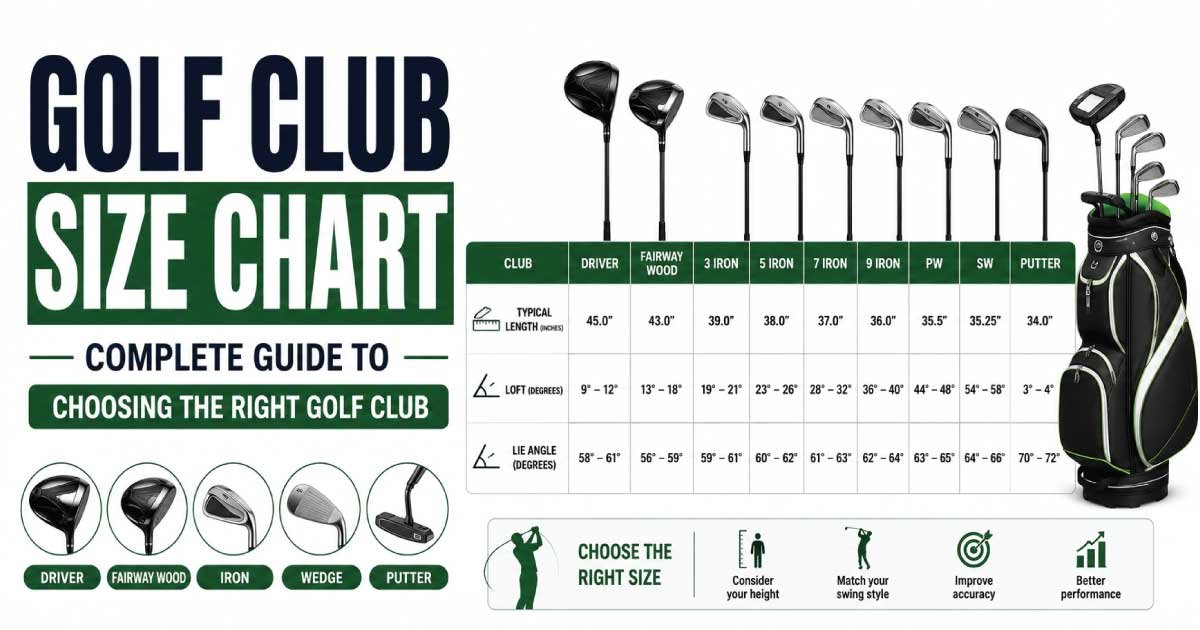
Choosing the right golf club size can make a major difference in swing consistency, comfort, distance, and overall performance. Golf clubs are not simply selected according to height. Golfer height, wrist-to-floor measurement, swing characteristics, club length, shaft flex, and playing ability can all influence the best fit.
A golf club size chart provides a useful starting point for determining the appropriate club length for men, women, juniors, and golfers of different heights. While standard clubs are available in common lengths, players who fall outside average measurements may benefit from custom fitting.
Golf clubs include drivers, fairway woods, hybrids, irons, wedges, and putters. Each type has different standard dimensions and plays a different role on the course.
This complete guide explains golf club sizes, standard club lengths, height-based sizing, wrist-to-floor measurements, junior golf club sizes, women’s and men’s club sizes, and how to determine whether your clubs are too long or too short.
Why Golf Club Size Matters
Golf is highly dependent on consistency. Even a small difference in club length can affect posture, swing path, contact point, and ball flight.
A properly sized golf club can help you:
- Maintain a comfortable setup
- Improve swing consistency
- Make more centered contact
- Maintain proper posture
- Control the club more effectively
- Improve distance and accuracy
A club that is too long may force you to stand too far from the ball or make it difficult to control the clubhead. A club that is too short can cause excessive bending and may change your swing mechanics.
The goal is not simply to choose the longest club you can use. The goal is to find a club that matches your body proportions and swing.
Golf Club Size Chart by Golfer Height
Height is one of the easiest ways to estimate golf club length.
| Golfer Height | General Club Length Adjustment |
|---|---|
| Under 5’0″ | About -1″ to -2″ |
| 5’0″–5’3″ | About -0.75″ to -1.5″ |
| 5’4″–5’6″ | About -0.5″ to -1″ |
| 5’7″–6’0″ | Standard length range |
| 6’1″–6’3″ | About +0.5″ |
| 6’4″–6’6″ | About +0.75″ to +1″ |
| Over 6’6″ | About +1″ or more |
These are general fitting guidelines rather than universal standards. Two golfers of the same height can require different club lengths because their arm and wrist-to-floor measurements differ.
Standard Golf Club Length Chart
Club lengths vary by manufacturer and club model. The following ranges provide a general reference for men’s standard clubs.
| Golf Club | Typical Length |
|---|---|
| Driver | 44–46 in |
| 3-Wood | 42–43 in |
| 5-Wood | 41–42 in |
| 3-Hybrid | 39–41 in |
| 4-Hybrid | 38.5–40.5 in |
| 4-Iron | 38–39 in |
| 5-Iron | 37.5–38.5 in |
| 6-Iron | 37–38 in |
| 7-Iron | 36.5–37.5 in |
| 8-Iron | 36–37 in |
| 9-Iron | 35.5–36.5 in |
| Pitching Wedge | 35–36 in |
| Sand Wedge | 34.5–35.5 in |
| Putter | 32–36 in |
Exact lengths differ between club manufacturers, models, and fitting systems.
How Golf Club Length Is Measured
Golf club length is generally measured from the sole of the club to the end of the grip along the shaft.
The measurement method can vary slightly between manufacturers, so published specifications may not always be directly comparable.
For practical club fitting, the most important point is consistency. When comparing clubs, use measurements from the same manufacturer or fitting system whenever possible.
Men’s Golf Club Size Chart
Men’s golf clubs are commonly manufactured around a standard length designed for an average adult male golfer.
| Club | Approx. Men’s Standard Length |
|---|---|
| Driver | 45–46 in |
| 3-Wood | 42.5–43 in |
| 5-Wood | 41.5–42 in |
| Hybrid | 39–41 in |
| 4-Iron | 38.5 in |
| 5-Iron | 38 in |
| 6-Iron | 37.5 in |
| 7-Iron | 37 in |
| 8-Iron | 36.5 in |
| 9-Iron | 36 in |
| Pitching Wedge | 35.5 in |
| Sand Wedge | 35 in |
These are approximate values because manufacturers use different club designs.
Women’s Golf Club Size Chart
Women’s golf clubs are generally shorter and lighter than men’s standard clubs, although individual fitting is more important than gender alone.
| Club | Approx. Women’s Standard Length |
|---|---|
| Driver | 43–44 in |
| 3-Wood | 41–42 in |
| 5-Wood | 40–41 in |
| Hybrid | 38–40 in |
| 5-Iron | 36–37 in |
| 6-Iron | 35.5–36.5 in |
| 7-Iron | 35–36 in |
| 8-Iron | 34.5–35.5 in |
| 9-Iron | 34–35 in |
| Pitching Wedge | 33.5–34.5 in |
| Sand Wedge | 33–34 in |
Women who are taller or shorter than average may benefit from a custom fitting rather than automatically selecting standard women’s lengths.
Golf Club Size by Height
A golfer’s height provides a useful first estimate for club length.
Golfers Under 5 Feet
Golfers below 5 feet tall may require significantly shorter clubs.
Depending on arm length and wrist-to-floor measurement, clubs may need to be shortened by approximately 1–2 inches.
Golfers 5’0″ to 5’3″
Players in this height range may benefit from clubs approximately 0.5–1.5 inches shorter than standard men’s clubs, depending on their proportions.
Golfers 5’4″ to 5’6″
Some golfers in this range may need slightly shorter clubs, while others may be comfortable with standard women’s or men’s lengths.
Golfers 5’7″ to 6’0″
Many golfers in this range can start with standard-length clubs and adjust according to wrist-to-floor measurements and swing characteristics.
Golfers Over 6 Feet
Tall golfers may require longer clubs, particularly if their wrist-to-floor measurement is above average.
What Is Wrist-to-Floor Measurement?
Wrist-to-floor measurement is one of the most useful measurements for golf club fitting.
It measures the distance from the floor to the crease of your wrist while standing naturally.
This measurement helps account for differences in arm length.
Two golfers can have the same height but different arm lengths. One may require standard-length clubs while the other may need clubs that are slightly shorter or longer.
Also Read: Pillow Size Chart for Better Sleep Every Night
How to Measure Wrist to Floor
You can measure wrist-to-floor height at home.
Step 1: Stand Naturally
Stand upright on a hard, level surface while wearing normal golf shoes or similar footwear.
Keep your arms relaxed at your sides.
Step 2: Measure From the Floor
Have someone measure from the floor directly upward to the crease of your wrist.
Do not stretch your arm or bend your wrist.
Step 3: Record the Measurement
Record the result in inches or centimeters.
Use this measurement together with your height when evaluating golf club length.
Golf Club Length Based on Wrist-to-Floor Measurement
Wrist-to-floor measurement can provide more information than height alone.
| Wrist-to-Floor Measurement | General Fitting Direction |
|---|---|
| Under 30 in | Shorter clubs may be appropriate |
| 30–32 in | Slightly short to standard |
| 32–34 in | Standard range for many golfers |
| 34–36 in | Slightly longer clubs may be appropriate |
| Over 36 in | Longer clubs may be appropriate |
These ranges are only general guidelines. Club fitting should also consider posture, arm length, hand position, and swing mechanics.
Iron Size Chart
Iron length decreases progressively as the number increases.
| Iron | Approx. Standard Length |
|---|---|
| 3-Iron | 39 in |
| 4-Iron | 38.5 in |
| 5-Iron | 38 in |
| 6-Iron | 37.5 in |
| 7-Iron | 37 in |
| 8-Iron | 36.5 in |
| 9-Iron | 36 in |
| Pitching Wedge | 35.5 in |
Manufacturers may use slightly different specifications.
The length progression is designed to help create different launch conditions and distances throughout the iron set.
Driver Size Guide
The driver is typically the longest club in a standard golf bag.
Modern drivers commonly fall around 44–46 inches, although individual models and player preferences vary.
A longer driver can potentially increase clubhead speed, but greater length can also make the club harder to control.
For many golfers, the best driver length is a compromise between:
- Clubhead speed
- Centered contact
- Directional control
- Swing consistency
Longer does not automatically mean farther if contact quality decreases.
Also Read: Standard Rug Size Chart and Rug Measurement Guide
Fairway Wood Size Chart
Fairway woods are shorter than drivers.
| Fairway Wood | Approximate Length |
|---|---|
| 3-Wood | 42–43 in |
| 5-Wood | 41–42 in |
| 7-Wood | 40–41 in |
| 9-Wood | 39.5–40.5 in |
The exact length depends on the manufacturer and club design.
Hybrid Golf Club Size Chart
Hybrids generally fall between fairway woods and irons in terms of length.
| Hybrid | Typical Length |
|---|---|
| 2-Hybrid | 40–41 in |
| 3-Hybrid | 39.5–40.5 in |
| 4-Hybrid | 39–40 in |
| 5-Hybrid | 38–39.5 in |
| 6-Hybrid | 37.5–39 in |
Hybrid length can vary considerably between manufacturers, so check the club specifications before purchasing.
Golf Wedge Size Chart
Wedges are shorter than most irons and are designed for control and precision.
| Wedge | Typical Length |
|---|---|
| Pitching Wedge | 35–36 in |
| Gap Wedge | 35–36 in |
| Sand Wedge | 34.5–35.5 in |
| Lob Wedge | 34–35.5 in |
Wedge length is often adjusted to maintain consistent distance gaps and comfortable control.
Putter Size Chart
Putter length is highly individual.
| Golfer Type | Common Putter Length |
|---|---|
| Junior | 26–32 in |
| Short Adult | 32–33 in |
| Average Adult | 33–35 in |
| Tall Adult | 35–36+ in |
The correct putter length depends heavily on setup posture, arm position, stroke style, and where the golfer naturally places the eyes relative to the ball.
Junior Golf Club Size Chart
Junior golfers need appropriately sized clubs because adult clubs can be too long and heavy.
| Junior Height | Approx. Club Length |
|---|---|
| 36–40 in | 26–29 in |
| 40–44 in | 28–32 in |
| 44–48 in | 30–34 in |
| 48–52 in | 32–36 in |
| 52–56 in | 34–38 in |
| 56–60 in | 36–40 in |
Junior club sizing varies significantly between manufacturers and junior golf systems.
The child should be able to control the club comfortably without excessive effort.
Also Read: Perfect Bookshelf Size Guide With Chart
Golf Club Size for Kids
Children should not simply use shortened adult clubs.
Junior golf clubs are typically designed with:
- Shorter shafts
- Lighter overall weight
- Appropriate grip sizes
- Junior-friendly flex
- Smaller clubheads or adjusted designs
The right club should allow the child to maintain balance and make a controlled swing.
As the child grows, club length and weight should be reassessed.
How to Know if Golf Clubs Are Too Long
Your clubs may be too long if you notice:
- Standing too far from the ball
- Difficulty controlling the clubhead
- Excessive upright posture
- Frequent heel strikes
- An uncomfortable setup
- Inconsistent swing path
Long clubs can make it difficult to establish a comfortable address position.
How to Know if Golf Clubs Are Too Short
Clubs may be too short if:
- You bend excessively at the waist
- The club sits too far inside the correct position
- You frequently strike the toe
- Your posture feels uncomfortable
- You feel cramped at address
However, contact location can be affected by many factors, so club length should not be diagnosed from ball-striking alone.
Golf Club Length and Swing Speed
Club length can influence swing speed.
A longer club can create a larger swing arc, but it can also make the club harder to control.
For this reason, increasing club length is not always the best solution for generating more distance.
Consistent center contact is often more important than simply adding length.
Also Read: TV Wall Mount Size Chart: Complete Guide to Standard Sizes
Golf Club Shaft Flex and Size
Club length is only one part of club fitting.
Shaft flex also affects how a club feels during the swing.
Common shaft flex categories include:
- Ladies
- Senior
- Regular
- Stiff
- Extra Stiff
The correct flex depends more on swing characteristics and clubhead speed than simply age or gender.
A golfer should consider shaft flex separately from club length.
Golf Grip Size Matters Too
The grip is another important part of golf club fitting.
Common grip categories include:
- Undersize
- Standard
- Midsize
- Oversize
Hand size and how the golfer holds the club can influence the best grip size.
A grip that is too large or too small may affect hand action and comfort.
Golf Club Size for Beginners
Beginners should prioritize clubs that are comfortable and easy to control.
A beginner does not necessarily need the longest or most advanced club.
Start with appropriate length, manageable weight, suitable shaft flex, and a comfortable grip.
As swing technique develops, a professional fitting can help refine the specifications.
Golf Club Size for Seniors
Older golfers may benefit from lighter club configurations, but age alone does not determine the ideal club size.
Many senior golfers benefit from:
- Appropriate club length
- Lighter shafts
- Suitable shaft flex
- Comfortable grips
- Easy-to-control clubheads
The goal should be to match the equipment to the golfer’s current swing rather than choosing solely according to age.
Common Golf Club Sizing Mistakes
Choosing Clubs Only by Height
Height is useful, but wrist-to-floor measurement provides additional information.
Assuming Everyone Needs Standard Length
Standard clubs are designed around general averages and will not fit every golfer perfectly.
Choosing Longer Clubs for More Distance
Longer clubs can be harder to control and may reduce centered contact.
Ignoring Grip Size
A poorly sized grip can affect comfort and swing mechanics.
Ignoring Shaft Flex
Shaft flex can influence feel and performance.
Using Adult Clubs for Children
Adult clubs may be too long and heavy for junior players.
Buying a Full Set Without Checking Specifications
Club lengths can differ between manufacturers and sets. Always check the specifications.
Final Thoughts on Choosing the Right Golf Club Size
Finding the correct golf club size is an important part of building a comfortable and consistent golf setup. Height provides a convenient starting point, but wrist-to-floor measurement, arm length, club type, swing characteristics, shaft flex, and grip size can all affect the final fit.
For most golfers, standard-length clubs may be a reasonable starting point. However, golfers who are significantly taller or shorter than average may benefit from adjusted club lengths.
Remember that every club in the bag has a different purpose and length. Drivers are longer, irons progressively become shorter, wedges prioritize control, and putters require an individualized setup.
The best golf clubs are not necessarily the longest or heaviest. They are the clubs that allow you to maintain a comfortable posture, control the clubhead, make consistent contact, and repeat your swing confidently. Use this golf club size chart as a starting guide, then fine-tune your equipment based on your individual measurements and playing needs.
Frequently Asked Questions About Golf Club Sizes
How do I know what golf club length I need?
Start with your height and wrist-to-floor measurement. These measurements provide a useful starting point for determining whether you may need standard, shorter, or longer clubs. A professional fitting can provide a more precise recommendation.
What is the standard golf club length?
There is no single standard length for every golf club. For example, men’s drivers are commonly around 44–46 inches, while a 7-iron is often around 36.5–37.5 inches. Manufacturers may use different specifications.
What golf club length should a 5’2″ golfer use?
A golfer who is 5’2″ may need clubs shorter than standard men’s length, but the exact adjustment depends on wrist-to-floor measurement and arm length. A fitting chart should be used as a starting point rather than a final prescription.
What golf club length should a 6’4″ golfer use?
A 6’4″ golfer may need clubs approximately 0.5–1 inch longer than standard, depending on wrist-to-floor measurement and posture. A professional fitting can determine the most suitable length.
Are men’s and women’s golf clubs different sizes?
Women’s clubs are generally shorter and lighter than men’s standard clubs. However, there is considerable variation, and golfers should choose clubs based on their physical proportions and swing characteristics rather than gender alone.
What is the best golf club size for beginners?
Beginners should use clubs that are easy to control and appropriate for their height and wrist-to-floor measurement. Comfortable length, suitable shaft flex, manageable weight, and proper grip size are all important.
How do I measure wrist-to-floor for golf clubs?
Stand naturally on a flat surface with your arms relaxed at your sides. Measure from the floor to the crease of your wrist. Take the measurement without bending or stretching your wrist.
Can golf clubs be too long?
Yes. Clubs that are too long can make it difficult to maintain proper posture and control the clubhead. They may also contribute to inconsistent contact and an uncomfortable setup.
Can golf clubs be too short?
Yes. Clubs that are too short may force you to bend excessively and can change your address position and swing mechanics. A properly fitted club should allow a natural and comfortable setup.
Does height determine golf club size?
Height is an important starting point, but it does not determine club length by itself. Wrist-to-floor measurement, arm length, posture, swing mechanics, and personal preference can also influence club fitting.
What length driver should I use?
Drivers commonly range from approximately 44–46 inches. The best length depends on the player’s ability to maintain clubhead speed and centered contact. A shorter driver can sometimes provide greater control.
What size golf clubs should a junior use?
Junior golf club length should be based primarily on the child’s height, arm length, age, and ability to control the club. Junior sets commonly range from approximately 26–40 inches depending on the child’s size and the club type.
Should all golf clubs be the same length?
No. Traditional golf sets use different lengths for different clubs. Longer clubs are used for longer shots, while shorter clubs provide greater control for shorter shots.
