
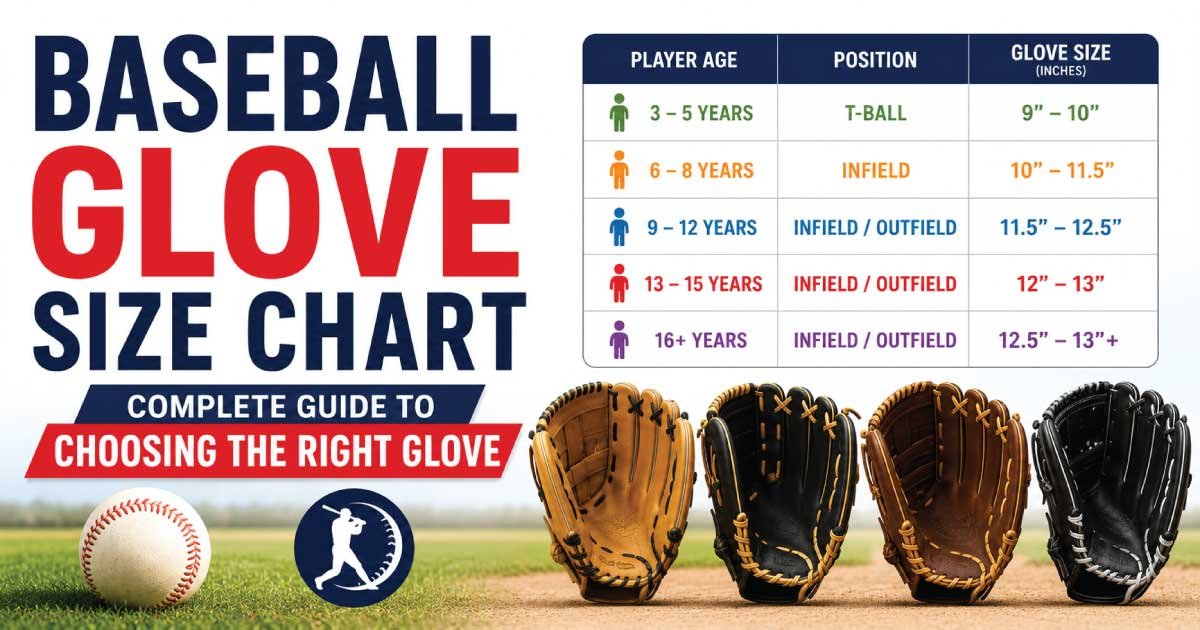
Choosing the right baseball glove size is essential for comfort, control, catching ability, and overall performance. A glove that is too large can be difficult to close and control, while one that is too small may not provide enough catching surface.
A baseball glove size chart makes it easier to find the appropriate glove based on age, position, and playing level. Unlike baseball bats, gloves are generally measured by their length in inches, from the tip of the index finger down to the heel of the glove.
The ideal glove size also depends on the player’s position. Infielders usually prefer smaller gloves for quick transfers, while outfielders often use larger gloves to provide more catching surface and reach.
This complete guide covers baseball glove sizes for youth players, adults, infielders, outfielders, pitchers, first basemen, catchers, softball players, and different age groups.
Why Baseball Glove Size Matters
A baseball glove is one of the most important pieces of equipment a player uses. Choosing the correct size can make catching, fielding, transferring the ball, and throwing more comfortable.
A properly sized glove should allow the player to:
- Catch the ball comfortably
- Close the glove properly
- Control the ball after catching
- Transfer the ball quickly
- Move the glove naturally
- Maintain good fielding technique
A glove that is too large may feel heavy and difficult to close. A glove that is too small may not provide enough pocket depth or catching area.
For this reason, age and hand size alone should not determine glove size. Playing position is also extremely important.
Baseball Glove Size Chart by Age
The following chart provides general glove size recommendations for baseball players.
| Player Age | Typical Glove Size | General Use |
|---|---|---|
| 3–5 years | 8–9 in | Beginner/T-ball |
| 5–7 years | 9–10 in | Youth baseball |
| 7–9 years | 9.5–10.5 in | Youth infield |
| 9–12 years | 10–11 in | Youth baseball |
| 12–14 years | 10.5–11.5 in | Youth/Intermediate |
| 14+ years | 11–12.5 in | High school/Adult |
| Adult Outfield | 12–13 in | Outfield |
| Adult First Base | 12–13 in | First base |
These are general ranges. The correct glove size can vary depending on the player’s position, hand size, league, and personal preference.
Baseball Glove Size Chart by Position
Position is one of the most important factors when choosing a baseball glove.
| Position | Youth Glove Size | Adult Glove Size |
|---|---|---|
| Infield | 9–11 in | 11–11.75 in |
| Pitcher | 9.5–11 in | 11.5–12 in |
| Third Base | 10–11 in | 11.5–12 in |
| Outfield | 10–12 in | 12–13 in |
| First Base | 10–12 in | 12–13 in |
| Catcher | 30–32.5 in | 32–34+ in |
Catcher’s mitts are measured differently from standard fielding gloves, so their measurements should not be directly compared with an 11-inch or 12-inch glove.
How Baseball Gloves Are Measured
Baseball gloves are measured in inches.
The measurement generally runs from the tip of the index finger, along the glove, to the bottom of the heel.
For example, an 11.5-inch glove is approximately 11.5 inches from the tip of the index finger to the heel.
The measurement does not represent the width of the glove or the circumference of the hand opening.
Youth Baseball Glove Size Chart
Youth players generally need smaller gloves because their hands are smaller and they need to be able to close the glove effectively.
| Age | Recommended Glove Size |
|---|---|
| 3–4 years | 8–9 in |
| 4–6 years | 9–10 in |
| 6–8 years | 9–10.5 in |
| 8–10 years | 10–11 in |
| 10–12 years | 10.5–11.5 in |
| 12–14 years | 11–12 in |
A young player should be able to comfortably squeeze the glove closed. If the glove is too large to control, moving to a smaller size can be beneficial.
Baseball Glove Size for 5-Year-Olds
A 5-year-old beginner will often use a glove around 9–10 inches.
For very small hands, an 8–9 inch glove may be easier to control.
At this age, comfort and ease of closing the glove are more important than choosing a large glove that the child may “grow into.”
A properly fitted youth glove can help a young player develop confidence when catching.
Baseball Glove Size for 8-Year-Olds
An 8-year-old player will often use a glove around 9.5–10.5 inches.
The correct size depends on the player’s position.
An infielder may prefer a smaller glove for quick transfers, while an outfielder may need a slightly larger glove.
Baseball Glove Size for 10-Year-Olds
A 10-year-old player may commonly use a glove around 10–11 inches.
Players who are transitioning to larger fields may begin using slightly larger gloves, especially at outfield positions.
The glove should still be easy to close and control.
Baseball Glove Size for 12-Year-Olds
A 12-year-old player may use a glove around 10.5–11.5 inches, depending on position and hand size.
Players at this age often begin developing more specialized positions, so position-specific sizing becomes increasingly important.
Baseball Glove Size for 13-Year-Olds
A 13-year-old player may use a glove around 11–12 inches.
Middle infielders may prefer smaller gloves, while outfielders may use larger gloves.
Players transitioning toward high school baseball should also consider the glove size commonly used for their position.
Baseball Glove Size for 14-Year-Olds
A 14-year-old player may use gloves around 11–12 inches, although larger sizes may be appropriate for outfield positions.
At this age, hand size, position, and playing level are usually more important than age alone.
High School Baseball Glove Size Chart
High school players generally use position-specific gloves.
| Position | Typical Glove Size |
|---|---|
| Middle Infield | 11–11.5 in |
| Third Base | 11.5–12 in |
| Pitcher | 11.5–12 in |
| Outfield | 12–12.75 in |
| First Base | 12–13 in |
| Catcher | 32–34 in mitt |
High school glove sizing can vary according to player preference and position.
Adult Baseball Glove Size Chart
Adult players typically use larger gloves than younger players, although infielders often prefer compact gloves for quick ball transfers.
| Position | Typical Adult Glove Size |
|---|---|
| Second Base | 11–11.5 in |
| Shortstop | 11–11.75 in |
| Third Base | 11.5–12 in |
| Pitcher | 11.5–12 in |
| Outfield | 12–13 in |
| First Base | 12–13 in |
| Catcher | 32–34+ in |
These are general recommendations rather than strict requirements.
Also Read: Standard Couch Size Chart 2026: Complete Guide
Infield Baseball Glove Size
Infielders often prefer smaller gloves because they need to quickly field the ball and transfer it from glove to throwing hand.
Second Base Glove Size
Second basemen commonly use gloves around 11–11.5 inches.
A smaller glove can make rapid transfers easier.
Shortstop Glove Size
Shortstops often use gloves around 11–11.75 inches.
The glove needs to provide enough catching surface while remaining quick and maneuverable.
Third Base Glove Size
Third basemen may prefer a slightly larger glove, often around 11.5–12 inches.
A larger pocket can help when handling hard-hit balls.
Outfield Baseball Glove Size
Outfielders generally use larger gloves because they need additional catching surface and reach.
Adult outfield gloves commonly range from approximately 12 to 13 inches.
Youth outfield gloves are generally smaller, depending on the player’s age.
A deeper pocket can be useful for securing fly balls and catching balls hit with greater distance.
Pitcher’s Glove Size
Pitchers often use gloves around 11.5–12 inches at the adult level.
The glove should provide enough pocket space while allowing the pitcher to comfortably control the ball.
Pitchers may also prefer closed web designs that make it more difficult for opponents to see the grip.
First Baseman Glove Size
First baseman’s gloves are specialized mitts designed specifically for the position.
Adult first baseman’s mitts commonly measure around 12–13 inches.
They have a longer shape that provides a larger catching target and helps with scooping throws from the infield.
Youth first baseman’s mitts are generally smaller.
Catcher’s Mitt Size Chart
Catcher’s mitts are measured differently from standard baseball gloves.
| Player Age | Typical Catcher’s Mitt |
|---|---|
| Under 8 years | 30–31 in |
| 8–10 years | 31–32 in |
| 10–13 years | 32–33 in |
| 13+ years | 32–34+ in |
Catcher’s mitts do not have individual finger stalls like conventional baseball gloves.
Instead, they are designed with extra padding and a rounded shape to withstand repeated high-speed pitches.
Baseball Glove Size by Position and Age
The combination of age and position provides a more useful guide than age alone.
| Age Group | Infield | Pitcher | Outfield | First Base |
|---|---|---|---|---|
| 5–7 | 9–10 in | 9–10 in | 9–10 in | 9.5–10.5 in |
| 8–10 | 10–10.5 in | 10–11 in | 10.5–11.5 in | 10.5–11.5 in |
| 11–13 | 10.5–11.5 in | 11–11.5 in | 11–12 in | 11.5–12 in |
| 14+ | 11–11.75 in | 11.5–12 in | 12–13 in | 12–13 in |
These ranges are intended as a general sizing reference.
Also Read: Queen Bed Size Chart: Complete Guide (Dimensions, Inches, Feet & CM)
How to Choose the Right Baseball Glove Size
Start by identifying the player’s position.
If the player plays shortstop or second base, a smaller glove may provide better control.
If the player plays outfield, a larger glove may provide better reach and catching surface.
Next, consider the player’s age and hand size.
Finally, make sure the player can comfortably close the glove.
A glove should not be selected solely because it is the size recommended for a particular age.
How Hand Size Affects Baseball Glove Fit
Hand size can affect how easily a player controls a glove.
A glove may have the correct length but still feel too loose or difficult to control if the hand opening is inappropriate.
For younger players, youth-specific gloves often provide narrower hand stalls and smaller wrist openings.
When possible, have the player try the glove on before buying.
What Is a Baseball Glove Pocket?
The pocket is the area of the glove where the baseball sits after being caught.
Different positions may favor different pocket designs.
Infield gloves often have shallower pockets to make ball transfers faster.
Outfield gloves usually have deeper pockets to help secure fly balls.
The glove’s shape, web, and break-in style all affect pocket depth.
Baseball Glove Web Types
The web is the section between the thumb and index finger.
Different web designs can be useful for different positions.
Common baseball glove web styles include:
- I-web
- H-web
- Basket web
- Trapeze web
- Modified trapeze
- Closed web
- Two-piece web
Middle infielders often prefer webs that allow quick ball transfers, while pitchers may prefer closed or partially closed webs.
Infield vs. Outfield Glove Size
The biggest difference between many infield and outfield gloves is length and pocket depth.
Infield Gloves
Infield gloves tend to be:
- Smaller
- More maneuverable
- Designed for quick transfers
- Built with shallower pockets
Outfield Gloves
Outfield gloves tend to be:
- Longer
- Deeper
- Designed for additional reach
- Built with larger catching surfaces
Using the correct glove for your position can improve comfort and fielding efficiency.
Baseball Glove vs. Softball Glove Size
Baseball and softball gloves are similar in appearance but can differ in design and sizing.
Softballs are larger than baseballs, so softball gloves often have deeper pockets and different dimensions.
If you play softball, choose a glove specifically designed for the type of softball you play rather than relying solely on a baseball glove size chart.
Also Read: Living Room End Table Size Guide With Chart
How Should a Baseball Glove Fit?
A baseball glove should fit securely around the hand and wrist.
The player should be able to open and close the glove without excessive effort.
The fingers should fit comfortably into the stalls without being cramped.
The wrist opening should feel secure but should not cause uncomfortable pressure.
A properly fitted glove should feel like an extension of the hand rather than a heavy object attached to it.
How to Break in a New Baseball Glove
New leather gloves can feel stiff.
Breaking in a glove helps make the pocket and closing action more comfortable.
Players can gradually loosen the glove through normal catching and fielding practice.
Common approaches include:
- Playing catch regularly
- Working the glove with your hands
- Forming the pocket naturally
- Repeatedly opening and closing the glove
Avoid using methods that could damage the leather or weaken the glove.
Common Baseball Glove Sizing Mistakes
Choosing a Glove Based Only on Age
Age is useful, but position and hand size are equally important.
Buying a Glove That Is Too Large
A larger glove is not always better. Young players may struggle to close and control it.
Using the Same Glove for Every Position
Different positions often benefit from different glove dimensions.
Ignoring Hand Fit
A glove should fit the player’s hand securely.
Choosing a Glove That Is Too Small
An undersized glove may reduce catching surface and comfort.
Confusing Catcher’s Mitt Measurements
Catcher’s mitts are measured differently from conventional fielding gloves.
Frequently Asked Questions About Baseball Glove Sizes
What size baseball glove should I get?
The correct baseball glove size depends mainly on the player’s age and position. Youth gloves generally range from about 9–11.5 inches, while adult infield gloves are often around 11–12 inches and adult outfield gloves around 12–13 inches.
What size baseball glove does a 10-year-old need?
A 10-year-old will commonly use a glove around 10–11 inches. Infielders may prefer the smaller end of the range, while outfielders may use a slightly larger glove.
What size baseball glove does a 12-year-old need?
A 12-year-old player may commonly use a 10.5–11.5 inch glove. Position and hand size should also be considered when selecting the final glove.
What size glove does a 14-year-old need?
Many 14-year-old players use gloves around 11–12 inches. Infielders generally use smaller gloves, while outfielders often use larger models.
What size baseball glove should an adult use?
Adult infielders commonly use gloves around 11–11.75 inches, while outfielders often use approximately 12–13 inches. Pitchers and third basemen commonly fall between these ranges.
What size glove is best for a shortstop?
Adult shortstops commonly use an 11–11.75 inch glove. Youth shortstops generally use smaller gloves based on age and hand size. Quick ball transfers are an important consideration for this position.
What size glove is best for an outfielder?
Adult outfielders commonly use gloves around 12–13 inches. The larger size provides additional catching surface and reach, which can be helpful when tracking fly balls.
What size glove does a first baseman use?
Adult first basemen commonly use a 12–13 inch first baseman’s mitt. These specialized mitts have a longer shape and larger catching surface than standard infield gloves.
What size glove does a catcher use?
Catcher’s mitts are commonly around 32–34 inches for older players. Youth catcher’s mitts are generally smaller, often around 30–33 inches depending on age.
Can a youth player use an adult baseball glove?
A youth player can technically use an adult glove, but it may be too large or difficult to control. Youth-specific gloves are often better because they are designed for smaller hands and easier closure.
Is a bigger baseball glove better?
Not always. Larger gloves provide more catching surface, but they can be harder to control and may slow down transfers. The best size depends on position, age, hand size, and playing style.
How are baseball gloves measured?
Standard baseball gloves are measured in inches from the tip of the index finger down to the heel. Catcher’s mitts are measured differently and use a circumference-style measurement.
What glove size is best for beginners?
Beginners should generally choose a glove that is easy to open, close, and control. For young players, gloves around 9–10.5 inches are common, depending on age and position.
Final Thoughts on Choosing the Right Baseball Glove Size
Choosing the right baseball glove size can make a significant difference in comfort and fielding performance. The best size depends on more than just age. Position, hand size, playing level, and personal preference all play an important role.
Younger players generally need smaller gloves that they can easily close and control. Infielders usually benefit from compact gloves that allow quick transfers, while outfielders often prefer larger gloves for additional reach and catching surface.
When choosing a glove, start with the appropriate size range for the player’s age and position. Then make sure the glove fits comfortably around the hand and can be opened and closed without excessive effort.
A properly sized glove should feel natural, secure, and easy to control. With the right baseball glove size chart as a reference, players and parents can make a more informed decision and find a glove that supports confident fielding and long-term development.
