
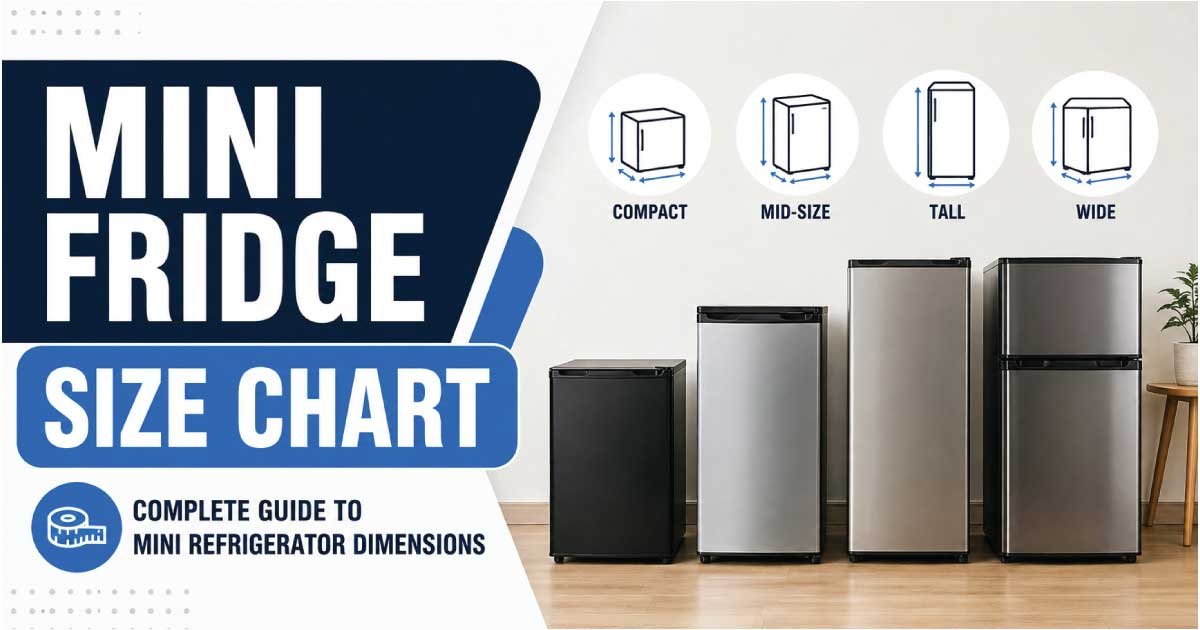
A mini fridge is a convenient refrigeration solution for bedrooms, offices, dorm rooms, apartments, guest rooms, garages, entertainment areas, and small kitchens. Because mini refrigerators come in many different sizes, choosing the right model requires more than simply checking its storage capacity.
The mini fridge size affects how much food and drinks you can store, where the refrigerator can be installed, how much floor space it occupies, and whether the door can open comfortably. Some compact refrigerators are small enough to fit under a desk, while larger apartment-size models provide considerably more storage.
In this mini fridge size chart and complete guide, you will learn about standard mini refrigerator dimensions, mini fridge width, height, depth, capacity, compact refrigerator sizes, dorm fridge dimensions, under-counter refrigerators, and how to measure your available space.
What Is a Mini Fridge?
A mini fridge, also called a compact refrigerator, is a smaller refrigerator designed for situations where a full-size refrigerator is unnecessary or would take up too much space.
Mini refrigerators are commonly used in:
- Dorm rooms
- Bedrooms
- Home offices
- Small apartments
- Guest rooms
- Garages
- Basements
- RVs
- Hotels
- Entertainment rooms
- Small kitchens
Depending on the model, a mini fridge may include a refrigerator compartment, freezer compartment, adjustable shelves, door storage, a vegetable drawer, or a combination of these features.
The most important measurements are height, width, depth, and interior capacity.
Mini Fridge Size Chart
The following chart provides general dimensions for common mini refrigerator categories.
| Mini Fridge Type | Typical Capacity | Approx. Width | Approx. Height | Approx. Depth |
|---|---|---|---|---|
| Personal Mini Fridge | 1.7–2.5 cu. ft. | 17–20 in | 19–27 in | 18–21 in |
| Small Compact Fridge | 2.5–3.2 cu. ft. | 18–20 in | 25–34 in | 19–22 in |
| Dorm Mini Fridge | 3.0–4.5 cu. ft. | 18–21 in | 30–36 in | 19–23 in |
| Medium Mini Fridge | 4.5–6 cu. ft. | 20–24 in | 32–38 in | 20–25 in |
| Apartment Compact Fridge | 6–10 cu. ft. | 22–24 in | 50–60 in | 23–27 in |
| Under-Counter Refrigerator | 4–6 cu. ft. | 20–24 in | 32–35 in | 22–25 in |
These dimensions are general ranges. Actual mini refrigerator dimensions vary by brand, model, door design, handle, cooling system, and interior configuration.
Standard Mini Fridge Dimensions
There is no single standard size for all mini refrigerators. Compact refrigerators are manufactured in several categories to meet different storage and space requirements.
A typical small mini fridge may be approximately:
- 18–20 inches wide
- 20–24 inches deep
- 25–35 inches high
Larger compact refrigerators can be significantly taller and may provide several cubic feet of additional storage.
When comparing refrigerators, remember that capacity and external dimensions are different measurements. Two refrigerators with similar exterior dimensions may have different usable interior space because of insulation, shelves, compressors, and freezer compartments.
Mini Fridge Width
Mini fridge width is particularly important when the refrigerator needs to fit into a specific location.
Common compact refrigerator widths include approximately:
- 17 inches
- 18 inches
- 19 inches
- 20 inches
- 21 inches
- 22 inches
- 24 inches
Very small personal refrigerators may be narrower, while larger compact and apartment refrigerators can approach standard under-counter or apartment refrigerator widths.
18-Inch Mini Fridge
An 18-inch-wide mini fridge can work well in compact areas such as dorm rooms, offices, and bedrooms.
20-Inch Mini Fridge
A 20-inch model offers a useful balance between compact size and storage capacity.
24-Inch Mini Fridge
A 24-inch compact refrigerator provides more storage and may be suitable for small kitchens, offices, entertainment spaces, or apartments.
Mini Fridge Height
Mini refrigerator height varies considerably.
Small personal models may be less than 25 inches tall, while larger compact refrigerators can reach approximately 35 to 40 inches. Apartment-size compact refrigerators may be significantly taller.
Common height categories include:
| Fridge Type | Approx. Height |
|---|---|
| Personal Mini Fridge | 19–27 in |
| Compact Mini Fridge | 25–34 in |
| Dorm Refrigerator | 30–36 in |
| Larger Compact Refrigerator | 32–40 in |
| Apartment Refrigerator | 50–60+ in |
Before selecting a refrigerator, measure the available vertical space rather than relying only on the product’s advertised category.
Mini Fridge Depth
Mini refrigerator depth commonly ranges from approximately 18 to 27 inches.
Depth can be affected by:
- Compressor placement
- Door thickness
- Door handle
- Rear ventilation
- Cabinet construction
- Cooling technology
A refrigerator that fits within the available width and height may still stick too far into the room if its depth is not considered.
Mini Fridge Capacity Chart
Capacity is measured in cubic feet and provides an indication of how much the refrigerator can hold.
| Capacity | Best For |
|---|---|
| 1.0–1.5 cu. ft. | Drinks and very small storage |
| 1.7–2.5 cu. ft. | Personal use |
| 2.5–3.5 cu. ft. | Dorm rooms and offices |
| 3.5–4.5 cu. ft. | Individual or shared use |
| 4.5–6 cu. ft. | Larger personal storage |
| 6–10 cu. ft. | Small apartments and kitchens |
Capacity should be considered alongside the refrigerator’s external dimensions.
A larger capacity does not automatically mean a better refrigerator if it cannot fit your available space.
Also Read: Door Size Chart: Complete Guide to Door Dimensions
What Size Mini Fridge Is Best for a Dorm Room?
A mini fridge between approximately 2.5 and 4.5 cubic feet is commonly suitable for dorm-room use.
Students may need enough space for:
- Drinks
- Snacks
- Fruit
- Leftovers
- Small food containers
- Condiments
- Dairy products
A compact refrigerator with a small freezer compartment can provide additional convenience.
Before purchasing a dorm refrigerator, check the room’s permitted appliance size because some student housing facilities have specific restrictions.
What Size Mini Fridge Is Best for a Bedroom?
For a bedroom, a compact model around 1.7 to 3.5 cubic feet can provide useful personal storage without taking up too much space.
A smaller refrigerator may be preferable if it will sit beside a desk or nightstand.
Consider the following before installation:
- Available floor space
- Door swing
- Noise level
- Ventilation
- Electrical outlet location
- Distance from walls
A refrigerator should not be squeezed tightly into an enclosed space unless the manufacturer’s installation instructions specifically allow it.
What Size Mini Fridge Is Best for an Office?
An office mini fridge typically needs enough space for drinks, lunch containers, fruit, and snacks.
A refrigerator around 2 to 4 cubic feet can be practical for individual or small-office use.
If several people will share the refrigerator, a larger 4- to 6-cubic-foot model may provide more useful storage.
What Size Mini Fridge Fits Under a Counter?
Under-counter refrigerators are generally designed around a cabinet-height installation.
Many are approximately 32 to 35 inches high, although exact dimensions vary.
This height can allow the refrigerator to sit beneath a countertop, but the actual opening must be measured carefully.
Check:
- Opening height
- Opening width
- Cabinet depth
- Door clearance
- Ventilation requirements
- Electrical connection
Do not assume that every compact refrigerator labeled “under-counter” will fit a particular cabinet opening.
Mini Fridge vs. Beverage Refrigerator
Mini fridges and beverage refrigerators are designed for different storage purposes.
A mini fridge typically provides general food and drink storage, while a beverage refrigerator is optimized for cans and bottles.
A beverage refrigerator may have:
- Adjustable racks
- Specialized bottle storage
- Glass doors
- Different temperature controls
If you need to store food, a general-purpose mini refrigerator may be more suitable.
Mini Fridge With Freezer Dimensions
Some mini refrigerators include a separate freezer compartment.
The freezer can be useful for:
- Frozen meals
- Ice
- Frozen snacks
- Small food packages
However, adding a freezer compartment can reduce the amount of refrigerator space available for fresh food.
When comparing models, look at both the total capacity and refrigerator/freezer capacity.
Also Read: Bedroom Rug Size Chart: Complete Guide
How Much Space Does a Mini Fridge Need?
The refrigerator should not be installed with no clearance around it unless the manufacturer specifically states that it can be built into an enclosed space.
Ventilation requirements vary between models.
Allow space according to the manufacturer’s installation instructions for:
- Rear ventilation
- Side clearance
- Top clearance
- Door opening
- Air circulation
The compressor and cooling system need appropriate ventilation to operate efficiently.
Mini Fridge Door Clearance
Door clearance is one of the most frequently overlooked measurements.
A refrigerator may physically fit into a space but still be difficult to use if the door cannot open fully.
Before installing a mini fridge, check:
- Door swing direction
- Door width
- Handle clearance
- Nearby cabinets
- Walls
- Furniture
- Countertops
Some models allow the door hinge to be reversed, which can make installation easier in tight spaces.
How to Measure for a Mini Fridge
Accurate measurements can prevent installation problems.
Step 1: Measure the Width
Measure the available opening from side to side.
If the refrigerator will be placed between cabinets, measure the opening at the top, middle, and bottom.
Step 2: Measure the Height
Measure from the floor to the underside of the countertop, shelf, or cabinet above.
If the refrigerator is freestanding, measure the total available vertical space.
Step 3: Measure the Depth
Measure from the wall to the front edge of the available space.
Remember that the refrigerator door and handle may extend beyond the main cabinet depth.
Step 4: Check Ventilation
Look at the manufacturer’s required clearance around the refrigerator.
Step 5: Check the Door Swing
Make sure the door has enough room to open fully.
Mini Fridge Dimensions for Small Spaces
Small spaces require careful consideration of both exterior dimensions and interior capacity.
A compact refrigerator around 18 to 20 inches wide can work well in many tight spaces.
For extremely limited areas, a personal refrigerator with a capacity around 1.5 to 2.5 cubic feet may be sufficient.
For better storage, consider a slightly larger model if the available space allows it.
Mini Fridge Dimensions for Apartments
Small apartments may benefit from a larger compact refrigerator rather than a very small personal model.
A refrigerator in the 4.5- to 10-cubic-foot range can provide substantially more storage while still occupying less space than a full-size refrigerator.
Apartment-size refrigerators may be taller than traditional dorm-style mini fridges, so ceiling clearance and installation space must be checked carefully.
Also Read: French Door Size Chart: Complete Guide to Perfect Size
Mini Fridge for Garage or Workshop
A compact refrigerator can be useful in a garage or workshop for drinks, snacks, and food storage.
Before placing a refrigerator in a garage, consider:
- Ambient temperature
- Ventilation
- Floor level
- Electrical outlet
- Door clearance
- Manufacturer operating requirements
Temperature conditions can affect refrigerator performance, so always follow the manufacturer’s recommendations for the intended environment.
Mini Fridge Size for an RV
RV refrigerators and compact refrigerators require special consideration because available space is limited.
Before choosing a refrigerator, measure:
- Width
- Height
- Depth
- Door opening
- Ventilation
- Electrical requirements
An RV refrigerator should be selected based on the exact available opening and the vehicle’s electrical system rather than dimensions alone.
Common Mini Fridge Size Mistakes
Choosing a Refrigerator That Is Too Large
A larger refrigerator may offer more storage but can block doors, walkways, or cabinets.
Measuring Only Width
Width alone is not enough. Height and depth can cause installation problems.
Ignoring the Door Swing
Make sure the refrigerator door can open fully.
Forgetting Ventilation
A compact refrigerator still requires appropriate airflow according to the manufacturer’s instructions.
Confusing Capacity With Exterior Size
A higher cubic-foot capacity does not always mean a refrigerator has dramatically larger exterior dimensions.
Not Measuring the Handle
Handles can extend beyond the main refrigerator body and affect available clearance.
Frequently Asked Questions About Mini Fridge Sizes
What is the standard size of a mini fridge?
There is no single standard mini fridge size. Many compact refrigerators are approximately 18 to 24 inches wide, 20 to 27 inches deep, and 25 to 36 inches high, depending on capacity and design.
How wide is a typical mini fridge?
A typical mini refrigerator is often around 18 to 24 inches wide. Smaller personal models may be narrower, while larger compact refrigerators can be approximately 24 inches wide or more.
How tall is a mini fridge?
Mini fridge height varies considerably. Small personal refrigerators may be around 19 to 27 inches tall, while larger dorm and compact models can reach approximately 30 to 40 inches.
How deep is a mini fridge?
Many mini refrigerators are approximately 18 to 27 inches deep. The exact depth depends on the model, door design, handle, compressor, and ventilation requirements.
What size mini fridge is best for a dorm?
A refrigerator around 2.5 to 4.5 cubic feet can be a practical choice for many dorm rooms. The best size depends on available space, storage requirements, and any housing rules regarding appliance dimensions.
What size mini fridge fits under a counter?
Many under-counter refrigerators are approximately 32 to 35 inches high, but exact dimensions vary. Always measure the opening and compare it with the manufacturer’s installation specifications.
How much clearance does a mini fridge need?
Clearance requirements vary by refrigerator model. The manufacturer’s installation instructions should be followed for rear, side, and top ventilation, as well as door-opening space.
Can a mini fridge be placed inside a cabinet?
Only if the refrigerator is specifically designed for built-in or enclosed installation. Freestanding mini fridges generally require ventilation around the unit, so they should not be enclosed without checking the manufacturer’s requirements.
Final Thoughts on Mini Fridge Sizes
Choosing the right mini fridge size depends on more than storage capacity. You need to consider the refrigerator’s width, height, depth, interior capacity, door swing, ventilation, and available installation space.
For personal use, a 1.7- to 3.5-cubic-foot mini fridge can provide convenient storage while taking up relatively little space. Dorm rooms and offices often benefit from models around 2.5 to 4.5 cubic feet, while larger compact refrigerators can provide enough storage for apartments and small kitchens.
Always measure the space before buying a mini refrigerator. Check the exact manufacturer dimensions, including the body, door, handle, hinges, and required ventilation clearance.
Use this Mini Fridge Size Chart as a starting point when comparing compact refrigerators, but always verify the exact specifications of the model you plan to purchase. A few minutes of careful measuring can prevent clearance problems and help you choose a refrigerator that fits your space comfortably.
