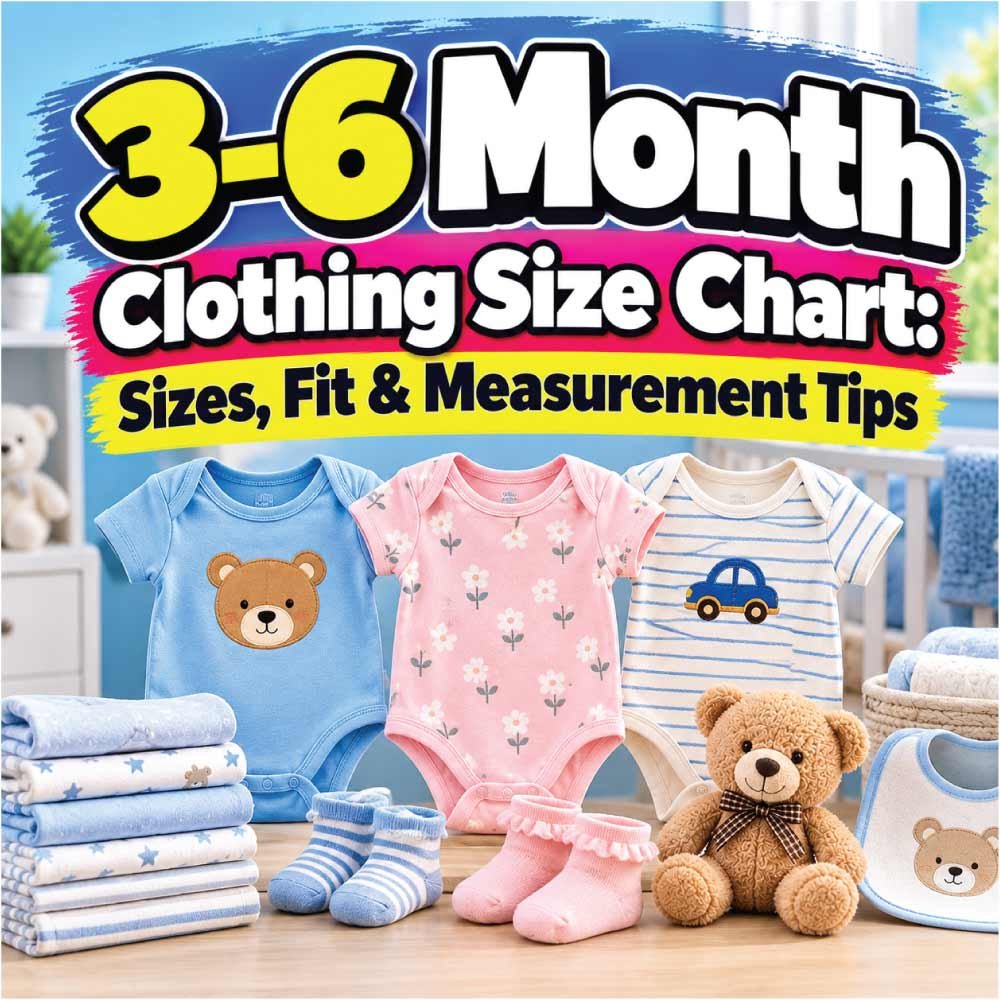
Finding the right clothes for a baby can be surprisingly difficult because baby clothing sizes are not completely standardized. A 3-6 month outfit from one brand may fit differently from the same labeled size from another. Babies also grow at different rates, so age alone is not always the best way to choose clothing.
This 3-6 Month Clothing Size Chart provides a practical starting point for understanding typical clothing measurements, including weight, height, chest, and garment fit. It also explains how to measure your baby, choose between sizes, understand labels, and avoid common sizing mistakes.
Whether you are shopping for everyday bodysuits, pajamas, shirts, pants, or gifts, using your baby’s actual measurements can help you select clothing that is comfortable without being unnecessarily oversized.
3-6 Month Clothing Size Chart
A 3-6 month clothing size generally refers to clothing designed for babies in the approximate three-to-six-month age range. However, the actual fit depends on the baby’s body proportions and the manufacturer’s sizing system.
The chart below provides general size guidance, not a universal standard. Always check the individual brand’s size chart when one is available.
| Measurement | Typical 3-6 Month Range |
|---|---|
| Age | 3-6 months |
| Weight | About 12-17 lb |
| Height/Length | About 23-27 in |
| Chest | About 16-17 in |
| Typical Label | 3-6M |
| Fit | Comfortable, with room for movement |
These ranges are useful for shopping, but babies within the same age group can have very different body shapes. A longer baby may need the next size even when their weight falls within the 3-6 month range.
Important: The measurements above should be treated as general shopping guidance rather than an exact medical or manufacturing standard. Brand charts can differ significantly.
What Does 3-6 Month Clothing Size Mean?
The 3-6M clothing size is primarily an age-based sizing label. It indicates that the manufacturer expects the garment to fit a baby somewhere around three to six months old.
It does not mean every six-month-old baby will fit the same garment. Clothing manufacturers use different measurements, proportions, and fit allowances when developing baby clothes.
For example, one brand might design its 3-6M bodysuit for a smaller baby, while another may make the same labeled size longer or roomier.
Why Age Is Only a Starting Point
Age is convenient because it makes clothing labels easy to understand, but it is not a precise measurement.
Two babies who are both four months old could differ considerably in:
- Weight
- Height or body length
- Chest measurement
- Torso length
- Leg length
- Overall body proportions
This is why height and weight are often more useful than age alone when choosing baby clothing.
What Does 3-6M Mean on a Clothing Tag?
A label such as 3-6M, 3-6 Months, or sometimes simply 3-6 generally indicates the manufacturer’s intended age range.
The label does not necessarily indicate an exact garment measurement. It is a sizing category that helps parents and shoppers identify an approximate fit.
If your baby is near the upper end of the recommended measurements, consider the next size, particularly for garments that need extra length.
3-6 Month Baby Clothing Size by Weight
Weight is one of the most commonly used measurements on baby clothing size charts.
A general 3-6 month range may accommodate babies around 12 to 17 pounds, but this varies by manufacturer. Some brands may recommend a narrower or wider range.
| Weight | General Clothing Guidance |
|---|---|
| Under 12 lb | May fit smaller sizes depending on length |
| 12-14 lb | Often within the 3-6M range |
| 14-17 lb | Often within the 3-6M range |
| Over 17 lb | Consider comparing the next size |
| Any weight | Check height and brand measurements too |
Weight alone should not determine the purchase. A baby who weighs 15 pounds but is particularly tall may require a larger size than a shorter baby of the same weight.
3-6 Month Baby Clothing Size by Height
Height or body length can be especially important for one-piece garments.
A typical 3-6 month size may accommodate babies around 23 to 27 inches long. Again, this is a general range rather than a universal standard.
Length matters because a garment can fit around the baby’s chest but still be too short through the torso.
This is particularly noticeable with:
- Bodysuits
- Footed pajamas
- Rompers
- Sleepsuits
- One-piece outfits
If your baby is close to the upper end of a brand’s height range, moving up one size can provide additional length and make dressing easier.
How to Measure a Baby for 3-6 Month Clothes
Taking a few simple measurements can make online clothing shopping much easier. You do not need specialized equipment; a flexible measuring tape is usually enough.
Measure Baby’s Length
For babies who cannot stand independently, measure body length while the baby is lying flat.
- Place the baby on a safe, flat surface.
- Keep the body as straight as comfortably possible.
- Measure from the top of the head to the bottom of the feet.
- Record the measurement in inches or centimeters.
- Compare it with the clothing manufacturer’s chart.
Do not force a baby’s legs or body into a rigid position simply to obtain a measurement.
Measure Chest
Wrap a soft measuring tape around the fullest part of the baby’s chest.
Keep the tape comfortably against the body without pulling it tightly. The goal is to obtain a body measurement, not the circumference of clothing.
Measure Waist
For garments where waist sizing matters, measure around the natural waist area.
The tape should be comfortably positioned rather than tight. Babies need freedom of movement, so avoid interpreting a snug body measurement as an appropriate snug clothing fit.
Measure Hips When Needed
Hips are less important for some baby garments but can matter for pants, shorts, and fitted bottoms.
Measure around the fullest part of the hips and compare the result with the manufacturer’s sizing information.
How Should 3-6 Month Clothes Fit?
Baby clothes should generally be comfortable, flexible, and easy to put on and remove. They should provide enough room for movement without being so large that the garment becomes impractical or unsafe.
A good fit should allow:
- Comfortable arm and leg movement
- Adequate torso length
- Easy fastening
- Room for normal diaper use
- Comfortable sitting and lying
- Simple diaper changes
Signs Clothes Are Too Small
Look for signs such as:
- Snaps pulling apart
- Fabric stretching tightly across the chest
- Sleeves or legs becoming noticeably short
- Difficulty fastening the garment
- Tightness around the diaper area
- Restricted movement
If a garment is already difficult to fasten or visibly tight, sizing up is generally more practical than trying to make the current size work.
Signs Clothes Are Too Large
Oversized clothing can also create problems.
Signs include:
- Sleeves covering the hands
- Excess fabric bunching heavily
- Pants extending far beyond the feet
- Neck openings that are excessively loose
- Garments sliding out of position
A little growing room can be useful, but excessive fabric can make clothing cumbersome.
3-6 Month Size Compared With Other Baby Sizes
Understanding neighboring sizes can help when your baby falls between categories.
| Baby Size | Approx. Age | Typical Weight | Typical Length |
|---|---|---|---|
| Newborn | Birth-3 months | Varies by brand | Varies by brand |
| 0-3M | 0-3 months | Often smaller than 3-6M | Often shorter than 3-6M |
| 3-6M | 3-6 months | About 12-17 lb | About 23-27 in |
| 6-9M | 6-9 months | Varies by brand | Varies by brand |
| 9-12M | 9-12 months | Varies by brand | Varies by brand |
The ranges in this comparison are intended as general guidance. There is no single universal baby clothing standard that guarantees identical measurements across every brand.
3-6M vs. 6-9M
The biggest difference is generally the amount of room and length provided.
If your baby is still comfortably within the 3-6M measurements, the smaller size may provide a better fit. If your baby is approaching or exceeding the manufacturer’s upper measurements, 6-9M may be worth considering.
Which Baby Clothes Come in 3-6 Month Sizes?
The 3-6 month category is available across nearly every type of infant clothing.
Bodysuits
Bodysuits are among the most common baby garments in this size. Because they fit around the torso and diaper area, length is especially important.
Look for enough room to fasten the bottom snaps without excessive stretching.
Sleepwear
Pajamas, sleepers, and other nighttime garments may require a slightly different fit from everyday clothing.
Check the manufacturer’s recommendations carefully, especially for sleepwear. The appropriate fit can depend on the garment’s design and intended use.
Pants and Leggings
For bottoms, consider both waist fit and leg length. A baby may need a larger size because of leg length even when the waist measurement still fits the smaller size.
Rompers and One-Piece Outfits
One-piece garments are more sensitive to torso length. If the baby has outgrown the garment vertically, increasing the size can be more useful than focusing only on weight.
Shirts and Tops
Tops may provide more flexibility because they do not need to accommodate the entire torso and diaper area. However, the neckline, sleeve length, and chest fit should still be checked.
Also Read:
How Many 3-6 Month Clothes Do You Need?
The ideal quantity depends on how frequently you do laundry, your baby’s growth rate, and your lifestyle.
Instead of buying a very large collection in one size, many parents prefer a practical mix of essential garments.
A basic wardrobe might include:
- Several everyday bodysuits
- A few pairs of pants or leggings
- Several sleep outfits
- A small number of shirts or tops
- A few seasonal layers
- Several socks if needed
- One or two special outfits
Avoid purchasing too many expensive outfits in exactly one size. Babies can move through clothing sizes quickly, and some garments may receive very little use before becoming too small.
Should You Buy 3-6 Month Clothes or the Next Size Up?
Buying a larger size can make sense when your baby is close to the upper end of the manufacturer’s range.
However, simply buying oversized clothing is not always the best strategy.
Choose 3-6M When:
- Your baby’s measurements fall comfortably within the chart.
- The current clothing size is becoming too small.
- You want a closer, more appropriate fit.
- The garment’s design depends heavily on correct proportions.
Consider the Next Size When:
- Your baby’s height is already near the upper limit.
- The torso is becoming too long for 3-6M one-piece garments.
- The baby is at or above the manufacturer’s maximum weight.
- The current size is tight around the chest, waist, or diaper area.
- You want some additional growing room.
When choosing between two sizes, prioritize the measurement that matters most for that particular garment.
Also Read:
Baby Clothing Size Charts Can Vary by Brand
One of the most important things to understand about infant clothing is that size labels are not perfectly standardized.
A 3-6 month label tells you the intended age category, but the actual garment dimensions can differ.
Differences may result from:
- Brand-specific sizing
- Garment style
- Intended fit
- Fabric stretch
- Manufacturing patterns
- Regional sizing practices
For online shopping, look for a brand’s actual measurement chart whenever possible.
If the chart lists height and weight, compare your baby’s current measurements with both rather than relying only on the printed age label.
Baby Clothing Size Conversion: Months, US, UK and EU
Parents shopping internationally may encounter different labeling systems.
Some clothing uses month-based labels such as 3-6M, while other products may use age, height, or numerical sizing.
| Label Type | Example | What It Generally Represents |
|---|---|---|
| Age-based | 3-6M | Approximate age range |
| Height-based | 68 cm | Approximate body height |
| Numeric | 3-6 | Manufacturer-specific category |
| Letter-based | S/M | Brand-specific sizing |
There is no reliable universal conversion in which every 3-6M garment corresponds to one identical US, UK, or EU size.
When shopping internationally, use the actual height and weight measurements provided by the seller whenever available.
Also Read:
Common Baby Clothing Sizing Mistakes
Choosing baby clothing based only on age is one of the most common mistakes, but there are several others.
Ignoring Height
Parents sometimes focus on weight and overlook length. This can cause problems with bodysuits and sleepers.
Assuming Every Brand Fits the Same
A 3-6M label is not guaranteed to have identical dimensions across manufacturers.
Buying Too Much of One Size
Babies grow quickly. Buying a large wardrobe in one size can result in unworn clothing.
Forgetting Seasonal Timing
A baby may reach 3-6 months during a completely different season from when the clothes were purchased. Consider when the baby is likely to wear the garment, not just the current age.
Choosing Based Only on Appearance
An attractive outfit is not useful if it is uncomfortable or difficult to fasten. Fit, fabric, ease of dressing, and practical use should also influence your choice.
Not Checking the Return Policy
For online purchases, reviewing the retailer’s return or exchange policy can be useful because fit can vary even when measurements appear appropriate.
Tips for Buying 3-6 Month Baby Clothes Online
Online shopping removes the opportunity to test the clothing before purchase, so measurements become even more important.
Before ordering:
- Measure your baby recently rather than relying on an old measurement.
- Compare the baby’s measurements with the seller’s chart.
- Check both height and weight when both are provided.
- Look at garment-specific sizing information.
- Consider whether the material has stretch.
- Check whether the item is designed to fit snugly or loosely.
- Think about the season in which the baby will wear it.
- Avoid assuming that the same size will fit identically across brands.
- Keep receipts or order information when the retailer permits returns.
A few minutes spent checking measurements can prevent the inconvenience of ordering multiple sizes unnecessarily.
Frequently Asked Questions About 3-6 Month Clothing Sizes
What size is 3-6 months in baby clothes?
3-6M is an age-based baby clothing category intended approximately for babies between three and six months old. A typical range may accommodate around 12-17 pounds and 23-27 inches, but manufacturers can use different measurements.
Is 3-6 months the same as 6 months?
Not necessarily. A 3-6M label generally describes a range, while a 6M label may be used differently depending on the manufacturer. Always compare the brand’s height and weight recommendations before choosing between the two.
What weight is 3-6 month clothing for?
A general 3-6 month clothing range is around 12-17 pounds, but this is not universal. Some manufacturers may use different weight limits, so the brand’s own chart should take priority when available.
What height is 3-6 month clothing for?
A typical general range is approximately 23-27 inches in body length. However, baby clothing manufacturers may recommend different heights. Check the individual product chart for the most appropriate fit.
Can a 2-month-old wear 3-6 month clothes?
Yes, a two-month-old may fit 3-6M clothing if their measurements are within the manufacturer’s recommended range. Age labels are only a guide, so compare the baby’s height and weight with the actual size chart.
Can a 6-month-old wear 3-6 month clothes?
A six-month-old may still wear 3-6M clothing if the garments fit comfortably and the baby’s measurements remain within the manufacturer’s range. If clothing is becoming tight or short, move to the next size.
Should baby clothes be loose or tight?
Baby clothing should generally provide comfortable movement without being excessively loose or restrictive. The ideal fit depends on the garment, fabric, and manufacturer’s design. Check that fastenings are comfortable and that the baby can move freely.
How do I know when my baby has outgrown 3-6M clothes?
Common signs include tight snaps, short sleeves or legs, difficulty fastening clothing, restricted movement, or fabric pulling across the body. Compare your baby’s latest measurements with the next available size.
Is 3-6M the same for every brand?
No. Baby clothing sizes can vary between brands. Different manufacturers may use different measurements, proportions, and fits for the same age label. A brand-specific size chart is more reliable than assuming all 3-6M garments are identical.
Should I buy 3-6M or 6-9M for a growing baby?
If your baby’s measurements are comfortably within 3-6M, that size will generally provide a more appropriate current fit. If the baby is near the upper limits, compare the next size and consider the garment’s length and design.
Final Tips for Choosing 3-6 Month Baby Clothes
The best way to use a 3-6 Month Clothing Size Chart is as a starting point rather than an absolute rule. Age labels are convenient, but your baby’s actual measurements provide better information about fit.
Remember these key points:
- Check height and weight, not age alone.
- Use the manufacturer’s chart whenever possible.
- Pay special attention to length for bodysuits and one-piece outfits.
- Look for comfortable movement and practical fastening.
- Consider sizing up when your baby is close to the chart’s upper limit.
- Avoid buying too many clothes in one size.
- Think about seasonal needs before purchasing.
- Expect some variation between brands.
A well-fitting outfit should make dressing easier and allow your baby to move comfortably. By combining the 3-6M label with actual measurements and brand-specific guidance, you can make more confident clothing choices and reduce the risk of buying items that are quickly outgrown.
