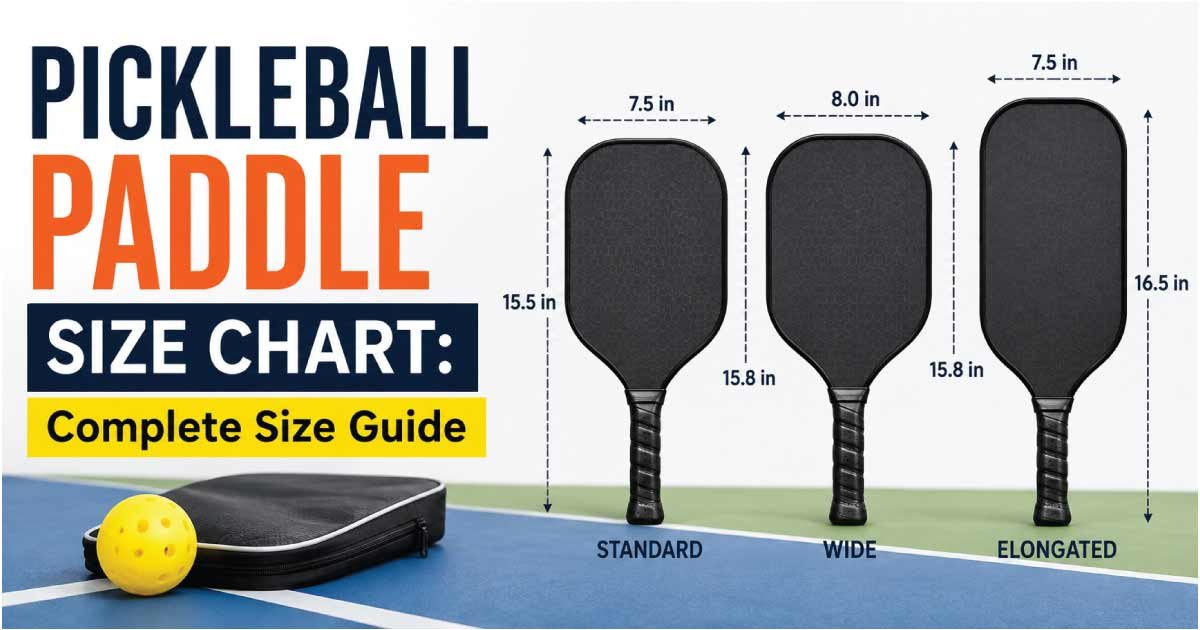
Choosing the right pickleball paddle size can make a noticeable difference in comfort, control, power, and overall performance. While pickleball paddles do not have the same standardized sizing system as shoes or clothing, players can compare paddles by length, width, face area, grip size, weight, and overall dimensions.
A paddle that is too heavy may feel difficult to maneuver, while one that is too light may not provide the power a player wants. Similarly, a long paddle can provide additional reach and leverage, whereas a wider paddle can offer a larger hitting area.
This pickleball paddle size chart explains common paddle dimensions, grip sizes, weight categories, paddle shapes, and how to choose the right paddle based on your playing style and experience.
Pickleball Paddle Size Chart
Most pickleball paddles are designed to stay within the standard overall equipment limits used for the sport. Within those limits, manufacturers offer several shapes and proportions.
| Paddle Type | Approx. Length | Approx. Width | Typical Weight | Best For |
|---|---|---|---|---|
| Compact | 15–16 in. | 7.5–8.0 in. | 7–8.5 oz | Beginners, control |
| Standard | 15.5–16 in. | 7.5–8.2 in. | 7.5–8.5 oz | All-around play |
| Widebody | 15–16 in. | 8–8.5 in. | 7.5–9 oz | Large hitting area |
| Hybrid | 16–16.5 in. | 7.5–8 in. | 7.5–9 oz | Balance of reach and control |
| Elongated | 16–17 in. | 7–7.5 in. | 7.5–9.5 oz | Reach and power |
Dimensions and weights are general ranges. Individual paddle designs vary.
What Is Pickleball Paddle Size?
Pickleball paddle size refers to the physical dimensions and characteristics of a paddle rather than a single measurement.
The most important factors include:
- Paddle length
- Paddle width
- Face area
- Grip length
- Grip circumference
- Paddle weight
- Overall shape
- Handle length
Two paddles can have similar weights but feel completely different because of differences in balance, shape, grip length, and weight distribution.
Why Paddle Size Matters
The size and shape of a paddle can influence:
- Reach
- Swing speed
- Power
- Control
- Maneuverability
- Sweet spot
- Comfort
- Reaction speed
Choosing the right combination is especially important when developing a consistent playing style.
Pickleball Paddle Dimensions
Paddle dimensions are generally measured by length and width.
Paddle Length
Longer paddles provide additional reach and can offer greater leverage during swings.
They may be useful for players who want:
- More reach
- Additional leverage
- Greater court coverage
- More power
- Extended reach on difficult shots
However, longer paddles can feel less maneuverable than wider or shorter designs.
Paddle Width
Wider paddles generally provide a larger face area.
A wider face can make it easier to contact the ball and may provide a more forgiving hitting surface.
Wide paddles can be attractive to:
- Beginners
- Recreational players
- Doubles players
- Players prioritizing control
- Players who want a larger sweet spot
Pickleball Paddle Size Chart by Shape
Paddle shape is one of the most useful ways to compare different designs.
| Paddle Shape | Typical Characteristics | Main Advantage | Best For |
|---|---|---|---|
| Widebody | Shorter and wider | Larger face | Control and forgiveness |
| Standard | Balanced proportions | Versatility | All-around players |
| Hybrid | Moderate length and width | Balanced performance | Versatile play |
| Elongated | Longer and narrower | Reach and leverage | Power and reach |
| Compact | Smaller face | Quick handling | Fast reactions |
No single paddle shape is best for every player. The right choice depends on how you move, swing, and play.
Pickleball Paddle Size by Weight
Weight is one of the most important paddle characteristics.
Paddles are commonly grouped into lightweight, midweight, and heavyweight categories.
| Weight Category | Approx. Weight | Characteristics | Best For |
|---|---|---|---|
| Lightweight | Under 7.5 oz | Fast and maneuverable | Quick hands, beginners |
| Midweight | 7.5–8.5 oz | Balanced power and control | Most players |
| Heavyweight | Over 8.5 oz | More stability and power | Power-focused players |
Weight ranges can overlap depending on how a particular manufacturer classifies its paddles.
Lightweight Pickleball Paddles
Lightweight paddles are easy to move quickly.
They can be useful when fast reactions and rapid paddle movement are priorities.
Potential advantages include:
- Quick hand speed
- Easy maneuverability
- Less fatigue during extended play
- Fast transitions
- Easier handling for some beginners
The trade-off is that lighter paddles may provide less natural stability and momentum on hard shots.
Midweight Pickleball Paddles
Midweight paddles offer a balance between maneuverability and stability.
For many recreational players, this category provides a practical starting point.
They can offer:
- Good control
- Moderate power
- Reasonable maneuverability
- Stable contact
- Versatile performance
Heavyweight Pickleball Paddles
Heavier paddles can generate more momentum during a swing.
They may appeal to players who prioritize:
- Power
- Stability
- Strong drives
- Solid contact
- Deep shots
The additional weight can make quick reactions more demanding.
Pickleball Paddle Grip Size Chart
Grip size is another important consideration.
The grip should feel secure without requiring excessive squeezing.
| Grip Size | Approx. Circumference | General Fit |
|---|---|---|
| Small | 4.0 in. | Smaller hands |
| Medium | 4.125–4.25 in. | Average hands |
| Large | 4.375–4.5 in. | Larger hands |
| Extra Large | 4.5+ in. | Very large hands |
Grip sizing varies among manufacturers, so check the individual paddle specifications before buying.
Why Grip Size Matters
An appropriately sized grip can help with:
- Comfort
- Paddle control
- Wrist movement
- Stability
- Swing consistency
A grip that is too large can make wrist movement more difficult. A grip that is too small may require excessive squeezing to keep the paddle stable.
How to Measure Your Pickleball Paddle Grip
You can estimate your ideal grip size by measuring your hand.
Method 1: Hand Measurement
Measure from the middle crease of your palm to the tip of your ring finger.
This provides a useful starting point for selecting a grip circumference.
Method 2: Finger Test
Hold the paddle naturally.
Your fingers should wrap comfortably around the grip without excessive overlap or a large gap.
If the grip feels too thin, you may be able to increase its size with an appropriate grip wrap or overgrip.
Pickleball Paddle Handle Length
Handle length can vary considerably between paddle designs.
A longer handle can provide additional leverage and may appeal to players who use two-handed backhands.
| Handle Type | Approx. Length | Best For |
|---|---|---|
| Short | 4–4.5 in. | Quick handling |
| Standard | 4.5–5 in. | General play |
| Long | 5–5.5 in. | Two-handed backhands |
| Extra Long | 5.5+ in. | Reach and leverage |
Handle length is particularly important for players who regularly place both hands on the paddle.
Paddle Length vs. Paddle Width
Choosing between a longer paddle and a wider paddle is essentially a choice between different performance priorities.
Longer Paddle
An elongated paddle can provide:
- Additional reach
- More leverage
- Extended hitting range
- Potentially greater power
The narrower face may require more precise ball contact.
Wider Paddle
A wider paddle can provide:
- Larger hitting area
- Greater forgiveness
- Easier contact
- Stable feel
- Good control
The shorter profile may provide less reach than an elongated paddle.
Pickleball Paddle Size for Beginners
Beginners often benefit from a paddle that is comfortable, balanced, and forgiving.
A standard or widebody paddle can be a practical starting point because it provides a useful combination of hitting area and maneuverability.
Recommended Beginner Characteristics
Look for:
- Moderate weight
- Comfortable grip
- Standard or wide face
- Balanced construction
- Manageable handle length
- Comfortable swing feel
There is no requirement for every beginner to use the same paddle type. Personal comfort should remain a major consideration.
Discover More:
Pickleball Paddle Size for Intermediate Players
As players develop their technique, they may begin to recognize specific preferences.
An intermediate player may want to prioritize:
- Power
- Control
- Reach
- Spin
- Fast handling
- Stability
At this stage, paddle shape and weight distribution can become as important as basic dimensions.
A player who likes aggressive baseline shots may prefer an elongated design, while a player focused on quick exchanges may prefer a maneuverable standard or widebody paddle.
Pickleball Paddle Size for Advanced Players
Experienced players often choose paddles based on their specific style rather than simply selecting a general size.
An advanced player may carefully compare:
- Paddle weight
- Balance point
- Face shape
- Handle length
- Grip circumference
- Core construction
- Surface characteristics
- Swing feel
At this level, small differences can influence how the paddle feels during fast exchanges and powerful shots.
Widebody vs. Elongated Pickleball Paddle
Widebody and elongated paddles represent two common design approaches.
| Feature | Widebody Paddle | Elongated Paddle |
|---|---|---|
| Face Shape | Wider | Longer and narrower |
| Hitting Area | Broad | Extended vertically |
| Reach | Moderate | Greater |
| Maneuverability | Generally good | Moderate |
| Forgiveness | Often high | More technique dependent |
| Best For | Control and versatility | Reach and power |
If you frequently miss the ball near the edge of the paddle, a wider face may feel more forgiving.
If you need additional reach and leverage, an elongated paddle may be more appealing.
Pickleball Paddle Weight and Playing Style
Your playing style should influence the weight you choose.
Control Players
Players who prioritize soft shots, placement, and quick reactions may prefer a lightweight or midweight paddle.
Power Players
Players who rely heavily on drives and aggressive shots may prefer a midweight or heavyweight paddle.
All-Around Players
A midweight paddle is often a practical choice for players who want a balance between power and control.
Discover More:
Pickleball Paddle Size and Sweet Spot
The sweet spot is the area of the paddle where ball contact tends to feel most effective.
Paddle shape can influence the size and location of the effective hitting area.
Wide paddles generally provide a broader face, while elongated paddles extend the hitting area vertically.
A larger effective hitting area can be particularly useful for beginners who are still developing consistent ball contact.
How to Choose the Right Pickleball Paddle Size
Choosing a paddle becomes easier when you evaluate several factors together.
Consider Your Hand Size
Start with a comfortable grip.
Your hand should feel secure without needing to squeeze the handle excessively.
Consider Your Playing Style
Ask yourself whether you prioritize:
- Power
- Control
- Reach
- Speed
- Stability
- Quick reactions
Consider Your Experience
Beginners often benefit from forgiving and manageable designs, while experienced players may prefer more specialized paddle shapes.
Consider Your Physical Comfort
A paddle should not feel unnecessarily difficult to swing.
If you experience fatigue during play, consider whether the paddle’s weight and balance are appropriate for you.
Pickleball Paddle Size Buying Checklist
Before purchasing a paddle, compare:
- Paddle length
- Paddle width
- Paddle weight
- Grip circumference
- Handle length
- Paddle shape
- Face area
- Balance
- Swing feel
- Playing style
- Experience level
- Comfort during extended play
Discover More:
Common Pickleball Paddle Size Mistakes
Choosing the Heaviest Paddle
A heavier paddle isn’t automatically better. Additional weight may provide stability and power, but it can also make the paddle harder to maneuver.
Choosing Based Only on Length
A long paddle can provide excellent reach, but width, weight, and grip size also affect performance.
Ignoring Grip Size
A paddle with the wrong grip circumference can feel uncomfortable and make consistent control more difficult.
Choosing a Paddle That Is Too Specialized
Beginners may benefit from a balanced paddle instead of immediately choosing a highly specialized power or elongated model.
Ignoring Overall Comfort
Specifications are useful, but how a paddle feels in your hand is equally important.
Pickleball Paddle Size for Doubles vs. Singles
The ideal paddle does not necessarily change dramatically between doubles and singles, but playing style can influence the preferred design.
Doubles Play
Doubles often involves quick exchanges near the kitchen line, making maneuverability and fast hand movement important.
A manageable midweight or standard paddle can work well.
Singles Play
Singles involves more court coverage and movement. Some players may prefer an elongated paddle because of the additional reach and leverage.
Ultimately, player preference and technique matter more than a strict doubles-versus-singles size rule.
Frequently Asked Questions About Pickleball Paddle Size
What is the standard pickleball paddle size?
There is no single universal paddle shape or exact dimension. Many paddles are approximately 15.5–16 inches long and around 7.5–8.5 inches wide, while elongated designs are longer and narrower.
What is the best pickleball paddle size for beginners?
A standard or widebody paddle with a moderate weight can be a good starting point for many beginners. These designs can provide a useful balance of control, stability, and forgiveness.
What pickleball paddle size is best for power?
Players who prioritize power often prefer a midweight or heavier paddle, sometimes combined with an elongated shape. The additional mass and longer profile can provide leverage and momentum during swings.
What pickleball paddle size is best for control?
A widebody or standard paddle with a manageable weight can be a good choice for control-focused players. A broader face may provide a forgiving hitting area and comfortable handling.
What grip size should I use for pickleball?
Common pickleball grip circumferences range from approximately 4 to 4.5 inches. Smaller hands generally work better with smaller grips, while larger hands may require a larger circumference.
Is a longer pickleball paddle better?
A longer paddle can provide additional reach and leverage, but it may sacrifice some maneuverability compared with a wider paddle. Whether it is better depends on your playing style.
Is a heavier pickleball paddle better?
A heavier paddle can provide greater stability and power, but it may be harder to move quickly. A lighter paddle can be easier to maneuver. The best weight depends on your preferences and playing style.
What is the best pickleball paddle size for doubles?
A standard or widebody paddle can work well for doubles because quick reactions and maneuverability are important during rapid exchanges. However, individual playing style should guide the final choice.
What is the best pickleball paddle size for singles?
An elongated paddle can appeal to singles players who value reach and leverage. However, a standard paddle can also perform well depending on the player’s technique and preferences.
Does paddle width matter in pickleball?
Yes. Width influences the shape of the hitting surface and can affect forgiveness and maneuverability. Wider paddles generally provide a broader face, while narrower elongated paddles emphasize reach.
How heavy should a pickleball paddle be?
A midweight paddle around 7.5–8.5 ounces can provide a balanced starting point for many players. Lightweight paddles favor maneuverability, while heavier paddles can provide more stability and power.
How do I know if my pickleball paddle grip is too big?
If you struggle to comfortably wrap your fingers around the handle or need to adjust your hand position frequently, the grip may be too large. A comfortable grip should feel secure without excessive squeezing.
Final Thoughts on Pickleball Paddle Sizes
The right pickleball paddle size depends on much more than paddle length. Weight, width, shape, grip circumference, handle length, and balance all contribute to how a paddle feels during play.
For beginners, a standard or widebody paddle with a moderate weight can provide a comfortable combination of control and forgiveness. Players who prioritize quick reactions may prefer a lighter paddle, while power-focused players may prefer additional weight.
Elongated paddles can provide more reach and leverage, while wider paddles can offer a broad hitting surface and forgiving feel. Grip size should also match your hand comfortably so you can maintain control without excessive tension.
When comparing paddles, use the pickleball paddle size chart as a starting point, but don’t choose based on dimensions alone. Your playing style, experience, hand size, comfort, and preferred balance should all influence the final decision.
The best paddle is ultimately the one that feels natural in your hand, supports your style of play, and allows you to swing comfortably and consistently throughout a match.
