
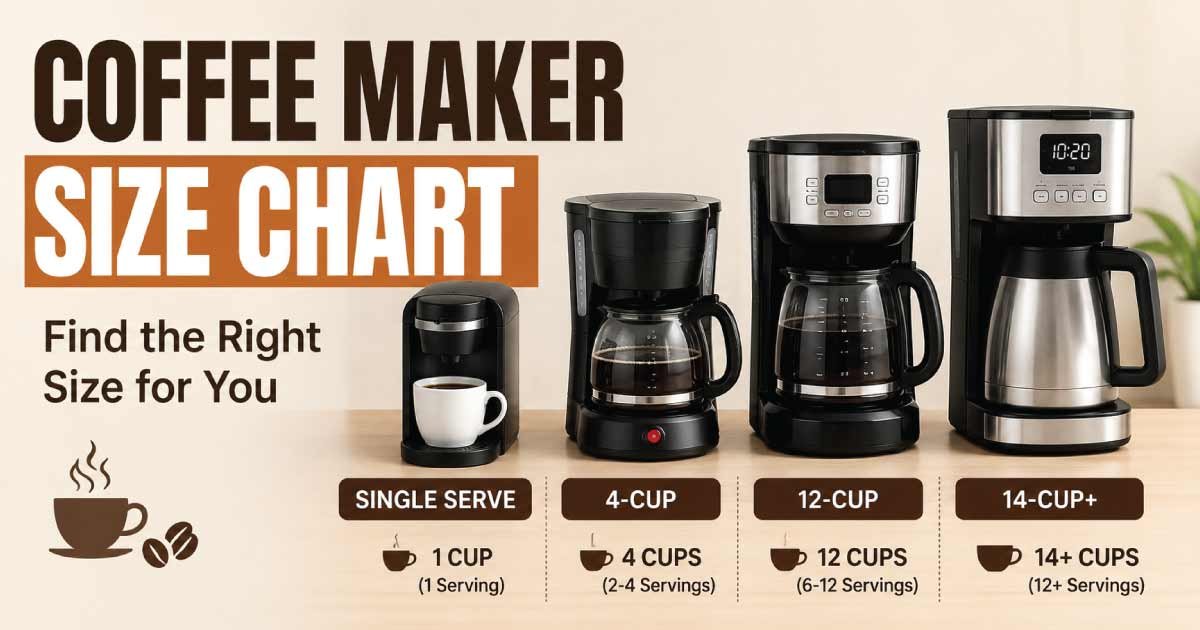
Choosing the right coffee maker size is about more than deciding how much coffee you want to brew. The physical size of the machine also matters, especially when counter space is limited. A coffee maker that fits your brewing needs but takes up too much room can make your kitchen feel crowded.
Coffee makers are available in many sizes, from compact single-serve machines to large coffee makers designed for families, offices, and entertaining. Capacity is commonly measured in cups, while the machine itself is measured by its width, depth, and height.
This coffee maker size chart explains common coffee maker capacities, approximate dimensions, recommended household sizes, carafe sizes, and the best type of coffee maker for different situations.
Coffee Maker Size Chart
Coffee maker capacity is usually described by the number of cups it can brew. However, a “cup” on a coffee maker may be smaller than a standard drinking mug, so it is important to consider both the stated capacity and the size of the cups you normally use.
| Coffee Maker Size | Approx. Capacity | Approx. Servings | Approx. Width | Best For |
|---|---|---|---|---|
| Mini / Single Serve | 1–2 cups | 1 person | 5–8 in. | Individuals, small kitchens |
| Compact | 4–5 cups | 1–2 people | 7–9 in. | Couples |
| Medium | 8–10 cups | 2–4 people | 8–10 in. | Small families |
| Large | 12 cups | 4–6 people | 9–12 in. | Families |
| Extra Large | 14–16+ cups | 6+ people | 10–14+ in. | Offices and gatherings |
Dimensions vary according to coffee maker design and features.
What Is a Coffee Maker?
A coffee maker is an appliance designed to brew coffee by combining ground coffee with heated water. Traditional drip coffee makers heat water and gradually pass it through coffee grounds before collecting the brewed coffee in a carafe.
Modern coffee makers are available in several designs, including:
- Drip coffee makers
- Single-serve coffee makers
- Espresso machines
- Pod coffee makers
- Thermal carafe coffee makers
- Programmable coffee makers
- Combination coffee machines
- Compact travel coffee makers
Each type has different capacity and space requirements.
Why Coffee Maker Size Matters
The correct coffee maker size can help you:
- Brew the right amount of coffee
- Avoid unnecessary counter clutter
- Reduce wasted coffee
- Serve several people efficiently
- Store the appliance more easily
- Choose an appropriate carafe size
Coffee Maker Sizes by Capacity
The capacity you need depends primarily on how many people drink coffee and how much they normally consume.
1–2 Cup Coffee Makers
Single-serve or mini coffee makers are designed for individual use.
They are particularly useful for:
- One-person households
- Dorm rooms
- Small apartments
- Office desks
- Travel
- Occasional coffee drinkers
Their compact footprint makes them easy to fit into small kitchens.
A 1–2 cup coffee maker is generally a poor choice for a household where several people need coffee at the same time.
4–5 Cup Coffee Makers
A 4–5 cup coffee maker is a compact option for one or two people.
It provides more capacity than a single-serve machine while remaining relatively small.
This size can be ideal for:
- Couples
- Small kitchens
- Guest rooms
- Occasional coffee drinkers
- Small offices
8–10 Cup Coffee Makers
An 8–10 cup coffee maker is a versatile choice for many households.
It can provide enough coffee for several people without requiring the footprint of a very large machine.
This size works well for:
- Couples who drink several cups
- Families
- Small offices
- Home entertaining
- Regular daily brewing
12 Cup Coffee Makers
A 12-cup coffee maker is one of the most common larger household sizes.
It is useful for:
- Families
- Multiple coffee drinkers
- Larger households
- Hosting guests
- People who want extra coffee
A 12-cup machine can be convenient when several people want coffee around the same time.
14–16+ Cup Coffee Makers
Extra-large coffee makers are primarily useful for offices, events, large families, or people who regularly serve many people.
They require more counter and storage space, so they are not always practical for a small kitchen.
Coffee Maker Size Chart by Number of People
| People Drinking Coffee | Recommended Capacity | Suggested Coffee Maker |
|---|---|---|
| 1 person | 1–4 cups | Single-serve or compact |
| 2 people | 4–6 cups | Compact |
| 3 people | 6–8 cups | Medium |
| 4 people | 8–10 cups | Medium |
| 5–6 people | 10–12 cups | Large |
| 7+ people | 12–16+ cups | Extra Large |
These recommendations are flexible because coffee consumption varies from person to person.
How Big Is a Coffee Maker?
Coffee maker dimensions vary significantly depending on the type of machine.
A compact single-serve machine may occupy only a small section of the countertop, while a larger drip coffee maker can require considerably more space.
The three primary external dimensions are:
- Width
- Depth
- Height
Coffee Maker Width
Width determines how much horizontal counter space the appliance occupies.
Compact coffee makers may be approximately 5–8 inches wide, while larger machines can be 10–14 inches wide or more.
Before choosing a coffee maker, measure the available counter space rather than assuming that a particular cup capacity has a standard width.
Coffee Maker Depth
Depth determines how far the machine extends toward the front of the countertop.
This measurement is especially important when the coffee maker is placed beneath cabinets.
You should have enough space to operate the controls, fill the water reservoir, and remove the carafe.
Coffee Maker Height
Height becomes important when the machine is positioned beneath upper kitchen cabinets.
Some coffee makers require additional vertical space because the water reservoir or filter compartment opens upward.
Coffee Maker Dimensions Chart
| Coffee Maker Type | Approx. Width | Approx. Depth | Approx. Height | Typical Capacity |
|---|---|---|---|---|
| Single Serve | 5–8 in. | 8–12 in. | 10–14 in. | 1 cup |
| Compact Drip | 7–9 in. | 8–12 in. | 9–13 in. | 4–5 cups |
| Standard Drip | 8–10 in. | 10–14 in. | 11–15 in. | 8–10 cups |
| Large Drip | 9–12 in. | 11–15 in. | 12–16 in. | 12 cups |
| Combination Machine | 10–14 in. | 12–16 in. | 13–18 in. | Varies |
| Espresso Machine | 7–16 in. | 10–18 in. | 10–18 in. | Single or multiple servings |
Approximate ranges are intended for planning purposes. Actual appliance dimensions vary.
Coffee Maker Cup Size Explained
One important detail when choosing a coffee maker is that the word cup can be misleading.
A coffee maker’s cup measurement may not equal the size of a standard mug.
For example, a machine advertised as a 12-cup coffee maker may produce twelve smaller coffee servings rather than twelve large mugs.
Coffee Maker Cup vs. Mug
If you normally drink large mugs of coffee, you may need a coffee maker with a larger stated capacity than you initially expect.
Consider your actual drinking habits rather than relying only on the cup number printed on the appliance.
Coffee Maker Carafe Sizes
Traditional drip coffee makers usually include either a glass or thermal carafe.
The carafe size should match your typical brewing needs.
| Carafe Size | Approx. Volume | Best For |
|---|---|---|
| 4–5 cups | Small | 1–2 people |
| 6–8 cups | Medium | 2–3 people |
| 10 cups | Large | 3–4 people |
| 12 cups | Extra Large | 4–6 people |
| 14+ cups | Commercial/Large | Groups and offices |
Carafe design also affects how easy the coffee maker is to use. A wide opening may make cleaning easier, while a thermal carafe can help maintain temperature without requiring a warming plate.
What Size Coffee Maker Do I Need?
The best size depends on your household and how much coffee you typically prepare.
For One Person
A single-serve or 4–5 cup coffee maker can be ideal.
If you drink only one cup at a time, a compact machine may prevent unnecessary coffee waste.
For Two People
A 4–8 cup coffee maker provides flexibility for two people.
If both people drink multiple cups, consider the larger end of this range.
For a Family of Four
An 8–12 cup coffee maker can be a practical choice.
A larger carafe can reduce the need to brew multiple times during the morning.
For Large Families
A 12-cup or larger coffee maker can be more convenient when several people drink coffee.
Consider a larger capacity if you frequently host guests.
Discover More:
How to Choose a Coffee Maker for a Small Kitchen
Small kitchens require careful consideration of both capacity and physical dimensions.
A compact coffee maker can provide enough brewing capacity without taking over your countertop.
Look for These Features
For a small kitchen, consider:
- Narrow width
- Short depth
- Compact water reservoir
- Removable components
- Easy storage
- Simple controls
- Front-accessible water tank
Vertical space also matters. A machine may have a small footprint but still be difficult to operate under a low cabinet.
Coffee Maker Size for Office Use
Offices often need larger coffee makers because multiple people may use the same machine.
An 8–12 cup coffee maker can work well for a small office, while larger groups may benefit from higher-capacity equipment.
Consider:
- Number of users
- Brewing frequency
- Counter space
- Water reservoir size
- Carafe capacity
- Cleaning requirements
For very large groups, multiple coffee makers may be more practical than one extremely large machine.
Coffee Maker Size for Entertaining
If you regularly host guests, capacity becomes more important.
A 10–12 cup coffee maker can be convenient for gatherings because you can brew a larger quantity at once.
For occasional entertaining, however, you may not need a large appliance permanently occupying your counter.
Consider a coffee maker that provides enough capacity for normal household use while still allowing you to brew additional batches when needed.
Single-Serve vs. Drip Coffee Maker Sizes
Single-serve and drip coffee makers have different strengths.
| Feature | Single-Serve | Drip Coffee Maker |
|---|---|---|
| Typical Capacity | 1 serving | 4–12+ cups |
| Counter Space | Usually smaller | Usually larger |
| Best For | Individuals | Families |
| Brewing | One serving | Multiple servings |
| Coffee Waste | Usually lower | Can be higher |
| Guests | Less convenient | More convenient |
| Carafe | Usually none | Usually included |
A single-serve machine is convenient when everyone wants different coffee at different times. A drip machine is generally more efficient when several people want coffee together.
Coffee Maker Size and Counter Space
Before purchasing, measure the area where you plan to place the coffee maker.
Measure Width
Measure the available horizontal space from side to side.
Leave enough room to operate the machine and remove the carafe.
Measure Depth
Make sure the appliance does not extend too far beyond the countertop.
A deep machine can interfere with nearby appliances or reduce usable workspace.
Measure Height
Check the distance between the countertop and any cabinets above it.
The coffee maker may require additional clearance when opening the lid or filling the water reservoir.
Coffee Maker Storage Considerations
If you do not want your coffee maker permanently sitting on the counter, check its storage requirements.
Before placing it inside a cabinet, make sure it is:
- Completely cool
- Clean and dry
- Easy to lift
- Stored safely
- Protected from moisture
Larger coffee makers can be surprisingly heavy, especially when they include glass carafes and large water reservoirs.
Discover More:
Common Coffee Maker Size Mistakes
Choosing Based Only on Cup Capacity
A 12-cup coffee maker may fit your brewing needs but still be too large for your countertop.
Always consider physical dimensions.
Ignoring Cabinet Clearance
Some coffee makers require their top section to open upward.
A low cabinet can make filling the machine difficult.
Buying Too Large a Coffee Maker
If only one person drinks coffee, a large 12-cup machine may take up unnecessary space.
Choosing Too Small a Coffee Maker
A small machine can become frustrating when several people need coffee at the same time.
Forgetting Carafe Clearance
The coffee maker needs enough room to remove the carafe easily.
How to Maintain Your Coffee Maker
Proper maintenance can help keep your coffee maker working efficiently.
Clean the Carafe Regularly
Wash the carafe and lid regularly to prevent coffee residue from building up.
Clean Removable Parts
Depending on the design, clean:
- Filter basket
- Water reservoir
- Drip tray
- Carafe
- Exterior surfaces
Clean the Brewing System
Coffee makers can accumulate mineral deposits and coffee oils over time. Follow the cleaning instructions provided with your machine.
Regular cleaning can also help maintain the taste of your coffee.
Discover More:
Coffee Maker Buying Checklist
Before choosing a coffee maker, consider:
- Number of coffee drinkers
- Cups brewed per day
- Desired capacity
- Counter width
- Counter depth
- Cabinet clearance
- Carafe size
- Water reservoir size
- Single-serve or drip design
- Ease of cleaning
- Storage requirements
- Frequency of entertaining
- Brewing speed
- Available kitchen space
Frequently Asked Questions About Coffee Maker Sizes
What is the standard size of a coffee maker?
There is no single standard coffee maker size. Many household drip coffee makers are designed for approximately 8–12 cups, while compact and single-serve machines are considerably smaller.
What size coffee maker is best for two people?
A 4–8 cup coffee maker can work well for two people. Choose toward the larger end if both people drink several cups throughout the day.
What size coffee maker is best for a family of four?
An 8–12 cup coffee maker is generally a practical range for a family of four. A larger capacity can be useful if several family members drink multiple cups or if you frequently host guests.
Is a 12-cup coffee maker really 12 cups?
The “cup” measurement used by coffee makers may be smaller than a typical household mug. Therefore, a 12-cup machine does not necessarily produce twelve large mugs of coffee.
How much counter space does a coffee maker need?
Coffee makers vary in size. Compact machines may need only a small section of counter space, while larger models can require more than a foot of width and depth. Always check the appliance’s actual dimensions.
Can a coffee maker fit under kitchen cabinets?
Many coffee makers can sit beneath cabinets, but you need to check the height and how the machine opens. Some models require additional vertical clearance to fill the water reservoir or coffee grounds.
What is the smallest coffee maker size?
Single-serve coffee makers are among the smallest options and are designed primarily for one serving at a time. Compact drip machines are another option for people who want a small carafe.
What size coffee maker is best for an office?
An 8–12 cup coffee maker can be suitable for a small office. Larger groups may need a higher-capacity machine or multiple coffee makers depending on usage.
Is a bigger coffee maker better?
Not necessarily. A larger coffee maker is useful for families and groups, but a compact model may be more convenient for one or two people. Choose capacity based on actual daily use.
Should I choose a single-serve or 12-cup coffee maker?
Choose a single-serve machine if you usually make one drink at a time. A 12-cup drip coffee maker is better when several people want coffee simultaneously or you regularly prepare larger batches.
Final Thoughts on Coffee Maker Sizes
Choosing the right coffee maker size requires balancing brewing capacity with available kitchen space. A compact single-serve machine can be ideal for one person, while a 4–5 cup model works well for couples with modest coffee needs.
For many households, an 8–10 cup coffee maker offers a useful balance between capacity and counter space. Families and frequent hosts may prefer a 12-cup model, while offices and larger groups may benefit from machines with even greater capacity.
Remember that coffee maker “cups” are not always the same as the size of a standard drinking mug. Consider how much coffee you actually drink rather than choosing based solely on the advertised cup count.
Before buying, measure your counter width, depth, and cabinet clearance, and make sure there is enough room to fill the water reservoir and remove the carafe.
The best coffee maker is not necessarily the largest one. It is the machine that provides enough coffee for your household while fitting comfortably into your kitchen and matching the way you actually brew and enjoy coffee.
