
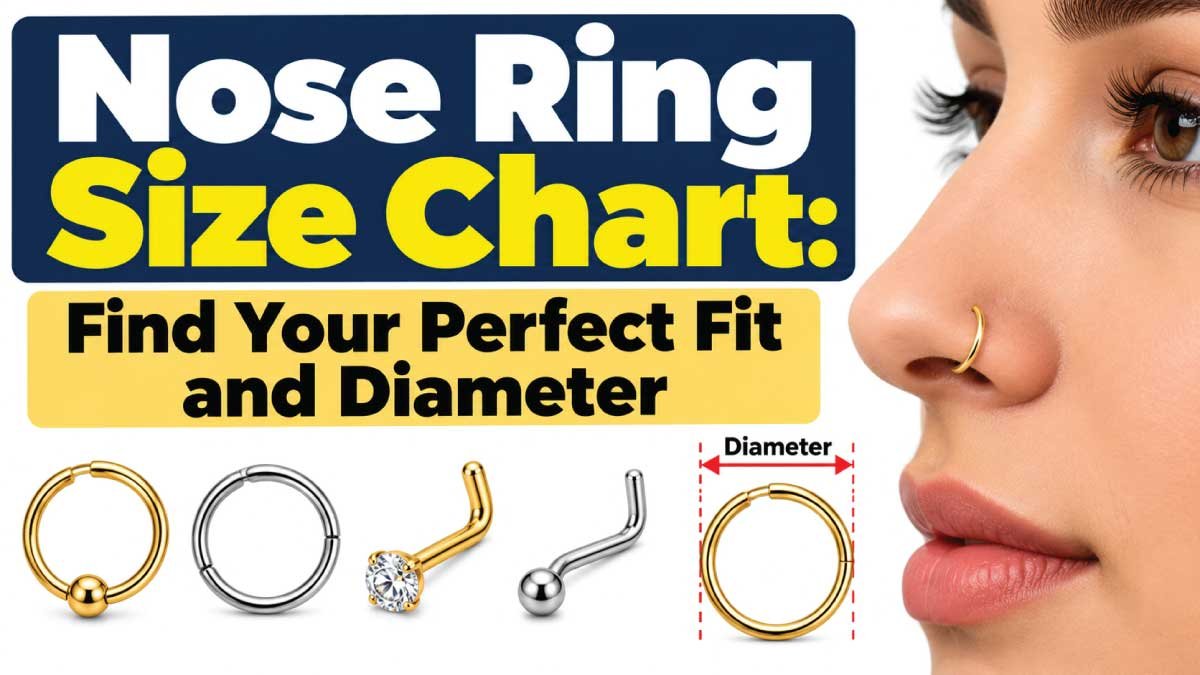
Choosing the right nose ring size is essential for comfort, a secure fit, and the look you want. Whether you prefer a delicate nose stud, a snug nose hoop, or a statement-making ring, understanding nose jewelry measurements can help you avoid pieces that feel too tight, hang awkwardly, or irritate your piercing.
This nose ring size chart explains common nose ring diameters, jewelry gauges, post lengths, and stud sizes. You will also learn how to measure your piercing, compare hoops with studs, understand millimeter measurements, and select jewelry that suits your anatomy and piercing type.
Because nose shapes and piercing placements vary, a size that works for one person may not fit another. Use the charts as a starting point, then consider your current jewelry measurements, healing stage, and piercer’s advice before making a purchase.
Nose Ring Size Chart: Quick Reference Guide
Nose jewelry is commonly measured using three main dimensions: gauge, diameter, and wearable length. Gauge describes the thickness of the jewelry, diameter measures the width of a hoop, and wearable length refers to the portion of a stud or post that passes through the piercing.
The following chart provides a general reference for commonly encountered nose jewelry sizes. These measurements are not universal standards, and availability varies by jewelry style and manufacturer.
| Gauge | Approximate Thickness (mm) | Common Jewelry Use | Important Note |
|---|---|---|---|
| 20G | 0.8 mm | Fine nose studs and delicate jewelry | Check compatibility with the existing piercing |
| 18G | 1.0 mm | Some nose studs and rings | Slightly thicker than 20G |
| 16G | 1.2 mm | Some specialized nose jewelry | Not suitable for every nostril piercing |
| 22G | 0.6 mm | Very fine jewelry | May be too thin for some piercings |
Gauge numbers work in reverse: a smaller gauge number indicates thicker jewelry. For example, 18G jewelry is thicker than 20G jewelry.
Do not choose a thicker ring simply because it looks more durable. The jewelry must be appropriate for your piercing, and inserting a larger gauge into an established piercing can cause irritation or tissue injury.
Nose Ring Diameter Chart
The diameter of a nose hoop determines how far it extends across the piercing area. A smaller hoop generally sits closer to the nostril, while a larger hoop creates a more open, visible curve.
Nose hoop diameters are commonly measured in millimeters. The most suitable diameter depends on the piercing location, nostril shape, desired appearance, and the amount of space needed around the jewelry.
| Inner Diameter (mm) | Approximate Inner Diameter (inches) | General Appearance | Typical Styling Use |
|---|---|---|---|
| 5 mm | 0.20 in | Very snug | Only where anatomy and placement permit |
| 6 mm | 0.24 in | Small and close-fitting | Compact hoop appearance |
| 7 mm | 0.28 in | Close-fitting | Subtle nostril hoop |
| 8 mm | 0.31 in | Moderate and relatively snug | Common everyday hoop style |
| 9 mm | 0.35 in | Slightly more open | A little extra visible curve |
| 10 mm | 0.39 in | Medium and noticeable | More relaxed hoop appearance |
| 11 mm | 0.43 in | Open and prominent | Looser-looking style |
| 12 mm | 0.47 in | Large and visibly curved | Statement or larger-fit jewelry |
These diameters are examples of commonly sold sizes, not a recommendation that every size will fit every nostril. A 6 mm hoop can fit one piercing comfortably but press against another person’s nostril. Likewise, a 10 mm hoop may be appropriate for one placement and hang too loosely in another.
How to Choose the Right Hoop Diameter
Consider these factors before selecting a nose hoop:
Piercing placement: A higher or lower nostril piercing can change how a hoop sits.
Nostril shape: The curve and thickness of your nostril affect the space available.
Desired appearance: A close-fitting hoop looks different from a larger, more visible ring.
Jewelry design: Seam rings, hinged rings, and captive-bead rings may sit differently even when their listed diameters match.
Comfort: Jewelry should not pinch, pull, or place continuous pressure on the piercing.
If your current hoop fits comfortably, measuring its inner diameter is often more useful than guessing from a photograph.
Nose Ring Gauge Chart: Understanding Jewelry Thickness
Gauge is one of the most important measurements when buying a nose ring. It describes the thickness of the post or ring wire that passes through the piercing.
Although 20G and 18G are common sizes in nose jewelry, not every piercing uses the same gauge. Some nose studs have thinner posts, while certain hoops or specialized piercings use thicker jewelry.
| Gauge Size | Approximate Thickness (mm) | Approximate Thickness (inches) | Relative Thickness |
|---|---|---|---|
| 22G | 0.6 mm | 0.024 in | Very thin |
| 20G | 0.8 mm | 0.031 in | Thin |
| 18G | 1.0 mm | 0.039 in | Moderately thin |
| 16G | 1.2 mm | 0.047 in | Thicker |
| 14G | 1.6 mm | 0.063 in | Considerably thicker |
Measurements are rounded for readability. Always confirm the manufacturer’s listed dimensions when a precise fit is necessary.
Which Nose Ring Gauge Should You Choose?
The best gauge is the one that matches your piercing and the jewelry recommended for it.
- 20G: Often used for delicate nostril studs and fine rings.
- 18G: A slightly thicker option that may suit some established nostril piercings.
- 16G: Used for certain piercings and jewelry designs, but should not be assumed to fit a standard nostril piercing.
- 22G: Very fine jewelry that may not be appropriate for every piercing or jewelry style.
Never force jewelry into a piercing if the post seems too thick. If you want to change gauge sizes, ask a qualified professional piercer to assess whether the change is appropriate.
Nose Stud Size Chart: Post Length and Decorative Size
Nose studs differ from hoops because their fit depends on both the post and the decorative end. A stud can have the correct gauge but still feel uncomfortable if its post is too short or too long.
Two measurements matter most:
- Wearable length: The length of the post intended to sit inside the piercing channel.
- Top or decorative-end size: The width of the visible gem, ball, or other design.
The following table illustrates common measurement ranges found in nose stud jewelry. These are general shopping references rather than universal fitting specifications.
| Measurement | Example Sizes (mm) | What It Means |
|---|---|---|
| Short post | 5–6 mm | May suit some established piercings |
| Medium post | 6–7 mm | A commonly encountered length range |
| Longer post | 7–8 mm | May provide extra room for certain anatomies |
| Small decorative top | 1.5–2 mm | Subtle, minimalist appearance |
| Medium decorative top | 2–3 mm | Noticeable but relatively understated |
| Larger decorative top | 3–4 mm or more | More prominent visual effect |
A longer post is not automatically more comfortable. Excess length can allow the jewelry to move, catch on clothing, or irritate the piercing. A post that is too short may press into swollen tissue.
Nose Screw, L-Bend, and Flat-Back Studs
Different stud designs affect how the jewelry fits and stays in place.
Nose screw: Features a curved or twisted section that helps hold the jewelry inside the nostril.
L-bend stud: Has an angled section that helps prevent the stud from falling out.
Flat-back labret: Uses a flat disc on the inside of the nostril and a decorative end on the outside.
Straight nose bone: Has a small fixed end intended to help retain the jewelry.
The ideal post length depends on your anatomy and the jewelry design. A nose screw and a flat-back stud may require different measurements even for the same piercing.
For a new or healing piercing, a professional piercer should select jewelry that accommodates swelling without being excessively long. Do not change healing jewelry on your own simply to obtain a tighter fit.
Also Read:
How to Measure Your Nose Ring Size Correctly
Measuring existing jewelry can help you order a replacement with a similar fit. However, measuring the jewelry itself is different from measuring your piercing anatomy.
How to Measure Nose Hoop Diameter
Follow these steps when measuring a hoop you already own:
- Remove the jewelry only if the piercing is fully healed and removal is safe.
- Place the hoop on a flat surface.
- Use a ruler or caliper to measure the distance across the inside of the ring.
- Record the inner diameter, not the outside edge-to-edge measurement.
- Compare your result with the manufacturer’s size options.
For example, if the inner opening measures approximately 8 mm, an 8 mm inner-diameter hoop is a useful starting point when looking for a similar fit.
Do not assume the same measurement will work for a different piercing location. If you are unsure whether the jewelry fits correctly, ask a piercer to assess the placement.
How to Measure Nose Ring Gauge
Gauge measures the thickness of the jewelry wire or post, not the size of the hoop opening.
A precision caliper may measure thickness directly, but small differences can be difficult to identify accurately with a basic ruler. Jewelry packaging or the manufacturer’s specifications are often more reliable.
Avoid estimating gauge from a photograph. Perspective, image scaling, and camera angles can make jewelry appear thicker or thinner than it actually is.
How to Measure Nose Stud Post Length
For a removable stud, measure the wearable portion of the post rather than the decorative top or retaining end.
For flat-back jewelry, this usually means measuring the straight post between the back disc and the decorative end, excluding the parts that do not pass through the piercing channel.
For a nose screw or L-bend, measuring the entire curved piece will not provide a useful wearable-length measurement. Check the manufacturer’s measurement method or ask the seller to clarify what the listed length represents.
Also Read:
Nose Ring Size Conversion: Millimeters to Inches
Nose jewelry is usually listed in millimeters, although some sellers also provide inches. Knowing how to convert measurements makes it easier to compare sizes across different product listings.
The basic conversion is:
1 inch = 25.4 millimeters
To convert millimeters into inches, divide the millimeter measurement by 25.4. To convert inches into millimeters, multiply the inch measurement by 25.4.
| Measurement (mm) | Approximate Measurement (inches) |
|---|---|
| 5 mm | 0.20 in |
| 6 mm | 0.24 in |
| 7 mm | 0.28 in |
| 8 mm | 0.31 in |
| 9 mm | 0.35 in |
| 10 mm | 0.39 in |
| 12 mm | 0.47 in |
These conversions are rounded to two decimal places. When choosing jewelry, rely on the original millimeter measurement if both the product listing and your measuring tool use millimeters.
Remember that diameter, gauge, and post length measure different things. Converting units does not make these dimensions interchangeable.
Also Read:
How to Choose the Best Nose Ring Size for Your Piercing
A nose ring should fit comfortably while matching your preferred appearance. The right choice depends on more than the number printed on the product label.
Consider Your Piercing Location
A standard nostril piercing and a septum piercing require different fitting considerations. Nostril jewelry follows the placement and contour of the nostril, while a septum ring sits through the septum piercing channel.
A hoop intended for a nostril piercing should not automatically be treated as suitable for a septum piercing. Confirm the jewelry type, gauge, and dimensions before buying.
Match the Jewelry to Your Desired Style
Your preferred appearance can help narrow down the options:
Minimalist look: A small decorative stud or a close-fitting hoop, provided the anatomy allows it.
Everyday style: A comfortable stud or a hoop with enough clearance to avoid pinching.
Bold look: A larger decorative end or a more open hoop.
Subtle sparkle: A small gemstone or low-profile decorative top.
The goal is to balance appearance with comfort. A ring that looks attractive but constantly presses against the nostril is not a good fit.
Account for Healing and Swelling
New piercings can swell, so jewelry needs enough room to accommodate normal changes in tissue size. Jewelry that fits a fully healed piercing may be unsuitable during the initial healing period.
For a healing piercing:
- Follow your piercer’s instructions.
- Do not replace jewelry simply to achieve a smaller diameter.
- Avoid jewelry that is embedded, tight, or causing pressure.
- Have a qualified piercer assess the fit when swelling or discomfort occurs.
If jewelry becomes embedded or you experience severe swelling, increasing pain, spreading redness, fever, or other signs of infection, seek prompt medical advice. Do not attempt to force the jewelry out or make a major size change yourself.
Check Jewelry Material and Construction
Size is only one part of a comfortable fit. Jewelry quality and material also matter.
Consider jewelry made from materials appropriate for body piercing, such as verified implant-grade titanium or suitable solid gold. Confirm the exact material rather than relying on vague labels such as “hypoallergenic.”
Look for smooth finishes, secure closures, and a design that does not have sharp edges or rough seams that could irritate the piercing.
Common Nose Ring Sizing Mistakes to Avoid
Even a small measurement error can change how nose jewelry sits. Avoid these common problems when choosing a replacement or your first piece of jewelry.
Confusing Inner Diameter With Outer Diameter
The inner diameter describes the open space inside the hoop. The outer diameter includes the thickness of the jewelry itself.
If a seller lists inner diameter but you measure the outside edge, your result may lead you to order the wrong size.
Assuming Every Nose Piercing Uses the Same Gauge
Nostril anatomy, piercing placement, jewelry style, and professional fitting choices can vary. Do not assume that every nostril piercing uses 20G or that every hoop must have the same thickness.
Choosing a Hoop That Is Too Small
A hoop that is too tight may press against the nostril, create discomfort, or irritate the piercing. A snug appearance should never come at the expense of comfortable clearance.
Choosing a Hoop That Is Too Large
A hoop that is excessively large may rotate, move around, or catch on clothing and towels. It can also look different from the style you expected.
Ignoring Post Length
A nose stud may have the correct gauge and decorative-end size but still fit poorly because its post is too short or too long. Check all relevant dimensions before ordering.
Changing Jewelry Before the Piercing Is Ready
A piercing that appears healed on the outside may still be healing internally. Follow professional guidance about when jewelry can be changed, and avoid forcing a new piece into a resistant piercing.
Frequently Asked Questions About Nose Ring Sizes
What is the most common nose ring size?
Many nostril jewelry options are sold in 20G (approximately 0.8 mm) and 18G (approximately 1.0 mm), but there is no single size that fits everyone. Your existing jewelry and professional piercer’s assessment are better guides than a general chart.
What diameter nose hoop should I get?
Commonly available inner diameters include 6 mm, 7 mm, 8 mm, 9 mm, and 10 mm. The right option depends on your nostril shape, piercing position, and desired fit. Measuring a well-fitting existing hoop can provide a useful starting point.
Is an 8 mm or 10 mm nose ring bigger?
A 10 mm hoop has a larger inner diameter than an 8 mm hoop. It generally provides more open space and a more visible curve, although the final appearance depends on the jewelry thickness and piercing location.
Is 18G thicker than 20G?
Yes. In the gauge system used for body jewelry, a smaller gauge number represents a thicker piece. An 18G post is approximately 1.0 mm thick, while a 20G post is approximately 0.8 mm thick.
How do I know if my nose ring is too tight?
Signs of a poor fit include persistent pressure, pinching, increasing pain, swelling around the jewelry, or the jewelry pressing into the skin. A ring should not be forced into position or cause ongoing discomfort. Have a professional piercer assess a questionable fit.
Can I wear a 20G nose ring in an 18G piercing?
A 20G ring is thinner than an 18G ring. Although thinner jewelry may sometimes fit through a larger piercing, it may move more than intended and may not provide the fit you want. Ask a piercer whether the difference is appropriate for your piercing and jewelry design.
How do I know whether I need a nose stud or a hoop?
Choose based on your preferred appearance, piercing placement, and the jewelry that fits comfortably. Studs offer a small decorative point, while hoops create a curved line around the nostril. For a healing piercing, follow your piercer’s recommendation rather than changing styles for appearance alone.
Conclusion
Finding the right nose ring size starts with understanding gauge, inner diameter, and wearable post length. A size chart can help you compare jewelry, but your piercing’s location, anatomy, healing stage, and preferred style all influence the final fit.
Measure existing jewelry carefully, confirm the manufacturer’s dimensions, and avoid forcing jewelry that feels too tight. When changing gauge, selecting jewelry for a healing piercing, or dealing with persistent discomfort, consult a qualified professional piercer. With accurate measurements and a comfort-first approach, you can choose a nose ring that suits both your piercing and your personal style.
