
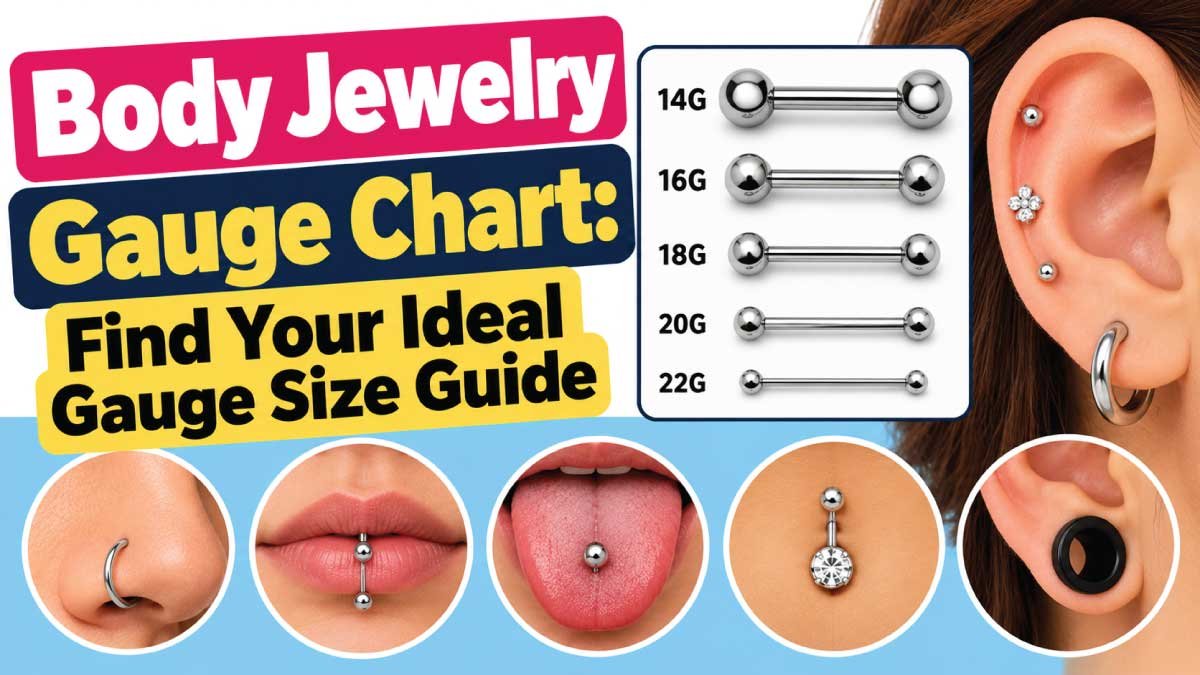
Choosing the right body jewelry gauge is essential for a comfortable fit, attractive appearance, and proper care of your piercing. Whether you are shopping for nose rings, cartilage studs, belly button rings, lip jewelry, or stretched earlobe plugs, understanding gauge sizes helps you select jewelry that matches your piercing.
Body jewelry sizing can be confusing because the gauge number works in reverse: a higher gauge number means thinner jewelry, while a lower gauge number means thicker jewelry. For example, 20G jewelry is thinner than 16G jewelry, and 14G jewelry is thicker than both.
This body jewelry gauge size guide explains how gauge measurements work, provides a gauge-to-millimeter conversion chart, compares common sizes by piercing type, and explains how to measure your jewelry for a suitable fit.
What Is a Body Jewelry Gauge?
A body jewelry gauge is a measurement of the thickness, or diameter, of the part of the jewelry that passes through a piercing. This measurement is commonly used for barbells, labret studs, captive bead rings, nose rings, and other piercing jewelry.
Gauge sizes are usually written with the letter G, such as 18G, 16G, or 14G. Some sellers use GA or lowercase g to represent the same measurement.
Unlike ordinary measurements in millimeters, gauge numbers follow a reverse scale. As the gauge number decreases, the jewelry becomes thicker. As the gauge number increases, the jewelry becomes thinner.
For example, an 18G post is approximately 1.0 mm thick, while a 14G post is approximately 1.6 mm thick. Both measurements describe the jewelry’s thickness, not the length of a barbell or the diameter of a hoop.
Understanding this distinction helps prevent common sizing mistakes when purchasing replacement jewelry or comparing products from different sellers.
Body Jewelry Gauge Chart: Gauge to Millimeters and Inches
The following chart shows common body jewelry gauges and their approximate metric and inch equivalents. Use it as a general reference when comparing jewelry sizes.
| Gauge Size | Thickness (Millimeters) | Thickness (Inches, Approx.) |
|---|---|---|
| 22G | 0.6 mm | 0.025 in |
| 20G | 0.8 mm | 0.032 in |
| 18G | 1.0 mm | 0.040 in |
| 16G | 1.2 mm | 0.047 in |
| 14G | 1.6 mm | 0.063 in |
| 12G | 2.0 mm | 0.079 in |
| 10G | 2.4–2.5 mm | 0.094–0.098 in |
| 8G | 3.0–3.2 mm | 0.118–0.126 in |
| 6G | 4.0 mm | 0.157 in |
| 4G | 5.0 mm | 0.197 in |
| 2G | 6.0 mm | 0.236 in |
| 1G | 7.0 mm | 0.276 in |
| 0G | 8.0 mm | 0.315 in |
| 00G | 10.0 mm | 0.394 in |
Note: Values are approximate because manufacturers may round some gauge measurements differently. For larger stretched piercings, jewelry is often labeled directly in millimeters or inches.
How to Read the Gauge Chart
The most important rule is that a smaller gauge number represents a thicker piece of jewelry. If you are comparing 18G, 16G, and 14G jewelry, the 14G option is the thickest and the 18G option is the thinnest.
Millimeter measurements are particularly helpful when shopping because they describe the actual thickness. If your current jewelry measures approximately 1.2 mm across its post, you can look for a compatible 16G replacement, provided that your piercing and jewelry design use that size.
Do not assume that jewelry with a similar appearance has the same gauge. A decorative top or gemstone may look large even when its post is very thin.
Common Body Jewelry Gauge Sizes Explained
Different gauge sizes serve different purposes, depending on the piercing location, anatomy, jewelry design, and professional piercer’s recommendation.
22G Body Jewelry
22G jewelry is approximately 0.6 mm thick. It is a very thin option and may be found in certain delicate jewelry designs or specialized piercing products.
Because the post is relatively thin, it is important to confirm that this size is appropriate for the particular piercing. A thin piece of jewelry is not automatically a better choice simply because it appears delicate.
20G Body Jewelry
20G jewelry measures approximately 0.8 mm in diameter. It is commonly associated with traditional earlobe earrings and some nostril jewelry.
This size can be useful for people whose piercings were made for thin posts. However, compatibility depends on the original piercing size, the jewelry’s construction, and whether the piercing has healed.
18G Body Jewelry
18G jewelry is approximately 1.0 mm thick. It is often used for earlobe jewelry, certain cartilage piercings, and some nostril jewelry.
It offers a slightly thicker post than 20G while remaining relatively slim. It may be suitable for some existing piercings, but you should not switch sizes without checking the current gauge.
16G Body Jewelry
16G jewelry measures approximately 1.2 mm thick. It is commonly used for various cartilage piercings, labret studs, and some eyebrow or lip jewelry.
This size is popular because it works with many piercing designs. Nevertheless, the correct fit depends on the location and individual anatomy, rather than popularity alone.
14G Body Jewelry
14G jewelry is approximately 1.6 mm thick. It is a common size for navel rings, certain septum rings, some industrial barbells, and various other body piercings.
Because 14G is thicker than 16G and 18G, it should not be inserted into a smaller piercing by force. Always confirm that the piercing can safely accommodate the intended size.
12G and 10G Body Jewelry
12G jewelry is approximately 2.0 mm thick, while 10G jewelry is approximately 2.4–2.5 mm thick. These sizes are often associated with larger-gauge piercings and gradual earlobe stretching.
They are not interchangeable with standard thin-post jewelry. Moving to a larger size requires consideration of tissue condition, healing, and the current piercing diameter.
8G and Larger Body Jewelry
Sizes such as 8G, 6G, 4G, 2G, 0G, and 00G are commonly associated with stretched earlobes and other specialized piercing applications.
As the gauge number gets lower, the jewelry becomes thicker. At larger sizes, jewelry is often described by its direct millimeter measurement instead of relying solely on gauge notation.
For example, 00G is commonly listed as approximately 10 mm, although the exact conversion can vary between references and products.
Body Jewelry Gauge Chart by Piercing Type
The correct gauge depends on where the jewelry will be worn. The table below provides general examples of commonly used sizes. These are not universal requirements, and individual piercings may need different measurements.
| Piercing Type | Common Gauge Range | Approximate Thickness |
|---|---|---|
| Standard earlobe | 20G–18G | 0.8–1.0 mm |
| Nostril | 20G–18G | 0.8–1.0 mm |
| Ear cartilage | 18G–16G | 1.0–1.2 mm |
| Tragus | 18G–16G | 1.0–1.2 mm |
| Lip or labret | 16G–14G | 1.2–1.6 mm |
| Eyebrow | 16G–14G | 1.2–1.6 mm |
| Industrial ear piercing | 14G–16G | 1.2–1.6 mm |
| Navel or belly button | Commonly 14G | 1.6 mm |
| Septum | 16G–14G | 1.2–1.6 mm |
| Tongue | Commonly 14G | 1.6 mm |
| Nipple | Commonly 14G | 1.6 mm |
| Stretched earlobe | 12G and larger jewelry | 2.0 mm and above |
These ranges are general examples, not a substitute for professional sizing. Some piercing types have several accepted sizes, and a piercer may recommend a different gauge based on anatomy and the piercing’s history.
Ear Piercing Gauge Sizes
Earlobe jewelry is often thinner than cartilage jewelry, although this varies with the piercing and its history. Traditional earrings may use 20G or 18G posts, while cartilage jewelry frequently uses 18G or 16G posts.
Industrial piercings often use thicker barbells, but the correct gauge and bar length depend on the anatomy of the ear and the placement of the piercing.
If you are replacing an earring, measure the post rather than the decorative front. The gemstone, ball, or ornament does not determine the gauge.
Nose Piercing Gauge Sizes
Nostril jewelry commonly uses 20G or 18G posts, while septum jewelry is often available in 16G or 14G sizes. These are general patterns rather than fixed rules.
Nostril studs, nose screws, labret-style studs, and septum rings may have different shapes and dimensions. Confirm both the post thickness and the jewelry style before buying a replacement.
Lip, Eyebrow, and Tongue Piercing Gauges
Lip and eyebrow jewelry may commonly use 16G or 14G posts, depending on the piercing. Tongue jewelry often uses a 14G barbell, although the appropriate dimensions should be confirmed by a qualified piercer.
For these locations, gauge is only one part of sizing. Bar length, available space, swelling, and the design of the jewelry can all affect comfort and suitability.
Navel and Nipple Piercing Gauges
Navel rings and nipple barbells commonly use 14G jewelry, but individual measurements can differ. A suitable bar must accommodate the anatomy without excessive pressure or unnecessary movement.
Do not select a thicker or thinner post solely because it is available in a preferred design. The existing piercing and professional sizing advice should guide your choice.
How to Measure Your Body Jewelry Gauge
Measuring your current jewelry can help you identify the correct replacement size. However, measurements should be taken carefully because a small difference in diameter can affect the fit.
Step 1: Identify the Post or Ring Thickness
Find the straight section of the jewelry that passes through the piercing. For a barbell or labret stud, this is the shaft or post. For a ring, it is the thickness of the metal or material itself.
Do not measure the length of a barbell or the inside diameter of a ring when trying to identify its gauge. Those measurements describe different dimensions.
Step 2: Use a Measuring Tool
A precision caliper is useful for measuring jewelry thickness. If you have one, measure across the post’s outside diameter without squeezing or damaging the jewelry.
A ruler may not be accurate enough for very thin posts because the differences between sizes can be small. If you cannot measure the jewelry confidently, ask a professional piercer to identify the gauge.
Step 3: Compare the Measurement With the Chart
Once you have a measurement in millimeters, compare it with the conversion chart.
For example:
- Approximately 0.8 mm corresponds to 20G.
- Approximately 1.0 mm corresponds to 18G.
- Approximately 1.2 mm corresponds to 16G.
- Approximately 1.6 mm corresponds to 14G.
- Approximately 2.0 mm corresponds to 12G.
Remember that these are rounded equivalents. A small measurement discrepancy can result from the measuring tool, manufacturing tolerances, or differences between conversion references.
Step 4: Confirm the Fit Before Purchasing
Check the product’s listed gauge and confirm that the jewelry is designed for your piercing. If the size is uncertain, ask the seller or a qualified piercer for clarification.
Never force a new piece of jewelry into a piercing to test its size. If it does not slide in comfortably, stop rather than pushing it through resistant tissue.
Also Read:
Gauge vs. Length vs. Diameter: What Is the Difference?
Body jewelry products may display several measurements, and each describes a different part of the item.
| Measurement | What It Means | Example |
|---|---|---|
| Gauge | Thickness of the post, bar, or ring material | 16G or 1.2 mm |
| Bar length | Distance between the ends of the wearable bar, excluding decorative attachments | 8 mm |
| Ring diameter | Width across the inside of a circular ring | 10 mm |
| Ball or top diameter | Width of the decorative end, ball, or gemstone setting | 3 mm |
Understanding these terms helps you avoid ordering jewelry that has the right thickness but the wrong length or ring diameter.
For example, a 14G navel ring may have the correct post thickness but still be unsuitable if its curved bar is too short. Likewise, a hoop with the correct gauge may have an inside diameter that is too small or too large for the piercing.
Always check every measurement listed for the jewelry style you intend to wear.
How to Choose the Right Body Jewelry Gauge
Selecting the right gauge requires more than matching a number on a chart. Consider the following factors before purchasing.
Check Your Existing Jewelry
If you are replacing a comfortable, well-fitting piece, identifying its gauge can be a useful starting point. Check any packaging or product details you still have, or have the jewelry measured professionally.
However, the gauge of your current jewelry should not automatically determine the size of a new piercing. A newly performed piercing may require a different size and design.
Consider the Piercing Location
Different body areas commonly use different jewelry thicknesses. Earlobe jewelry may be thinner than a navel ring or a tongue barbell.
Use piercing-specific sizing information rather than choosing a gauge based on appearance alone. Anatomy, piercing placement, and professional recommendations remain important.
Choose Suitable Jewelry Material
Material quality is important alongside gauge. Jewelry made from appropriate, well-finished materials can help reduce irritation and support comfortable wear.
For fresh piercings, ask a reputable piercer about suitable materials, such as appropriately certified implant-grade titanium. Avoid assuming that every product described as stainless steel, titanium, or hypoallergenic is automatically suitable for every person or piercing.
Consider the Jewelry Design
A straight barbell, curved barbell, labret stud, and captive bead ring may require different sizing considerations. Gauge determines thickness, but it does not establish whether a particular shape will fit the piercing.
Check the manufacturer’s sizing information for the specific style, including post length or ring diameter where applicable.
Avoid Guessing Between Two Sizes
If you are unsure whether your piercing uses 16G or 14G jewelry, do not assume that the thicker option will fit better. The difference is meaningful, and inserting an oversized post can damage tissue.
When measurements are unclear, professional identification is safer than experimenting with different sizes.
Also Read:
Can You Change to a Different Gauge Size?
Changing gauge sizes depends on the piercing’s condition, its current dimensions, and the amount of difference between the old and new jewelry.
Moving to a thinner piece may cause the piercing to accommodate a smaller diameter over time. A thicker piece may not fit comfortably, particularly if the piercing has not been stretched or was originally made for thinner jewelry.
If you have stretched earlobes, gradual progression is especially important. Do not force jewelry into the next size, use pain as a measure of progress, or continue stretching when the tissue is irritated.
Fresh or healing piercings require particular care. Avoid changing the jewelry or gauge before it is ready, unless a qualified piercer recommends a change for an appropriate reason.
If jewelry causes significant pain, bleeding, unusual swelling, or persistent irritation, stop attempting to change the size and seek professional advice. For signs of infection or severe symptoms, obtain medical care.
Common Body Jewelry Gauge Mistakes to Avoid
Even experienced jewelry buyers can make sizing mistakes. Understanding the following issues can help you avoid an unsuitable purchase.
Assuming larger numbers mean thicker jewelry: Gauge works in reverse, so 14G is thicker than 18G.
Confusing gauge with length: A 16G post describes thickness, not how long the jewelry is.
Ignoring millimeter measurements: Metric dimensions make it easier to compare products with different labels.
Choosing jewelry based on appearance: A large decorative top does not necessarily mean the post is thick.
Forcing jewelry into a piercing: Resistance or pain may indicate an unsuitable size or a problem with the piercing.
Ignoring product-specific sizing: Different designs may require different lengths and diameters even when their gauges match.
Assuming all manufacturers use identical rounding: Some gauges have slightly different listed metric equivalents, so confirm the actual product measurement when precision matters.
Also Read:
Frequently Asked Questions About Body Jewelry Gauge Sizes
What Is the Most Common Body Jewelry Gauge?
There is no single gauge that suits every piercing. Common sizes include 20G and 18G for many earlobe and nostril styles, 16G for various cartilage and lip piercings, and 14G for many navel rings and other body jewelry. The appropriate size depends on the individual piercing.
Is 16G Thicker Than 18G?
Yes. 16G jewelry is approximately 1.2 mm thick, while 18G jewelry is approximately 1.0 mm thick. The lower gauge number represents the thicker piece.
What Gauge Is 1.6 mm Body Jewelry?
A thickness of approximately 1.6 mm corresponds to 14G. This is a common conversion, although you should check the product’s actual listed dimensions if an exact fit is important.
What Gauge Is 2 mm Body Jewelry?
A thickness of approximately 2.0 mm corresponds to 12G. It is thicker than 14G jewelry and is often associated with larger-gauge piercing jewelry.
Is 14G Bigger Than 16G?
Yes. 14G jewelry is approximately 1.6 mm thick, while 16G jewelry is approximately 1.2 mm thick. Therefore, 14G is the thicker size.
Can I Wear a Different Gauge in My Piercing?
Possibly, but it depends on the piercing and the difference between the sizes. A different gauge may fit poorly or irritate the tissue. Confirm the current size and consult a qualified piercer before changing to a thicker or thinner piece.
Does Gauge Determine the Length of Body Jewelry?
No. Gauge describes thickness, while bar length and ring diameter describe other dimensions. You need the appropriate measurements for the particular jewelry style to achieve a suitable fit.
How Do I Know My Current Piercing Gauge?
Check the original jewelry packaging or product details, measure the post with a precision caliper, or ask a professional piercer to identify the size. Avoid guessing from the decorative top or the overall appearance of the jewelry.
Conclusion
A body jewelry gauge chart makes it easier to compare piercing jewelry and understand which thickness may suit your needs. The essential rule is simple: the smaller the gauge number, the thicker the jewelry. For example, 20G is approximately 0.8 mm, 16G is approximately 1.2 mm, and 14G is approximately 1.6 mm.
Use millimeter measurements to compare products, distinguish gauge from length and ring diameter, and confirm the size for your specific piercing before purchasing. When you are unsure about the correct fit, a qualified piercer can help you identify an appropriate size without unnecessary irritation or injury.
