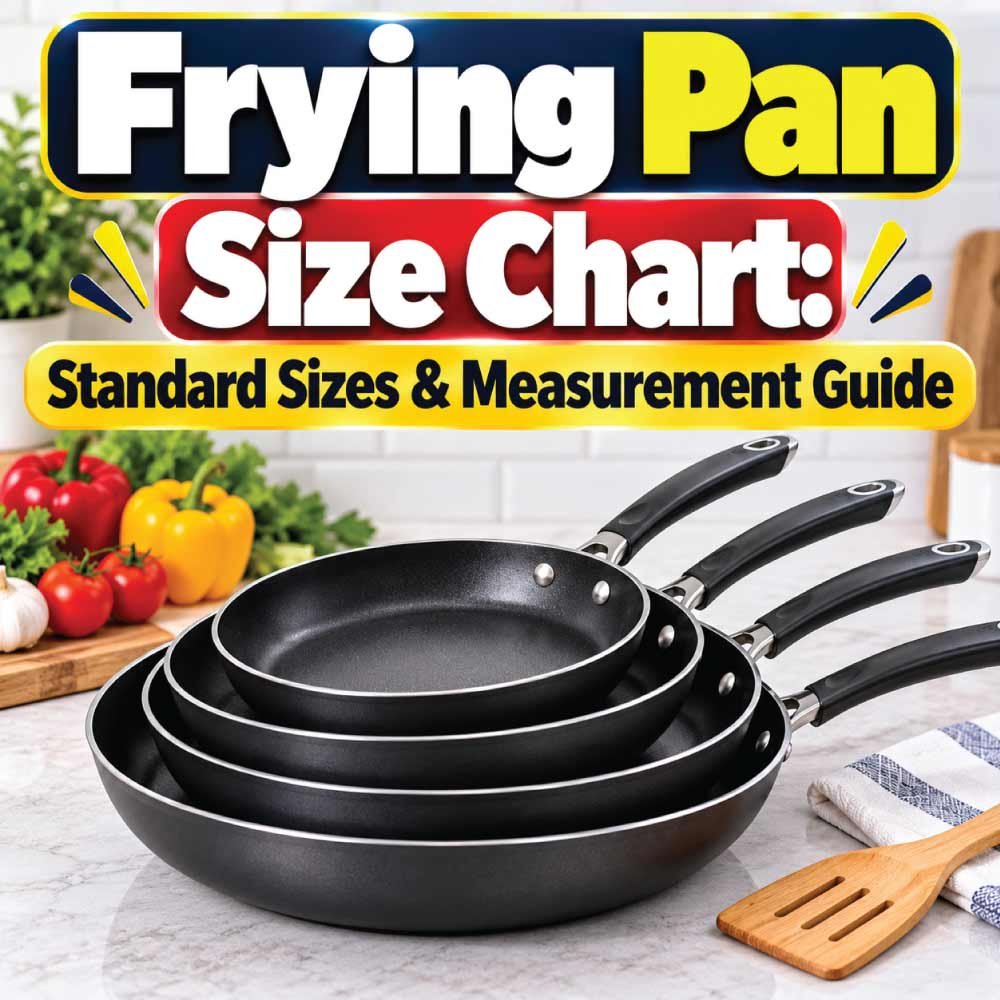
Choosing the right frying pan size can make everyday cooking much easier. A pan that is too small can crowd food and cause uneven cooking, while an oversized pan may heat less efficiently and take up unnecessary storage space. That is why understanding a frying pan size chart is useful when buying cookware or deciding which pan to use for a particular meal.
Frying pans are commonly measured by their top diameter, with popular sizes ranging from about 8 to 14 inches. The best size depends on the number of people you are cooking for, the type of food you prepare, your stovetop, and how much cooking surface you need.
This guide explains standard frying pan sizes, how they are measured, what each size is best for, and how to choose the right skillet for everyday cooking.
Frying Pan Size Chart
Frying pans are generally identified by their diameter across the top, from one inside rim to the opposite inside rim or according to the manufacturer’s stated size. The most common household sizes are 8, 10, and 12 inches.
| Pan Size | Diameter | Approx. Diameter (cm) | Best For | Typical Servings |
|---|---|---|---|---|
| Small | 6–8 in | 15–20 cm | Eggs, single portions, small sides | 1 |
| Medium | 9–10 in | 23–25 cm | Omelets, vegetables, small meals | 1–2 |
| Large | 11–12 in | 28–30 cm | Family meals, meat, stir-fries | 2–4 |
| Extra Large | 13–14 in | 33–36 cm | Large batches and entertaining | 4+ |
These are general size categories rather than universal manufacturing standards. Actual cooking surface, wall height, weight, and capacity can differ between manufacturers and pan designs.
For most households, a 10-inch or 12-inch frying pan provides the most practical balance between cooking area, maneuverability, and storage.
What Is a Standard Frying Pan Size?
There is no single frying pan size that is considered standard for every kitchen. However, 10-inch and 12-inch frying pans are among the most common general-purpose sizes.
A 10-inch pan is useful for smaller households and everyday portions. It provides enough surface area for eggs, vegetables, chicken breasts, grilled sandwiches, and many other foods without becoming unnecessarily bulky.
A 12-inch skillet offers more cooking space and is often preferable when preparing meals for several people. It provides room to spread ingredients into a single layer, which can be important when sautéing, searing, or browning food.
Common Frying Pan Sizes
The most useful sizes can be summarized as follows:
- 6–8 inches: Best for individual portions and small tasks.
- 9–10 inches: Good for one or two people and everyday cooking.
- 11–12 inches: Versatile for families and larger meals.
- 13–14 inches: Useful for large batches but requires more storage and stovetop space.
The ideal size is not simply the largest pan that fits your stove. You need enough cooking area for your food while keeping the pan comfortable to lift, turn, and clean.
Frying Pan Sizes in Inches and Centimeters
If you shop internationally, you may see cookware dimensions listed in either inches or centimeters. Knowing the conversion makes it easier to compare pans.
| Frying Pan Size | Approx. Diameter in cm | Size Category |
|---|---|---|
| 6 in | 15 cm | Small |
| 7 in | 18 cm | Small |
| 8 in | 20 cm | Small |
| 9 in | 23 cm | Medium |
| 10 in | 25 cm | Medium |
| 11 in | 28 cm | Large |
| 12 in | 30 cm | Large |
| 13 in | 33 cm | Extra large |
| 14 in | 36 cm | Extra large |
The centimeter values are rounded conversions. A 10-inch pan, for example, is approximately 25.4 cm in diameter.
Keep in mind that the advertised pan size usually refers to the overall diameter across the top, not necessarily the flat cooking surface at the bottom.
8-Inch Frying Pan: Best for Small Portions
An 8-inch frying pan is a convenient option for individual cooking. Its relatively small footprint makes it easy to handle and store.
It works particularly well for:
- One or two eggs
- Small omelets
- Single servings of vegetables
- Heating small portions
- Grilled sandwiches
- Small pancakes
- Cooking for one person
An 8-inch skillet can also be useful when you need several pans on the stove at once.
Its main limitation is cooking area. Trying to prepare a large quantity of food in an 8-inch pan can overcrowd the ingredients. Overcrowding may prevent foods from browning properly and can make stirring difficult.
10-Inch Frying Pan: The Everyday Choice
For many kitchens, the 10-inch frying pan is an excellent all-purpose option. It is large enough for many common meals without being as heavy or bulky as a 12-inch skillet.
A 10-inch pan is suitable for:
- 2–3 eggs
- Omelets
- Pancakes
- Chicken portions
- Fish fillets
- Sautéed vegetables
- Fried rice
- Small stir-fries
- Grilled sandwiches
- Breakfast foods
It is particularly practical for one or two people.
If you want to purchase only one frying pan for a small household, a 10-inch model is often a versatile starting point. However, the exact cooking capacity depends on the shape and depth of the pan.
12-Inch Frying Pan: Best for Family Cooking
A 12-inch frying pan provides substantially more cooking surface than a 10-inch pan. This makes it a popular choice for families and people who regularly prepare larger meals.
It is useful for:
- Several eggs
- Multiple chicken breasts
- Larger fish fillets
- Stir-fried vegetables
- Ground meat
- Pasta sauces
- One-pan dinners
- Sautéing larger quantities
- Family-sized breakfast dishes
The larger surface also gives ingredients more room to spread out. This can be helpful when browning meat or vegetables.
The trade-off is that a 12-inch skillet can be heavier, harder to store, and less convenient on a small stovetop.
14-Inch Frying Pan: When You Need Extra Space
A 14-inch frying pan is designed for larger cooking jobs. It can be useful for preparing food for several people or cooking ingredients in larger batches.
However, extra-large cookware is not automatically better.
Before buying one, consider:
- Whether your stovetop has enough room.
- Whether the burner can heat the pan effectively.
- Whether your storage space can accommodate it.
- Whether you can comfortably lift it when full.
- Whether the pan’s construction makes it suitable for your cooktop.
For everyday cooking, a 14-inch skillet may be unnecessarily large for many households. A 12-inch pan is often easier to manage while still providing substantial cooking space.
How Frying Pans Are Measured
One common source of confusion is the difference between pan diameter and cooking surface diameter.
Most frying pan sizes are described by the diameter across the top of the pan. To measure your pan at home, place it on a flat surface and measure straight across the widest part of the rim.
Step-by-Step Measurement
- Let the pan cool completely if it has recently been used.
- Place the frying pan on a stable, flat surface.
- Use a ruler or measuring tape.
- Measure from one side of the top rim directly across to the opposite side.
- Keep the measuring tool straight rather than following the curved wall.
- Record the measurement in inches or centimeters.
For example, a measurement of approximately 25.4 cm corresponds to a 10-inch frying pan.
Measure the Cooking Surface Too
If you need to know how much usable space you actually have, measure the flat interior base separately.
A pan can be advertised as 12 inches while its flat cooking surface is noticeably smaller because the sides slope upward or curve inward.
This distinction matters when you are trying to determine whether a particular food item will fit comfortably.
Frying Pan Size vs. Cooking Surface
Pan diameter alone does not tell the whole story. Two frying pans with the same advertised diameter can have different usable cooking areas.
The shape of the sides affects how much food can sit directly on the heated base. A pan with strongly sloped sides may have less flat surface than one with straighter walls.
Other factors include:
- Base diameter
- Wall height
- Side angle
- Pan shape
- Handle design
- Construction material
- Overall capacity
For searing and browning, flat cooking surface area can be especially important. For foods that require tossing or stirring, the wall shape and depth also affect usability.
Frying Pan Size by Number of People
The number of diners is a useful starting point when selecting pan size, but it should not be treated as an exact rule.
| Number of People | Recommended Pan Size | Typical Use |
|---|---|---|
| 1 person | 8–10 in | Individual meals |
| 2 people | 10–12 in | Everyday meals |
| 3–4 people | 12 in | Family meals |
| 4+ people | 12–14 in | Larger batches |
Your cooking style matters just as much as household size. Someone cooking several separate dishes may prefer multiple smaller pans, while someone preparing one-pan meals may benefit from a larger skillet.
10-Inch vs. 12-Inch Frying Pan
The difference between a 10-inch and 12-inch frying pan may appear small, but the additional diameter provides considerably more cooking area.
A 10-inch pan is generally easier to handle and works well for smaller portions. A 12-inch pan offers greater capacity and makes it easier to spread food across the surface.
| Feature | 10-Inch Pan | 12-Inch Pan |
|---|---|---|
| Approx. diameter | 25 cm | 30 cm |
| Best household size | 1–2 people | 2–4 people |
| Cooking area | Moderate | Larger |
| Handling | Easier | Heavier for many designs |
| Storage | Easier | Requires more space |
| Large meals | Limited | Better suited |
| General versatility | Very good | Excellent |
If you regularly cook for a family, the 12-inch option will usually provide more flexibility. If you mostly prepare individual portions, a 10-inch skillet may be easier to use.
Also Read:
Frying Pan Size vs. Skillet Size
The terms frying pan and skillet are often used interchangeably, especially in everyday cookware shopping.
Both generally refer to a relatively wide, flat cooking vessel with sloped or moderately curved sides and a handle. However, cookware designs vary significantly.
Some skillets have deeper sides, while some frying pans have a shallower profile. Cast iron skillets may also have different shapes and weight characteristics from lightweight nonstick frying pans.
Therefore, when comparing two products, look beyond the name and check:
- Diameter
- Flat cooking surface
- Depth
- Weight
- Handle length
- Material
- Lid compatibility
- Cooktop compatibility
The actual dimensions are more useful than whether a manufacturer calls the product a frying pan or skillet.
How to Choose the Right Frying Pan Size
Selecting a pan is easiest when you consider several factors together rather than relying only on household size.
Consider Your Typical Meal
Think about the foods you cook most often.
If your meals are mainly eggs, toast, small portions of vegetables, and individual servings, an 8- or 10-inch pan may be sufficient.
If you regularly cook meat, vegetables, rice, or complete family meals, a 12-inch skillet offers more flexibility.
Consider Your Stovetop
A pan should work comfortably with your cooking surface.
On a smaller stovetop, a very large skillet may extend beyond the most effective heating area. On a spacious cooktop, larger cookware can be easier to accommodate.
Check your cookware and appliance manufacturer’s recommendations when cooktop compatibility is important.
Consider Storage
A 14-inch skillet can take considerably more cabinet or drawer space than an 8-inch pan.
Before buying, check:
- Cabinet width
- Drawer depth
- Shelf height
- Pan stacking space
- Handle clearance
A pan that is excellent for cooking but difficult to store may become inconvenient in daily use.
Consider Weight
Large pans can become significantly heavier once filled with food.
If you frequently need to lift, move, or tilt the pan, choose a size and construction that you can comfortably handle.
Also Read:
Should You Own More Than One Frying Pan?
Many kitchens benefit from having two or more frying pans in different sizes.
A practical combination is:
- 8-inch pan: Individual portions and small tasks.
- 10-inch pan: Everyday cooking.
- 12-inch pan: Family meals and larger batches.
You do not necessarily need all three. If space or budget is limited, choosing either a 10-inch or 12-inch pan based on your normal cooking needs can cover many tasks.
Having multiple sizes becomes especially useful when preparing several foods simultaneously.
Common Frying Pan Size Mistakes
Choosing the wrong pan size can make cooking unnecessarily difficult. Several mistakes occur frequently.
Using a Small Pan for Large Quantities
Overfilling a small skillet leaves insufficient space for ingredients to cook properly. Food may steam instead of developing the desired browning.
Assuming Advertised Diameter Equals Cooking Area
A 12-inch label does not necessarily mean you have a 12-inch flat cooking surface. Always consider the base shape.
Buying the Largest Pan Available
More space can be useful, but an oversized skillet may be heavy, difficult to store, and inconvenient on smaller cooktops.
Ignoring Handle Clearance
A pan’s overall dimensions include more than its cooking surface. A long handle can affect how much space the cookware requires on the stovetop or in a cabinet.
Choosing Based Only on Serving Count
Two people may have completely different cooking habits. One might cook small individual portions, while another prepares large batch meals. Use serving count as a guide rather than a strict formula.
Also Read:
Frying Pan Size and Food Type
Different foods benefit from different amounts of cooking space.
| Food or Cooking Task | Useful Pan Size | Reason |
|---|---|---|
| 1–2 eggs | 6–8 in | Small cooking area |
| Omelet | 8–10 in | Easy to shape and handle |
| Grilled sandwich | 8–10 in | Compact footprint |
| Chicken portions | 10–12 in | More surface for browning |
| Sautéed vegetables | 10–12 in | Allows ingredients to spread |
| Stir-fry | 12 in or larger | More room for movement |
| Family breakfast | 12–14 in | Larger cooking area |
| Large batch cooking | 12–14 in | Greater capacity |
These recommendations are general cooking guidance. The best size also depends on ingredient quantity, pan depth, and the recipe.
Frying Pan Size and Cooktop Compatibility
Your pan should be appropriate for the type and size of cooktop you use.
For gas cooking, the burner flame should be appropriate for the pan rather than extending excessively around the sides.
For electric and radiant cooktops, the flat base needs good contact with the cooking surface.
For induction cooking, the pan must be induction-compatible, and the effective heating area depends on the cookware and cooktop design.
Always follow the cookware manufacturer’s instructions for compatible cooking surfaces and maximum recommended heat settings.
Tips for Getting the Most From Your Frying Pan
The right size is only part of good cookware selection. Proper use also helps maintain performance.
- Avoid overcrowding the pan when browning food.
- Match the pan size to the quantity you are cooking.
- Preheat according to the manufacturer’s recommendations.
- Use appropriate utensils for the pan’s surface.
- Avoid sudden temperature changes that may damage some cookware.
- Follow care instructions for nonstick, stainless steel, cast iron, or other materials.
- Allow the pan to cool appropriately before cleaning when required by the manufacturer.
- Store large pans where they can be lifted safely and easily.
A well-sized pan gives you better control and can make recipes easier to execute consistently.
Frequently Asked Questions About Frying Pan Sizes
What is the most common frying pan size?
The 10-inch and 12-inch frying pans are among the most common general-purpose choices. A 10-inch pan works well for smaller households and everyday portions, while a 12-inch skillet provides more space for family meals and larger quantities.
Is a 10-inch or 12-inch frying pan better?
Neither is universally better. A 10-inch pan is easier to handle and well suited to one or two people. A 12-inch pan provides more cooking area and is generally better for larger portions, family meals, and foods that need room to spread.
How many people can a 12-inch frying pan feed?
A 12-inch frying pan can commonly handle meals for two to four people, depending on the recipe and ingredient quantity. Its actual capacity depends on the pan’s shape, depth, and usable cooking surface.
How do I know what size my frying pan is?
Measure straight across the top of the pan from one side of the rim to the opposite side. This gives you the approximate diameter used to identify the pan size. You can also measure the flat base separately to understand the actual cooking area.
Is an 8-inch frying pan too small?
An 8-inch frying pan is not necessarily too small. It is particularly useful for individual portions, eggs, small omelets, sandwiches, and other compact meals. It becomes limiting when you need to cook larger quantities or spread many ingredients across the surface.
What frying pan size is best for a family?
For many families, a 12-inch frying pan is a practical general-purpose choice. It offers more cooking space than a 10-inch skillet without being as cumbersome as some extra-large pans.
Does a larger frying pan cook better?
Not necessarily. A larger pan provides more surface area, but the best results depend on matching the pan to the food quantity and cooking method. An oversized pan can be less convenient and may not heat in the same way as a properly matched pan.
Are frying pan sizes measured inside or outside?
Cookware sizes are commonly stated using the top diameter, but measurement conventions can vary between manufacturers. For an exact product dimension, check the manufacturer’s specifications rather than assuming the advertised size represents the flat interior cooking surface.
Final Thoughts
The best frying pan size depends on how much food you normally cook, how many people you serve, your stovetop, storage space, and the type of recipes you prepare.
An 8-inch pan is convenient for individual portions, a 10-inch frying pan is a versatile everyday option, and a 12-inch skillet provides the extra space needed for many family meals. Larger 13- and 14-inch pans can be useful for batch cooking but require more room and careful consideration of handling and cooktop compatibility.
When comparing cookware, look beyond the number printed on the package. Check the diameter, flat cooking surface, depth, weight, handle dimensions, material, and cooktop compatibility. Using a frying pan size chart as a starting point will help you choose cookware that fits both your kitchen and your cooking habits.
