
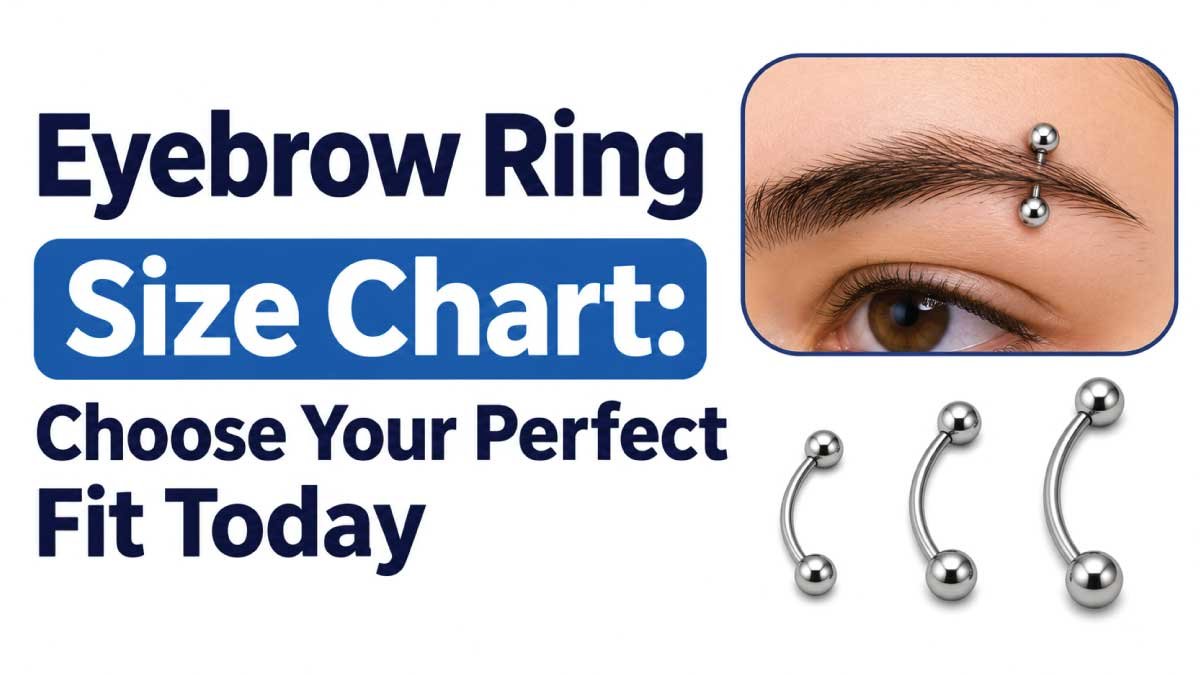
Choosing the right eyebrow ring size is essential for comfortable wear, proper healing, and a secure fit. An eyebrow piercing that is too tight can put pressure on the skin, while jewelry that is too long may move excessively or catch on clothing and towels. Understanding gauge, wearable length, and jewelry diameter helps you select a suitable piece for your piercing.
This eyebrow ring size chart explains common gauge measurements, standard barbell lengths, and curved barbell dimensions. It also covers how to measure an eyebrow piercing, choose suitable jewelry, and avoid common sizing mistakes.
Eyebrow Ring Size Chart
Eyebrow piercing jewelry is commonly measured by gauge and wearable length. Gauge describes the thickness of the jewelry, while length refers to the distance between the two ends of a curved barbell.
The most common eyebrow piercing gauge is 16G, although 18G and 14G jewelry may also be used depending on the piercing and individual anatomy.
| Gauge | Thickness in Inches | Thickness in Millimeters | Common Use |
|---|---|---|---|
| 18G | 0.040 in | 1.0 mm | Smaller, delicate jewelry |
| 16G | 0.051 in | 1.2 mm | Common eyebrow piercing size |
| 14G | 0.064 in | 1.6 mm | Larger or stretched piercings |
For many eyebrow piercings, 16G is a standard starting point. However, the correct gauge depends on the size of the original piercing and the jewelry used by the professional piercer.
Standard Eyebrow Ring Length Chart
Curved barbells are among the most common jewelry styles for eyebrow piercings. Their wearable length is measured in a straight line between the inside surfaces of the two ends, rather than along the curve of the bar.
| Wearable Length | Millimeters | Typical Fit |
|---|---|---|
| 5/16 inch | 8 mm | Short or snug fit |
| 3/8 inch | 10 mm | Common everyday length |
| 7/16 inch | 11 mm | Slightly longer fit |
| 1/2 inch | 12 mm | Longer or roomier fit |
| 9/16 inch | 14 mm | Extended length |
A 3/8-inch (10 mm) curved barbell is a commonly available eyebrow jewelry length. Nevertheless, individual anatomy and piercing placement determine whether this size is appropriate.
Eyebrow Ring Size Conversion Chart
Jewelry measurements are often listed in millimeters or inches. Understanding the conversion makes it easier to compare products from different manufacturers.
| Measurement in Inches | Measurement in Millimeters |
|---|---|
| 1/4 inch | 6.35 mm |
| 5/16 inch | 7.94 mm |
| 3/8 inch | 9.53 mm |
| 7/16 inch | 11.11 mm |
| 1/2 inch | 12.70 mm |
| 9/16 inch | 14.29 mm |
| 5/8 inch | 15.88 mm |
Jewelry manufacturers may round measurements to the nearest whole millimeter. Always check the actual product specifications before purchasing.
What Is the Standard Eyebrow Ring Size?
The most commonly available eyebrow jewelry size is 16G (1.2 mm) in thickness, with a wearable length around 3/8 inch (10 mm). This combination is widely used for curved barbells designed for eyebrow piercings.
However, there is no single standard size that fits everyone. Eyebrow thickness, piercing angle, placement, and individual anatomy all influence the appropriate jewelry dimensions.
A shorter barbell may work for someone with a shallow piercing, while another person may need a longer piece to accommodate their anatomy comfortably.
It is important not to choose jewelry based only on what is described as a standard size. A professional piercer can measure the piercing and recommend the correct dimensions.
Understanding Eyebrow Ring Measurements
Before purchasing eyebrow jewelry, it helps to understand the three main measurements used in product descriptions.
Gauge or Thickness
Gauge refers to the thickness of the jewelry shaft that passes through the piercing. The gauge system works in reverse: a higher gauge number means thinner jewelry.
For example, 18G jewelry is thinner than 16G, while 14G jewelry is thicker.
Common eyebrow jewelry thicknesses include:
- 18G (1.0 mm): A thinner option used in some eyebrow piercings.
- 16G (1.2 mm): A widely available standard size.
- 14G (1.6 mm): A thicker option for piercings designed for that gauge.
Never force thicker jewelry into a smaller piercing. Doing so can cause irritation, tearing, or other tissue damage.
Wearable Length
Wearable length is the distance between the inside surfaces of the jewelry ends. It determines how much space the curved barbell provides for the pierced tissue.
A barbell that is too short can press against the skin. One that is too long may move around excessively and become caught on clothing or other objects.
The correct length should provide enough room without unnecessary movement.
Ball or End Size
The ball size refers to the diameter of the decorative ends attached to the barbell. Common ball sizes vary by manufacturer and jewelry design.
| Ball Diameter | Millimeters | Appearance |
|---|---|---|
| 3/32 inch | 2.4 mm | Small and subtle |
| 1/8 inch | 3.2 mm | Common compact size |
| 5/32 inch | 4.0 mm | More noticeable |
| 3/16 inch | 4.8 mm | Larger decorative appearance |
Larger ends create a more prominent look, while smaller ends provide a minimal appearance. The ends should also be secure and suitable for the jewelry’s threading system.
Types of Eyebrow Jewelry and Their Sizes
Different jewelry styles have different shapes and measurement requirements. Understanding these differences can help you choose a suitable design.
Curved Barbell
A curved barbell is one of the most common choices for eyebrow piercings. It follows the natural curve of the piercing and typically has a removable ball or decorative end on each side.
Most designs are available in 16G, with several wearable lengths. The exact size should match the piercing’s angle and tissue thickness.
Straight Barbell
Straight barbells are not generally the first choice for traditional eyebrow piercings because their shape may not follow the natural angle of the piercing. They should only be used when a qualified piercer confirms that the design is suitable.
Captive Bead Ring
A captive bead ring uses a removable bead held between the two ends of a circular ring. Its sizing is usually described by gauge and inner diameter.
The inner diameter determines how much room the ring provides around the piercing. A ring that is too small may place pressure on the tissue, while an oversized ring can move excessively.
Seamless Ring
Seamless rings have a continuous appearance without a separate bead. They are available in different gauges and inner diameters, but their suitability depends on the piercing’s position and anatomy.
Not every ring style is appropriate for every eyebrow piercing.
How to Measure Your Eyebrow Piercing
Accurate measurements help prevent jewelry that is too tight, too loose, or uncomfortable. If your piercing is healed, a professional piercer can measure it using suitable jewelry-sizing tools.
Step 1: Identify the Jewelry Gauge
Check the specifications of your current jewelry or ask your piercer to identify its gauge. Do not estimate thickness by appearance alone.
If you are replacing existing jewelry, matching the original gauge is generally important.
Step 2: Measure the Wearable Length
For a curved barbell, wearable length is measured between the inside surfaces of the two ends. It does not include the decorative balls.
A professional piercer can determine the appropriate length by checking how the jewelry sits in the piercing.
Step 3: Check the Fit
The jewelry should not dig into the surrounding skin or create excessive pressure. It should also not hang so loosely that it moves unnecessarily.
If the jewelry leaves deep indentations, causes persistent discomfort, or appears to be sinking into the skin, seek professional advice.
Step 4: Confirm the End Size
Check that the decorative ends are large enough to remain secure but do not interfere with comfortable wear.
Always confirm the threading and compatibility of replacement ends before purchasing them.
Also Read:
How to Choose the Right Eyebrow Ring Size
Selecting the correct eyebrow ring involves more than matching a measurement on a size chart. Consider the following factors before buying.
Consider Your Piercing Anatomy
Everyone has different eyebrow shapes, tissue thicknesses, and piercing placements. A size that fits one person may not fit another.
Your piercer can evaluate the available tissue and recommend jewelry that accommodates your anatomy.
Choose the Correct Gauge
Gauge should match the piercing. Most standard eyebrow jewelry is available in 16G, but some piercings may use another thickness.
Avoid changing to a thicker or thinner gauge without professional guidance, especially if the piercing is new or irritated.
Allow Appropriate Space
Jewelry should fit comfortably without squeezing the tissue. However, excessive length can increase movement and the chance of snagging.
A professional piercer can help determine whether your current jewelry needs a different length.
Select Suitable Materials
Material quality is particularly important for body jewelry. Implant-grade titanium is a commonly recommended option, while appropriately certified implant-grade steel and solid gold may be suitable for some healed piercings.
Avoid poorly finished jewelry, unknown metal alloys, and materials that cause irritation.
Also Read:
Eyebrow Ring Size for New and Healed Piercings
Jewelry requirements can change as an eyebrow piercing heals.
New Eyebrow Piercings
A fresh piercing may need jewelry with additional room to accommodate initial swelling. The appropriate jewelry should be selected and installed by a professional piercer.
Do not replace or shorten jewelry yourself during the early healing period. Changing it too soon can irritate the piercing or interfere with healing.
Healed Eyebrow Piercings
Once a piercing has healed, a piercer may recommend a different wearable length if the original jewelry has become unnecessarily long.
The replacement should still provide comfortable clearance and should not place pressure on the piercing channel.
Downsizing Jewelry
Downsizing means replacing longer initial jewelry with a shorter piece after swelling has settled. It should be done at the appropriate time by a professional piercer.
Do not downsize simply because the jewelry looks long. The tissue must have enough room, and the piercing must be ready for the change.
Also Read:
Common Eyebrow Ring Sizing Mistakes
Choosing the wrong dimensions can lead to discomfort, irritation, and unnecessary jewelry problems. Avoid these common mistakes.
Choosing Jewelry Based Only on Appearance
Two eyebrow barbells may look similar but have different gauges and wearable lengths. Always check the listed measurements instead of relying on photographs.
Confusing Gauge Numbers
A higher gauge number means thinner jewelry. For example, 18G is thinner than 16G. Confusing these measurements can result in buying jewelry that does not fit.
Measuring the Entire Barbell
Wearable length does not include the decorative ends. Measuring the complete jewelry from one end to the other can lead to an incorrect size selection.
Buying Jewelry That Is Too Tight
A short barbell may press against the tissue and cause discomfort. Jewelry should never feel as though it is squeezing the piercing.
Ignoring Material Quality
Incorrect sizing is not the only cause of irritation. Low-quality materials, rough surfaces, and unsuitable metals can also create problems.
Changing Jewelry Too Early
Fresh piercings require time to heal. Replacing jewelry before the piercing is ready can cause irritation and damage. Ask a professional piercer before making changes.
Eyebrow Ring Size Chart by Jewelry Style
This comparison summarizes the measurements commonly used for different eyebrow jewelry designs.
| Jewelry Style | Main Measurements | Common Design |
|---|---|---|
| Curved Barbell | Gauge and wearable length | Curved shaft with two ends |
| Captive Bead Ring | Gauge and inner diameter | Circular ring with bead |
| Seamless Ring | Gauge and inner diameter | Continuous circular design |
| Decorative Curved Barbell | Gauge and wearable length | Curved shaft with decorative ends |
The listed measurements are not interchangeable. A curved barbell’s wearable length and a ring’s inner diameter describe different dimensions.
Frequently Asked Questions
What Is the Most Common Eyebrow Ring Size?
A 16G (1.2 mm) curved barbell is a commonly available eyebrow jewelry size. A wearable length of approximately 3/8 inch (10 mm) is also common, although the right fit depends on individual anatomy and piercing placement.
Is 16G or 18G Better for an Eyebrow Piercing?
Neither size is automatically better for everyone. 16G is a common standard, while 18G is thinner. The correct gauge depends on the original piercing and the jewelry recommended by your piercer.
How Long Is a Standard Eyebrow Ring?
Many curved eyebrow barbells have a wearable length of approximately 3/8 inch (10 mm). Other options include 8 mm, 11 mm, and 12 mm. The appropriate length varies between individuals.
What Does 16G Mean in an Eyebrow Ring?
16G describes the thickness of the jewelry shaft. It is approximately 1.2 mm thick. The gauge does not describe the barbell’s length or the size of its decorative ends.
Can I Wear an 18G Ring in a 16G Piercing?
An 18G piece is thinner than a 16G piece. Using thinner jewelry may allow the piercing channel to shrink, and it may not provide the fit you want. Ask a professional piercer before changing gauges.
How Do I Know If My Eyebrow Ring Is Too Tight?
A ring may be too tight if it presses into the skin, creates deep indentations, or causes persistent discomfort. If jewelry appears to be embedding or the area becomes increasingly swollen, seek prompt professional assessment.
Can I Use a Nose Ring for an Eyebrow Piercing?
Not every nose ring is suitable for an eyebrow piercing. Jewelry differs in shape, gauge, diameter, and fit. Use jewelry specifically appropriate for your piercing and have a piercer confirm compatibility.
What Is the Difference Between Eyebrow Ring Diameter and Length?
Wearable length is used for curved barbells and measures the usable distance between the ends. Inner diameter is used for circular rings and measures the distance across the inside of the ring.
When Should I Change My Eyebrow Piercing Jewelry?
Change jewelry only when the piercing is ready and a suitable replacement has been selected. Fresh piercings should not be changed without professional guidance. A piercer can also determine when downsizing is appropriate.
What Material Is Best for Eyebrow Rings?
Implant-grade titanium is a popular choice because it is lightweight and suitable for many people with metal sensitivities. Other materials may also be appropriate when their quality and specifications are verified.
Final Thoughts
Choosing the correct eyebrow ring size helps support comfortable wear and reduces unnecessary pressure on the piercing. A 16G curved barbell with a wearable length around 10 mm is a common option, but it is not a universal measurement.
Always consider gauge, wearable length, jewelry style, and individual anatomy before purchasing. If you are unsure about your measurements or the condition of your piercing, consult a professional piercer for an accurate fitting.
